The Rise of B2A: One Article to Fully Grasp the 14 Major Agent Applications and the Infra Track
Zhidx November 12 News, recently, well-known Silicon Valley venture capital firm a16z published an article on its official website titled *Welcome to the B2A Economy*, putting forward a new judgment: AI Agents are becoming the main users of the Internet. In the future, enterprises will not only compete for human consumers, but also compete for the traffic and orders brought by AI Agents.
Over the past few decades, Internet companies have been trying to prevent robots from accessing websites. Now, they may have to reverse their strategy and compete for business from robots.
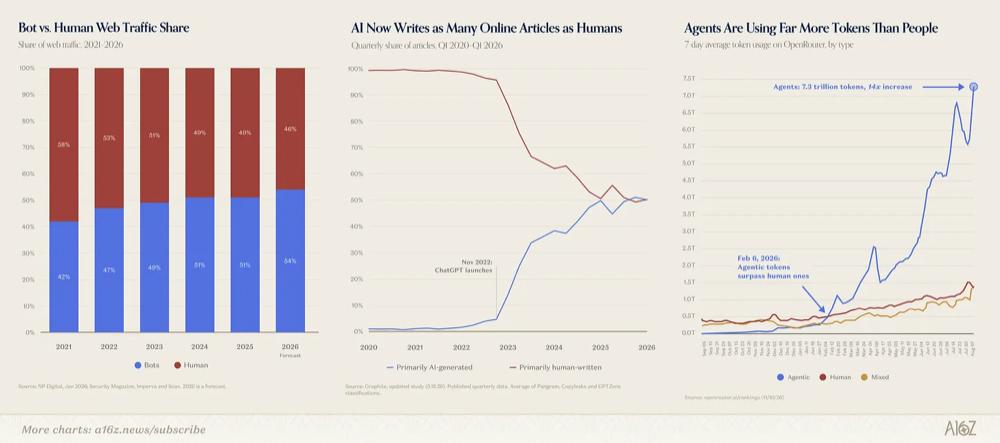
AI Agents have already contributed most of the Internet traffic, written more than half of new articles online, and generated most of the code put into production environments. As Agents shift from answering questions to performing tasks, they will increasingly replace humans in deciding which products to buy, which services to subscribe to, and where to spend money.
The article refers to this business model as B2A (Business-to-Agent), which is an economic model where enterprises target intelligent agents.
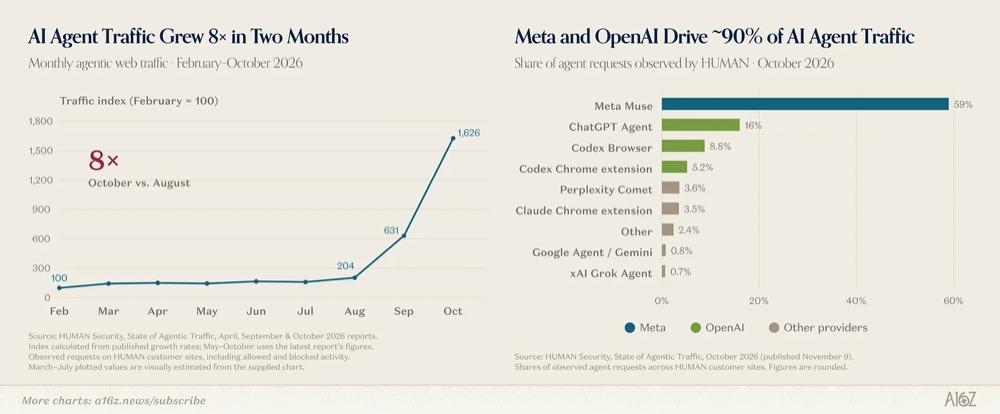
E-commerce platform Shopify disclosed that in the first quarter of 2026, AI-generated traffic to its stores increased 8 times year-on-year, and the volume of orders from AI search increased nearly 13 times year-on-year. Cybersecurity firm Human Security found that from August to October this year, Agent browser traffic increased 8 times.
In the field of software development, Agents have begun to directly use third-party products. More than 60% of new databases on database platform Supabase are created by AI tools, and the number of deployments triggered by Agents on cloud deployment platform Vercel has increased 28 times over the past year.
The article believes that B2A business opportunities go far beyond AI shopping. When Agents begin to select and invoke products on behalf of humans, the Internet's traffic distribution, software sales, as well as payment and identity verification methods may all change accordingly.
01. AI-generated orders increased nearly 13 times in one year, and the Internet welcomes a new traffic entry
Every platform transformation of the Internet has changed the way users access services, and also spawned new business models.
In the Web era, enterprises could set up online stores accessible to anyone; in the mobile Internet era, these stores were installed in users' mobile phones, spawning new products such as Uber that run relying on mobile devices.
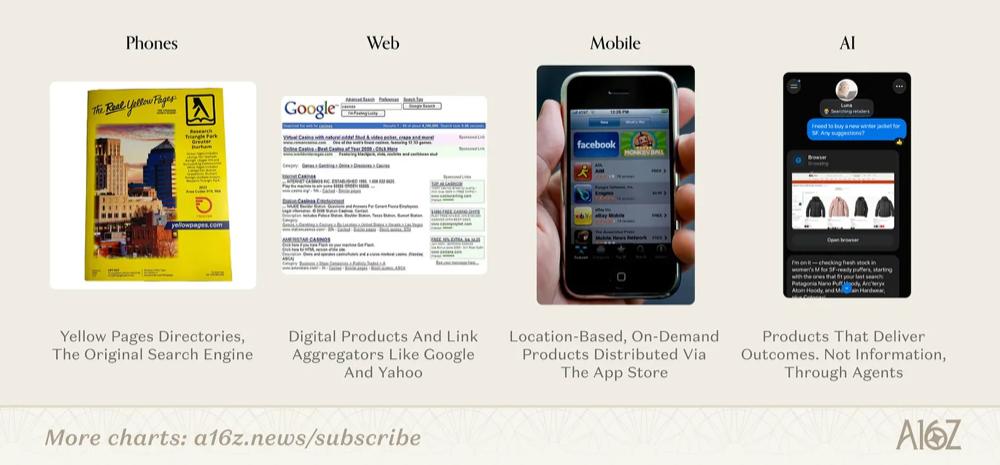
AI has already changed the tasks people can accomplish, but its transformation of product distribution methods has only just begun.
The article argues that the development of AI in product capabilities is much faster than the change of distribution channels, which is why except for ChatGPT, the large-scale popularization of consumer-grade AI products is still limited.
If Agents can truly enter the daily life of ordinary consumers and be widely used, AI will have the opportunity to complete the leap from technical capability upgrade to Internet platform transformation.
Large model products such as ChatGPT, Claude, and Grok have already become important traffic sources for many enterprises.
Shopify disclosed that in the first quarter of 2026, AI-generated traffic to stores on its platform increased 8 times year-on-year, and the volume of orders generated through AI search increased nearly 13 times year-on-year.
Another set of data comes from cybersecurity firm Human Security. From August to October this year, the company observed an 8-fold increase in Agent browser traffic. Among them, Muse contributed about 60% of the activity volume, and products under OpenAI contributed a total of about 30%.
Compared with traditional search and advertising drainage, Agents may become a more effective product recommendation channel. Agents master users' more specific needs and preferences, and can filter goods and services accordingly.
Consumer traffic brought by AI recommendations has already shown higher user engagement, better revenue conversion effect, and lower bounce rate.
In the United States, in about 11% of consumers' shopping processes, users will first visit AI services before entering the actual transaction website.
As Agents gain more operation permissions, these traffics no longer need to appear in the form of website visits. Users can directly put forward demands to AI, and Agents will find goods, compare services, and decide which one to buy in the end.
For enterprises, whether consumers can find their products will increasingly depend on whether Agents are willing to recommend and use them.
02. AI selects software and will also recommend users to purchase paid packages
Agents can not only bring traffic to enterprises, but also begin to directly decide which third-party tools to invoke.
At present, most Agents still access the Internet through browsers: either take over the user's existing browser, or create their own virtual machine and browser instance to complete tasks like humans through operations such as clicking, inputting, and page jumping.
However, connectors, plugins and Model Context Protocol (MCP) are providing another way. Agents can directly access third-party tools and websites through these interfaces without relying on web page operations.
The article compares this tool ecosystem to a more powerful Agent app store.
In the past, users needed to compare software, register accounts, select packages, and then operate different tools one by one. Agents can connect multiple products for use around the final task.
AI platforms are also gradually solving the identity and authorization issues required for cross-product access.
For example, Sign in with ChatGPT allows users to log in to third-party products through ChatGPT identity, providing a more convenient identity access method for Agents to use external services.
As users can authorize identity information or access tokens to third-party services, it will become easier for Agents to register, use and pay for products on behalf of users.
In the future, Agents will be able to independently select and install the tools needed to complete tasks without human intervention one by one.
Claude already supports enterprise administrators to uniformly connect plugins for the entire organization, allowing enterprise employees to directly use these tools.
OpenAI also recently launched Businesses in ChatGPT, where enterprises can claim their merchant information in ChatGPT, add product data sources, and view how users interact with their business in ChatGPT.
As AI platforms access more third-party products into their own ecosystems, users may no longer need to directly open software or websites to complete tasks that previously required the cooperation of multiple applications.
Enterprises will also face a new problem: how to make Agents find their products and prioritize using them when performing tasks?
03. Four types of opportunities in the B2A economy: from Agent applications to payment infrastructure
a16z divides the potential beneficiaries of the B2A economy into four categories, including companies that directly provide Agent capabilities, as well as enterprises that provide products and infrastructure for Agents.
- Category 1: Agent and large model companies.
At present, consumer-oriented Agent products include independent applications such as Instinct, Muse and Wabi.
But in the future, Agent capabilities do not necessarily only exist in dedicated intelligent agent products. As the underlying model has stronger action capabilities, more and more existing products can directly perform tasks assigned by users.
Among them, ChatGPT has 1.2 billion weekly active users, which has a large user base in the process of transforming to Agent products.
- Category 2: New products spawned by Agents.
Amazon's business model relies on the Internet, and Uber is built on the basis of the popularization of mobile Internet. Agents may also spawn product forms that were previously impossible to achieve.
a16z mentioned three directions:
The first is small and medium-sized enterprises that can operate independently, where Agents can undertake a large number of daily operation and management tasks.
The second is trading markets or network-based products with AI as the intermediary, connecting different users, merchants and services through Agents.
The third is automatically optimized products, allowing Agents to continuously monitor business operation status, and independently adjust and optimize processes according to goals.
These products may no longer require users to repeatedly open software for operation, but have Agents continuously perform tasks.
- Category 3: Existing enterprises that optimize products for Agents.
As large models become a new source of traffic, the GEO (Generative Engine Optimization) industry that optimizes around generative AI search results has emerged.
Different from traditional SEO which mainly strives for search engine rankings, GEO helps enterprises increase the chance of their products and content being discovered, cited and recommended in large model responses.
However, GEO mainly solves the problem of product discovery.
When Agents have purchasing and execution capabilities, enterprises not only need to let AI know their products, but also be selected when Agents compare multiple options, and let Agents successfully complete registration, subscription or purchase.
This means that Agent-oriented optimization will further extend from product discovery to product evaluation, selection and transaction execution links.
- Category 4: Agent infrastructure companies.
In order to complete tasks in the real world on behalf of humans, Agents also need supporting payment, identity, anti-fraud and communication tools.
Even under the current relatively limited Agent usage scale, existing payment, identity verification and communication systems have already begun to bear pressure.
For example, after an Agent initiates a transaction, the payment platform needs to identify legitimate transactions and fraudulent behaviors; the identity verification system needs to confirm whether the Agent is authorized by the user.
At the same time, Agents also need to communicate with external users and services through channels such as iMessage, telephone, and email.
These systems were originally designed mainly around human users. As more and more Agents begin to perform tasks, existing infrastructure will face new usage demands.
At present, many large enterprises still block Agent traffic due to concerns about fraud and chargebacks.
But if Agents can continuously bring high-quality customers and transactions, these enterprises may have to readjust their access rules, shifting from preventing robots to actively serving robots.
04. AI creates 60% of new databases, programming Agents have benefited a number of software companies
The programming field has taken the lead in seeing changes in product usage patterns driven by Agents.
According to data released by GitHub, as of September 2026, more than 40% of code merge requests (Pull Request, PR) on the platform start with Agent-generated drafts, and this proportion was only 17% six months ago.
Agents are no longer just assisting developers to write a few lines of code, but beginning to undertake a series of work from development to deployment.
For example, when a user asks an Agent to build a website, it may need to invoke different services such as databases, cloud hosting, identity verification, email sending and monitoring.
Users only need to put forward the demand for building a website, and the Agent can select the required external tools during the development process.
Therefore, the development of AI programming has not only driven Agent products such as Cursor, Codex, Claude Code, and Cognition, but also promoted the development of natural language programming platforms such as Replit, Lovable and Base44.
Companies that provide database, payment and application deployment services have also obtained a large number of usage demands from Agents.
Database platform Supabase disclosed in June 2026 that more than 60% of new databases are created by AI tools.
Another database platform Neon disclosed in May 2025 that automated Agents have contributed 80% of its new database deployments.
Payment company Stripe disclosed in June 2026 that Agents contributed nearly 40% of its document access traffic, and 70% of command line interface (CLI) requests for API resources.
Cloud deployment platform Vercel disclosed in October 2026 that the number of deployments triggered by Agents increased 28 times in the past 12 months.
In the traditional software development process, developers need to access platforms such as databases, deployment, and payment by themselves, understand product functions and complete configurations.
Now, Agents can directly read documents, call APIs, create databases, and deploy applications to the cloud.
The direct users of software companies are changing from developers to Agents that perform tasks for developers.
Software developers account for less than 1% of the global workforce. If programming Agents can already drive the rapid growth of usage of database and cloud deployment services, then when the remaining more than 99% of the workforce starts to use Agents to complete work, the related service market may undergo even greater changes.
The article believes that it is far from enough to summarize this market only with "AI e-commerce". Agents will not only promote transactions of physical goods and services, but also change the traffic distribution, Token consumption and revenue flow between digital products.
05. From job hunting to stock trading, a16z sorts out seven major Agent application tracks
In addition to programming, AI Agents are also entering the work and daily life of ordinary people. At the end of the article, a16z sorted out two Agent economic ecological maps, covering user-oriented Agent applications and infrastructure supporting Agent operation respectively.
Among them, the application territory is divided into seven directions: general intelligent agents, work, travel, family, social interaction, recruitment, and personal finance and investment.
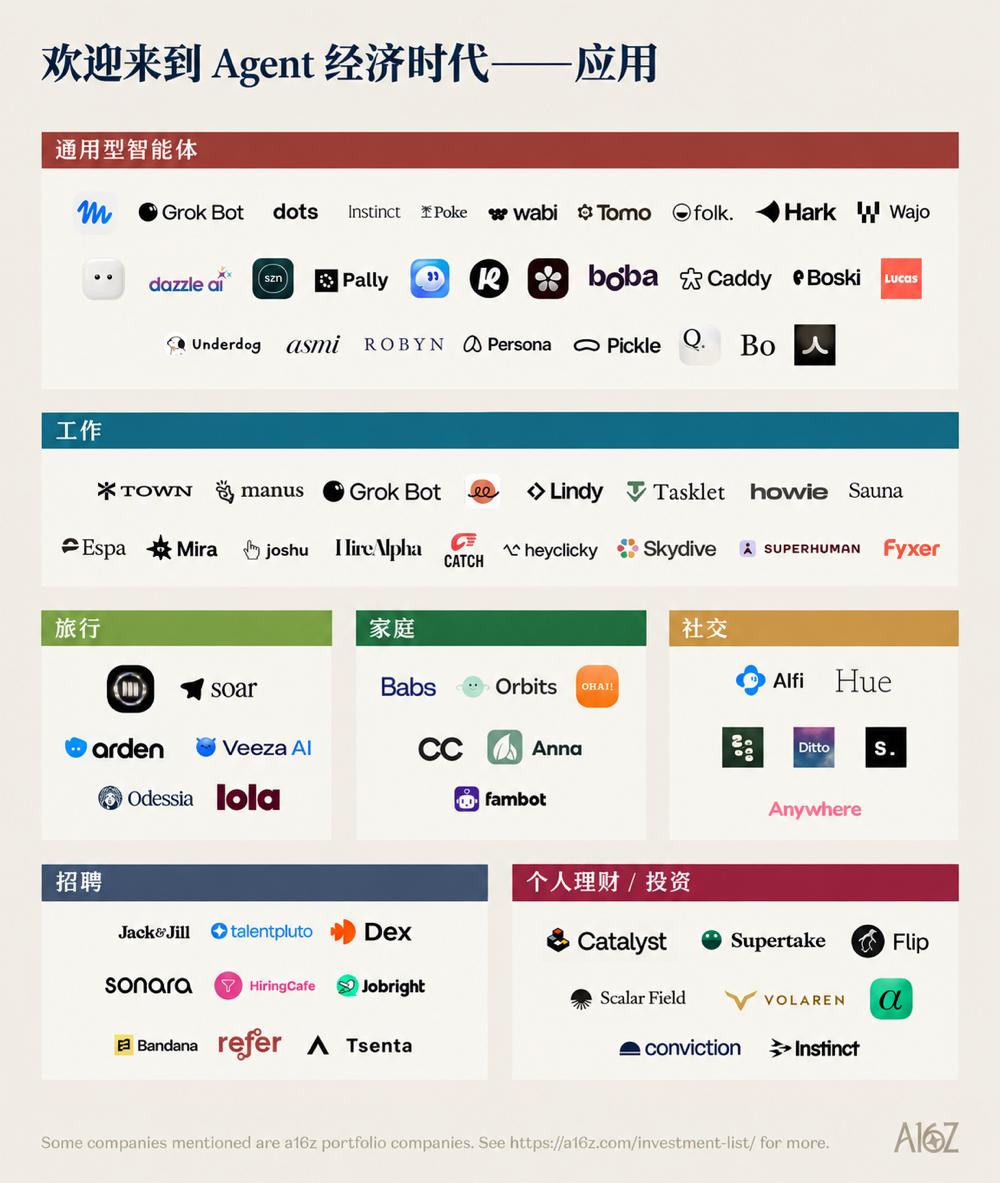
Agent application ecological territory sorted out by a16z
(1) In the field of general intelligent agents, giants such as Meta, xAI and OpenAI have successively launched independent products.
In September this year, Meta launched the personal AI Agent Muse, which can send emails, book trips, fill out forms and purchase goods on behalf of users. Muse has an independent cloud virtual machine and browser, and can continue to perform tasks after the user closes the application. Meta also connected it to Link, a payment tool under Stripe, enabling it to directly complete shopping checkout.
xAI under Elon Musk launched Grok Bot in August this year, positioned as an AI teammate that can work around the clock. Each Bot has its own computer, can log in to the software that users use daily, process tasks such as sales lead development, marketing activities, daily office work and code repair across applications, and initiate confirmation when user approval is needed.
OpenAI launched Dots in September, which also has an independent cloud computer and can perform tasks around the clock. Dots can connect more than 4000 applications through plugins, and gradually learn users' preferences and working methods based on long-term interactions.
(2) In the work scenario, Manus is a representative that has achieved large-scale commercial revenue earlier.
Manus can independently carry out work such as data research, data analysis, and web page production according to user requirements. This year, Manus disclosed that its annual recurring revenue (ARR) has exceeded 100 million US dollars (about 667 million RMB), and it only took