As the brutal domestic competition has bottomed out, can going global save new energy carmakers?
The stock market siege in China's domestic auto market is pushing overseas expansion from an optional growth story to the life-and-death line of automakers.
In October, retail sales of domestic passenger vehicles declined sharply year-on-year, and the penetration rate of new energy vehicles continued to rise, but failed to drive the growth of the overall market. With the dividends of electrification peaking, the demand for fuel vehicles shrinking rapidly, and the structural mismatch of production capacity intertwined, the domestic market has officially entered a zero-sum game stage of dividing the cake.
In sharp contrast are the auto export data: exports of new energy passenger vehicles almost doubled year-on-year, and the contrarian growth of leading automakers such as Chery, Geely and BYD is highly dependent on the support of overseas markets.
This stark internal and external scissors gap has formed a general consensus in the industry: overseas expansion is the most important breakthrough direction at present.
However, the global market is fragmented by rules and full of barriers. Southeast Asia, Europe, Latin America, and North America all have their own assessment standards, and overseas expansion also hides multiple hidden reefs in terms of profitability, brand and geopolitics.
Domestic competition has hit rock bottom, and the overseas market is the real deciding factor, but it is not a panacea, but a brand-new competition field with higher difficulty.
01 Polarized Performance of the Auto Market
China's auto market last month showed a rare sense of fragmentation.
Data from the China Passenger Car Association shows that retail sales of narrow-sense domestic passenger vehicles reached 1.643 million units in October, down 27.1% year-on-year; the cumulative volume from January to October was 14.978 million units, down 22.3% year-on-year. Retail sales of new energy passenger vehicles reached 1.109 million units, down 13.7% year-on-year; retail sales of conventional fuel vehicles fell 45% year-on-year, of which pure fuel vehicles decreased by 51%.
The export side presents a completely opposite picture: in October, passenger vehicle exports reached 928,000 units, up 68.5% year-on-year, and their proportion in the total sales of passenger vehicle manufacturers rose to 35% from 19% in the same period last year; among them, exports of new energy passenger vehicles reached 582,000 units, surging 144.7% year-on-year. Institutions calculated based on the China Passenger Car Association's caliber that the cumulative exports of passenger vehicles from January to October reached 7.91 million units, up 74% year-on-year; the cumulative exports of new energy passenger vehicles reached 4.47 million units, up about 140% year-on-year.
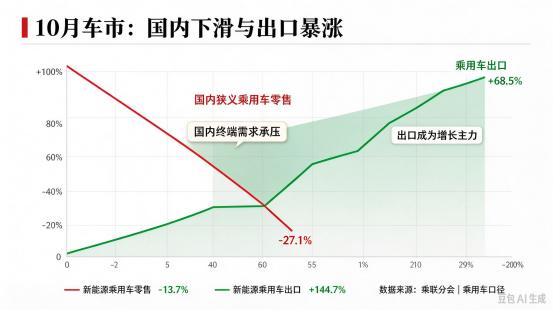
On one side, terminal retail sales plummeted by double digits, on the other side, exports soared by nearly 70%. This scissors gap has split China's automotive industry in 2026 into two completely different worlds.
On corporate financial statements, the performance is also sharply polarized. Chery Group exported 200,600 vehicles in October, up 58.7% year-on-year, accounting for 67.8% of its total monthly sales of 295,900 units. Geely exported 107,200 vehicles in October, up 158% year-on-year, while its total sales of 310,200 units only increased by 1%; BYD sold 490,200 vehicles in October, up 11% year-on-year, but its local sales of 321,000 units decreased by 10% year-on-year, and the monthly growth rate was entirely supported by 170,200 export units.
The performance of new car-making forces is more extreme. Leapmotor delivered 106,127 vehicles globally in October, up 51% year-on-year; Xpeng delivered 50,237 vehicles, up 19.6% year-on-year, both hitting new highs within the year; while Hongmeng Smart Travel delivered about 33,500 vehicles, halving year-on-year; Li Auto delivered 29,025 vehicles, down about 8.6% year-on-year; NIO delivered 34,246 vehicles, down 15% year-on-year.
The overseas incremental contribution is indispensable for Leapmotor and Xpeng to maintain growth, especially for Xpeng. In October, Xpeng's overseas deliveries reached 13,326 units, up 166% year-on-year, accounting for 26.5% of the total monthly deliveries; calculated based on its public data, the year-on-year overseas increment of about 8,300 units has exceeded the total year-on-year increment of the month (about 8,200 units).
Between the rise and fall, one judgment is being repeatedly verified: in the domestic market with stock game, the depth of overseas expansion is becoming the watershed that determines life and death.
02 Intense Internal Competition Drives Overseas Expansion
It is a one-sided judgment to simply attribute the decline of the domestic auto market to weak consumption.
The pressure on the domestic market is the result of the intertwining of multiple factors. The dividend of electrification substitution is coming to an end. In October, the retail penetration rate of new energy vehicles reached 67.5%, up 10.5 percentage points year-on-year, hitting a record high, but the retail scale of new energy vehicles still decreased by 13.7% year-on-year.
When the vast majority of new cars in the market are new energy models, the track will bid farewell to the stage of incremental expansion and enter the stage of stock share competition. The era when growth can be achieved as long as production capacity keeps up has come to an end.
The accelerated shrinkage of the fuel vehicle market further amplifies the pressure on the overall market. In October, the retail sales of conventional fuel vehicles fell by 45% year-on-year, and the decline of pure fuel vehicles even reached 51%. Many fuel vehicle users did not switch to new energy vehicles, but directly withdrew from the car purchase market. New energy vehicles not only divert the share of fuel vehicles, but also shrink the total size of the entire auto market.
At the same time, there is also a prominent structural mismatch of production capacity in the industry. Data from the National Bureau of Statistics shows that the capacity utilization rate of the automobile manufacturing industry in the first half of 2026 was 70.6%, a slight decline year-on-year, lower than the 75% health line of the manufacturing industry. The surplus is not evenly distributed. The capacity utilization rate of leading new energy automakers such as BYD has remained at a high level for a long time, while the mid-tier automakers with annual sales of 100,000 to 500,000 units are underutilized, and the contradiction of idle backward fuel production lines and shortage of high-quality order production capacity continues to exist.
The comparison of Eastmoney Research Report shows that the average capacity utilization rate of China's automobile manufacturing industry in 2025 was about 73%, higher than that of the United States, Thailand and other markets. Therefore, it is not rigorous to simply conclude that the industry has severe overcapacity. A more accurate understanding is that the total volume is not completely out of control, but structural imbalance exists objectively, and price war is exactly the way for the industry to release this pressure.
Under the superposition of multiple factors, the domestic competition logic has been completely transformed. The market has shifted from expanding the total cake to dividing the stock, and the marginal revenue of enterprises continuing to increase investment in the local market has been decreasing. Overseas expansion has also changed from an optional growth bonus item to a mandatory option that has to be taken.
However, overseas expansion is not a unified blue ocean. The global market is divided into multiple tracks with completely different rules, which tests different capabilities of automakers.
Southeast Asia is the main battlefield for cost-effective models. Japanese fuel vehicles have a deep foundation, local consumers are highly sensitive to prices, and Chinese automakers are rapidly increasing sales by relying on the advantages of cost and configuration. The short board is the weak brand premium, and they are easy to fall into internal competition among peers.
Europe is a dual test field for brand power and compliance capability. WVTA whole vehicle certification, Carbon Border Adjustment Mechanism, Foreign Subsidies Regulation and electric vehicle anti-subsidy rules jointly build a high threshold.
The Latin American and Middle Eastern markets have considerable growth potential and relatively friendly policy environment, but shortcomings in infrastructure, exchange rate fluctuations and geopolitical risks are always accompanied. BYD's development in Brazil is quite representative: it sold 24,114 vehicles locally in October, ranking fourth in the market.
The North American market is restricted by strict trade barriers and local subsidy rules, and the channel for direct export of complete vehicles is basically closed, making it a difficult-to-break-through sector in the globalization map of Chinese automakers.
The difference in rules of different markets determines that the core test of overseas competition is not whether you can sell the cars out, but to choose the right market and find the right business model.
Direct export of complete vehicles belongs to the light mode, with fast landing and low investment, but it is extremely vulnerable to the impact of tariffs, exchange rates and policy changes; building factories locally and building local supply chains and R&D systems is the heavy mode, with a longer investment cycle, but it can bypass trade barriers and get close to local users.
03 A Competition Field with Higher Difficulty
The domestic market is a predicament, and the overseas market is by no means a smooth path. The beautiful sales figures cannot cover the holes in the profit statement.
Relying on the second growth curve of overseas business, Xpeng, which hit a new high in delivery volume within the year, still failed to cross the profit and loss line. In the 2026 interim report, Xpeng's revenue was 32.78 billion yuan, a slight decrease of 3.8%, and the half-year loss was 3.12 billion yuan.
BYD's gross profit margin in the first half of the year rose by 0.84 percentage points to 18.85%, and the gross profit margin of its automotive business reached 22.33%, but its attributable net profit has declined year-on-year for four consecutive quarters.
The scale is rising, but the profit has not kept up — this is the common situation of the whole industry.
What is more worthy of vigilance is that the difficulty of making money from overseas business is no lower than that in the domestic market.
Channel laying, local marketing, after-sales network and compliance certification, each item's cost is significantly higher than that in China. Many enterprises have good overseas sales but negative profits, which essentially rely on the profit transfusion from the domestic market.
In addition, the concentrated export of a large number of low-cost models will easily solidify the impression of "Chinese cars" as "cheap cars" in the hearts of overseas users. Once this impression is formed, it will be difficult for subsequent high-end models to achieve premium.
Apart from hidden reefs, the route divergence among leading enterprises has also been clear.
The cost-effective volume-oriented school is represented by BYD, Chery, SAIC and Leapmotor, with common features of scale priority, downward price exploration and dense channel layout. Chery is the most typical sample: its revenue in the first half of the year was 143.28 billion yuan, up only 1.2% year-on-year, and its attributable net profit was 8.567 billion yuan, down 11.7% year-on-year, but its overseas revenue was 98.968 billion yuan, up 51% year-on-year, accounting for nearly 70% of the total revenue. In other words, Chery's profit statement is supported by overseas business, while its domestic business is shrinking.
The high-end brand school is represented by Xpeng, NIO and Zeekr, which build brands with technology and experience, focus on high-value markets such as Europe, and bet on long-term brand assets. Xpeng's average overseas unit price exceeds 40,000 euros, and overseas revenue accounts for 25%, which is the most impressive report card on this road so far; NIO takes a differentiated route of battery swapping and service system in Europe, but its scale is still limited.
It is worth noting that the two routes are not mutually exclusive. BYD focuses on volume sales in the domestic market, and lays out both the mass market and high-end brands overseas. The cumulative sales of its Denza, Fangchengbao and Yangwang brands in the first half of the year reached about 220,000 units, taking the dual-track parallel route; Leapmotor sells its own cost-effective products through Stellantis's channels, taking the route of going overseas by borrowing ships. The real divergence does not lie in the route itself, but in whether the enterprise has the ability to manage the three accounts of scale, profit and compliance at the same time.
The rise and fall in October is largely determined by the depth of overseas expansion. This judgment holds, but three limitations need to be noted.
First, overseas expansion solves the problem of production capacity outlet, not the profit structure. It can digest idle production capacity, dilute R&D costs and provide growth stories, while bringing channel costs, compliance costs and brand construction costs. Whether overseas expansion can make money depends on the gross profit per vehicle, not the number of exported units.
Second, the final outcome of this competition does not lie in who exports more, but in who can operate overseas for a long time. The three truly trackable indicators are: gross profit margin of overseas business, proportion of localized production capacity, and proportion of overseas self-owned channels. Export volume is only the starting point, only the GMV, and these three indicators are the real deciding factors.
At present, what China's automotive industry is experiencing is a capability leap from "selling cars" to "operating business". The domestic stock game has hit rock bottom, and the overseas market is not a shelter, but a competition field with more complex rules, stronger competitors and lower fault tolerance rate. The one that can stand out will not be the one with the most beautiful export figures, but the one with the most solid globalization organizational capability.
Overseas expansion is never the end point, but just a new start with higher difficulty.
This article is from the WeChat official account "Unicorn Observation", author: Unicorn Observation, published by 36Kr with authorization.