What would happen to NVIDIA without Jensen Huang?
In recent days, the tech industry and capital market have been abuzz with gossip about Jensen Huang, and we will not repeat all the details for you here.
Putting aside the final outcome, we can explore one question: if Jensen Huang is ousted from his position as CEO, what will happen to NVIDIA? This is also an issue that the outside world pays more attention to.
In fact, you do not need to pay any attention to these extramarital affair rumors. The core only involves two questions: whether it involves violations of regulations (U.S. export control) and whether it violates the rules of corporate governance.
We will not discuss the issue of export control here. As for corporate governance rules, a romantic relationship between a CEO and their direct subordinate is a clear violation of the code of conduct at U.S. companies, which involves unequal power and conflicts of interest. In 2018, Brian Krzanich, CEO of Intel, and in 2019, Steve Easterbrook, CEO of McDonald's, were both "asked to leave" by the board of directors for this reason, which did not involve illegal acts.
According to NVIDIA's articles of association, a majority vote of the 11 directors is sufficient to remove the CEO. Therefore, if the board wants to replace the CEO, it does not need to wait for clear legal issues to emerge. This is why when the first piece of gossip came out, the board stated that it had confidence in the CEO, but when the second piece of gossip involving a direct internal subordinate came out, news spread that the board was discussing the removal of the CEO.
If Jensen Huang violates the company's rules and the board still protects him, the directors themselves will face shareholder lawsuits. In the end, the specific result of whether to replace Jensen Huang will still be decided by the board of directors.
Then let's go back to our ultimate question: is NVIDIA inseparable from Jensen Huang? Will NVIDIA still be the same NVIDIA without him?
01 Clarify the Causal Relationship
Without Jensen Huang, NVIDIA will still be NVIDIA.
Indeed, a good leader can better guide the direction and is the most important person of a company, but the direction and development of the industry and technology have never been the achievement of a single person. We need to make this causal relationship clear.
Jensen Huang is a founder with an engineering background. NVIDIA can achieve what it is today relying on more than 30 years of persistence in the GPU track, not on any extremely powerful technology invented by Jensen Huang himself. Moreover, Jensen Huang did not insist on developing GPUs more than a decade ago because he foresaw today's AI boom.
GPUs were originally designed for gaming. CUDA, launched in 2006, was developed to enable GPUs to perform general-purpose and scientific computing. In 2012, AlexNet ran deep learning programs using NVIDIA's consumer graphics cards, and then NVIDIA went through the cryptocurrency mining boom, and finally ushered in the era of large models.
Each era has its own demands, and NVIDIA has come step by step following the market demands of each period.
In NVIDIA's executive system, Chief Scientist Bill Dally is in charge of research, Michael Kagan who joined from Mellanox is now the CTO, and Ian Buck, the founder of CUDA, now manages the data center business, with more than 40,000 employees under them.
Today, the overall direction of AI has been clear, and NVIDIA's product roadmap has been arranged for several years ahead. None of these achievements were decided by Jensen Huang alone, so they will not disappear just because he leaves.
It is certain that without Jensen Huang's persistence, there would be no NVIDIA today. But for a company that has been fully on track, history has long given the answer to whether it can continue to operate after the founder leaves.
There are countless cases such as Apple, Intel, Microsoft, Amazon and TSMC. Among them, TSMC, my former employer, is also worth noting.
In 2005, Morris Chang handed over the position of CEO to Rick Tsai. After the 2009 financial crisis, Morris Chang returned to the position of CEO himself. In 2013, he handed over the management to Mark Liu and C.C. Wei, and officially retired in 2018. Today, TSMC led by C.C. Wei is several times stronger than it was in the Morris Chang era. The TSMC case also illustrates another point: the handover of leadership does not necessarily succeed at the first attempt, but as long as the governance mechanism is sound, you can replace the wrong person.
Therefore, we need to understand the governance model of Western technology companies: professional managers take the lead, with independent directors exercising checks and balances.
Apple, Microsoft, Google and Amazon are all managed by professional managers now. Among the giants where the founder still leads the front line, in addition to NVIDIA, there are only a few companies left such as Tesla and Meta, whose founders have extremely distinct personal characteristics and even serve as the corporate brand.
Jensen Huang only holds 3.58% of NVIDIA's shares and has no super-voting rights. In essence, NVIDIA has long been a company under the professional manager system. It just so happens that this professional manager is the founder, and he has performed exceptionally well, so he can stay in the position all the time.
It is very common among Western corporate giants that a person continues to hold the position as long as he does a good job, and the board replaces him once problems arise.
02 Management: Who Will Take Over
Before talking about the management, we have to mention a very special feature of NVIDIA: there is no second-in-command.
NVIDIA does not set up a COO position, and its management structure is extremely flat. At one point, there were as many as 55 executives reporting directly to Jensen Huang, and later the number was reduced to 36, while Bernstein's report mentioned that the number is about 60. Jensen Huang himself has always been unwilling to make a formal succession plan, on the grounds that succession arrangements will only create competition and division among executives.
When NVIDIA was advancing triumphantly in recent years, the market regarded this flat management as a model of corporate management.
Objectively speaking, this model has both advantages and disadvantages. The advantage is that decision-making is fast, information does not need to be transmitted layer by layer, Jensen Huang can directly hear voices from the front line, the organization is streamlined, and there is no layer-by-layer reporting and internal politics that are common in large companies. NVIDIA can launch a new generation of products every year, which is directly related to this model.
The disadvantages are also very obvious: once the top leader has an accident, the company will immediately face the risk that no one can take over; another disadvantage is that this model is extremely demanding for people — a CEO has to face dozens of executives to listen to their reports, which is an extremely heavy workload, and a professional manager may not be able to handle it.
Therefore, this model is tied to Jensen Huang himself. When Jensen Huang is in the position, it is an advantage; when he leaves, it needs to be adjusted. This is the natural result of leadership change, and it does not mean that the original model is wrong.
There are various successor lists circulating in the market. As for the position of interim CEO, I think the most certain candidate is CFO Colette Kress.
First of all, this position is only for the interim period. It only needs to get through the unstable period after Jensen Huang leaves temporarily, and does not require a very deep insight into the industry or technology.
Colette Kress joined NVIDIA in 2013 and has served as CFO for 13 years. She is most familiar to Wall Street and key customers. With a financial background and no in-depth knowledge of technology, she is the most suitable candidate for the transition period.
The internal technical candidate is Ian Buck, the well-known father of CUDA, who is now in charge of the large-scale and high-performance computing business and has the deepest relationship with several major cloud vendors. His shortcoming is that he has never served as the top leader and has no experience in managing the entire company.
In addition to the two popular candidates Colette Kress and Ian Buck, NVIDIA's internal CTO and several vice presidents are also possible internal candidates, and the company is still full of talents.
As for external candidates, Semafor named Johny Srouji, Apple's head of hardware chips, and investment bank Baird also stated that it tends to hire an external candidate. As for Lisa Su of AMD and Rene Haas of Arm that are circulating in the market, they are only speculations from the media and analysts for now, without any solid evidence.
My judgment is that the most possible combination is Kress serving as the interim CEO, while external headhunters are looking for a formal CEO, and technical executives like Ian Buck are responsible for stabilizing products and customers.
In this case, the new management will most likely set up a COO position, and integrate dozens of reporting lines into a conventional hierarchical structure. This will slow down the decision-making speed to some extent, but the company will no longer rely on a single person, which is an inevitable trade-off when entering the professional manager era.
03 Three Possible Scenarios
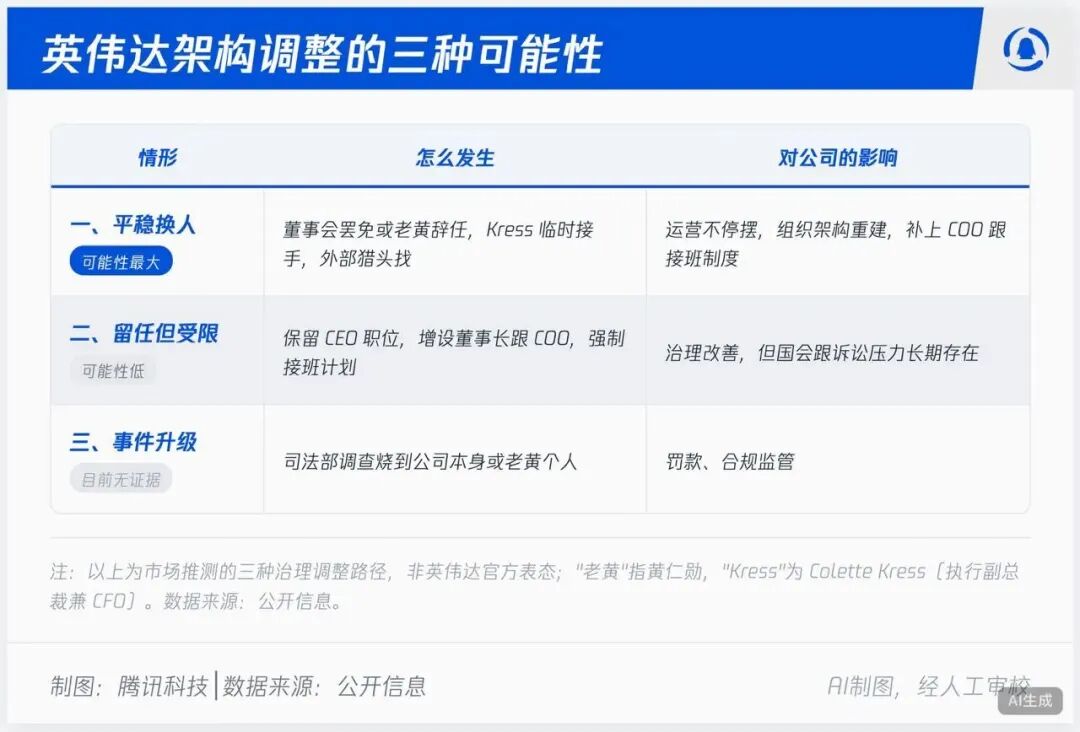
I have summarized the development of this incident into three scenarios.
The first scenario is a smooth leadership change, which is the most likely one at present. The board removes Jensen Huang or Jensen Huang resigns on his own, Kress takes over temporarily, and then the formal CEO is finalized. Jensen Huang will retain his identity as a shareholder, and may even keep an advisory title. The daily operation of the company will not stop, products will be shipped as usual, and orders will be delivered as scheduled. What takes time is the reconstruction of the organizational structure.
The second scenario is that Jensen Huang stays in the position, but his power is restricted: the board retains his CEO position, and at the same time sets up the positions of chairman and COO, and forces the formulation of a succession plan. This scenario was possible before the second extramarital affair was exposed, but now the possibility is very low.
The third scenario is that the incident escalates, such as involving violations of export control. In that case, NVIDIA will face fines and long-term compliance supervision, which is the most critical situation. However, there is no evidence pointing to this situation for the time being.
No matter which possibility it is, the people and compliance rules are the affected parts, and none of them will lead to the disappearance of demand for AI chips.
04 Impact on the Industrial Chain
With the above conclusion, let's look at the industrial chain.
First, let's look at downstream customers. Major cloud vendors such as Microsoft, Meta, Google and Amazon buy NVIDIA GPUs because their AI capital expenditure needs to be implemented, and because NVIDIA's products and CUDA ecosystem have no rivals at present, not because of Jensen Huang himself.
No matter whether the CEO is replaced or not, the orders that customers should place will not decrease by one single unit.
The customers that will be truly affected are another type of customers, that is, emerging cloud vendors and AI startups that rely on NVIDIA's capital support.
Jensen Huang has a unique business strategy in recent years: NVIDIA invests in customers, and customers then use the money to buy NVIDIA's chips. This strategy highly depends on Jensen Huang's personal courage and credibility. If a professional manager takes over as CEO, especially during the transition period, such investments will definitely become more conservative. Those second-tier computing power companies that are not profitable on their own and can only get financing with NVIDIA's support are the part of the industrial chain that should worry the most.
Then let's look at competitors. In the short term, capital has voted with its feet.
When NVIDIA's stock price plummeted on Monday, the Philadelphia Semiconductor Index rose sharply by nearly 7%, AMD's stock price rose by 13% in a single day, and Broadcom's stock price rose by more than 8%.
I think the real beneficiaries are Broadcom and Google. But in the long run, there will be no major changes in the overall market pattern, and it is only a short-term news-driven impact. Because when NVIDIA's management is in turmoil, it is a window period for major cloud vendors to increase their investment in self-developed ASICs. Broadcom is the biggest winner of ASICs, and Google's TPU is currently the only solution that can compete with NVIDIA at the system level.
Finally, let's look at the upstream supply chain, namely TSMC, SK Hynix, Micron, as well as system integrators such as Foxconn and Quanta.
Upstream orders depend on NVIDIA's shipment volume, and the shipment volume depends on downstream capital expenditure. No link in this chain is determined by who NVIDIA's CEO is.
Even if NVIDIA appoints a CEO who fully supports U.S. local manufacturing, only TSMC can manufacture NVIDIA's chips. Intel has no production capacity, nor has it significantly increased capital expenditure, and its process technology is one generation behind. NVIDIA cannot assign orders to Intel even if it wants to, which is an established industrial fact.
But interpreted from the news perspective, it will definitely be beneficial to Intel and unfavorable to TSMC, but this is only limited to the news level and cannot affect the real industrial situation.
In the past two days, well-known analyst Ming-Chi Kuo also talked about the value of Jensen Huang to NVIDIA.
Ming-Chi Kuo means that Jensen Huang is not necessarily the person in NVIDIA who knows the most about new technologies such as HVDC, CPO and CCL. The value of Jensen Huang is that he can take strategies, organization, technology and supply chain into consideration at the same time, and make quick decisions.
This is consistent with the causal relationship I mentioned earlier in this article. Jensen Huang is the decision-maker, not the person who invents the technology.
The suggestion Ming-Chi Kuo gave is to gradually reduce NVIDIA's reliance on Jensen Huang for decision-making, and arrange a succession plan at the same time, which is a gradual transition idea. But in fact, according to NVIDIA's articles of association, a majority of directors can directly replace the CEO. The board will hold a meeting that night to decide whether Jensen Huang stays or leaves, and it will not be so slow.
Ming-Chi Kuo also believes that Jensen Huang's radical decisions have driven the specification upgrade of the supply chain, and then driven the technological upgrade of the entire AI industry. According to his logic, after Jensen Huang leaves, the technological upgrade of the industry will slow down, which is actually inaccurate.
Looking down from the height of the entire AI system, NVIDIA itself is also pushed forward — what pushes NVIDIA forward is market demand and physical limits.
So it is not that Jensen Huang is radical. Jensen Huang has been the founder in position for more than 30 years, and he was not radical at all before. For more than a decade, NVIDIA's graphics cards always used process technology that was one generation behind, and they chose to use Samsung's foundry services for many times to cut costs. AMD was much more radical than NVIDIA before.
The technological iteration of AI hardware is driven by market demand. The reason why many seemingly radical new technologies are adopted is that demand has exceeded the physical limits of old technologies, so they have to be replaced, not because Jensen Huang himself is radical.
Take HVDC as an example. The power of a single cabinet has increased from dozens of kW in the past to more than 100 kW now, and will reach hundreds of kW or even 1MW in the future. The original low-voltage power supply cannot even fit the copper bars, so it has to be changed to 800V high-voltage direct current.
Then let's talk about CPO. As the transmission rate increases generation by generation, the transmission distance that copper wires can support becomes shorter and shorter, and the power consumption of pluggable optical modules is getting higher and higher. When it reaches a certain point, copper wires and pluggable modules can no longer support the demand, so the optical engine has to be moved next to the chip.
None of these upgrades are decided by random decisions, they are all forced out by physical limits. As long as downstream demand for computing power continues to rise, these technologies will definitely be adopted. No matter who becomes NVIDIA's CEO, they have to make these decisions. What's more, AMD, Broadcom and Google's TPU are all following these technical routes, and they do not have Jensen Huang.
History also proves this point. The delay of Blackwell, the overheating problem of cabinets, and the repeated postponement of the CPO launch time all show that what really determines the rhythm is the maturity of physics and the supply chain. No matter how radical Jensen Huang is, he cannot speed up the progress beyond the limit.
05 Global Perspective
Finally, let's make a brief summary.
The core of the incident itself only involves two questions: whether it is illegal, and whether it violates the company's rules. The former determines whether the incident will escalate, and the latter determines whether Jensen Huang will stay or leave.
In this matter, for a great company, it is only a matter of time before the founder leaves. Intel, Apple, Microsoft and T