After the game becomes a smash hit, it is only one week away from being plagiarized by AI.
Ideas That Could Be Stolen As Soon As They Are Released
Jade Scratch Scratch (formerly named Gambling Stone Scratch Lottery) became a hit, but Penpen from Sleepless Game Studio was not happy at all.
"You probably only have a one-week window." The mobile publisher who contacted them reminded them that a week later, pirated copies of this game would be everywhere on the market, and Penpen knew this statement was correct.
Jade Scratch Scratch was the entry work submitted by the team when they participated in the indie game exhibition. On May 16, 2026, the game released its Demo on the competition platform. In less than three or four days, many streamers began to broadcast this game. Penpen even posted a post to celebrate: "Our game is a hit!"
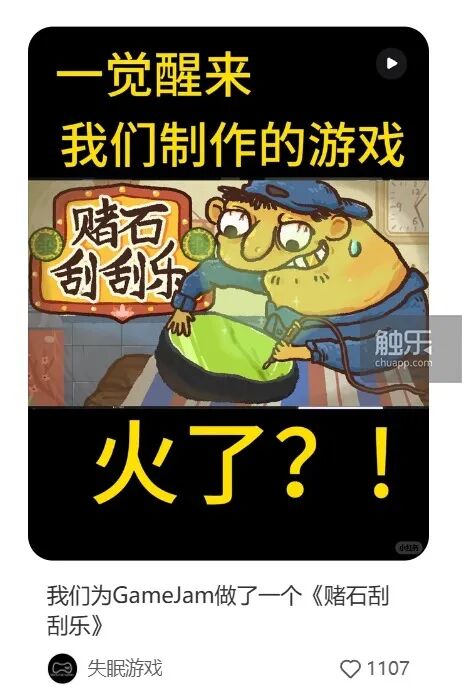
The celebration lasted for a very short time
The situation started to go bad right here. As the publisher said, a week later, a large number of mini-games with exactly the same core gameplay as Jade Scratch Scratch appeared on platforms such as Douyin. These games had almost identical visuals to Jade Scratch Scratch, except that AI was used to convert 2D visuals into 3D effects. By July and August, highly similar upcoming games also appeared on Steam. At the same time, Jade Scratch Scratch itself did not even have a clear release date.
For game developers, such incidents have been repeated over and over in recent months. Jupiter the Sorcerer, an indie developer who is trying to integrate AI into the workflow, told Chuapp that there are mainly two ways to "steal games with AI". One is to get the game package through various methods, feed it to AI to reverse engineer and then reproduce an almost identical copy; the other only requires the original author to have released a PV or gameplay video, and AI can directly copy the work through Vibe Coding. These games are usually launched on platforms in the form of mini-games such as Douyin, Google Play and even Roblox.
The earliest well-known victim includes Freya Holmér, a Unity plugin developer who is quite famous in the community. In March this year, she released a quite creative "Tetris" variant Demo. Within a few hours, a Vibe Coder posted a video reproducing her gameplay and a play link in the comment section. Since then, more similar situations have emerged continuously around the world. More than seven hours after the PV of Escape the Walls was released, someone reproduced its gameplay in Roblox; when Bills Must Be Paid was still in the process of looking for a domestic publisher, an almost 1:1 replica The Best Sixth Man appeared on Douyin.
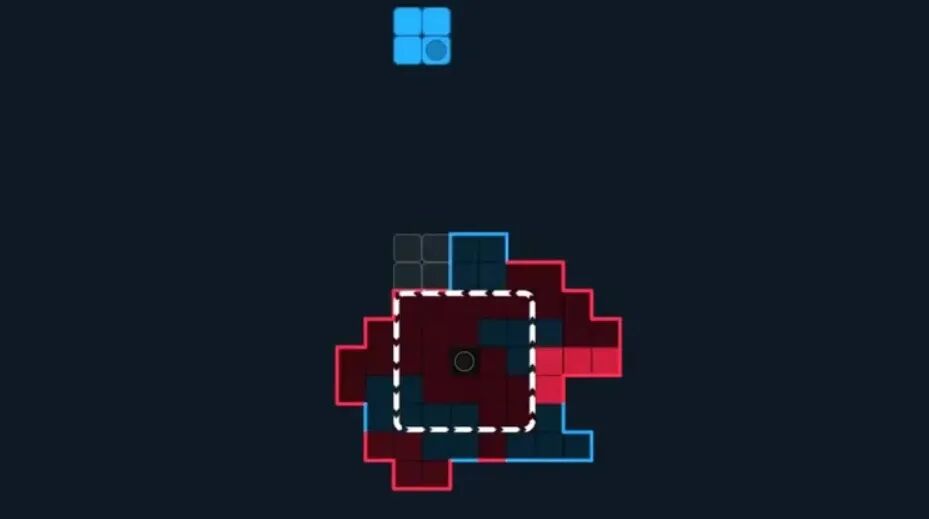
Only about 5 hours passed between the gameplay demonstration and being reproduced
Indie developers are in a state of panic. Shortly after the celebration post was published, Penpen called on everyone on his social account to "stop participating in Game Jams", and more people canceled their plans to release Demos online, or postponed any form of gameplay demonstration.
At the same time, among the more than 7,100 games that appeared in the Steam Next Fest in October this year, more than 41% were marked as using AI-assisted development, and 28% were generated entirely under the leadership of AI.
You Don't Have to Be an Expert, But You Can't Be Completely Clueless
Liangshui used to work as a programmer in a large tech company, participated in large projects using Unreal Engine and other tools, and also made Mods by himself. Liangshui is no stranger to the process of unpacking and reversing game data. In June this year, he told ChatGPT that he wanted to make a Mod for a certain game and needed to extract models. GPT started working without asking any further questions. "At about seven or eight minutes, it said it encountered encryption. Two or three minutes later, it stated that the key had been cracked."
It took about 10 minutes in total from the moment Liangshui sent the instruction to the time AI extracted the game model. As for the cost, Jupiter the Sorcerer estimated based on the token consumption during his own attempt, "the two-hour cost is roughly between 55 US dollars and 60 US dollars". With a subscription, the cost can even be converted to around 5 US dollars.
"You can see the scripts after unpacking, but the compiled code encapsulated in C++ cannot be obtained. Because reverse engineering of the original code, especially reversing from binary code, requires a very high threshold, which is usually only achievable by industry giants." Liangshui told Chuapp, "But as I just said, AI has completed the unpacking in 10 minutes, and in a few more minutes it can specifically extract the corresponding game logic and the assembly of art assets, which is very easy."
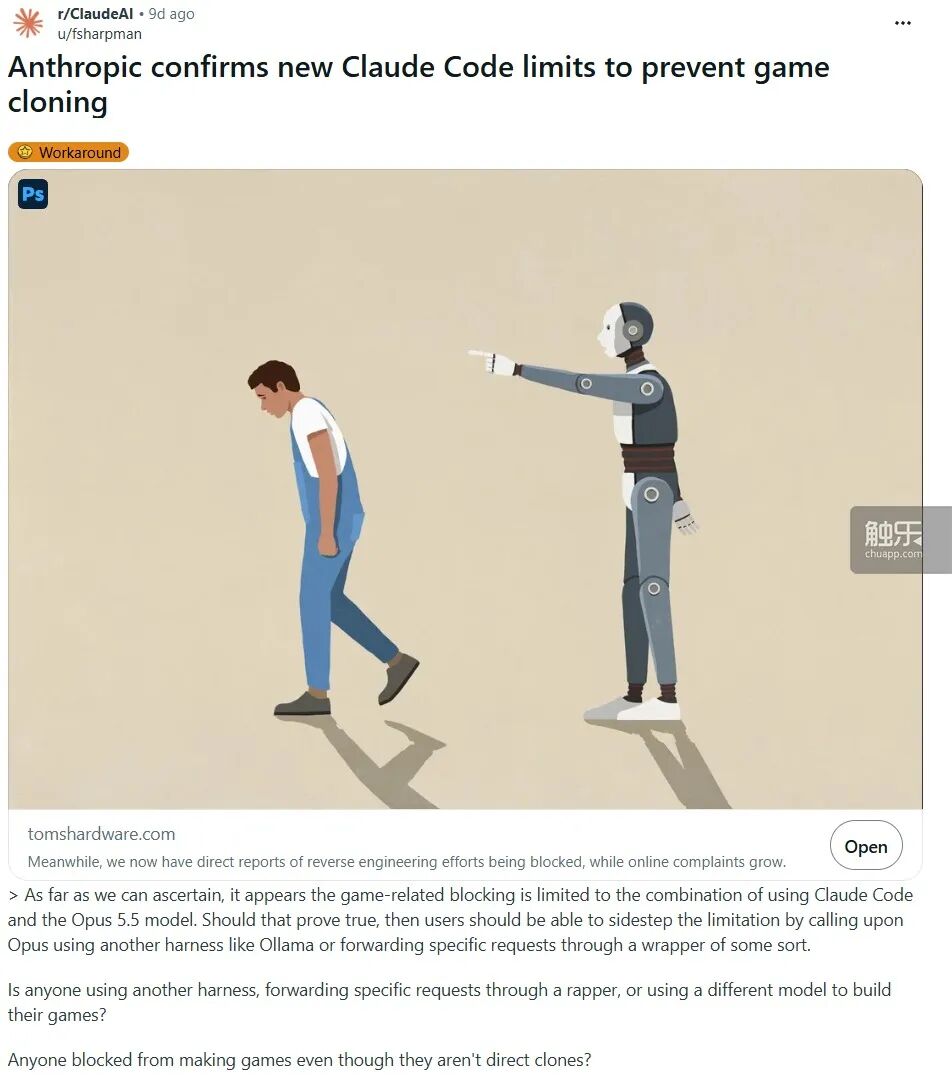
Anthropic tried to limit Claude's Opus 5.5 and Claude Code tools from reverse engineering old games, but many developers reported that the restriction caused accidental injuries to legitimate users
As for assembling the reversed data into a new game, "if it is a Unity or Godot project, two hours are enough". And most of the time is spent on testing, "the larger the game volume and the more complex the logic, the more test cases there are, so the longer it takes". But these are "actually not very troublesome for AI".
Liangshui will no longer release Demos and trial versions of his games to the public, and only release demonstration videos. "I can only say that my ideas are free, but if you want to copy my ideas, you have to pay some cost."
At least in China, the copyright law protects "expression" but not "ideas, methods, rules and systems". Gameplay is often classified as "idea" or "system" in judicial practice. Before that, there were many games with similar gameplay, but even for large manufacturers to perform similar operations, a team of seventy or eighty people usually needs 9 to 10 months of construction period. Now if one person uses AI to do it, "it takes at most one month or half a month".
In this process, although plagiarists don't have to know nothing about code, they really don't need strong technical skills. "Wishful programming still has its limitations. If you can't describe it clearly, you can't get the desired result. The clearer you describe, the more accurate and faster AI works." Liangshui said, "So your coding ability is not important. The most important things are your logical thinking ability and expression ability."
The Defenders of Rights Who Are Left Stranded and Unsupported
Sleepless Game Studio is trying to safeguard rights for Jade Scratch Scratch, but Penpen's biggest feeling now is that he is "left stranded and unsupported".
Although the game package was released from the work submission platform of Game Jam, the organizer has no ability to take data security protection measures for every game. Due to the tight development cycle, the team itself had no spare energy to consider such issues when packaging the game. This makes the Demo uploaded to the work submission platform equivalent to "running naked", and anyone who downloads it can directly access the source code. "It can be seen that many plagiarists directly took our things and used them, even the bugs are exactly the same." Penpen is very convinced of this point.
What's more, in front of AI, the preventive measures that indie game teams can take are quite feeble. "At most, you can only add a little obstacle to people who do reverse engineering," Jupiter the Sorcerer explained from a technical perspective, "the effective measure is actually to put part of the core game logic on the server, which will increase a lot of costs for reverse engineers." But for small teams developing single-player games, this operation is also very cumbersome and requires additional maintenance costs.
At the same time, Penpen is pinning his hopes on reporting counterfeit products on the platform to get them taken down. This is a theoretically feasible way, but it is full of difficulties in actual implementation.
"First of all, we need to prove ourselves, prove that we are the original author of the game, and prove that the plagiarists directly used our materials." Penpen recalled. Taking the Douyin platform as an example, he first needs to prove the company's operating qualifications, prove that the game is owned by the company, and then provide a large number of release screenshots and process screenshots to show which platforms we first released these games on... The whole process is even more complicated than the release process, which took about two weeks in total. Even if Douyin's business personnel contacted them during this process, they could not affect the review efficiency of other departments.
In addition, legally, the software copyright registration number is also auxiliary evidence to prove the original property right of the game. Theoretically, mini-games on the Douyin platform need to provide software copyright number and ICP before being launched. But Penpen found that first of all, the threshold for applying for software copyright is very low, and the institution will not check whether your work is truly original; even, pirates can get software copyright, ICP and complete the launch process much faster than them.
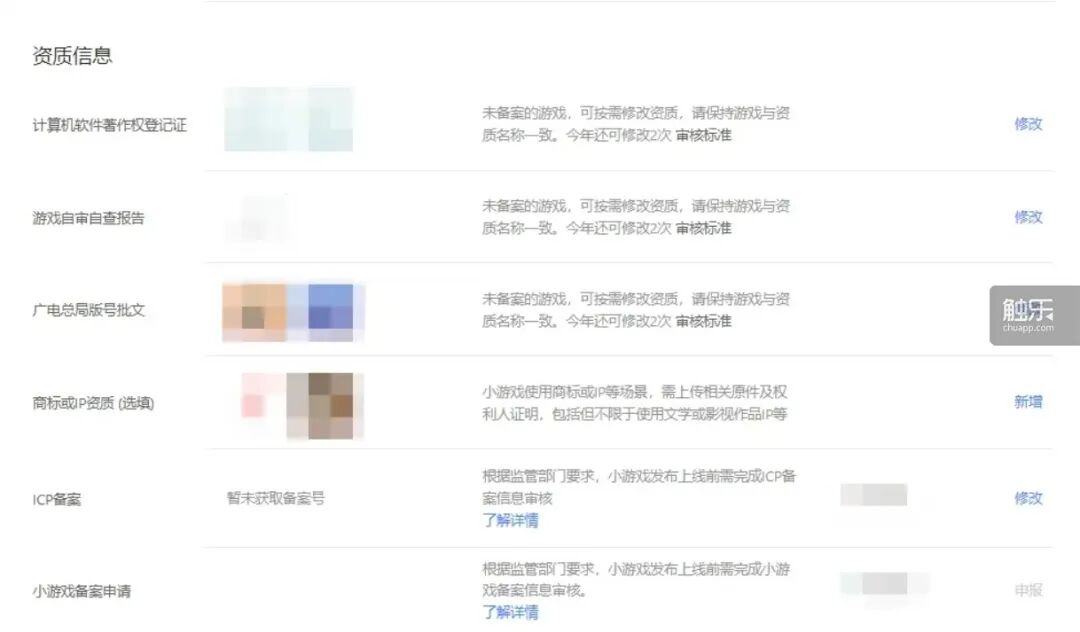
Launching mini-games on the platform actually requires a series of qualifications
"When we decided to officially establish Jade Scratch Scratch as a formal project, we immediately started to apply for software copyright." Penpen said, "But the application process for software copyright takes one month, we released the Demo on May 16, and the pirated version appeared on May 20."
A publisher who contacted them revealed that many companies have already prepared a large number of software copyright numbers in hand, and they only need to change the name of the corresponding work to make the product launch quickly. This may explain to some extent why pirated versions can appear in players' vision earlier than the genuine version and get a lot of promotion.
"When we appealed, we found that one of the counterfeit products got the software copyright only one day later than us... If we were unlucky and the review was slower, legally speaking, we might become the pirates." This situation is becoming a fact faced by many small teams.
Moreover, they ran into that classic problem again — "the law does not protect gameplay". Even if the team spends a long time proving that the existing mini-games are obviously plagiarized, the other party only needs to spend one day replacing the overly similar art materials and music materials, and then they can be successfully re-launched.
"Their logic is to copy you first, and then replace the visible external plagiarized parts in batches. So during the process of our appeal, the situation has already changed." Penpen felt very helpless.
If the ecology of mini-games is already chaotic, the trouble of safeguarding rights on Steam is beyond the team's expectation. Previously, they successfully reported a pirated version on Steam and got it taken down, but a week later, the other party initiated a "counter-notice", requiring Sleepless Game Studio to formally sue them.
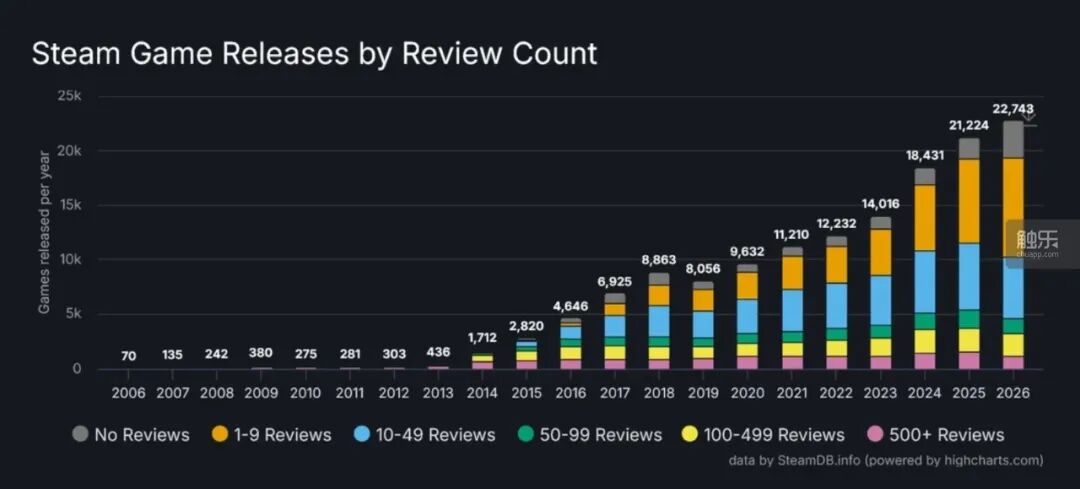
Data shows that after the emergence of AI, the number of games on Steam has exploded
"The problem is that Steam is an American platform. According to their laws, we need to sue in the United States to promote the subsequent process." The cost of doing this is unbearable for Penpen. The members of the studio are in a cooperative relationship, and the company itself has no capital reserve. Even if they sue pirates in China, the litigation fee of tens of thousands of yuan requires everyone to raise money together.
During the tug-of-war on Steam, they learned that the game behind the pirated version is a micro-enterprise named Guangzhou Green Light Network Co., Ltd., with a registered capital of only 10,000 yuan and 3 full-time employees. "It looks like a shell company no matter how you look at it," Penpen said, "even if we win the lawsuit in the United States, no funds will actually be compensated to us." Considering the cost of safeguarding rights, the team decided to spend more time on development for the time being, putting the lawsuit aside but "reserving legal measures against them".
At present, what Penpen can do is try to sue in China. They consulted a lawyer and sent a lawyer's letter to Guangzhou Green Light Network Co., Ltd. Since Jade Scratch Scratch itself has not been sold, the amount of compensation will be determined by referring to the profit of the other party.
However, Penpen is still pessimistic about the final result of rights protection. In the past few months, he has communicated with many developers who have similar experiences. Although not everyone encountered plagiarism before the game was launched like him, the results are much the same. After weighing the cost of rights protection and the time consumed, the vast majority of people will choose to accept a settlement at a lower amount than the claim of litigation.
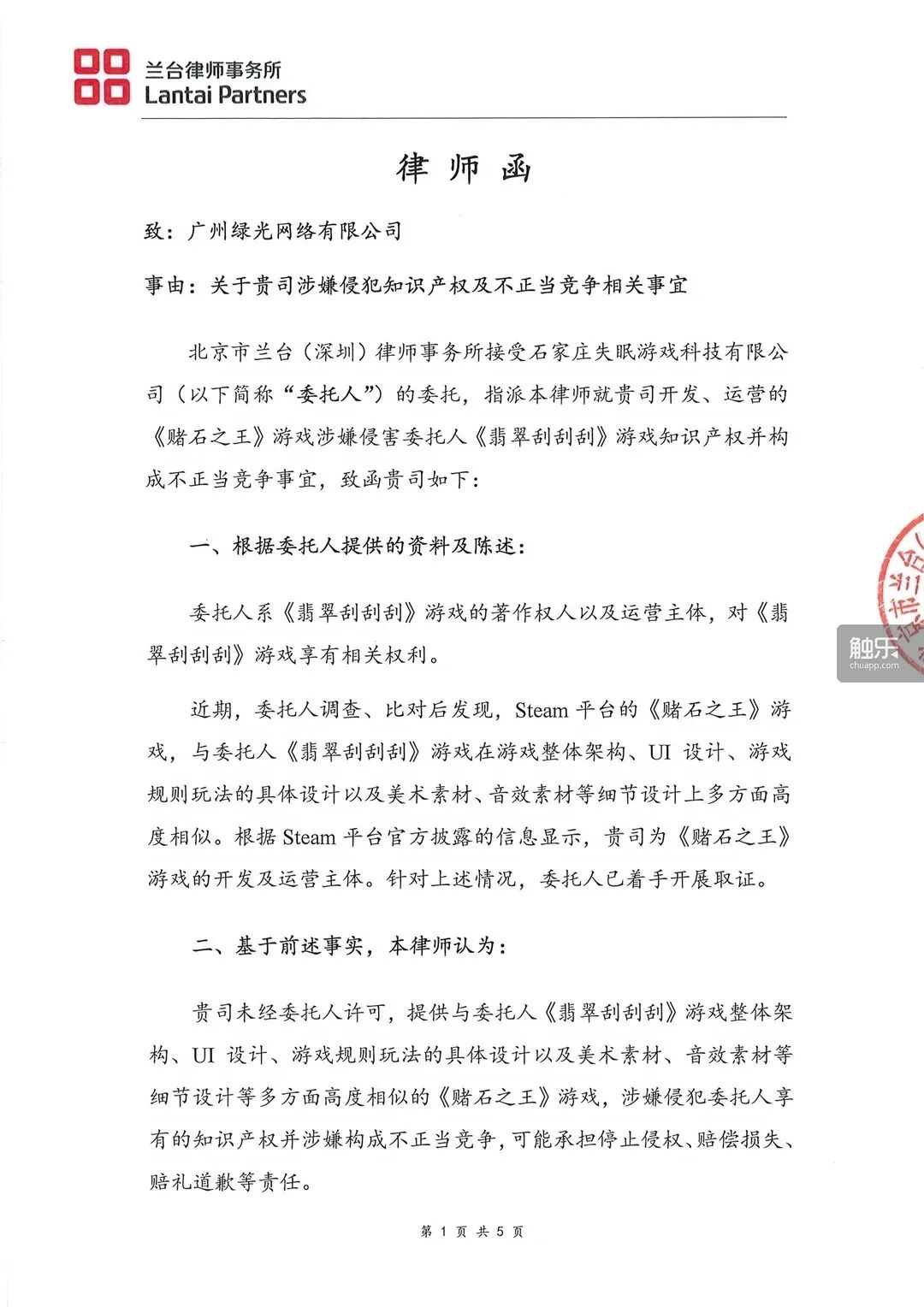
Sleepless Game Studio has sent a lawyer's letter to the pirated developer
Cannot Stop Plagiarism, So We Have to Find Another Way Out
Liangshui is currently developing web games by himself, and this type of game is even more severely hit by AI plagiarism. Based on his experience working in large companies and developing independently, he feels that under the current technical conditions, "protection" is almost impossible.
After the widely criticized October Steam Next Fest this year, Valve responded, but also stated that it "will not set a gate for AI-generated games", only emphasizing that it will adopt algorithms that are more in line with players' interests a few days after the start of the Next Fest. Anthropic posted an article saying that users are prohibited from using Claude to reverse engineer old games — in fact, other large models will more or less prevaricate when it comes to reverse engineering tasks, but Jupiter the Sorcerer said bluntly that "it's useless". This kind of security measure is actually very easy to bypass.
Only itch.io, where many small and micro developers gather, has clearly started to remove a large number of works judged as "AI slop". But pirates do not really favor this platform. On the whole, developers who are panicking that their works may be plagiarized still do not feel any protection at all.
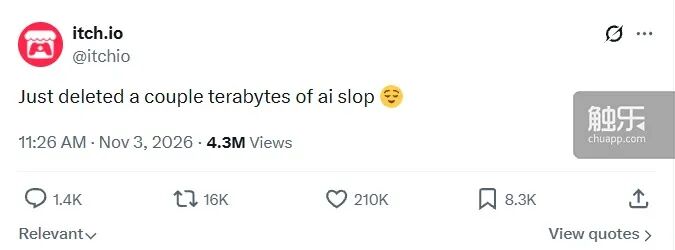
itch.io took the