The Token business is red-hot, but leading intermediaries have not yet made money.
A group of companies engaged in the Token business are heading for the capital market.
Recently, AI infrastructure company Wuwen Xinqiong announced the completion of a 2.3 billion yuan Series C financing, bringing its total accumulated financing to 4.3 billion yuan. According to media reports, it has submitted a listing application to the Hong Kong Stock Exchange in a confidential form. Two other companies have publicly submitted their listing documents: Jiuzhang Yunji submitted its prospectus to the Hong Kong Stock Exchange on September 29, and as early as the end of June, Silicon Flow also launched its Hong Kong stock IPO plan.
None of the three companies focus on developing general large models, but they hope to generate revenue from the rapidly growing demand for model calls. Through technologies such as computing power scheduling, model deployment, and inference optimization, they convert underlying computing resources into AI services that can be directly used by enterprises and developers.
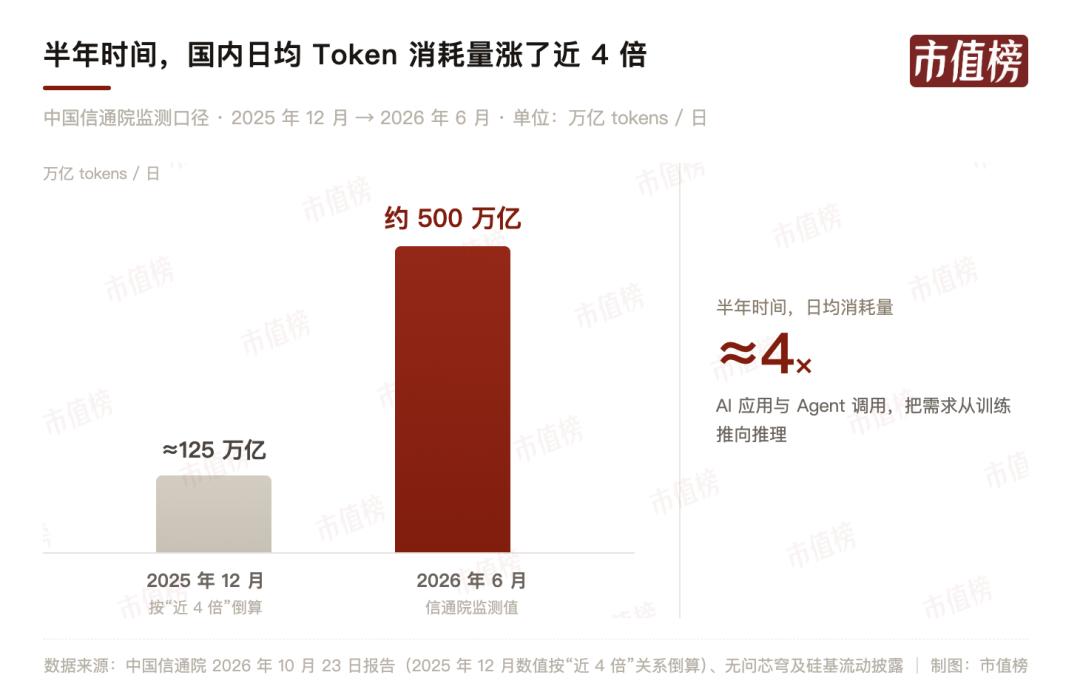
This business is expanding rapidly. According to a report released by the China Academy of Information and Communications Technology (CAICT) on October 23, the average daily domestic Token consumption in June 2026 was about 500 trillion, nearly 4 times that of December 2025.
However, the growth in demand does not mean high profits. In 2025, Silicon Flow's revenue increased by 653.2% year-on-year, but its overall gross profit margin dropped to -24%; Jiuzhang Yunji's annual revenue has exceeded 1 billion yuan, and its main revenue still comes from intelligent computing infrastructure construction rather than Token sales.
The more realistic problem is that model manufacturers such as DeepSeek themselves are selling APIs, and cloud vendors such as Alibaba Cloud and Volcano Engine also have their own computing power and customer bases. Since both upstream and downstream players can directly provide model services, how exactly do these companies in the middle of the industrial chain make money? Can selling Tokens become a profitable business?
01 Model vendors sell Tokens themselves, why are intermediaries still needed?
Since the beginning of this year, a growing number of AI infrastructure companies have started to engage in the Token business.
In June, Jiuzhang Yunji, which is mainly engaged in intelligent computing infrastructure construction and computing power services, released the "AI Factory" strategy and launched the Token Plan, combining its existing intelligent computing resources with large models to provide developers and enterprises with standardized, metered, pay-as-you-go one-stop Token computing power services.
A month later, Wuwen Xinqiong released the "Front Store, Back Factory, One Center" strategy at the World Artificial Intelligence Conference, taking the Token Factory as a key part of its business system. The company disclosed that from December 2025 to July 2026, the daily Token call volume of its Agentic MaaS platform increased by about 40 times.
Silicon Flow, which entered the Token market earlier, has also begun to extend its business to enterprise services. In October, the company disclosed its cooperation with Voyah Auto, building a unified large model service gateway for the latter to manage interfaces of multiple model suppliers.
The three companies have different business starting points, but now they are all striving for more model call demands. Behind this trend is the ongoing change in the demand structure of the large model market.
In the past few years, the most widely concerned part of the AI industry was model training. Enterprises invested a lot of capital in purchasing GPUs and building intelligent computing centers to meet the computing needs for model R&D. However, with the popularization of AI applications, especially the rise of Agents this year, model inference has begun to bring greater incremental growth.
According to the report released by the China Academy of Information and Communications Technology (CAICT) on October 23, in June 2026, the average daily domestic Token consumption was about 500 trillion, nearly 4 times that of December 2025.
The rapid growth of demand has naturally attracted more suppliers.
But the problem is that model vendors such as DeepSeek, Zhipu AI, and Moonshot AI are selling APIs themselves, and large manufacturers such as Alibaba Cloud and Volcano Engine also have their own models and cloud computing platforms. Since users can buy directly from the original manufacturers, what opportunities are left for third-party companies?
On the one hand, enterprises are using large models in more and more scenarios, and accessing multiple model suppliers at the same time also increases management costs.
Take Voyah Auto as an example. As AI is integrated into businesses such as customer service, R&D and marketing, multi-model access has brought problems including repeated development and scattered permissions. Silicon Flow built a unified model management platform for it, shortening the access time of new models from at least one week to one day.
On the other hand, the development of open-source models also leaves opportunities for third-party service providers.
Open-source models such as DeepSeek and Qwen can be deployed by third parties on their own. When using the same model, enterprises can either choose the official API or purchase the inference service provided by a third party.
But even for the exact same model, the service performance of different platforms varies greatly.
The latest monitoring by the China Academy of Information and Communications Technology (CAICT) found that the maximum gap in the output speed of the same open-source model on different platforms is nearly double, and the performance of some third-party platforms even exceeds that of the official platforms.
The difference mainly comes from the underlying capabilities of model deployment, inference optimization and computing power scheduling. For enterprises with large call volumes, the difference in inference speed and unit cost may directly affect the operating cost of AI applications.
Judging from the moves of these three companies, the Token business is attracting different types of infrastructure enterprises to enter this track. They are not only striving for customer demands that model vendors and cloud vendors have not fully covered, but also trying to generate revenue in links such as model deployment, computing power scheduling and service operation.
However, competition is also intensifying.
Original model manufacturers can continuously optimize their inference services, cloud vendors have more complete computing resources and customer bases, and enterprises may also choose to deploy models on their own. Even if independent third parties can provide better performance and services, they may not be able to maintain their advantages in the long run.
More importantly, as the demand for Token calls continues to grow, how much profit can these companies in the middle of the industrial chain actually retain?
02 Standing in the middle of the industrial chain, is it easy to make money from Tokens?
Judging from the disclosed financial data, selling Tokens is not yet a highly profitable business.
In 2025, Silicon Flow recorded a revenue of 55.33 million yuan, a year-on-year increase of 653.2%, but its overall gross profit margin dropped from 39.4% to -24%. Among the total revenue, the revenue of the Serverless API business billed directly by Tokens was about 14.3 million yuan. The gross profit margin of the public cloud segment including this business was as low as -119%, while the gross profit margin of the on-premise deployment business reached 82.5%.
Silicon Flow previously told the media that the losses mainly came from the Serverless API business, while dedicated instances and on-premise deployment contributed the main positive gross profit.
In other words, Silicon Flow's business that charges directly by Tokens has not yet achieved profitability, while its enterprise-oriented deployment and technical services deliver better profitability performance.
Jiuzhang Yunji has a similar situation.
In the first half of 2026, the gross profit margin of the company's intelligent computing infrastructure solutions reached 41.1%, but the gross profit margin of its intelligent computing cloud business was only 2.5%. Although the revenue proportion of the intelligent computing cloud business has risen to 26.1%, Jiuzhang Yunji still mainly relies on infrastructure projects to contribute gross profit at present.
The two companies have different businesses, but their financial data points to the same problem. Why do computing power and model services, which seem easier to scale, earn less than project construction and software deployment?
The first reason is cost.
Standardized inference services usually require service providers to purchase or lease GPUs in advance, deploy models, and then charge according to customers' call volumes. Even if customers do not make any calls temporarily, the costs of leasing, depreciation and operation and maintenance will not disappear.
In 2025, Silicon Flow's computing power resource cost reached 59.63 million yuan, accounting for 86.9% of the total sales cost.
In contrast, on-premise deployment mainly uses the existing computing resources of customers, and service providers generate revenue through software authorization, system deployment and technical support, without bearing the same scale of computing power cost.
Jiuzhang Yunji also needs to improve the utilization rate of computing power to share the cost. In the first half of 2026, its computing resource utilization rate increased from 56% at the end of 2025 to 79.6%, but the gross profit margin of the intelligent computing cloud business was still only 2.5%.
Another problem is the lack of pricing power.
According to the data cited in Silicon Flow's prospectus, the top three platforms in China's Token supply market in 2025 were Volcano Engine, Alibaba Cloud and Baidu Intelligent Cloud, which together accounted for about 87% of the market share. Silicon Flow, ranking fourth, only held a market share of 1.5%.
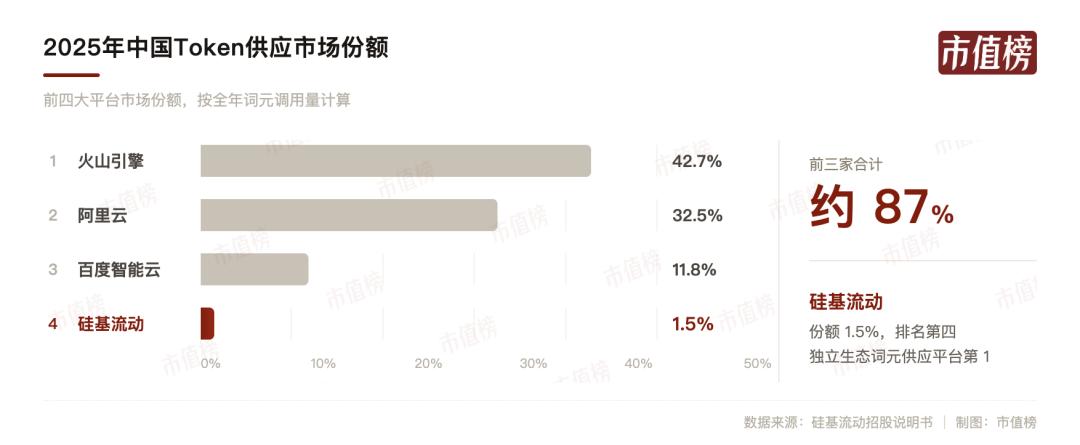
Large manufacturers not only own computing power and model resources, but also have a large number of enterprise customers, and can drive other cloud businesses through Token services. Independent service providers need to find profit between the computing power procurement cost and the selling price acceptable to customers.
Moreover, independent service providers have very limited pricing power.
Take open-source models such as DeepSeek and Qwen as examples. Enterprises can either buy the official API, or choose cloud vendors or third-party platforms. The same model has multiple suppliers, and customers can directly compare prices, response speed and stability.
This also means that even if independent service providers reduce inference costs through technical optimization, they may not be able to convert all the saved expenses into profits. To win customers, they may need to further lower their selling prices.
Wuwen Xinqiong is trying to obtain larger profit margins by improving inference efficiency. The company disclosed that its inference cost has dropped by about 90% over the past year, and from December 2025 to July 2026, the daily Token call volume of its Agentic MaaS platform increased by about 40 times.
However, Wuwen Xinqiong has not yet released its complete financial statements, and it is impossible to judge how much revenue and profit the growth of call volume and the decline of inference cost can bring at present.
The three companies are facing different tests. Silicon Flow has formed a certain scale of Token calls, but it needs to improve the gross profit margin of its public cloud business; Jiuzhang Yunji is trying to convert its existing computing power resources into continuous revenue; Wuwen Xinqiong needs to prove that technical optimization can be translated into actual profitability.
For these third-party service providers, Token call volume is only part of the business scale. The cost of producing Tokens and the price at which they can be sold determine how much money they can retain in the end.
03 In the Token business, who can hold the customers?
For independent Token service providers, in addition to technology and cost, there is another realistic problem: how to get more enterprise orders?
At present, a large number of enterprises have already purchased computing power, storage and databases on platforms such as Alibaba Cloud and Volcano Engine. For these enterprises, purchasing model services through their original cloud platforms allows them to continue using existing procurement contracts, settlement systems and technical environments.
This gives large cloud vendors natural channel advantages in Token sales. Even model vendors have begun to sell Tokens through cloud platforms.
On October 21, OpenAI announced a cooperation with Google Cloud, planning to sell its large models and Codex programming agents through the latter. Enterprises can directly purchase OpenAI's services through Google Cloud and settle with their existing cloud service procurement quotas.
The two companies compete in the AI field, but choose to cooperate in model sales.
This is not an isolated case. Reuters previously cited Anthropic's listing application documents and disclosed that in 2025, 47% of Anthropic's revenue came from sales completed through Amazon and Google cloud platforms.
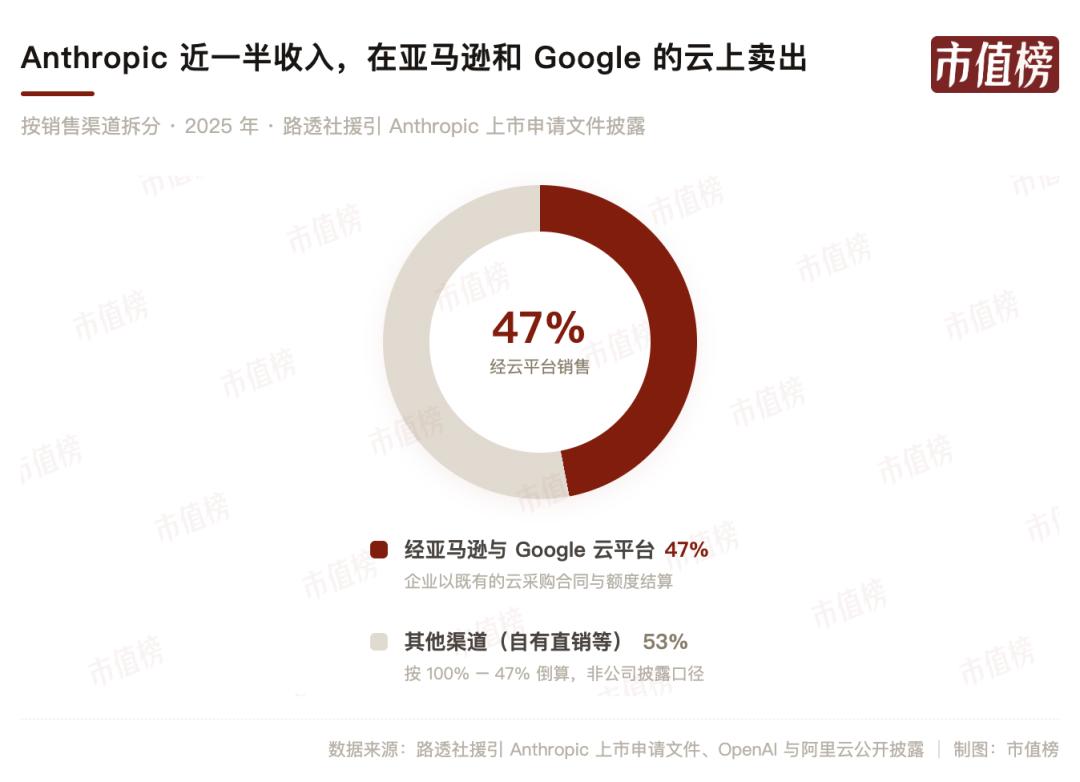
For model vendors, cloud platforms have mature enterprise sales channels that can help them reach more customers. Then, as the cooperation between model vendors and large cloud platforms gets closer and closer, how much room is left for independent third-party companies such as Silicon Flow, Jiuzhang Yunji and Wuwen Xinqiong?
Some companies choose to join the sales system of large manufacturers.
In June 2025, Silicon Flow reached a strategic cooperation with Alibaba Cloud, joined Alibaba Cloud's "Blossom Plan", settled in Alibaba Cloud Marketplace, and connected SiliconCloud to the Bailian platform. With the help of Alibaba Cloud's existing enterprise customers and sales network, Silicon Flow has the opportunity to expand the coverage of its own model inference services.
However, if customers mainly purchase services through cloud platforms, how many customer relationships can independent suppliers hold, and how much bargaining power can they retain in transactions?
In addition to leveraging the channels of large manufacturers, independent companies are also looking for other customer sources.
In May this year, Wuwen Xinqiong cooperated with Kewell Data and many domestic chip manufacturers to launch an enterprise-level Token Factory all-in-one solution. Through cooperation with hardware and infrastructure manufacturers, Wuwen Xinqiong can integrate inference software and computing power scheduling capabilities into the systems purchased by enterprises.
Jiuzhang Yunji relies on the customers accumulated from its past intelligent computing infrastructure business to further promote its intelligent computing cloud and Token services. However, enterprises that have purchased intelligent computing infrastructure may not continue to buy model inference services, and there is currently a lack of data to support how many existing customers can be converted.
Each of these models has its own advantages and disadvantages.
Leveraging cloud vendors and hardware partners can reduce the difficulty of entering the enterprise market, but it also means relying on the sales system of partners; operating enterprise customers directly requires bearing the costs of customer acquisition, technical support and long-term maintenance.
For independent service providers, having inference technology and computing power resources is not enough to guarantee long-term orders. As the cooperation between model vendors and large cloud platforms gets closer and closer, it is not easy for independent companies to fight for more customers and revenue in this track.