Why have smart wearables collectively become "jewelry-ized"?
Seventy thousand years ago, when humans had not invented the wheel or writing, they had already learned to string shells together and hang them around their necks.
That is the earliest "wearable device" we can find. It solves no practical problems, and only answers one question: Who am I, and where do I belong?
Seventy thousand years later, the core of the objects we wear on our bodies has changed. Sensors are embedded into rings, earrings and necklaces. The shipment volume of smart rings surged from 850,000 units in 2023 to about 4 million units in 2025, and is expected to reach 6 million units in 2026, making it the fastest-growing wearable category.
Smart wearables used to be a mature industry so stable that it was almost boring, with established players and fixed gameplay focused on watches, bands and health monitoring. What breaks the status quo is a seemingly "off-track" shift.
Hardware companies have collectively started to pursue aesthetics.
For many years in the past, they were eager to show off their high-tech attributes: rubber materials, black color schemes and LED lights were the standard profile of wearable devices in that era, a straightforward aesthetic full of "tool sense".
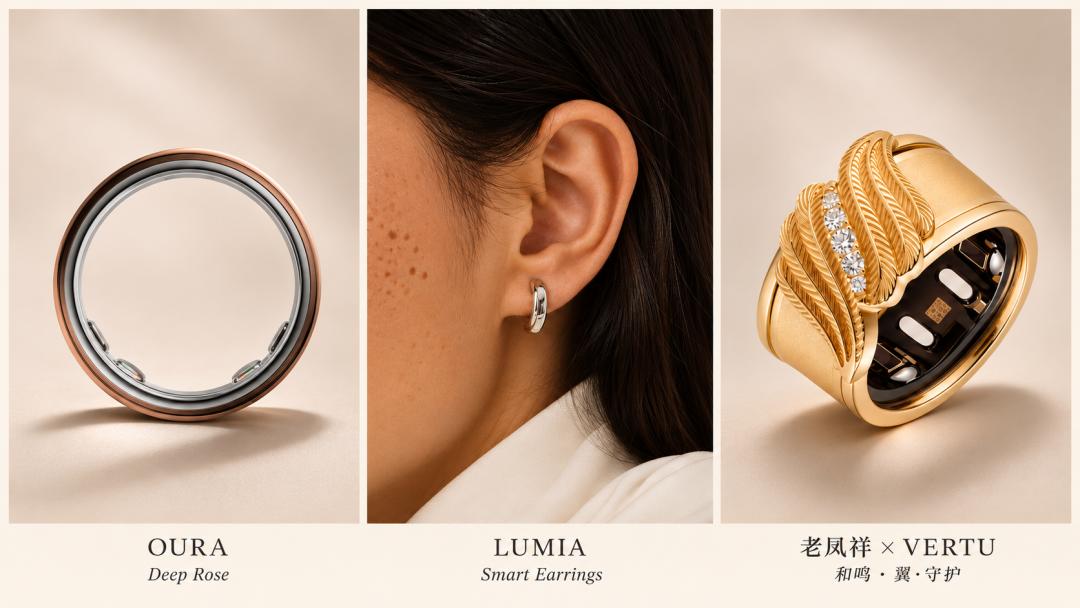
Nowadays, this profile is becoming softer. Oura polished its originally tech-heavy titanium alloy ring to create a smooth domed curved surface, and added a new copper-toned rose gold colorway that refracts the luster of high-end jewelry under light. It evolved from an engineering-style ring to a "jewelry-like" ring. Relying on this "unobtrusive beauty", it has sold a total of 5.5 million units, its paid membership doubled to 5 million within a year, and its valuation exceeded 10 billion US dollars.
Then the trend spread: necklaces, pendants, bracelets and earrings emerged in various forms within a year, and cold circuit boards began to be sealed in crystal resin, warm ceramics and woven chains. Dreame, a company that makes sweeping robots, took out a ring at its press conference, showing off its soft-glowing water-drop shape, and positioned it directly as "a high-end fashion jewelry ring"; even earlobes have become a new measurement site, Lumia integrated health monitoring into one of the world's smallest earrings, which looks like a geometric pendant inlaid with mother-of-pearl. Precious metals have also entered the market directly: the co-branded gold ring of Laofengxiang and VERTU uses traditional ancient gold craftsmanship to wrap the originally prominent optical sensor tightly.
Why did tech companies suddenly start focusing on appearance?
Interpreting this as a decoration beyond functions may underestimate this change.
For smart wearables to reach a broader crowd, it is necessary to re-understand demands and change the form that carries these demands. The jewelry-oriented trend provides an exploration, which increases the reasons for users to choose the products, and allows the devices to enter more existing wearable scenarios.
01 Form Achievements: The Pre-iPhone Moment of Wearable Devices
Behind this "aesthetic movement" is the anxiety about the incremental market. Taking the wrist-worn market as an example, statistics from Counterpoint show that the global smartwatch shipment in the second quarter of 2026 fell by 4% year-on-year, marking the first negative growth within the year. IDC's statistics on China's wrist-worn market also dropped by 4.3% in the same period.
Up to now, the smart wearable industry has achieved extremely high penetration among geeks and early adopters. What manufacturers need to do is not only to serve existing users well, but also to convince the next batch of users to make purchases.
More accurate monitoring and more complete data can deepen the existing use value, but may not impress those who have not made purchases yet. Some of them have unmet functional demands, while others recognize the usefulness of the devices but do not like the way they look on themselves. This is also the most intractable problem for smart wearables: how to make consumers voluntarily wear them continuously instead of locking them in drawers.
The voice of the demand side has spurred the shift of the supply side.
In the past, diverse forms competed for entry points to enhance the "must-buy" attribute brought by functional improvement. After functions gradually converged with technological advancement, appearance has come to the forefront.
The mobile phone industry has already gone through this plot. In the early days of smartphones, after functions of various brands converged, they collectively focused on form innovation, launching rotating screens, sliding covers and full keyboards, until the iPhone unified the form with a full-front screen design, and the competition returned to systems and functions. While the internal structure and interaction paradigm gradually converged, the design, customization and accessory ecosystem centered on personal style continued to diverge. Functional convergence spawns form experiments, and after form converges, the focus returns to functions.
Smart wearables are standing in the first half of this cycle, its pre-iPhone moment.
The current scattered forms of smart wearables are not chaos, but trial and error. There is no standard answer, and every route has its followers: rings bet on unobtrusiveness, pendants bet on companionship, glasses bet on entry points, and earrings bet on clean signals. More participants are still joining this track, and no one knows which route can survive until the day of form convergence. What is certain is that before convergence, all players must first prove that their products are wearable on the body.
Connecting the scattered industry news of the past year, we can see the full picture of this trial and error. The co-branded smart glasses of Gucci and Google are scheduled for 2027, Totwoo proved that wearables for emotional demands have long had a market with a 39.8% repurchase rate. Even Cece, which has been engaged in emotional companionship for more than ten years, has placed its bet on this track. Levi, the product lead of its first AI emotional smart ring, told AI Wuzao that they want to turn the companionship stored in mobile phones into a form that users can wear with them, and the first landing point is the ring. TAG Heuer quietly shut down its smartwatch product line that had burned hundreds of millions of euros and failed to make profits for ten years.
Those who enter and those who exit take opposite actions, but move in the same direction: they are all redefining the value of the things worn on the body.
However, explaining all this as manufacturers actively seeking increments still misses half of the truth.
Consumers are also participating in defining the appearance of the devices through spontaneous modification, customization and matching, turning standardized products into wearable items that better fit their own style. This demand is not limited to good looks. Comfort, low interference and easy maintenance also affect people's willingness to wear them for a long time. Consumers hope that the devices can keep up with their lives, meet their aesthetic standards at the same time, and do not need to continuously adjust their original habits just to use the devices.
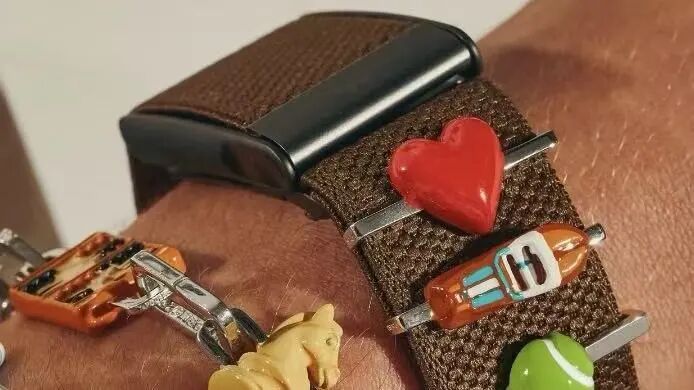
Behind this trial and error are two forces moving towards each other. Enterprises are looking for new users outward, and users are also correcting manufacturers' imagination of wearable products through their own choices and modifications.
The jewelry-oriented trend is not a one-time appearance upgrade, but a product exploration for smart wearables to expand the market. It aims to open up the unconnected gap between functional demands and willingness to wear.
02 Three Boundary Dissolutions, One Circle Breakthrough
Why can the jewelry-oriented trend help wearable devices reach a broader crowd?
The answer lies at the boundaries: several boundaries that used to be disconnected from each other are being dissolved in products one by one.
The first is the dissolution of crowd boundaries.
The base of wearable devices is a small circle of people who pay attention to health data, including heart rate, blood oxygen and sleep staging. The number of people who really care about these data is not as large as the industry imagines.
The jewelry-oriented trend tries to attract another group of people: those who pay for good looks, emotions and identity. A 2024 survey by Statista shows that 67% of women list appearance design as the primary factor when purchasing smart wearables.
Of course, these demands can also exist in the same person. Levi, the product lead of Cece's smart ring, told AI Wuzao, "The team wants to serve women who are willing to exercise, maintain health and dress up, and are curious about their own bodies besides work and study." In this user profile, interest in technology is no longer the only clue to understand consumers.
What the jewelry-oriented trend loosens is exactly the preset of potential users for tech products. A person does not need to be interested in technology first, and can find the connection between the product and themselves based on their familiar consumption experience. The wall built by product image between tech users and beauty-loving crowds has begun to show channels.
Looking further at the supply side, the barriers between technology and aesthetics are also loosening.
In the past, technology took function as its belief, while jewelry took beauty as its standard. The two sets of discourses were disconnected: engineers decided what products looked like, and aesthetics was only the last packaging before launch.
After the jewelry-oriented transformation, the same product needs to pass two sets of inspections at the same time: engineers are responsible for the accuracy of sensors, and aesthetics is responsible for the willingness of users to wear it out.
During the development of Oura's 5th generation ring, the team first determined the most elegant, most jewelry-like width, and then reversed the design of the battery and internal architecture. The size acceptable to the human body began to dictate how the technology is arranged.
Apart from size, shape and material will also change the internal design. Lyu Wei, founder of Nirva, said that the team adheres to the integrated forming appearance without any parting seams, so components need to be installed into the slender arc tube from one side, and the metal shell also increases the difficulty of antenna design.
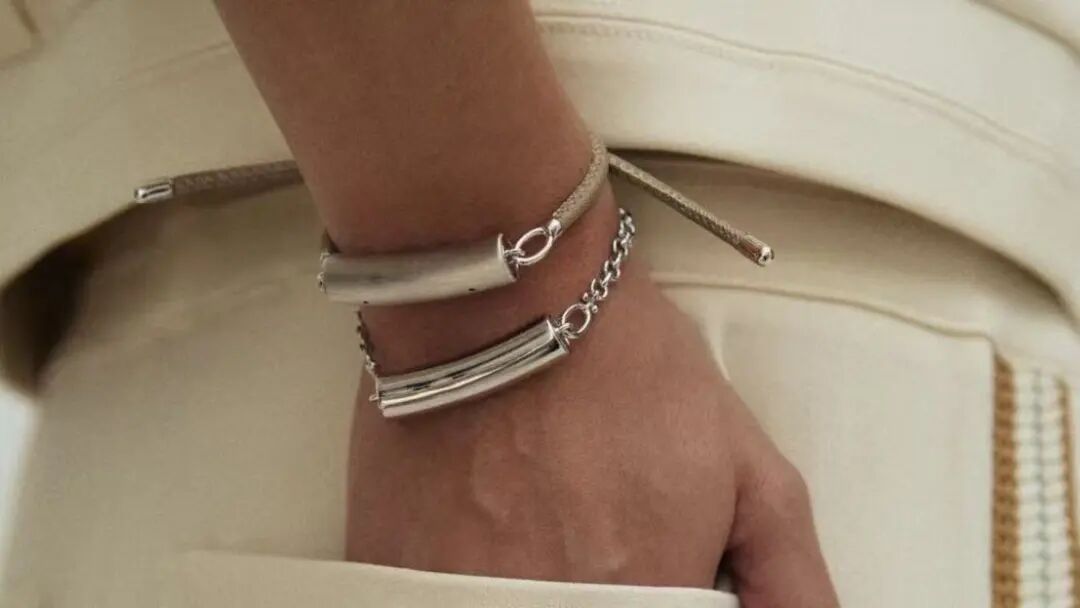
The more seamless the outside looks, the more reorganization is required inside. A curve, a joint, a kind of material may affect components, structure and manufacturing. "Good appearance" itself becomes an engineering problem, parameters are hidden in the style, and the process of hiding them also changes the technology.
Engineers and designers began to participate in product definition together. The boundary between technology and aesthetics has thus changed from a sequential division of labor in the development process to mutual shaping in R&D.
There is another boundary hidden in the user's daily wearable ecosystem.
Wrists, fingers and necks are not empty positions waiting for electronic devices to enter, where there are already jewelry, habits and commemorative meanings. People can of course wear a watch and a bracelet at the same time, but they still need to make trade-offs in matching, weight and comfort. The two-in-one design provides another possibility, allowing one wear to carry more demands.
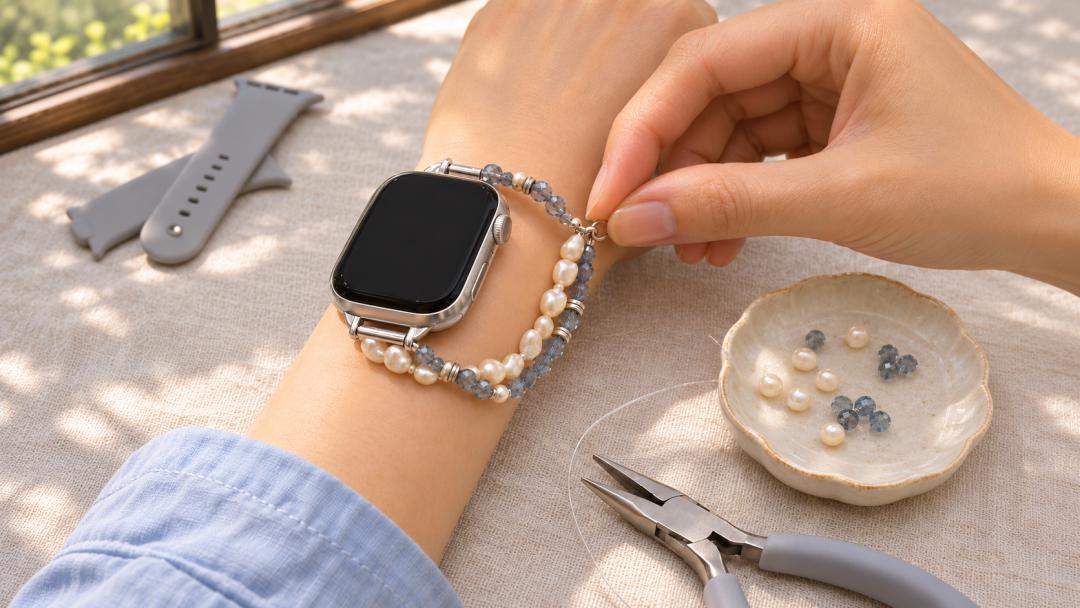
On e-commerce and social platforms, small shops that make watch bands for smart watches with crystals, jade and beaded strings, and users' DIY sharing have turned this possibility into a specific wearable way.
"BeadsDance", which makes jewelry watch bands for Apple Watch, is one of them. The store owner told AI Wuzao, "Some customers are attracted by the combination of beaded bracelets and watches, thinking it is a practical ornament, while others are interested in DIY by themselves." This kind of transformation turns users' wearable preferences into specific supply, so that the same device can retain its functions and get new matching options.
Manufacturers are also receiving this signal. Joel Lessard, head of accessories and apparel business at WHOOP, mentioned that users hope that the watch bands can match jewelry, watches and suits. In response to these demands, LeatherLuxe replaced the sport fabric with Italian leather, and provided styles with gradually narrowing bands, allowing the same sensor to have a wearable way suitable for formal outfits.
Manufacturers are actively seeking breakthroughs beyond their original circles, and also passively responding to such breakthroughs. After this boundary loosens, functions and decorations do not need to occupy separate positions, and the devices have the opportunity to integrate into the original wearable choices instead of being an extra item added.
Behind the three boundaries is the most fundamental tension of this category. Wearable devices face two relationships at the same time: inward, they contact the body to obtain data; outward, they enter the sight of others. Continuous monitoring requires them to be close to the body for a long time, making people forget their existence as much as possible; but an item worn on the body may gain value because it is seen and recognized by others.
WHOOP demonstrated with a screen-free fabric wristband that presence can also be a social business card. From professional athletes to tech executives, it does not need to show specific indicators, but allows people familiar with it to read the emphasis on self-discipline, training and recovery. The data stays in the mobile phone, and the wristband turns "I am a person who seriously manages my body" into a recognizable image.
Jean Baudrillard wrote in *The System of Objects*: "To become an object of consumption, the object must become a symbol." The meaning of objects thus goes beyond their use value, participating in the distinction between people and group identity. Wearable devices have long had such symbolic meaning, and the jewelry-oriented trend further enriches their expression: besides health management, taste, relationships and commemoration can also become the meaning of wearing them.
"Too strong presence" therefore needs to be re-deconstructed. The burden on the body, the disturbance brought by the screen and reminders still need to be reduced; while the meaning carried when recognized by others can be accumulated.
What the jewelry-oriented trend wants to dilute is the sense of device that needs to be accommodated, and what it hopes to establish is the sense of identity recognized by the wearer.
These changes expand the reasons for users to choose products, and also increase the requirements that enterprises must fulfill at the same time. The space for breaking through the original circles opens up, and the cost of trial and error also rises accordingly.
03 An Experiment with Extremely High Trial and Error Cost
The breakthrough beyond the original circle is established, and so is its strategic significance: users will wear the product for a longer time, and subscriptions will be renewed for one more month.
However, the richer the choices are, the more accurately enterprises need to judge the intersection of functions and aesthetics, and control the increased development, inventory and iteration costs. The jewelry-oriented trend is an experiment with extremely high trial and error cost, and there is more than one bill to pay.
The first account to calculate is the psychological account. Buying jewelry and buying devices are two different mentalities: the former pays for emotion and identity, while the latter pays for functions and parameters. These two mentalities do not necessarily exist in the same person.
People who pay for good looks may not need monitoring, and people who pay for monitoring may not care about appearance. If the two mentalities cannot be captured by the same product, the product will fail on both sides.
What is more tricky is that the decision-making paths are completely different: one group reads reviews, compares parameters and waits for promotions, while the other group makes decisions based on first impression, focuses on matching and pays on impulse. A company that needs to master two sets of marketing languages at the same time is essentially taking a re-examination of its organizational capabilities.
Miscalculating the psychological account will lead to loss of marketing expenses; miscalculating the supply chain account will lead to loss of cash flow.
In the past, smart hardware products could succeed with one production line and two colorways, with low mold opening cost and controllable inventory.
After the jewelry-oriented transformation, materials, styles