After waiting for half a year, the prices of computers during the Double 11 shopping festival are even higher than those during the 618 shopping festival, and the "wait-for-better-deals group" has lost again.
Double 11 is usually the time when many people snap up computers at the expected bottom price. But this year, consumers who have been waiting for price cuts have held out since the 618 Shopping Festival, only to find that the quotations during this year's Double 11 are even higher than they were half a year ago.
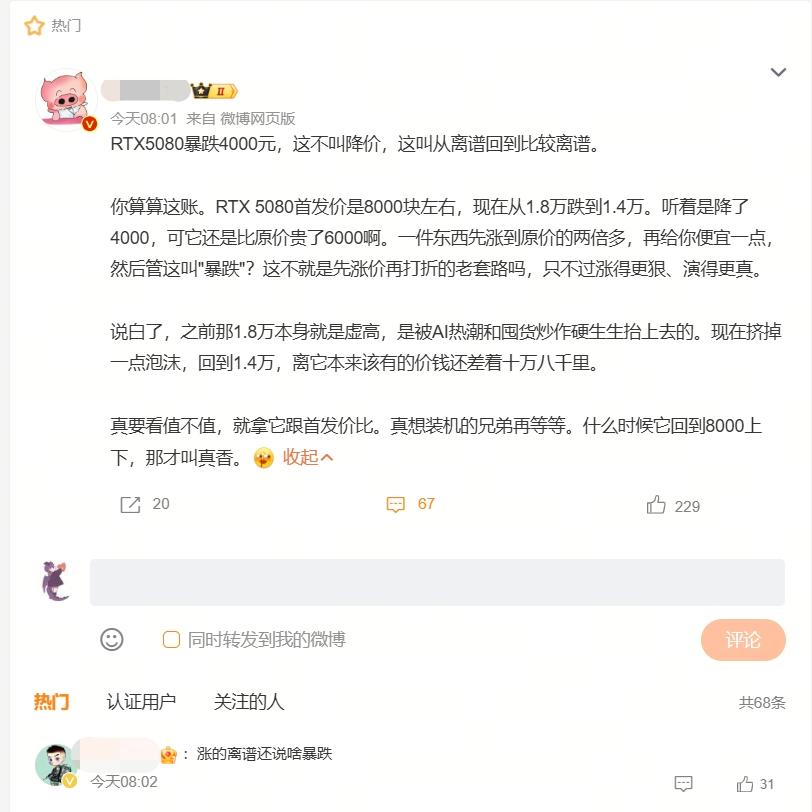
On November 10, a reporter from Time Weekly noticed that the quotation of NVIDIA RTX5080 at Huaqiangbei in Shenzhen dropped from about 18,000 yuan to 14,000 yuan, a direct cut of 4,000 yuan, which quickly became a trending search. But a closer look shows that the launch price of this graphics card was only 8299 yuan. Even after the 4000-yuan drop, the transaction price is still nearly twice the launch price — this so-called "price plunge" is essentially a false slump. Many netizens said they would remain on the sidelines, and almost thought they could afford it... What is more frustrating is that while the price of graphics cards has dropped, the price of complete computers has not.
This means that people waiting to buy computers at the bottom price from the 618 Shopping Festival to Double 11 have seen the quotations rise instead of fall.
Based on relevant data from online and offline channels, the PC category this year presents a status of "declining sales volume and rising price".
According to the latest data released by RUNTO on November 11, in the third quarter of 2026, the sales volume of China's notebook computer market across all online platforms reached 3.12 million units, down 14.0% year on year; the sales revenue was 24.1 billion yuan, down 2.6% year on year. The full-year forecast is adjusted down to 12 million units, with a year-on-year decrease of 10.7%. The average selling price on mainstream e-commerce platforms in this quarter was 7759 yuan, up 13.4% year on year. The sales share of the 4000–5999 yuan price range increased by 9.9 percentage points year on year to 30.4%, which has become the largest core price range at present; the sales volume of the market segment above 10,000 yuan increased by 85% year on year, marking the highest growth rate. The sales share of entry-level price ranges such as 0–1999 yuan and 2000–3999 yuan dropped by 1.9 and 8.0 percentage points year on year respectively to 1.3% and 8.6%. It is worth noting that this has been the fourth consecutive quarter of year-on-year decline in the notebook computer market since the fourth quarter of 2025.
In interviews, a number of industry insiders told reporters that behind the above phenomenon, the essence is that the continuously growing AI demand has "taken up" the production capacity of core PC components such as memory and solid-state drives, which pushes up costs and forces the prices of complete machines to rise. In addition, the phase-out of national subsidies has led some price-sensitive buyers to choose to wait and see, and such market trend will continue during this year's Double 11.
At present, in the face of the sluggish market, many brands have actively started to seek new development paths. Some brands have appropriately cut low-end products, and placed bets on high-end price ranges and AI PC products.
Computers are more expensive this Double 11
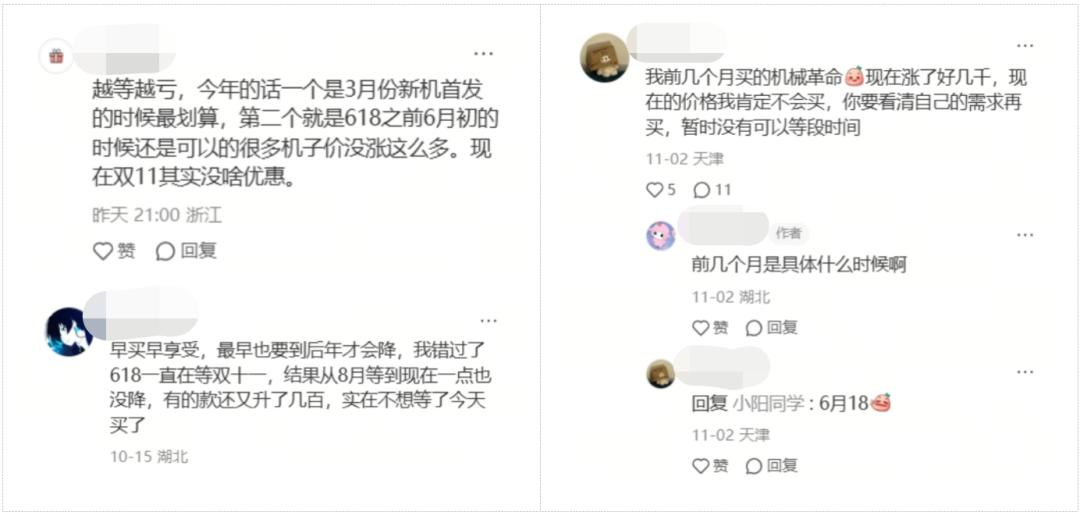
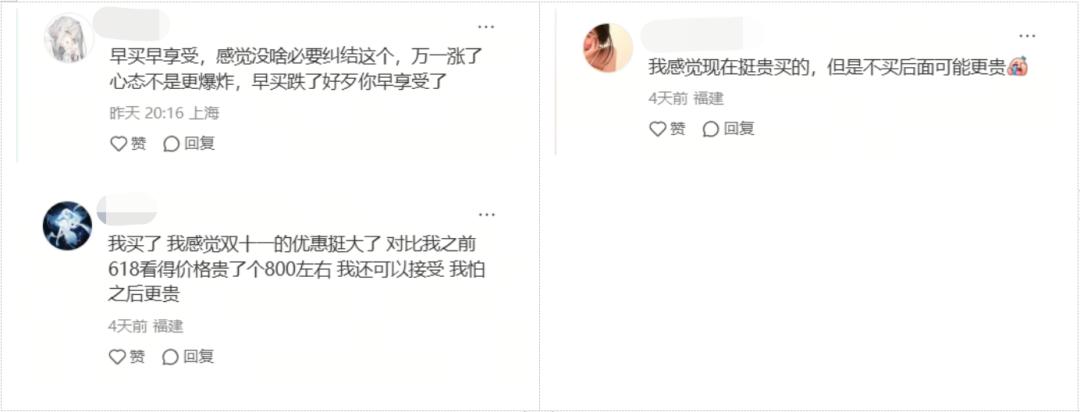
The reporter noticed that more and more people on social media are discussing the price increase of new computers. Some netizens complained that they have waited since the 618 Shopping Festival, only to find no price cut, and some models even rose by hundreds of yuan. They could not hold on any longer and placed orders on the very first day of this year's Double 11 pre-sale. More people are caught in the dilemma of "buy or wait": they think it is too expensive to buy now, but are afraid that the price will be higher later if they do not buy, so they have to comfort themselves with the saying "the earlier you buy, the earlier you enjoy".
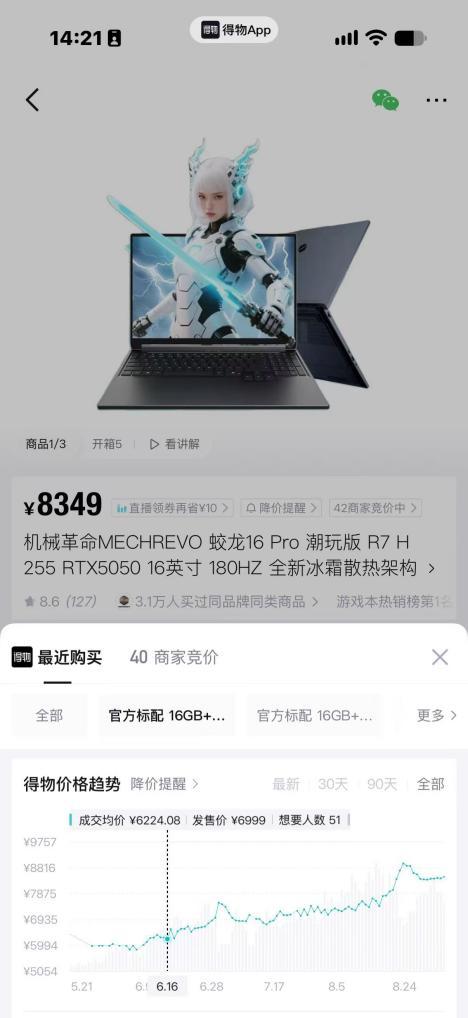
This situation is not an isolated case. The reporter found on the Dewu App that during this year's 618 Shopping Festival, the average in-platform transaction price of the popular gaming laptop Mechanical Revolution Jiaolong 16Pro was 6224.08 yuan. On the eve of Double 11, the average transaction price has risen to 8349 yuan. In just half a year, the average transaction price of the same computer increased by 2124.92 yuan, with a growth rate of about 34.1%. This is the actual money consumers paid after deducting national subsidies, platform coupons and interest-free installments.
Not only Mechanical Revolution, two other popular gaming laptops, Lenovo Legion R7000P and HP Omen 11, have also seen similar situations. Compared with the 618 Shopping Festival, their average transaction prices during this year's Double 11 increased by 2369.6 yuan and 2531.67 yuan respectively, with growth rates of around 30%.
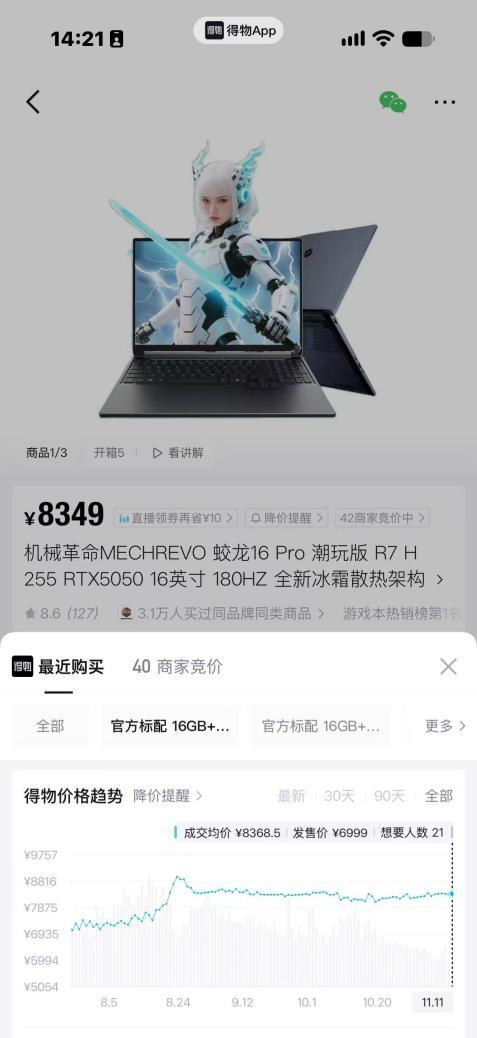
In fact, the price change of high-end computers this year is more obvious.
Recently, the price of Apple's new MacBook Pro has sparked heated discussions. Some netizens calculated that if all configurations are maxed out, the price of the 16-inch version is close to 120,000 yuan. Although the top-equipped model does not represent the purchase cost of ordinary consumers, it has once again drawn public attention to the topic of rising computer prices.

It is worth noting that while many brands are betting on the high-end market, they are also promoting AIPC products during this year's Double 11. For example, the livestream room of Li Jiaqi, who used to focus on beauty products, has put three AI computers with built-in Qanyun office software on the shelves: Lecoo Air, MACHENIKE Light 16S Youth Edition and Lenovo Zhaoyang Yue Plus, with prices ranging from 3000 to 10000 yuan. Many people placed orders decisively for the selling point of "AI empowerment". The data from RUNTO also shows that in the third quarter of this year, the sales volume share of AI PC reached 48.7%, showing a clear upward trend.
In fact, news of computer manufacturers adjusting prices has been coming out continuously since the beginning of this year. Starting from April this year, Microsoft, Lenovo, HP and Dell collectively raised their prices, with a general industry increase of around 8%, and the price of popular models increased by more than 30%. At the same time, it is not only these popular models that have been on the market for a period of time that have raised prices, the starting price of new-generation computers has also increased.
Through the comparison function of the Dewu App, the reporter found that for the popular model Lenovo Xiaoxin Pro16, with the same configuration of 16-inch screen, 1TB storage and 120Hz high refresh rate, the official starting price was adjusted from 5499 yuan of the previous generation to 7499 yuan of this generation, an increase of about 36%.
What's more, some brands plan to raise prices after the end of Double 11. According to IT Home, Colorful officially announced that it will raise the guide price of its motherboards after November 11. This means that the bottom-buying day that consumers expected is turning into the starting line of price increases.
For consumers who originally planned to replace their computers during Double 11, even with platform discounts, the prices this year may not return to the level of the 618 Shopping Festival.
During the big promotion period, the reporter visited multiple digital malls in Shanghai and found that the purchase cost of computers this year has risen significantly compared with previous years, especially for accessories such as memory and hard drives. Even on Double 11, the selling prices of some popular models can hardly return to the level of the 618 Shopping Festival.
"In previous years, many consumers would wait for computer price cuts during Double 11, but the prices of many models have already risen this year. Although there are still promotional discounts on platforms, the final cost is not necessarily cheaper than that during the 618 Shopping Festival," a digital store owner surnamed Chen told the reporter. He also said that many consumers came to inquire about computer prices during this year's Double 11, and some postponed their purchases due to rising prices. In addition, many distributors mentioned that the prices of complete machines and components are still going up, and there is no sign of a pullback in the short term.
Is AI the driving force behind rising computer prices?
In fact, the current PC industrial chain is facing dual pressure from both sales volume and price. IDC data also confirms this point: global PC shipments in the third quarter of 2026 reached 62.7 million units, down 20.1% year on year; HP's shipments fell by 30.9%, Dell's by 25.0%, Lenovo's by 22.6%, and none of the top five vendors achieved growth.
Behind the rising computer prices is the continuous increase in the cost of core components such as memory and solid-state drives.
A report released by TrendForce in October shows that taking a mainstream laptop priced at about 6000 yuan as an example, in the third quarter of this year, the three components of processor, memory and solid-state drive already accounted for 68% of the total material cost of the complete machine, while this proportion was only 45% at the beginning of last year. As the previously purchased low-cost inventory is gradually consumed, computer manufacturers have to face higher production costs.
According to statistics from DRAMeXchange, a subsidiary of TrendForce, in October 2026, the average contract price of DDR 8Gb (1Gx8) reached 27.5 US dollars, up 5.77% month on month from 26 US dollars in September. For the fourth quarter, the institution still expects the contract price to maintain double-digit growth, and enterprise-level SSD has become the core category driving the expansion of this round of price increase.
In the view of Li Keyi, chief expert of Yuanhe Semiconductor Technology Co., Ltd., the source of the price increase is still in the upstream storage link. He said that this round of price increase is different from the periodic supply and demand fluctuations in the storage industry in the past. The real variable is the change in the production capacity allocation pattern: storage manufacturers prioritize advanced process production capacity for high-end computing power terminals, and the storage supply for consumer-grade PCs has tightened accordingly. Since 2026, the prices of consumer-grade memory and flash memory have continued to rise, the prices of mainstream specifications have increased significantly compared with the same period last year, and the prices of some models have doubled. The upward cost is transmitted level by level along the supply chain, and finally reflected in the rising pricing of gaming laptops and lightweight laptops.
During the transmission process, the pressure on each link of the industrial chain is not the same. Upstream storage manufacturers benefit from the tilt of production capacity to high-end computing power, achieving simultaneous increases in volume and price, and their performance is generally good. ODM (Original Design Manufacturer) foundries in the middle are squeezed from both ends: on the one hand, they have to lock the quotation of complete machines when material costs rise, on the other hand, they have to accept the price reduction demands from brand owners, so their OEM gross profit margin continues to narrow, and some enterprises turn to high-end model OEM or deploy their own brands. Small and medium-sized brands lack bargaining power in the supply chain, cannot obtain priority production capacity, and their procurement costs are higher than head manufacturers, so they can only choose between raising prices and losing sales, or not raising prices and losing profits. Offline channel dealers are facing both narrowing gross profit and diverting customer flow, so they are accelerating to seek profits from service-oriented businesses.
What makes consumers who plan to replace computers more worried is that the tight memory supply may last for several years. On October 28, SK Hynix, a major global memory chip manufacturer, revealed at its third quarter earnings conference that including the signed long-term supply agreements and the customer demands under negotiation, the company's DRAM and HBM supply for the next three years until 2029 has been basically sold out. SK Hynix also predicts that due to the continuous growth of AI demand and the long time required to build new factories and expand production capacity, the global memory chip supply shortage may last until 2030.
Not only SK Hynix, manufacturers such as Samsung and Micron also prioritize their advanced production capacity for HBM, server DDR5 and enterprise-level QLC SSD, so the supply of traditional consumer-grade DRAM and part of NAND is indirectly compressed.
This also makes many consumers wonder: will it be difficult for computers to become cheaper in the next few years?
Although the continuous tight memory supply may push up computer costs, it does not mean that computer prices will keep rising. The final terminal selling price in the future still depends on changes in supply and demand, manufacturer pricing and promotion intensity. At least for now, the past experience of waiting for promotion nodes such as 618 and Double 11 to buy computers at lower prices may not apply this year.
However, for consumers who do have the need to buy computers recently, there is no need to rush to place orders just for fear of future price increases. During this year's Double 11, major platforms still offer promotional discounts, and eligible consumers can also stack national subsidies. Taking Shanghai as an example, computers that meet policy requirements can enjoy a subsidy of 15% of the final selling price after deducting all links of discounts, with a maximum of 1500 yuan per unit, and consumers need to obtain subsidy qualifications in accordance with local regulations.
For consumers who plan to replace their computers this year, Double 11 may not bring the low price seen during the 618 Shopping Festival, but combining historical transaction prices, platform discounts and national subsidies, there is still a chance to reduce the actual purchase cost. For daily office work, study, audio and video entertainment, mainstream configurations are usually sufficient, there is no need to blindly pursue high-end graphics cards or large-capacity memory; if it is mainly used for scenarios such as games and video editing, you can choose the configuration according to the performance requirements of commonly used software.