Tencent quietly stepped into Baidu's backyard.
Everyone is fixated on the Agent battle, while Tencent has quietly stepped into Baidu's backyard.
On November 11, Tencent launched Yuanbao Search, an independent web page. Users do not need to download an app to search web pages, WeChat Official Accounts, WeChat Channels and academic literature, and can also get AI to organize answers.
This move is rather abnormal. While the whole industry is embedding search into chat boxes, Tencent has singled out search and moved it back to the browser.
This will directly impact Baidu's core business territory.
But what is more worth discussing is: when AI starts to take over information acquisition, why has search, this old entry point, become important again?
The demand for search has not disappeared
Let's first look at a set of easily overlooked facts.
As of December 2025, the number of Chinese search engine users reached 782 million, accounting for 69.5% of all internet users. Although this figure has decreased from 878 million at the end of 2024, search is still an internet market with hundreds of millions of users.
A seemingly traditional entry point still carries a wide range of user demands. This is the market background for Tencent to re-enter the search track.
But the question is, why is Yuanbao the one to take on this task?
In its early days, Yuanbao existed as an important bargaining chip for Tencent to compete for the AI entry point. Since this year, the advancement of WorkBuddy has extended the focus of competition from AI assistants to office work, knowledge management and Agent execution.
But Agent has a practical threshold: users will only think of it when they have a task to complete.
More often than not, people just want to know a fact, figure out a problem, or find a piece of material. Checking the weather, learning about a company, verifying a piece of news — these demands arise every day, and users already know exactly where to go to get them solved.
The value of search lies precisely in this kind of daily scenario.
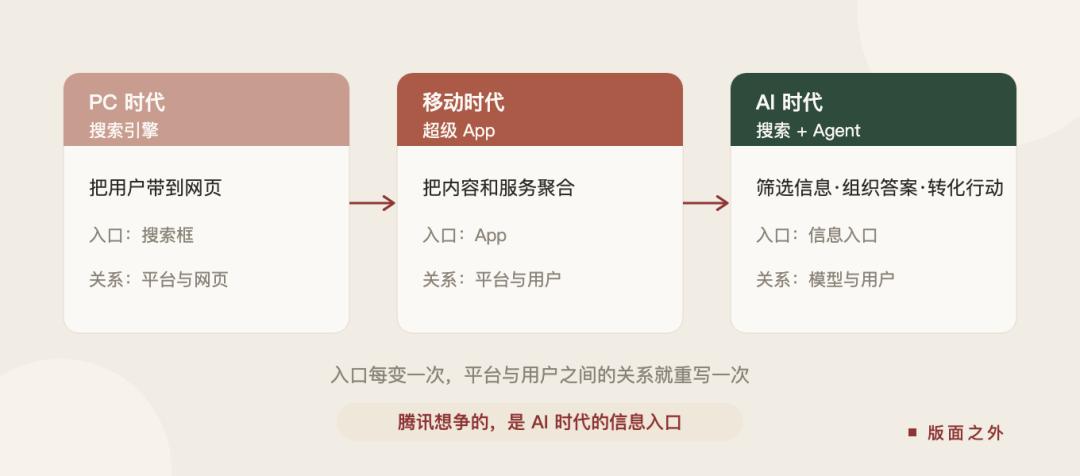
For Yuanbao, chat and Agent have expanded its capability boundary, while search provides a more easily triggered usage scenario.
This is also why the independent web entry point deserves attention.
If search is only a function in the Yuanbao app, it will first serve users who have already opened Yuanbao; by launching an independent web page that users can directly access from the browser, the scope of competition is expanded accordingly.
People who have not installed Yuanbao but have search habits will also have the chance to become its users.
What Tencent wants to achieve is that Yuanbao does not have to wait for users to think of AI before being opened. As long as users have the need to find information, they will have the chance to enter its entry point.
However, the search market is not a blank field.
Baidu has been operating in this sector for more than 20 years, and has long turned search into a huge business.
When Tencent re-enters the market at this moment, the first problem it faces is: now that Baidu has integrated AI into search, how many opportunities do latecomers still have?
AI search rewrites the traffic business
No one knows better than Baidu about the impact of AI on search.
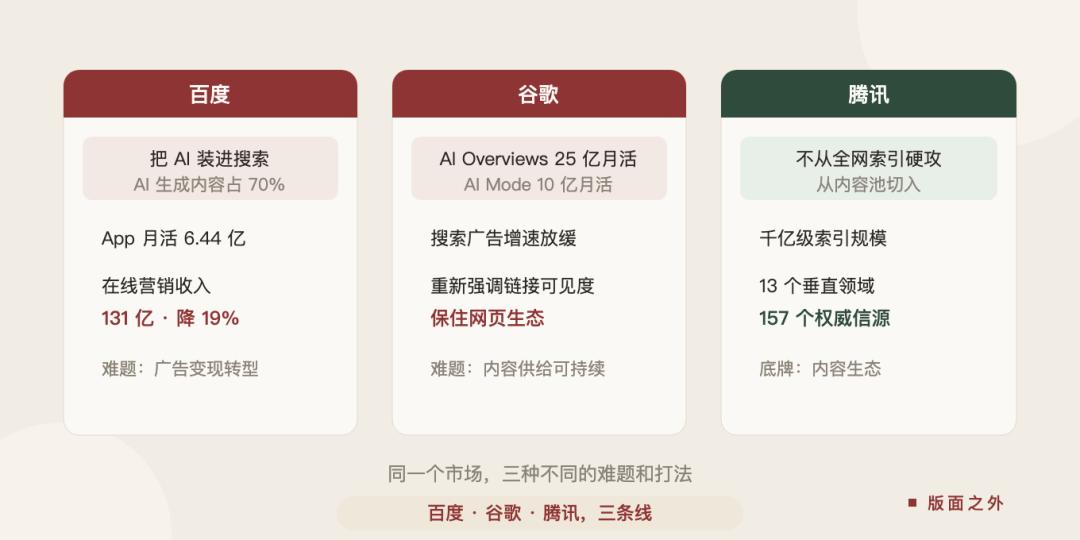
In 2025, Baidu accelerated the AI transformation of its search business. By July of that year, the proportion of AI-generated content in Baidu's mobile search result pages had reached 64%, and the figure further rose to around 70% in October.
The changes go far beyond the result pages.
Baidu upgraded its search box to an intelligent box that supports long-text and multi-modal input, expanded search results from traditional link lists to structured content including text, images, videos and files, and also connected to MCP services, allowing users to call external tools.
Search has started to handle more complex problems, and has also extended to task execution.
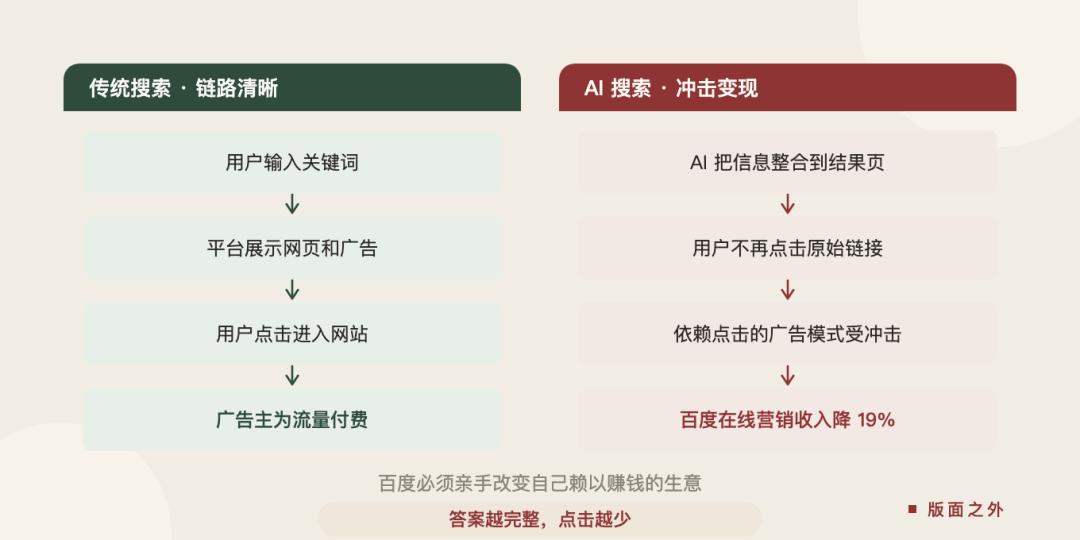
Statistics show that Baidu still has a huge user base. In the second quarter of 2026, the monthly active users of Baidu App reached 644 million. Web page indexes, search algorithms and user habits are all accumulations that latecomers can hardly replicate in a short period of time.
But Baidu faces an unavoidable contradiction: the more capable AI is of answering questions directly, the less necessary it is for users to click on links.
The commercial chain of traditional search is relatively clear. Users enter keywords, the platform displays web pages and advertisements, users click to enter the websites, and advertisers pay for the traffic. When AI integrates information into the result page, users may no longer open the original web pages, and the advertising model that used to rely on clicks will be impacted.
This is not a simple product upgrade issue, but a business that Baidu must personally transform, as it is the very foundation of its revenue.
In the second quarter of 2026, Baidu's online marketing revenue reached 13.1 billion yuan, down 19% year on year. Although this change is affected by multiple factors such as macro advertising demand and industry competition, and cannot be simply attributed to AI search, the pressure on the traditional advertising business has made the commercial pressure of search transformation more obvious.
Baidu must continue to promote AI search to retain users. But when the answers become more and more complete, whether advertisers pay for answer exposure, brand recommendation or external link clicks, the old monetization logic needs to be readjusted.
This is not a problem exclusive to Baidu. Google on the other side of the ocean is also experiencing similar changes.
Google wants to protect the web ecosystem
What has Google done to deal with this situation?
It first did the same thing as Baidu, adding AI summaries to search result pages.
After AI Overviews went online, Google launched AI Mode, allowing users to ask follow-up questions around a single problem. In June 2026, Google disclosed that AI Overviews had more than 2.5 billion monthly active users, and AI Mode had more than 1 billion monthly active users.
AI functions are driving the growth of search queries, and search usage has hit a record high. But the growth of user scale has not hidden the cracks in the business model.
In the third quarter of 2026, Google's search advertising revenue increased by 12% year on year to 63.4 billion US dollars, lower than market expectations, and significantly slower than the nearly 20% growth rate earlier this year.
Philipp Schindler, Google's Chief Business Officer, confessed on the earnings call that AI Mode is affecting the traditional search business, and the advertising monetization capability is being suppressed.
There is another very important difference between Google and Baidu.
What Baidu needs to solve first is how to transform its search advertising revenue, while what Google is facing is not only its own advertising business, but also the sustainability of the entire web ecosystem.
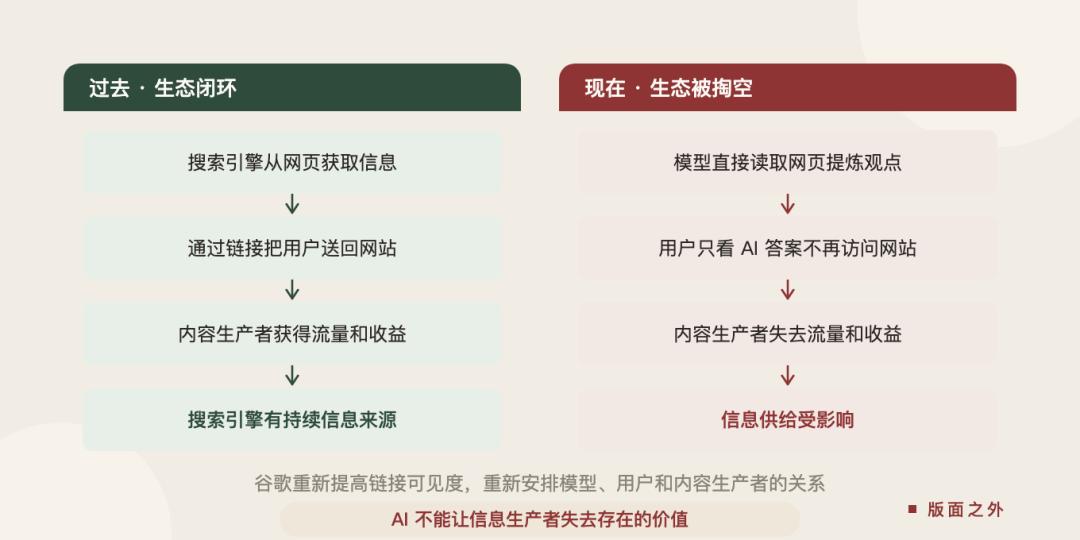
Google has long connected websites, news organizations, professional content producers and advertisers. Search engines obtain information from web pages on the one hand, and send users back to websites through links on the other. This mechanism allows content producers to get traffic, and also gives search engines a continuously updated source of information.
AI has changed this relationship.
Models can directly read web pages, extract viewpoints and organize answers. The efficiency for users to obtain information has improved, but if more and more people only read AI-generated answers and no longer visit the original websites, content producers will lose traffic and revenue.
In the short term, AI search keeps users on the platform for a longer time. In the long run, if content producers lose the motivation to keep creating, the information supply that search engines rely on to operate will also be affected.
What Google needs to solve is not just how to make money from AI answers, but also to prevent AI search from hollowing out the content ecosystem behind web pages.
It is against this background that Google has made a noteworthy adjustment.
On October 15, Google announced that it would adjust the presentation of AI Mode and AI Overviews, improve the visibility of web links in answers, and make important sources easier to be clicked.
A company that was working hard to make AI answer questions directly has begun to re-emphasize links.
This is not a simple return to traditional search. The value of links has changed. Previously, it was mainly responsible for bringing users to related web pages, but today it also undertakes the functions of marking information sources, verifying answers and maintaining content supply.
By improving the visibility of links again, Google is actually rearranging the relationship between models, users and content producers.
AI can organize information for users, but it cannot make content producers lose their value of existence.
And this points exactly to another card in Tencent's hand: content.
Tencent's hidden card is the content ecosystem
The content ecosystem is the most valuable card Tencent can play when re-entering the search market, and it is also an important resource that differentiates it from Baidu.
WeChat Official Accounts, WeChat Channels, and the information accumulated in various businesses over the years, which used to be scattered in different products, now have the chance to be reorganized by AI.
Besides, this is not Tencent's first attempt to enter the search market.
In 2006, Tencent launched Soso; in 2013, the Soso business was merged into Sogou, and later the search capability was gradually precipitated into products such as WeChat Search. In the era of traditional web search, Baidu had already accumulated a huge number of web indexes, algorithms and user habits, so it was difficult for Tencent to shake the market with only a search box.
This time when re-entering the market, Tencent has adopted a different strategy: instead of launching a head-on attack on the full-network index, it starts by tapping into its own richest content pool first.
In October 2026, Tencent Cloud has opened Yuanbao Search to enterprises and developers. This search system has a trillion-level index scale, with hundreds of millions of daily calls, supporting more than 50 businesses including WorkBuddy, ima, Tencent Financial Technology and Tencent Video, and has also connected 157 authoritative information sources in 13 vertical fields such as finance, healthcare, law and travel.
This means that before Yuanbao Search was launched for ordinary users, it had already run in multiple internal business scenarios of Tencent, accumulating technical and service capabilities.
But the content ecosystem card is attractive, yet it is not easy to play it well in practice.
The content of Official Accounts and Channels is huge in quantity, but uneven in quality. Research from professional institutions, experience from industry practitioners, personal opinions and marketing content may all appear around the same keyword.
A rigorous industry analysis and a plagiarized article from a marketing account may appear in adjacent search results. The more content there is, the heavier the responsibility of screening becomes.
Search will not get better just because there is more content; it may also amplify the chaos in the content together.
Another unavoidable problem is commercialization.
Li Ruizhang, product leader of Tencent Yuanbao Search web version, said in an interview with the media that Yuanbao Search does not reject ads, but users should not have to find answers in ads.
This statement actually touches the most sensitive boundary of AI search: when ads may also be integrated into answers by the model, the platform must keep a clear distinction between commercial information and natural information. Users can accept ads in search results, but it is difficult for them to accept that they cannot identify where the answers come from.
The content ecosystem gives it the bargaining chip to enter the market, but cannot directly win users for it.
What Tencent needs to prove in the end is the content quality of Yuanbao Search.
Search is not only an entry point, but also the foundation of Agent
The content ecosystem is Tencent's hidden card for re-entering the market, and the independent web page determines where to start competing for users.
But the value of search is not only about acquiring information. Without stable information retrieval capability, it is difficult for Agent to continuously complete tasks that require real-time information.
This is also why Tencent Cloud has previously opened Yuanbao Search to products such as WorkBuddy and ima. Search does not have to exist only as a function of Yuanbao, it can become a underlying capability that multiple Agents call together.
Looking at Tencent's product layout from this perspective, several lines are connected: Yuanbao targets individual users, WorkBuddy undertakes office tasks, ima handles knowledge management, the WeChat ecosystem provides content, and search provides information retrieval capability for all these products.
Externally, Yuanbao Search competes for user entry points, and internally, search becomes the infrastructure for Tencent's AI products to acquire information.
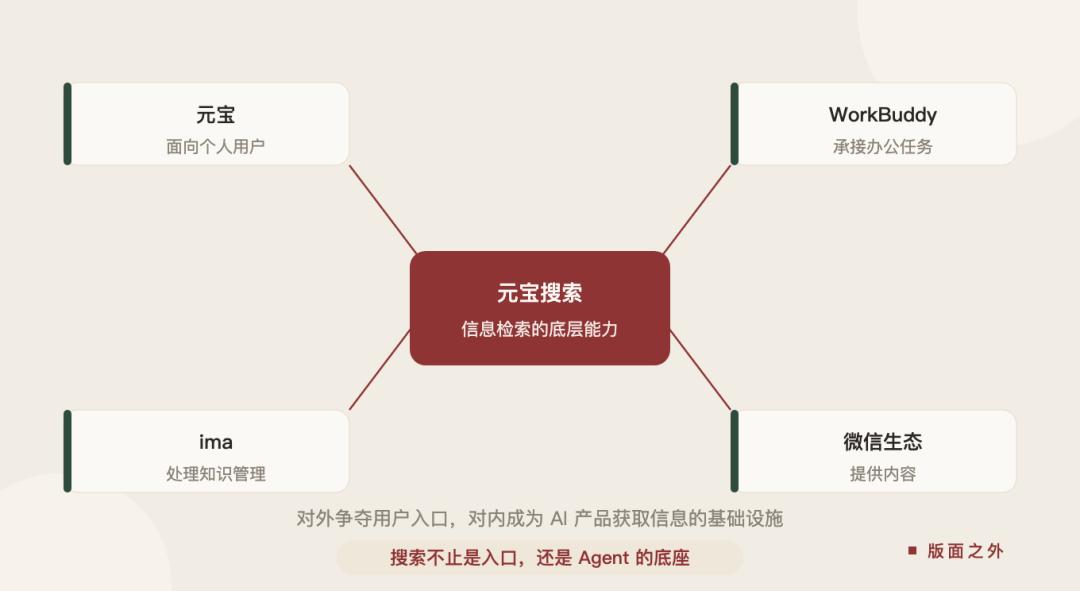
This also explains why Tencent made search an independent web page. It hopes to undertake users' most daily information demands, and also hopes to extend the search capability to more complex Agent tasks.
Looking back at the development of the internet, competition for entry points has been changing all the time