Sharp surge, domestic chips are experiencing collective explosive growth.
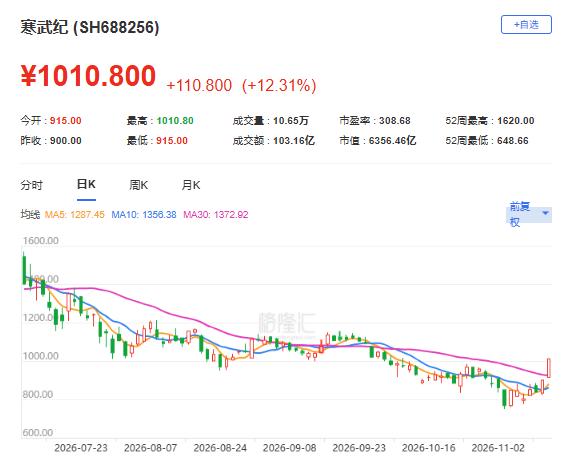
On the morning of November 12, the four leading domestic GPU enterprises saw a collective rally in intraday trading today. As of press time, Moore Threads rose 9.69%, Muxi Co., Ltd. rose 10.71%, Enflame Technology rose 16.78%, and Biren Technology rose 11%. As a standout player in domestic AI chips, Cambricon also rose nearly 12%.
The latest Q3 financial reports of the four enterprises were disclosed intensively in this round of market rally. Moore Threads recorded a total operating revenue of 3.289 billion yuan in the first three quarters, a year-on-year increase of 319.15%, and the attributable net profit reached 38 million yuan, successfully turning losses into profits.
In the single third quarter, Moore Threads achieved operating revenue of 1.552 billion yuan, a year-on-year increase of 1773.9%, and the non-recurring profit and loss deducted net profit was 20.0724 million yuan, one year ahead of the original profit target set for 2027.
The profit performance of Muxi Co., Ltd. is more stable. It achieved operating revenue of 2.824 billion yuan in the first three quarters, a year-on-year increase of 128.45%, and the attributable net profit reached 639 million yuan, a year-on-year increase of 284.94%.
In the single third quarter, Muxi Co., Ltd. realized operating revenue of 1.50 billion yuan, a year-on-year increase of 367.12%, and the non-recurring profit and loss deducted net profit reached 308 million yuan, while the figure was 54 million yuan in the second quarter.
Enflame Technology is still in the loss stage at present, but the loss margin continues to narrow. In the first three quarters, it achieved operating revenue of 2.332 billion yuan, a year-on-year increase of 331.74%, the attributable net loss was 754 million yuan, narrowing by 15.07% year-on-year, and the operating revenue in the single third quarter was 1.212 billion yuan, a year-on-year increase of 395.34%.
As a listed enterprise on the Sci-Tech Innovation Board in September, Enflame Technology saw a large opening price increase on its first trading day after listing. At present, the number of its tradable shares is 17.9 million, with a turnover rate of 11.06%, and its total market value has reached 239.2 billion yuan.
A horizontal comparison of the financial data of the four enterprises shows that their revenue growth rates are all maintained in the three-digit range of 128% to 332%, but there is a divergence in profit realization. Only Muxi and Moore Threads have achieved profits, while Enflame Technology is still absorbing R&D losses.
The overall prosperity of the industry has been verified in macro statistics. Data from Guojin Securities shows that the domestic computing power chip industry achieved operating revenue of 39.189 billion yuan in the first three quarters, a year-on-year increase of 74.71%, and the attributable net profit was 9.606 billion yuan, a year-on-year increase of 153.94%. The profit growth rate is significantly faster than the revenue growth rate.
The two leading enterprises in the industry support the overall scale. Cambricon achieved operating revenue of 9.526 billion yuan in the first three quarters, a year-on-year increase of 106.76%, the attributable net profit was 3.715 billion yuan, a year-on-year increase of 131.49%, the gross profit margin of the single quarter reached 58.69%, and the total market value was 631 billion yuan.
Hygon Information achieved operating revenue of 14.955 billion yuan in the first three quarters, a year-on-year increase of 57.58%, and the attributable net profit was recorded at 2.847 billion yuan, a year-on-year increase of 45.12%.
The external catalysts for the market trend mainly come from four aspects, among which the most concerned news broke last night. According to reports from The Wall Street Journal and Bloomberg, the NVIDIA board of directors is preparing to push forward the removal process of CEO Jensen Huang, has contacted external institutions to select successors, and considered appointing an interim CEO, with a meeting scheduled as early as Wednesday to make a decision.
The market reacted directly to this. NVIDIA's after-hours share price once fell 8% to 9%, and the cumulative decline in the first three trading days of this week was close to 7%. The White House stated that it will not interfere with the board's decision, and the company will release its quarterly financial report next week.
The core trigger of this incident lies in corporate governance issues rather than end-user computing power demand. According to The New York Times, Jensen Huang had an improper relationship with the vice president of the healthcare business who reports directly to him. The board of directors launched an independent investigation on November 8 and hired a law firm to intervene.
The core impact of this incident on the domestic chip industry chain lies in the improvement of order certainty. If NVIDIA falls into a management vacuum, its product roadmap and delivery rhythm for key customers will face uncertainties, cloud manufacturers will have a stronger willingness to disperse supply chain risks, and domestic computing power chips will gain support from expected differences as a result.
The second catalyst comes from Alibaba's spin-off move. On the evening of November 10, Alibaba announced that it has submitted an application to the Hong Kong Stock Exchange for the spin-off of T-Head for independent listing. T-Head has confidentially submitted its listing application on September 11, and will remain a subsidiary of Alibaba after listing.
The business fundamentals of T-Head show a certain scale. Its Zhenwu series AI chips have accumulated shipments of 560,000 units as of April, serving more than 650 enterprise customers, with external commercialization accounting for more than 60%, and annualized operating revenue exceeding 10 billion yuan. The Zhenwu V900 is scheduled to be mass-produced in the first quarter of 2027.
Industry share reference shows that according to IDC's statistics, in China's cloud AI accelerator shipments in 2025, Huawei ranks first with 812,000 units, T-Head ranks second with 265,000 units, Kunlunxin and Cambricon each have 116,000 units. Baidu's Kunlunxin has also submitted its listing application to the Hong Kong Stock Exchange and launched the tutoring process for listing on the Sci-Tech Innovation Board.
The third catalyst comes from changes in computing power rental prices. The overseas on-demand computing power index on November 10 shows that the price of B200 rose 1.9% to 6.97 US dollars per hour, and the price of H100 rose 1.7% to 3.06 US dollars, both hitting record highs.
The computing power supply side continues to be in a tight state. Emerging cloud manufacturers have 132.5 billion US dollars of orders in hand in the third quarter, and the deliverable capacity in 2027 has been basically sold out. The effective demand is about 10 times the supply in the same period, and the pricing of all SKUs continues to rise in the fourth quarter after multiple price increases within the year.
The price of existing computing power cards is also rising accordingly. The rent of Ampere and Hopper series increased by 30% to 50% month-on-month, and the price of old cards also increased, showing the tight supply feature of this cycle.
The fourth catalyst comes from the mapping of overseas markets. Micron Technology surged 11.89% overnight, Western Digital rose 13%, SK Hynix rose 5.36%, Kioxia rose 5.55%, AMD rose 7.32%, and TSMC rose 4.25%. The rally of the storage and computing power sectors provided a reference for the A-share market.
In addition, market news says that DeepSeek's next-generation model V5 is planned to be pre-trained based on domestic chips. If this path is implemented, domestic computing power will expand from the inference side to the training side, bringing greater marginal increment.
The NVIDIA board meeting is about to be held, and all the Q3 financial reports of the four leading GPU enterprises have been fully disclosed.
After the relatively sufficient risk release and correction in the early stage, the sector has ushered in an obvious oversold rebound recently. If the overall rebound of technology stocks can continue further, the chip sector with both industrial logic and fundamental support will most likely become the preferred position for capital allocation in the follow-up period.
This article is from the WeChat official account "Gelonghui APP" (ID: hkguruclub), written by Aragorn, and published with authorization from 36Kr.