The initial appraisal value is 3400 yuan, yet the actual buyback price is only 2400 yuan. Why does the quotation for a used iPhone change so drastically?
In October 2025, Mr. An from Dalian sent out an iPhone 15 Pro Max.
Before shipment, the recycling quotation given by the platform on the "Trade-In" page was 4488 yuan. Three days later, the mobile phone was placed on the quality inspection platform thousands of kilometers away, and the price dropped to 3017 yuan. The reason given in the test report was: obvious bumps, scratches and paint peeling.
Mr. An opened the photos in the report and could not find these "obvious" traces. He called to inquire, and the customer service asked him to zoom in on the photo, "There are two white spots on the right side of the button, which should be the lightened color caused by wear."
He zoomed in the photo enough to see the pixels, but still could not find the two white spots. So he requested to return the phone and cancel the order. After that, the platform took the initiative to contact him, and the quotation rose all the way from 3400 yuan, 3600 yuan to 4200 yuan. When he still insisted on returning the phone, the other party said that they could recycle it at the original price of 4488 yuan as initially offered.
On December 21, 2025, CCTV's Morning News covered this incident for more than six minutes, as well as an almost identical experience of Mr. Cao from Guangdong: the estimated price was 3810 yuan, while the quality inspection price was 2851 yuan. The data of the Black Cat Complaint Platform cited in the program shows that there are more than 32,000 complaints related to trade-in, of which more than 14,000 are about mobile phone recycling, and 90% are concentrated in the problem of "high estimated price but low acquisition price".
A few months later, the same industry released its performance report. On March 11, 2026, Aihuishou's parent company Reuse Group released its 2025 financial report: the annual revenue was 21.05 billion yuan, a year-on-year increase of 28.9%; the net profit was 336 million yuan, marking the first full-year profit under the GAAP caliber since its listing four years ago. In the second quarter of 2026, Reuse Group's performance was even more impressive: revenue reached 6.61 billion yuan, a year-on-year increase of 32.4%, and the adjusted operating profit was 206 million yuan, a year-on-year increase of 70.1%.
On one side is a business scale of 21 billion yuan, on the other side are 30,000 complaints; on one side is the "first full-year profit", on the other side the phrase "price suppression through quality inspection" repeatedly appears in the complaint sections of platforms such as Black Cat.
A financial report that does not look like "excess profit"
Looking through Reuse Group's 2025 financial report, with a revenue of 21 billion yuan, the final net profit in hand is only 336 million yuan, and the net profit margin is only 1.6%, which does not seem to be a business with "excess profit".
However, the gross profit margin of 20.7% means that the absolute price difference Reuse Group earns from each transaction is not small. For comparison, the overall gross profit margin of JD self-operated business has long been around 15%, and that of Suning.com is around 20%. A second-hand 3C retail company has achieved a gross profit margin equivalent to or even higher than that of first-hand retailers.
So the question arises: with a gross profit margin of 20.7%, why does Reuse Group only have a net profit margin of 1.6%? This is mainly due to two types of costs: fulfillment expenses and sales expenses.
In terms of fulfillment expenses, in 2025, Reuse Group's annual fulfillment expenses were 1.7617 billion yuan, accounting for about 8.4% of revenue, with a year-on-year increase of 27.4%. This sum of money corresponds to the offline store network, door-to-door delivery staff, regional quality inspection centers and reverse logistics. This is a heavy-asset business that "must get the mobile phone from the user's hand".
In terms of sales and marketing expenses, the total amount in 2025 was 1.6537 billion yuan, accounting for about 7.9% of revenue, with a year-on-year increase of 21%, which corresponds to the traffic cost of entry platforms such as JD.com and Taobao, as well as promotion subsidies and brand advertisements. In the second quarter of 2026, in order to cooperate with national subsidies and the 618 Shopping Festival, this expense increased by 24.8% year-on-year.
Thus, the structural dilemma of this business is very clear: it has the gross profit margin of the retail industry, but does not have the expense rate of the retail industry. The only cost item it can adjust freely is not in its own expense statement, but on the quotation sheet given to users.
Excess profit does not lie in the profit statement, but in the pricing power
Reuse Group's business model forms a closed loop: C2B recycling (Aihuishou) — processing and refurbishment — B2B distribution (Paijitang) — B2C retail (Paipai, Aihuishou Select). There are three pricing sessions in this closed loop: the first one is the online estimated price, which functions to acquire customers; the second one is the quality inspection price, which is the actual transaction price; the third one is the resale price, corresponding to realization.
When it went public in 2021, Reuse Group's platform service revenue (3P) still accounted for a considerable proportion. By 2025, the revenue structure has been completely reversed: 1P self-operated commodity revenue reached 19.38 billion yuan, accounting for 92.1%; 3P platform service revenue was 1.67 billion yuan, accounting for 7.9%, and the year-on-year growth of 3P was only 12.4%. In the second quarter of 2026, 1P revenue was 6.19 billion yuan, and 3P service revenue was 410 million yuan, with the self-operated proportion further rising to more than 93%.
That is to say, the platform that started with the model of "recyclers bidding" in the early days now generates more than 93% of its revenue from buying low and selling high on its own. It is no longer a matchmaker, but the largest buyer, quality inspector, pricing party, standard setter in this market, as well as the largest seller downstream.
It is worth noting that on Aihuishou's official website, the gold category is marked with "real-time gold price from Shanghai Gold Exchange, accurate weighing without error", the luxury goods category is marked with "hundreds of parties bidding, real-time bidding by multiple merchants, refusing unilateral price suppression", while the mobile phone category is marked with other words: "no tricks in valuation".
Why can't mobile phones be bid on? Because gold has the exchange quoted price, luxury goods have the public second-hand market price, but for the appearance condition of mobile phones: whether a scratch counts as a scratch, whether backlight counts as severe backlight, whether 89% battery health counts as wear and tear... there is no public unified measurement standard at all.
Pricing power only exists where there is no public measurement standard. The testing system publicly disclosed by Reuse Group includes 38 testing indicators, 36 quality inspection grades, self-developed Matrix automated quality inspection system with an automation rate of over 80%, more than 6,000 certified engineers, and the single-unit testing cost is far lower than manual testing.
However, the existence of standards does not mean the fairness of standards. Among the 38 indicators, how much money is deducted for each item, to what extent the deduction is made, and who will review it... This set of "evaluation scales" is set by the platform itself and not disclosed to the public. What users can see are only a few photos and descriptions of "difference items", for example, there are obvious scratches/bumps/paint peeling on the body appearance.
In the whole mobile phone recycling chain, when the quality inspector, pricing party and buyer are the same entity, and the quality inspection process leaves no trace for the public, any "strict judgment" cannot be falsified. And a judgment that cannot be falsified naturally tends to favor the party that makes the judgment.
On the Black Cat Complaint Platform, a user revealed that on September 18, 2026, he purchased an iPhone 18 Pro Max through trade-in, and the final price after subsidy was 12499 yuan. The original old iPhone 16 Pro Max 512G was given an online estimated price of 6200 yuan, but when the new phone arrived and he went to hand over the old device, the door-to-door recycling staff found a small gray spot on the camera, which is a defect that non-professionals cannot notice at all. Due to this reason, the actual recycling price was only 5300 yuan.
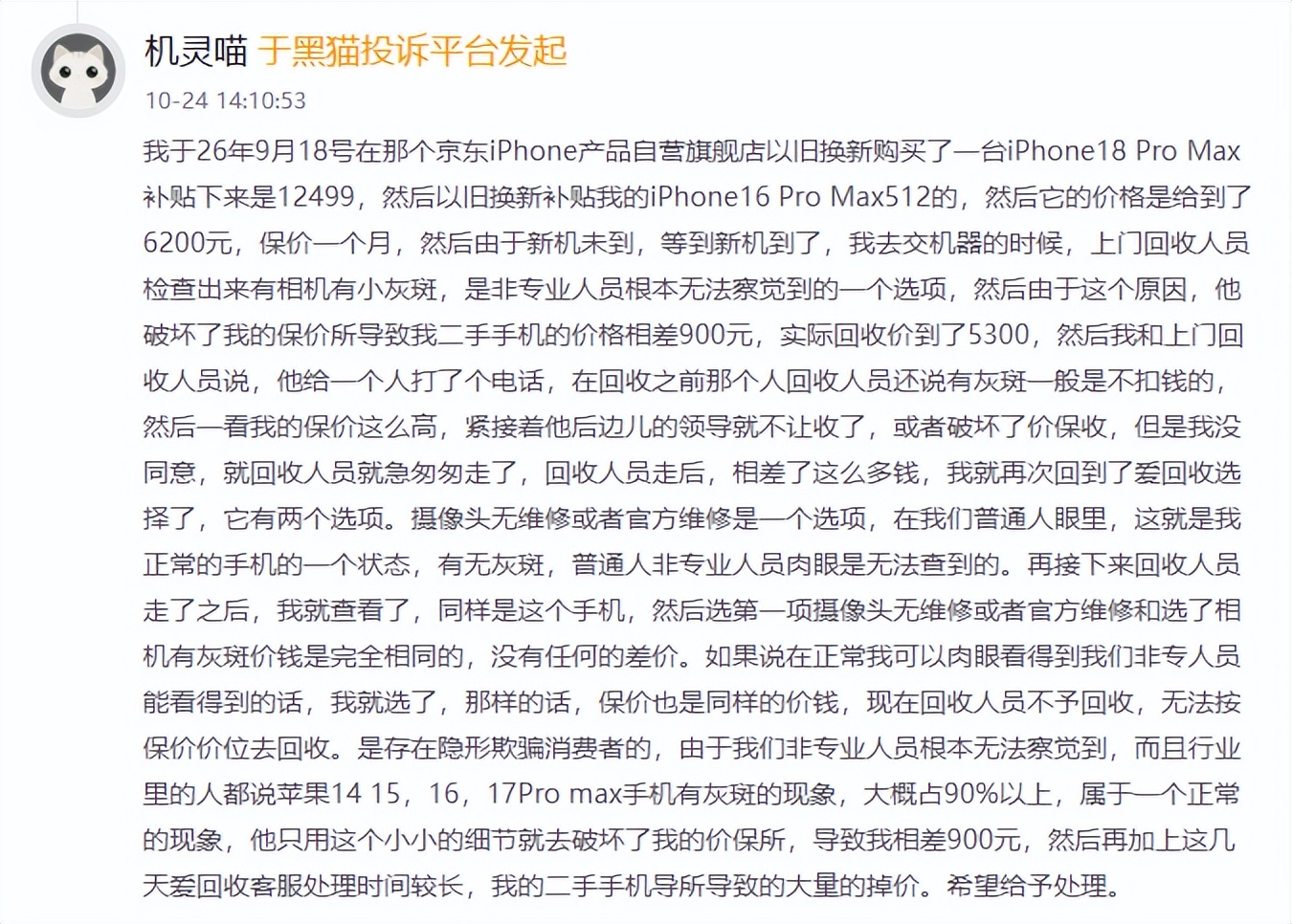
(Source: Black Cat Complaint)
This is not an isolated case. Another user stated on Black Cat Complaint on October 17 that he purchased an iPhone 18 Pro Max on September 27, and the associated order also recycled his iPhone 16 Pro Max. At that time, it was marked with a price guarantee commitment of 5250 yuan plus 300 yuan, but the door-to-door inspection only offered 1600 yuan plus 300 yuan subsidy, while a local physical phone store offered him 5100 yuan for the same device.
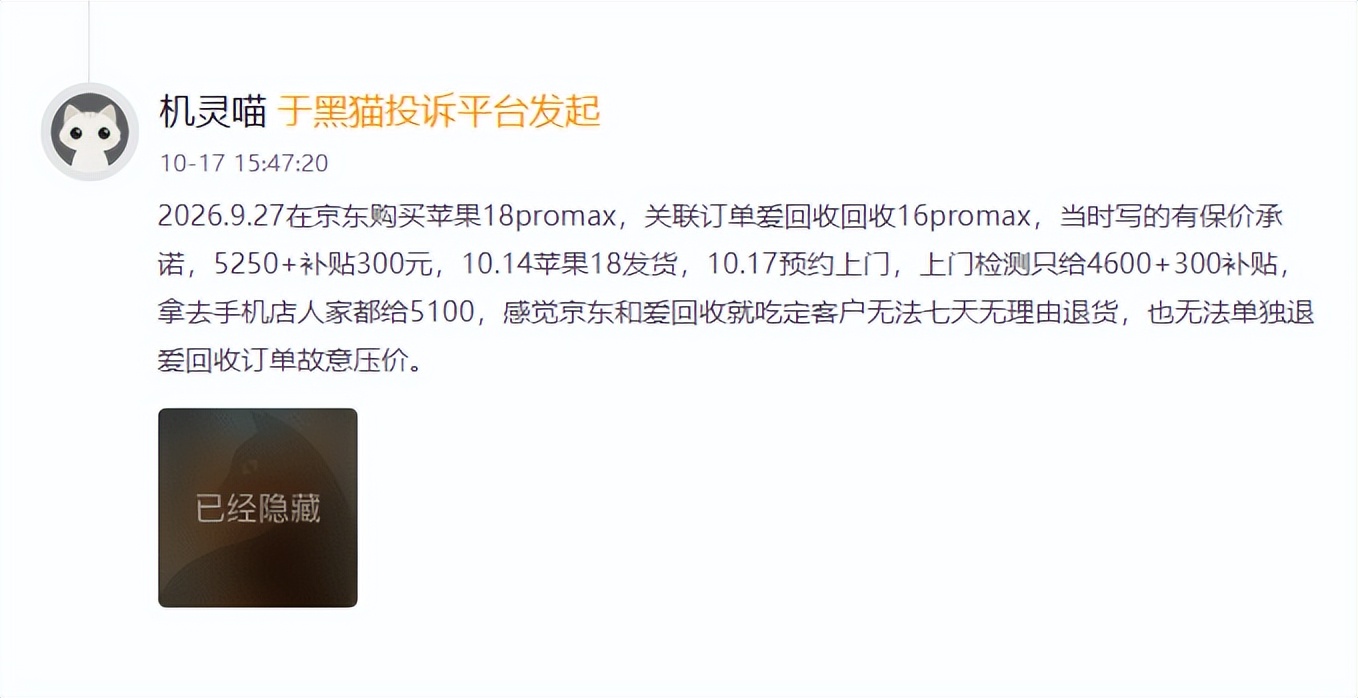
(Source: Black Cat Complaint)
In response to this, Aihuishou's official explanation is only one sentence: "The online valuation is an estimated price, and the final transaction price is subject to the actual quality inspection result and user confirmation."
It is worth mentioning that after the release of the 2026 interim report, Reuse Group analyzed the reasons for the performance increase in the conference call: "rising new phone prices", "stable second-hand market conditions", and "improved precision in operation and pricing". Among them, "improved precision in operation and pricing" means that the same device is sold at a higher price, or purchased at a lower price, or both.
With national subsidies superimposed on trade-in subsidies, the cost of price suppression is amplified
Since January 1, 2026, five departments including the Ministry of Commerce have provided subsidies of 15% of the transaction price for mobile phones, tablets, smart watches and bands, and smart glasses with a unit selling price not exceeding 6000 yuan, with a maximum subsidy of 500 yuan per item. This is a new-purchase subsidy, which does not take the delivery of old devices as a prerequisite. Even if you do not hand in your old mobile phone, you can still get this 500 yuan.
However, on the trade-in pages of many e-commerce platforms, the national 500-yuan "new purchase subsidy" and the platform's "trade-in subsidy" are placed in the same line. What users see is a total amount: "old device recycling price 1200 yuan + trade-in subsidy 800 yuan = 2000 yuan".
The problem is that the platform's subsidy has a threshold: the old device recycling price must reach a certain level before the subsidy takes effect.
A user told Blue Shark Consumption that his old iPhone15 Pro 1TB had an estimated price of 3400 yuan, but when the new phone was delivered and activated, Aihuishou's door-to-door recycling staff gave a testing and evaluation price of only 2400 yuan. Since it did not cross the threshold of 3000 yuan, the trade-in subsidy was directly invalidated. In this case, the user lost not only 1000 yuan due to "price suppression", but also nearly 2000 yuan in total with the loss of the trade-in subsidy. And the new phone has been activated and cannot be returned. The user did not agree with Aihuishou's quotation, and later sold the old device to an Apple authorized store at a price of 3420 yuan.
On the Black Cat Complaint Platform, another user had the same experience: the estimated price of the old device was just near the threshold of "get a 300-yuan coupon when the amount is over 200 yuan", but after quality inspection, he was told that the device "was only worth 150 yuan", 50 yuan short of meeting the condition. The platform's solution was "subsidize 50 yuan, and the total recycling price is still 200 yuan, but the money will be paid in two parts". The problem is that paying in two parts does not meet the rule of "single order amount over 200 yuan", so the 300-yuan coupon is still invalid.
In fact, this is not a problem of Aihuishou alone. This is a business with a net profit margin of 1.6%, fulfillment cost of 8.4%, traffic cost of 7.9%, and growth relying on national subsidies and super traffic entrances, whose model is highly dependent on "high estimated price and low acquisition price".
It may be difficult to change this situation. The platform needs to make the testing standards public, and a national standard for the appearance grading of second-hand electronic products needs to be established, to clarify the judgment threshold of "scratch" and "bump" and the corresponding price deduction range, but this cannot rely on the platform's consciousness.
On November 19, 2026, Reuse Group will release its Q3 financial report, and the performance is likely to continue to rise. The capital market will pay attention to the gross profit margin, the proportion of To C business, and how many basis points the non-GAAP operating profit margin has increased. But these figures will not include "the proportion of users who accept the suppressed price", which is the real gross profit margin of this business.