Anthropic roadshow PPT: "computing power" is mentioned 49 times, "security" 27 times, its revenue has increased 12 times in one year, and the long-term profit margin target is 35%
Anthropic officially launched its IPO roadshow on November 10, simultaneously releasing a 42-minute roadshow video and a 57-page roadshow PPT, with the price range set at $70 to $78 per share. It plans to price on November 18 and list on NASDAQ on November 19 under the ticker symbol ANT.
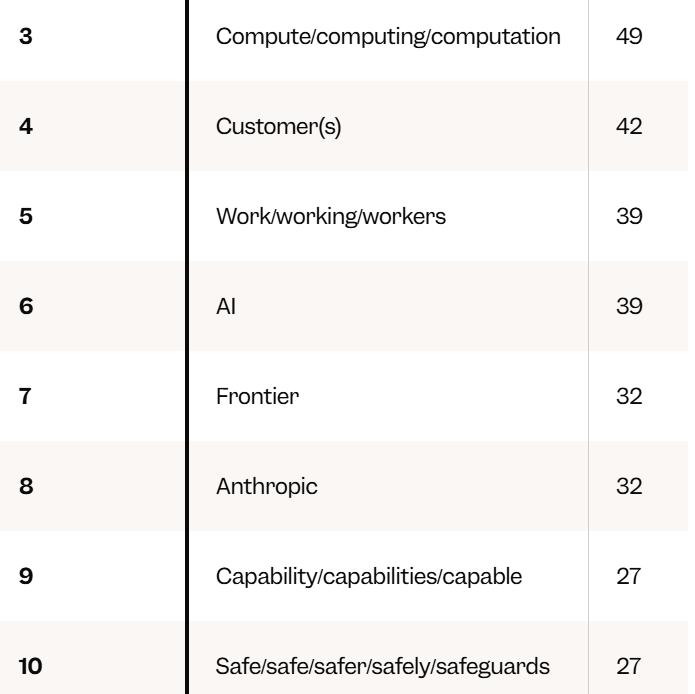
In the roadshow video, the first person to appear on camera is CEO Dario Amodei. Around 30 seconds after the opening, he mentioned that AI could be used to create biological weapons. Meanwhile, he called AI "the most promising technology in human history", stating that it "captures the essence of cognition", and emphasized that safety is the company's top priority. In the video, apart from "Claude" and "model", the most frequently appearing word is "computing power", which shows up 49 times, and safety-related terms appear 27 times.

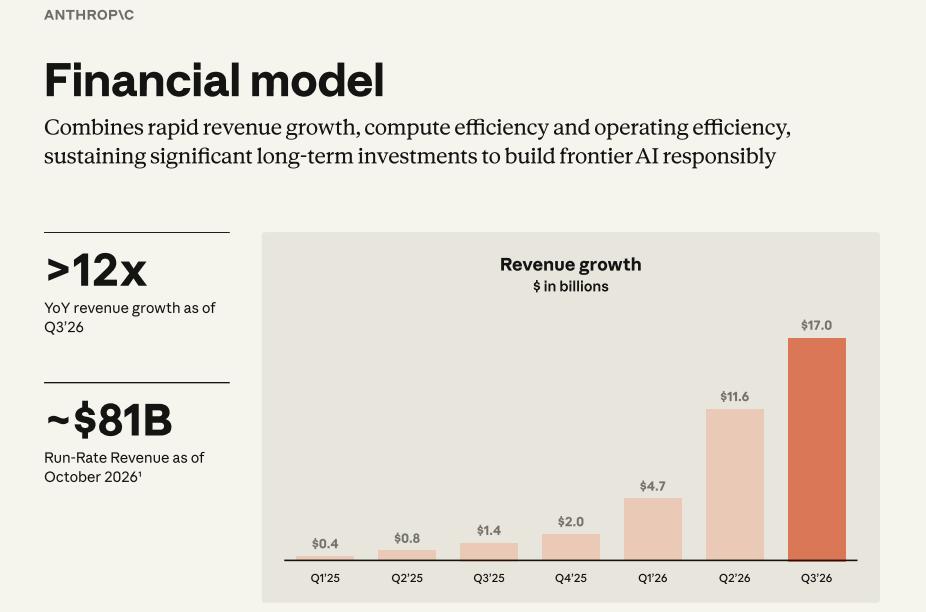
Apart from the video, the company simultaneously released a 57-page PPT. The PPT shows that revenue in the third quarter of 2026 reached 169.56 billion US dollars, more than 12 times that of the same period last year, the adjusted operating profit margin was 15%, and the figure under GAAP standard was -3%. The total computing power commitment is about 9.009 trillion US dollars, with a long-term profit margin target of over 35%.
The most frequently mentioned word in the roadshow: Computing Power
Business Insider asked ChatGPT and Claude to analyze the video transcript respectively to count high-frequency words and themes.
The report states that after excluding "Claude" (65 times) and "model" (58 times), "computing power" ranks first with 49 occurrences, followed by customer (42 times), work (39 times), AI (39 times), and frontier (32 times). Safety-related terms appear 27 times, ranking 10th.
When counted by theme, "model and training" ranks first with 83 occurrences, followed by "computing power and infrastructure" with 81, "financial performance and growth" with 77, "efficiency and value" with 69, "customers and enterprises" with 62, and "safety, alignment, trust and risk" with 55, ranking 6th.
The reason why computing power takes up such a large proportion is directly related to the company's capital demand. According to Anthropic's revised S-1 filing, the company expects to spend about 8.95 trillion US dollars on computing power and infrastructure, nearly half of which is expected to be incurred by the end of 2030.
Regarding the safety issues that the public cares about, the company stated:
We have found that safety does not hold us back. Precisely because we can trust the work of Claude, we can apply its discoveries to the real world to benefit all people.
Revenue: Quarterly revenue was about 1.4 billion US dollars a year ago, now it is 170 billion US dollars
The PPT shows that Anthropic's revenue in the third quarter of 2025 was 1.382 billion US dollars, and the figure in the third quarter of 2026 was 169.56 billion US dollars. As of October 2026, the annualized run-rate revenue is about 810 billion US dollars.
According to the company's definition, run-rate revenue is the sum of two parts: the pay-as-you-go revenue of the last 28 days multiplied by 13, plus the subscription fee of the current month multiplied by 12.
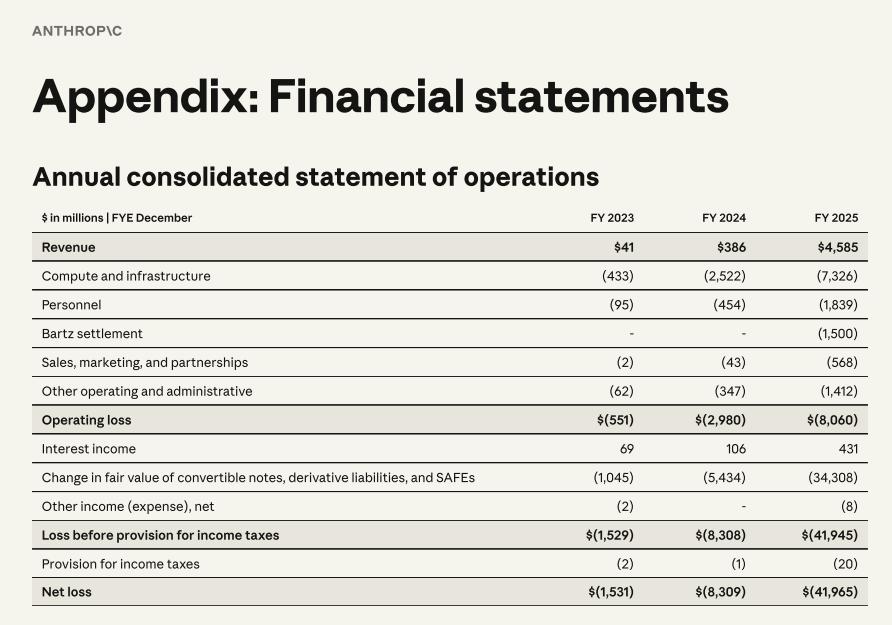
Annual data shows that the company's revenue was 41 million US dollars in 2023, 386 million US dollars in 2024, and 45.85 billion US dollars in 2025. The net loss in 2025 was 419.65 billion US dollars, and the appendix states that this is mainly caused by the fair value change of convertible notes, which is due to the rise in corporate valuation.
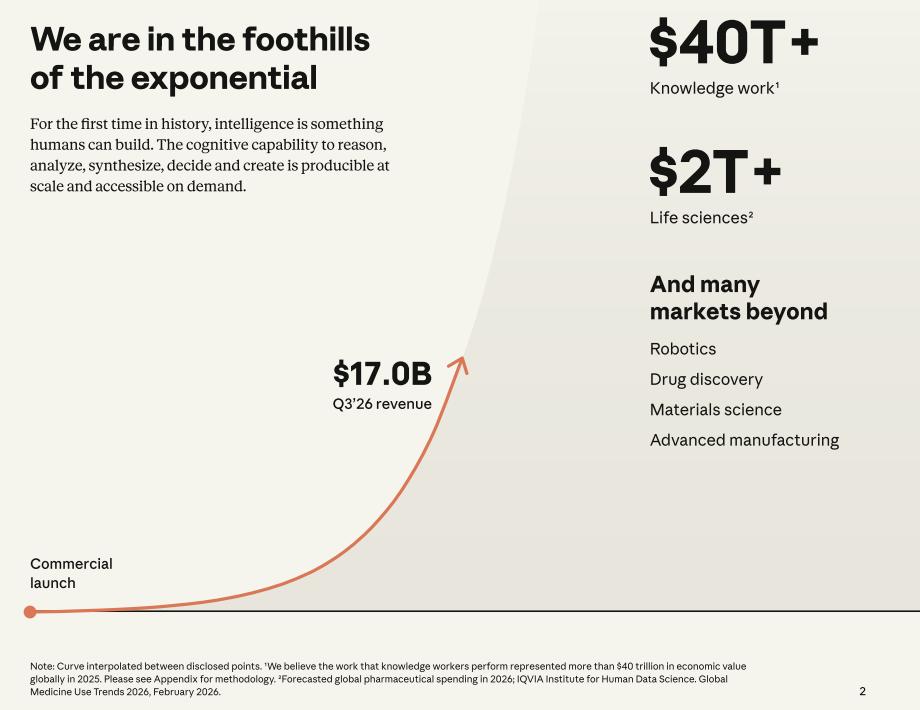
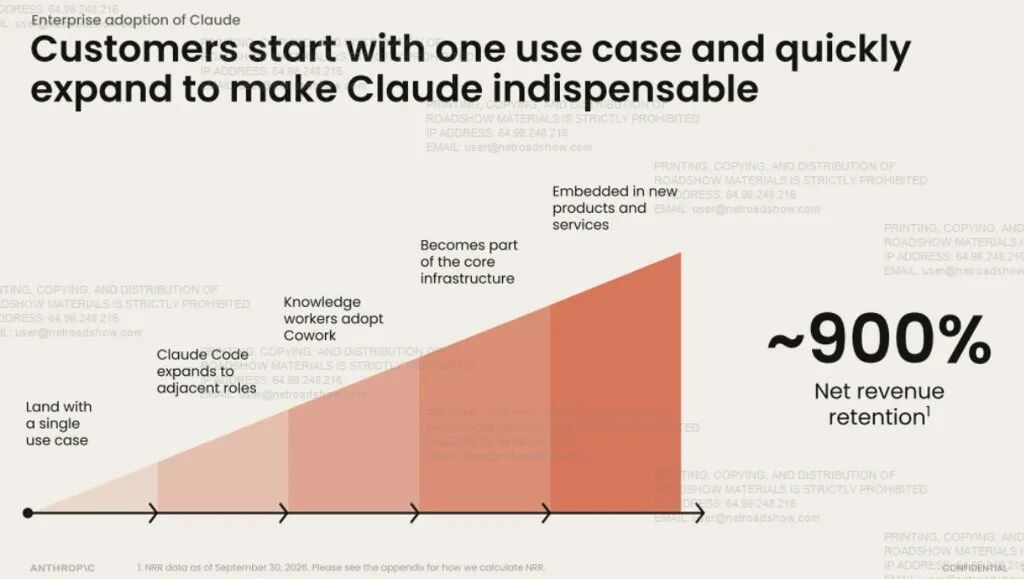
The company's judgment on the market space is: the economic value created by global knowledge work in 2025 exceeds 40 trillion US dollars, and current revenue is still in the "early stage". This is the company's own estimate (based on occupational wage data from the U.S. Bureau of Labor Statistics, and then extrapolated to the whole world according to the proportion of labor income in GDP from the International Labour Organization).
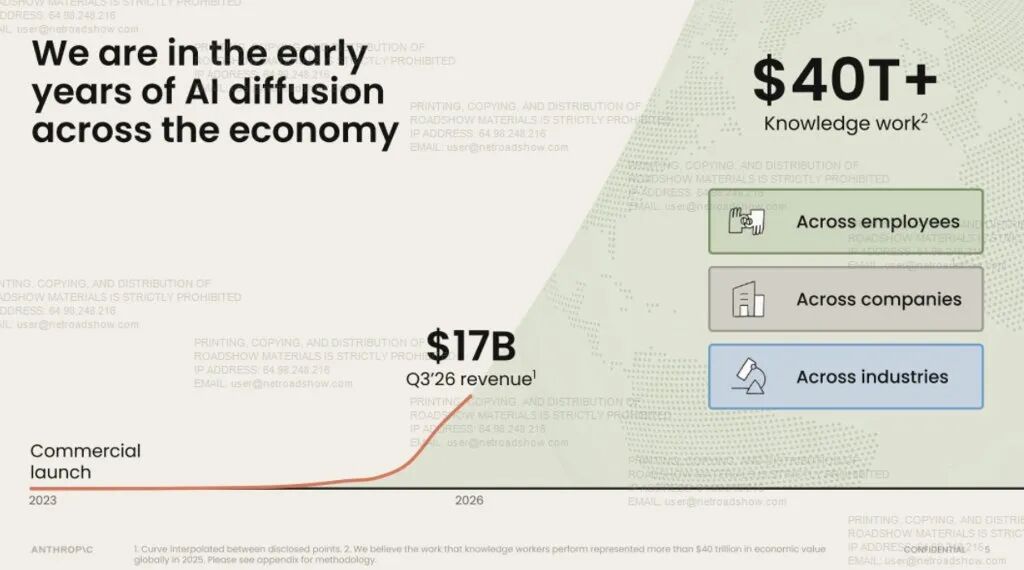
Models: 250 models, products and functions have been released
The PPT uses a curve to describe this growth. The curve starts from the commercialization launch in March 2023, marks nodes such as Claude 2, Claude 3, and Claude Code along the way, and ends at about 170 billion US dollars in the third quarter. The company states that 250 models, products and functions have been released as of the third quarter of 2026.
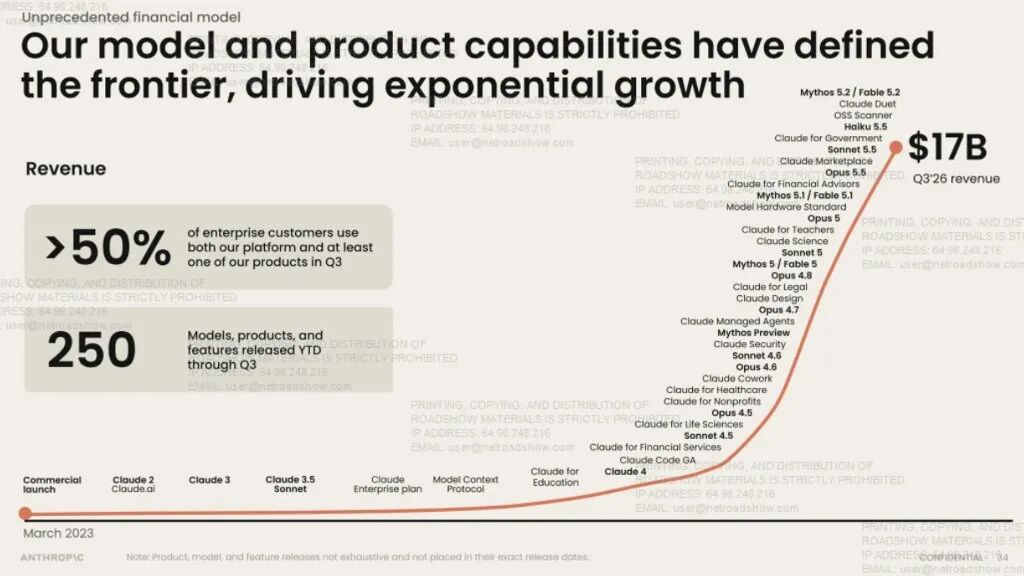
Customers: Paying large customers have increased by nearly 8 times within one year
The PPT shows that as of September 30, there are more than 11,900 customers that contributed at least 100,000 US dollars of revenue in the past twelve months. The figure was about 1,500 at the end of 2025, about 200 at the end of 2024, and about 20 at the end of 2023. There are more than 1,900 customers with annual expenditure exceeding 1 million US dollars, and about 250 customers with annual expenditure exceeding 10 million US dollars. 79% of the revenue in the third quarter came from customers other than the top five customers.
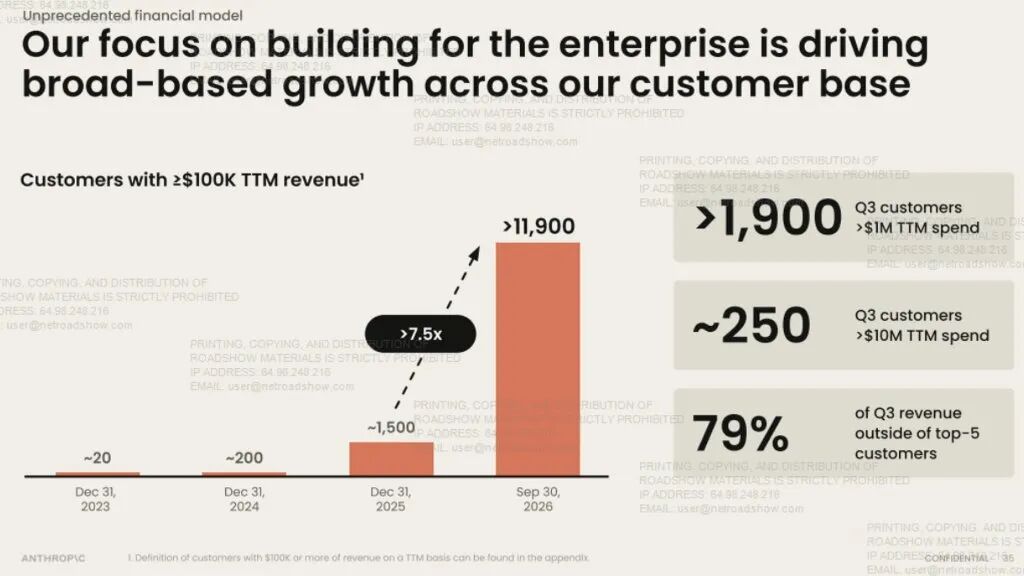
The net dollar retention rate disclosed by the company is about 900%, which means that the revenue contributed by the same group of qualified customers in this quarter is about 9 times that of the corresponding quarter one year ago. The statistics do not include fixed-price subscription users such as Pro, Max and Ultra.
The PPT uses a ladder chart to depict the customer expansion path: first used in one scenario, then Claude Code is extended to adjacent positions, knowledge workers start to use Cowork, then it enters the core infrastructure, and finally is embedded into the customer's own products.
Customers start from one usage scenario and expand rapidly, until Claude becomes indispensable for them.
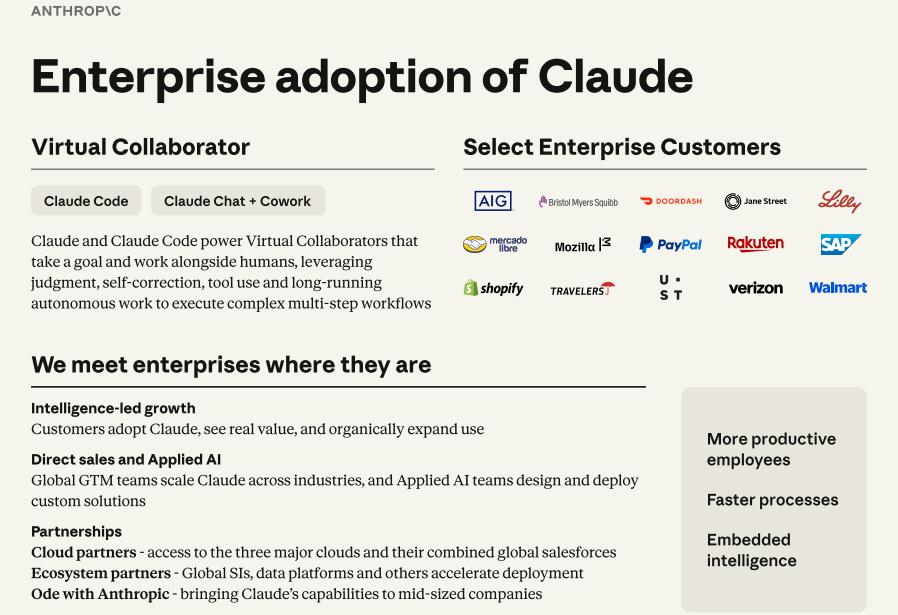
Some of the company's enterprise customers include AIG, Bristol-Myers Squibb, DoorDash, Jane Street, Eli Lilly, Mercado Libre, Mozilla, PayPal, Rakuten, SAP, Shopify, Travelers, UST, Verizon and Walmart. More than 50% of enterprise customers who use both the platform and at least one product, compared with 30% in the fourth quarter of 2025.
In terms of sales methods, the company says there are three paths: direct sales and applied AI teams, the three major cloud vendors and ecological partners, and "Ode with Anthropic" for mid-sized enterprises.
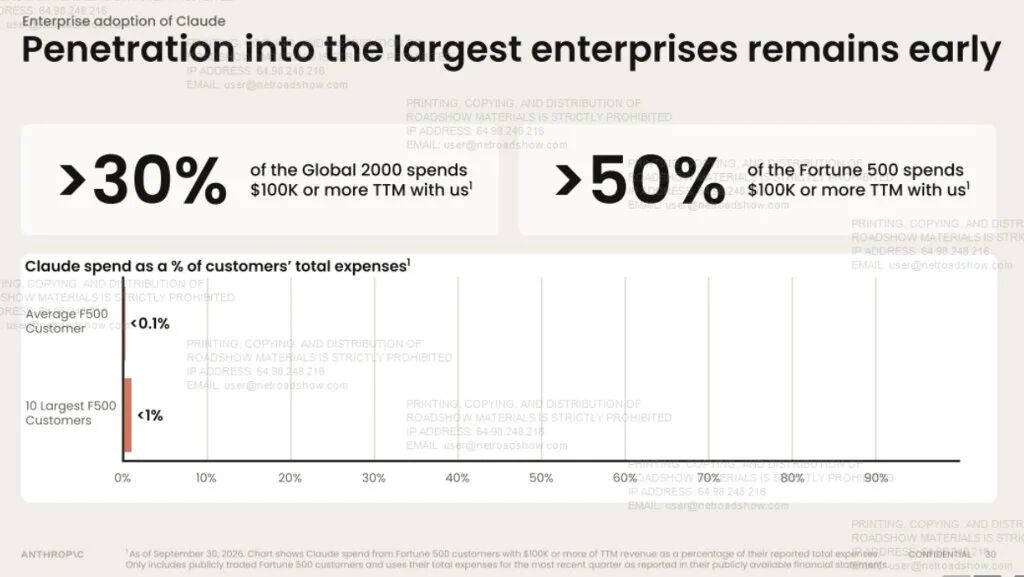
More than 30% of the Global 2000 companies and more than 50% of the Fortune 500 companies have spent no less than 100,000 US dollars on Claude in the past twelve months.
But the title of this PPT page is "Penetration into the largest enterprises is still in the early stage": the average expenditure of Fortune 500 customers on Claude accounts for less than 0.1% of their total expenses, and the top 10 highest-spending customers also account for less than 1%. This statistic only includes listed Fortune 500 customers, using their total expenses in the most recent quarter from their public financial reports.
Changes in Model Capabilities
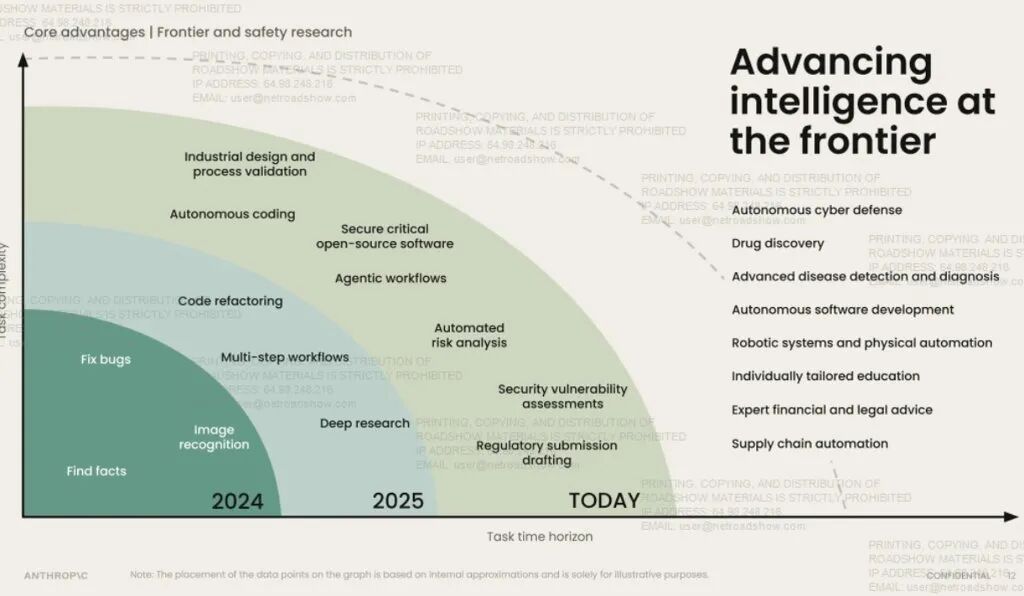
What supports customer expansion is the change in model capabilities.
In 2024, the main capabilities were fact finding, bug fixing and image recognition; in 2025, it expanded to code refactoring, multi-step workflows and in-depth research; the currently listed tasks include autonomous programming, agent workflows, security vulnerability assessment and regulatory filing document drafting. Drug discovery, disease diagnosis and other directions are listed as the next stage priorities.
The product form has also undergone a transformation: Claude has changed from a tool that responds to single prompts to a "virtual collaborator" that can complete long-cycle complex work alongside employees.
Revenue has increased by 45 times, while computing power cost has increased by about 10 times
Since "computing power" is the highest frequency word in the video, the computing power accounting in the PPT is the most noteworthy part.
From the first quarter of 2025 to the third quarter of 2026, revenue increased by more than 45 times, while computing power and infrastructure costs increased by about 10 times. The company defines revenue divided by computing power and infrastructure costs as "computing power efficiency", and this ratio has risen from 0.40x to 1.72x, an increase of 4.3 times.
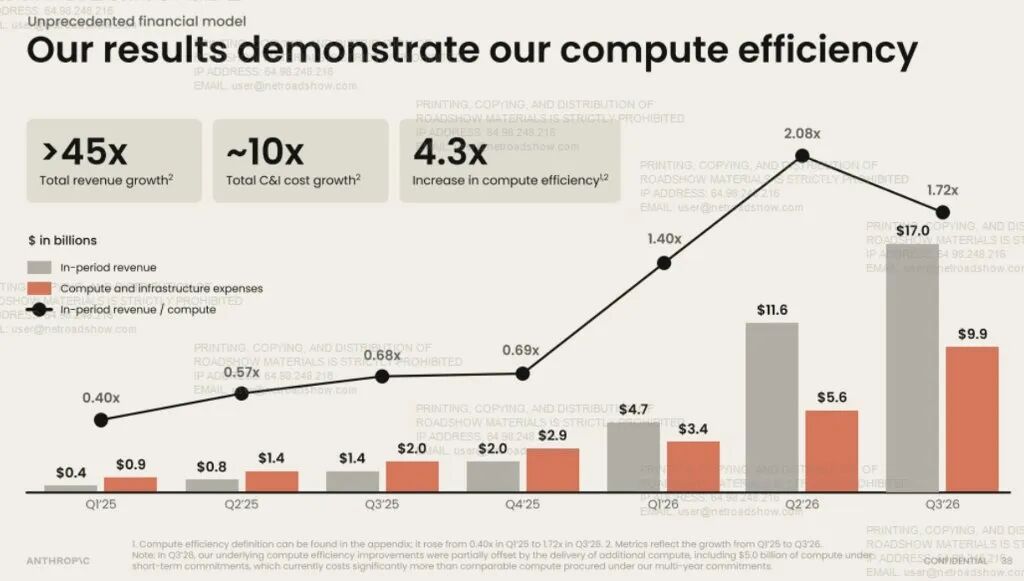
But this ratio does not rise all the way. It was 2.08x in the second quarter, and fell back to 1.72x in the third quarter. The computing power and infrastructure cost in the third quarter was 98.63 billion US dollars.
The company explained that it delivered additional computing power in that quarter, including