Token hits the "Double 11" shelves: AI inference is booming, and gray unregulated transfer hubs have also emerged.
There are three recent developments worth examining together: First, during this year's Double 11 shopping festival, Token has been placed on e-commerce shelves and even entered livestreaming rooms. Second, data released by the China Center for Information Industry Development shows that the volume of artificial intelligence inference data in China has exceeded the training data volume for the first time. Third, chip manufacturers and other related players have made shifts in their layout strategies. Centering on AI inference, new changes have emerged across the whole upstream and downstream of the industrial chain.
This year's "Double 11" shopping festival has seen a new type of product appear on e-commerce shelves: Token.
Data from JD.com shows that during the 2-hour livestream of the JD 3C Digital Procurement & Sales livestreaming room on November 2, the sales volume of large model Token package products increased by 20 times month-on-month. From 8 p.m. on October 30 to 24:00 on November 1, the sales volume of AI computers and other products bundled with Token packages sold on JD.com increased by 100% month-on-month. Data from Tmall shows that on November 2, in Austin Li's livestreaming room, a monthly personal membership card of Qianwen Office priced at 0.01 yuan sold 50,000 copies within 10 minutes after going on sale, and nearly 100,000 copies were sold in half an hour, corresponding to a Token quota of about 2 trillion.
In addition to the consumer-side change of Token being put on shelves, two other new developments are worth reviewing together.
One is that at the end of October, data released by the China Center for Information Industry Development shows that the volume of artificial intelligence inference data in China has exceeded the training data volume for the first time. As of June this year, the daily average token call volume has exceeded 175 trillion, which is more than 1000 times higher than that at the beginning of 2024.
The other is that at the just-concluded China International Import Expo, chip manufacturers including Intel and Qualcomm took agent phones, AI PCs and edge-side AI solutions as their key display highlights. Wang Zhicong, Chairman of Intel China, said in an interview with *Sci-Tech Innovation Board Daily*, "In the next five years or so, a larger proportion of computing power will be deployed on the inference side, and extend to devices closer to the edge."
The three signals put together, including the mass consumption of Token, inference data volume exceeding training data volume, and the shift of key publicity priorities of chip manufacturers, also reflect that inference is becoming the "mainstream study" of the AI industry. Centering on AI inference, new changes are taking place in the upstream and downstream of the industrial chain, and new concerns and risk points are emerging accordingly.
Token Promotion Wave: Hidden Channel Chaos Under Discounts
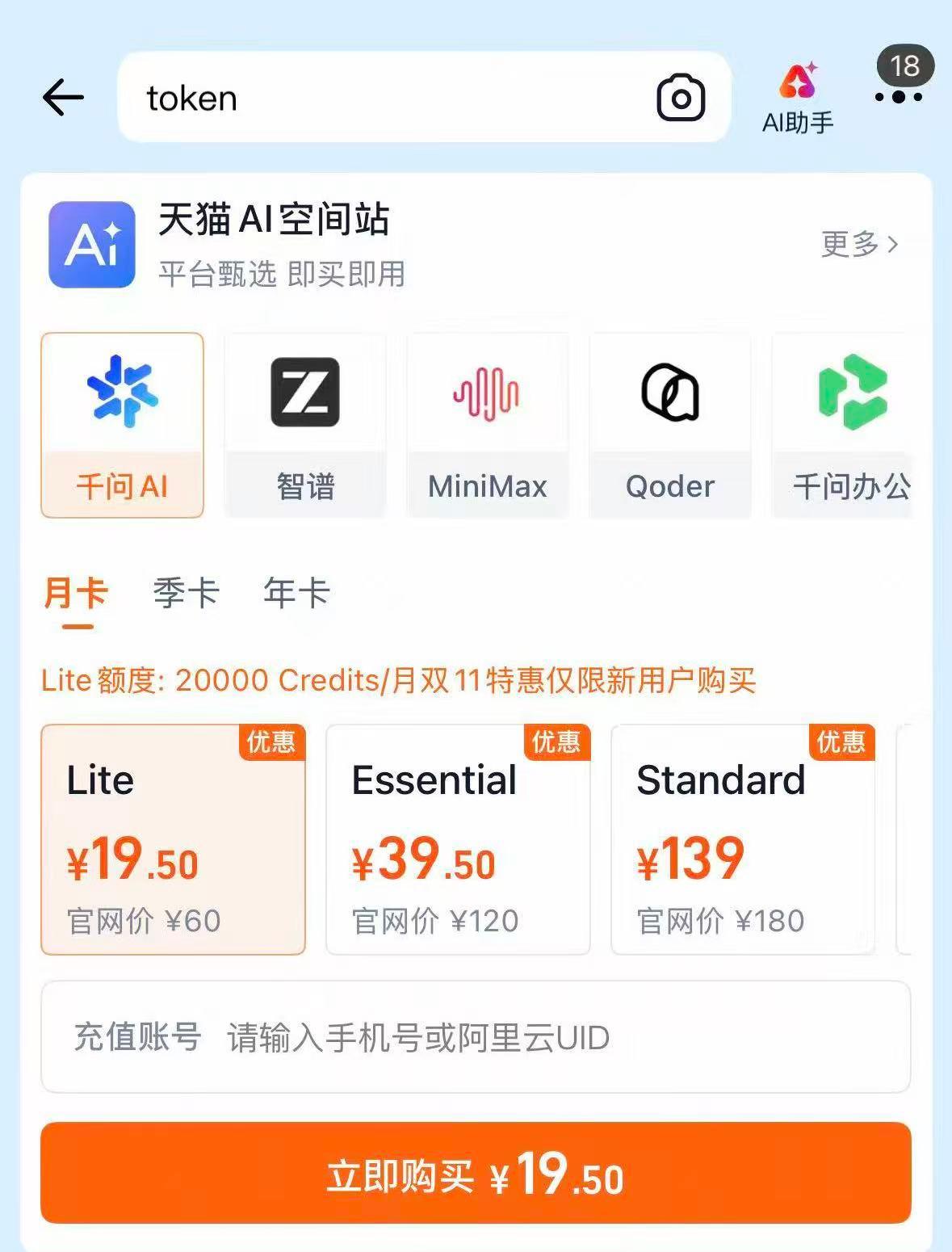
When the reporter of *Sci-Tech Innovation Board Daily* searched for "Token" on Taobao, the specially set "Tmall AI Space Station" popped up on the homepage, marked with "Platform Selected, Ready to Use Immediately" below. Major models such as Qianwen, Zhipu, MiniMax, and Qoder are arranged in it.
In comparison, buying Token during the Double 11 shopping festival is indeed much cheaper.
Take Qianwen AI as an example, the monthly Lite card is priced at 19.5 yuan, while the official website price is 60 yuan; the Essential version is priced at 39.5 yuan, while the official website price is 120 yuan; the Standard version is priced at 139 yuan, while the official website price is 180 yuan.
The reporter of *Sci-Tech Innovation Board Daily* checked the promotion pages of other model software and found that some products have a 50% discount, and some are even as low as 30% off. For example, the three monthly cards of MiniMax are all 50% off, Zhipu weekly cards start at 50% off, the first month of Qianwen Office basic version member monthly card starts at 30% off, and Qoder monthly card is 33% off.
In addition to Taobao, JD.com has recently launched an AI software recharge hall, which contains products from manufacturers such as Zhipu GLM, JD Cloud, Volcano Engine, and DeepSeek. Among them, the Zhipu Coding Personal Edition GLM-5.3 monthly card package ranks first in the IT technology e-book bestseller list.
It is understood that during the Double 11 period, JD Cloud new user points package offers 10,000 points for 0.01 yuan, Kimi K3 10,000 Token for 0.01 yuan, and the limited version of Zhipu AI member 7-day premium experience is available for 0.09 yuan for snap-up.
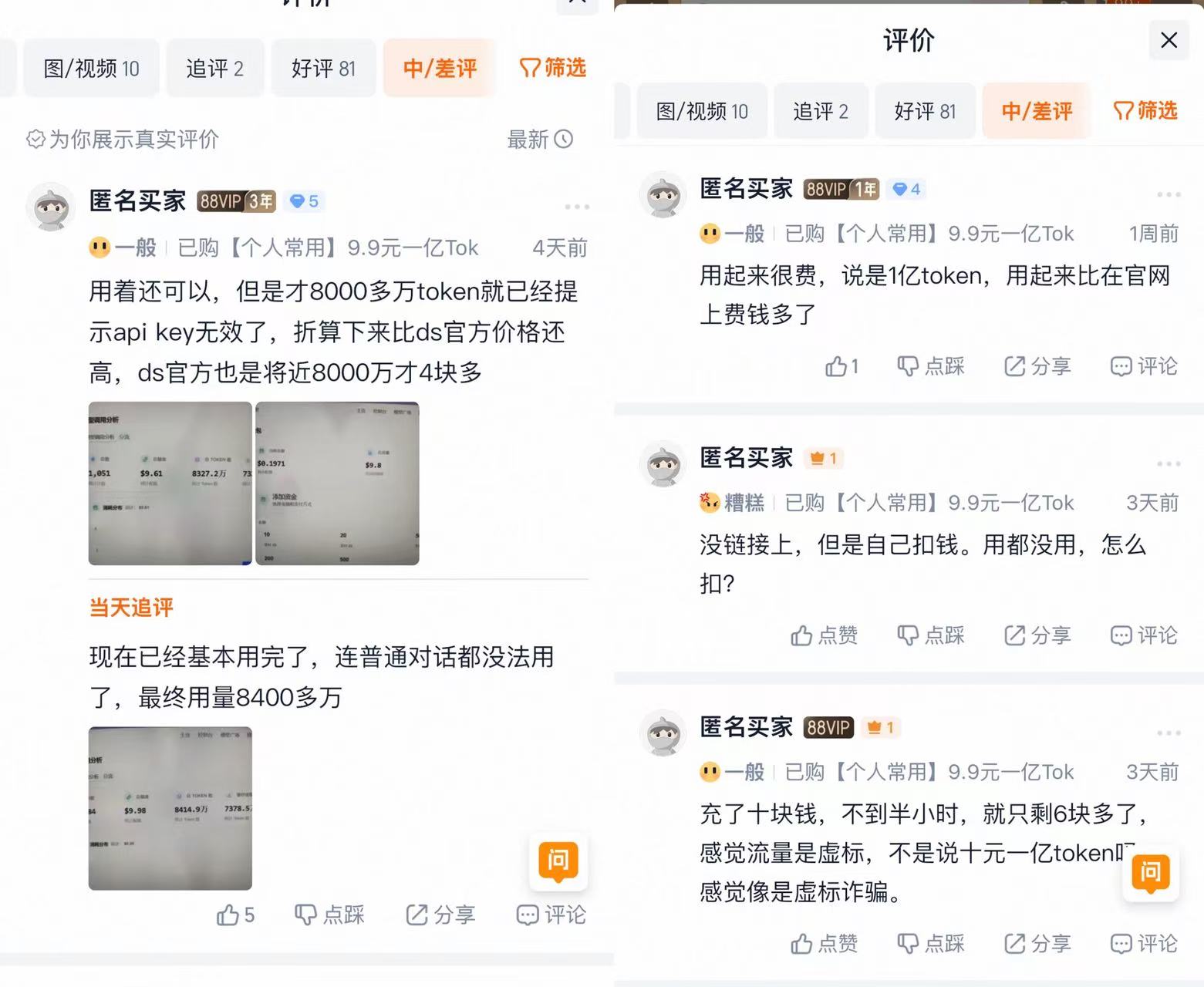
However, in addition to these official stores, some stores with a small number of followers are also selling Token. As intermediaries, many of these "AI transfer stations" operate in the gray area of the internet, with operators hiding their identities throughout the process, no public filing information, and no clear operating entity. Most of these stores have followers in double digits. In the comment area, there are also negative reviews such as "it consumes too much when using", "it costs much more than on the official website", and "the traffic is falsely marked".
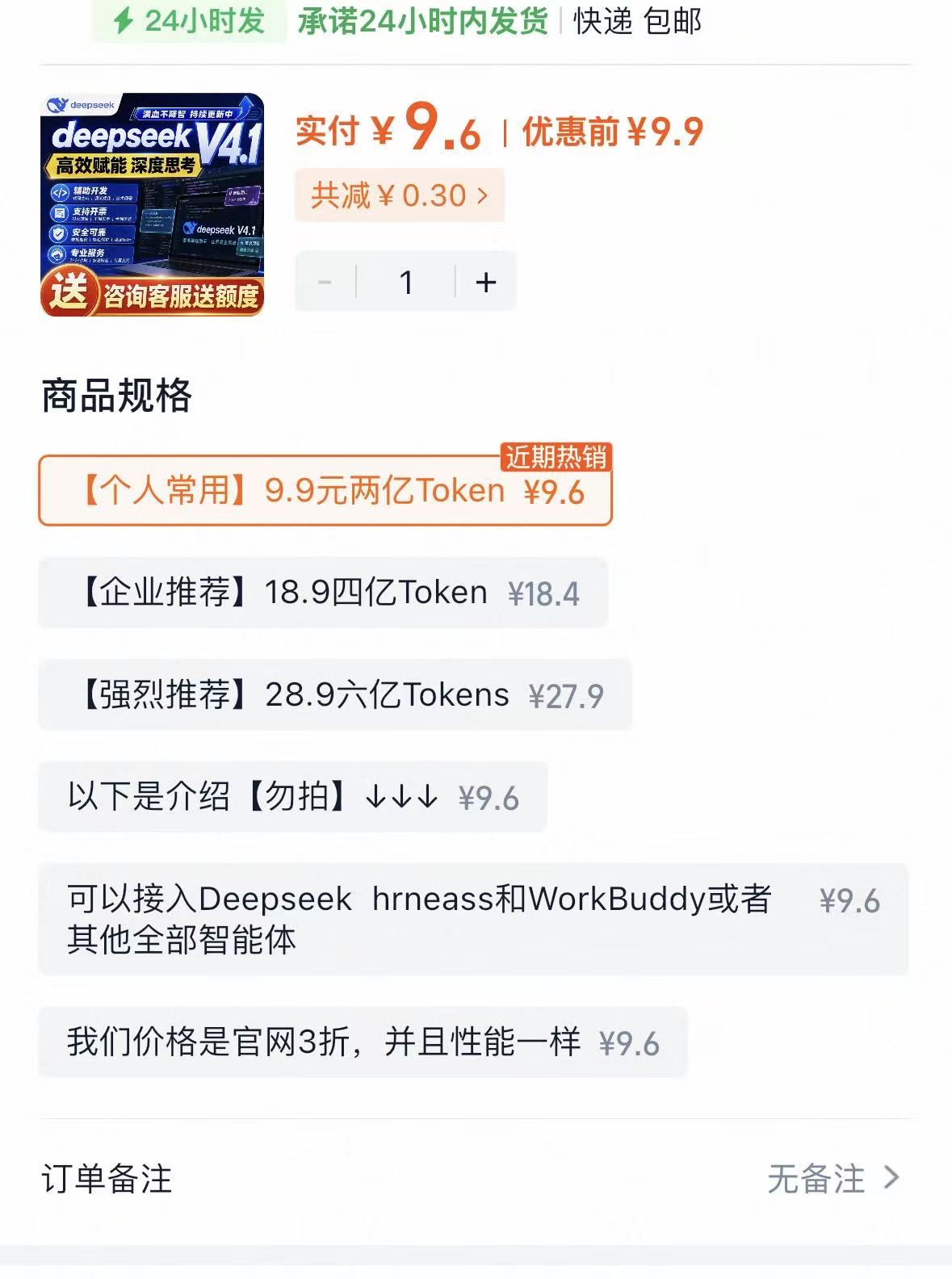
The reporter of *Sci-Tech Innovation Board Daily* randomly purchased a product priced at 9.6 yuan on Taobao. The store took "the price is 30% of the official website, and the performance is the same" and "10 million Token for 1 yuan" as its selling points.
After completing the configuration according to the operation document provided by the store owner, the reporter successfully called the model on WorkBuddy. Subsequently, the reporter conducted a test, asking the model to write a research report around the theme of "inference data volume exceeding training data volume". The results show that the context usage of the unofficial entry is 199.3K, consuming 0.3958 yuan, while the official entry is 210.1K, and the gap between the two is not large.
However, a single test cannot prove that the channel is always reliable. In the newly added communication group, the group owner also reminded users: "If the price is too low, sometimes there will be server congestion and disconnection when there are too many people, please forgive for that." But disconnection is only a poor experience, and the problems behind the "AI transfer station" such as unprotected data transmission, privacy leakage, malicious implantation, remote control, data outflow, and out-of-control management are hidden under the surface.
For ordinary consumers, Token is not a standard commodity that can be simply compared for price. The model capabilities of different manufacturers are different, and the tasks that can be completed with the same amount of tokens under different models may vary. The validity period of the quota after personal recharge, refund rules and data privacy protection also need to be further standardized.
Wang Jiandong, Deputy Director of the Big Data Development Department of the State Information Center, also suggested that the token measurement caliber should be unified as soon as possible, a conversion standard should be established, the billing disclosure should be standardized, and third-party verification should be introduced.
Upstream Chip and Cloud Vendors Restructure Their Layout Centering on "Inference"
As the inference data volume exceeds the training data volume for the first time, the display priorities of upstream chip manufacturers are also changing. Agents, edge-cloud collaboration, edge inference, and computing power scheduling have become the new round of core competitive points.
This can be seen from the just-concluded China International Import Expo. For example, major chip manufacturers such as Intel and Qualcomm no longer only display chips, but also place the linkage with intelligent terminals such as agent phones and AI PCs, as well as edge-side AI solutions in prominent positions.
Wang Zhicong, Chairman of Intel China, said in an interview with the reporter of *Sci-Tech Innovation Board Daily* that future AI capabilities need to be deployed collaboratively between the end and the cloud. Intel is cooperating with domestic model manufacturers and agent manufacturers to extend models and applications to laptops, traditional PCs, and small-sized AI Box edge computing devices.
Regarding the computing power solution, Intel also exhibited a green computing power warehouse, which can be deployed nearby in areas with green power resources such as photovoltaic and wind power, convert green power into inference Token on the spot, and then distribute it outward through the computing power network. Wang Zhicong revealed that relevant solutions may start to be implemented in the first quarter or the first half of next year.
"End-side AI is evolving from single-point applications such as image processing and speech recognition to agent experiences such as intention understanding and task orchestration; the cloud side undertakes tasks that require stronger intelligence and computing power, while the end side gives full play to the advantages of real-time performance, stability, privacy protection and personalization, and reduces dependence on the network." said Wan Weixing, head of AI product technology in China at Qualcomm. In addition, Qualcomm also took "agent" as the core narrative at the 2026 Snapdragon Summit, and the Snapdragon X2 series processors are used for agent AI PCs.
AMD's roadmap points more directly to "local replacement of cloud Token". The Ryzen AI Max PRO 400 series released in September 2026 is called by AMD "the world's first x86 client processor that can run 300-billion-parameter models without cloud offloading". In terms of shipment data, Michael Nordquist, Vice President of Global Client Product Marketing at AMD, revealed that AMD AI PCs have accumulated shipments of tens of millions of units, with more than 250 designs; among them, agent PCs that can run 100-billion-parameter models have shipped more than 500,000 units.
The RTX Spark superchip designed by MediaTek in cooperation with NVIDIA has officially landed on Windows 11 PCs, and the first batch of models covers six brands: ASUS, Dell, HP, Lenovo, Microsoft and MSI. According to the introduction, the biggest change in the implementation experience is that agents have moved from the cloud to the local. At the development end, it can assist in writing code and testing, and at the creation end, it can process video editing and 3D rendering, all of which can be processed offline locally.
For cloud services, "In the era of large models, the delivery unit of cloud services is shifting to Token. Cloud vendors no longer only provide basic resources such as computing, storage and network, but also include services such as model deployment, inference acceleration, elastic scheduling and security compliance." Liu Hua, Deputy General Manager of the Emerging Business Department of UCloud, believes that for customers, what they buy is not only computing power resources, but also stable model inference capabilities that can be called.
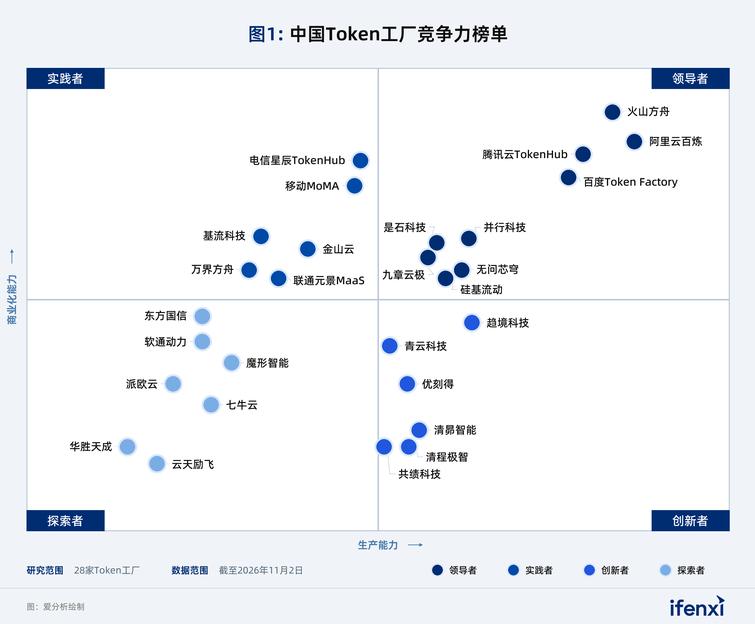
Image source:
This article is from "CLS", Author: Wang Nai, 36Kr is published with authorization.