Qianwen Office Remedial Training, Chen Yusen Embarks on His Second Entrepreneurial Venture
In June 2026, in a half-mu paddy field on the outskirts of Hangzhou, Alibaba partners including Jack Ma and Wu Yongming rolled up their trouser legs and transplanted rice seedlings in the mud.
That day, an article titled "Only With Seedlings In Hand Can We Ensure Grain Supply In The Future" was published on Alibaba's internal intranet.
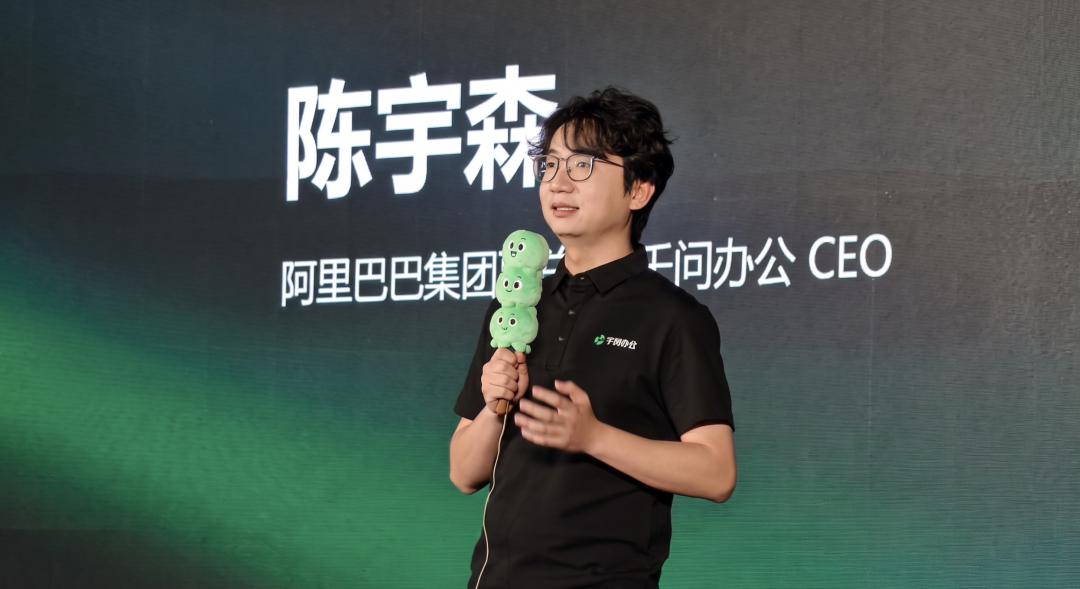
34-year-old Chen Yusen was also in the rice transplanting team, and he was the youngest executive among the group.
A few days earlier, he had just been appointed CEO of DingTalk, and now he also serves as CEO of Qwen Workspace.
In the first week after taking over as CEO of DingTalk, Chen Yusen sent an all-staff internal letter, canceling DingTalk's mandatory 9 PM review meeting, as well as the morning meeting check-in and late-night post patrol. Alibaba's traditional management tends to process control and high visibility, while Chen Yusen, with a technical background, is more accustomed to using automated tools to reduce repetitive work.
This is not just a change in management style, but also reflects a new exam question for Alibaba in the face of AI.
Alibaba has no shortage of models, computing power and cloud infrastructure, what it lacks is the ability to turn these capabilities into Agent products that enterprises are willing to use.
What Chen Yusen needs to do is to make Agent truly integrated into the work processes of enterprises.
This is not the first time he has faced enterprise customers. Twelve years ago, when he started his first business, he had encountered setbacks on this very issue.
I. Technical Indicators Cannot Bring Commercial Orders
In 2014, China's mobile internet entered a period of rapid expansion. In that year, the number of mobile internet users reached 527 million, and the proportion of mobile internet access exceeded that of PC for the first time. Applications such as mobile payment, mobile games, and e-commerce grew rapidly, and a large number of young technicians began to look for entrepreneurial opportunities.
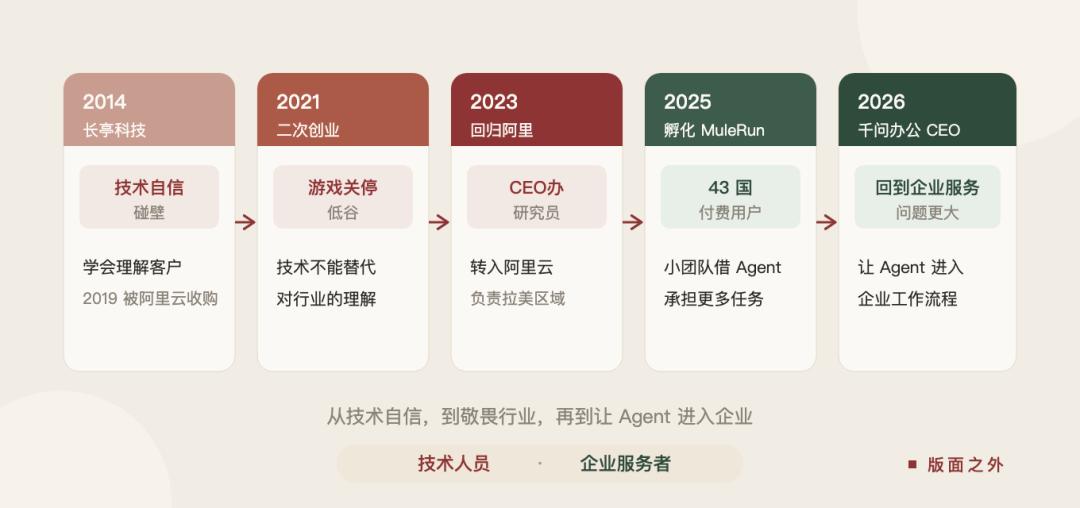
Chen Yusen graduated from Zhejiang University in this year. Instead of choosing large factories like Alibaba, he co-founded Chaitin Tech in Beijing with several members of the "Blue Lotus" team, entering the enterprise-level network security field.
In the early days of starting a business, what he had the most was technical confidence.
During his university years, Chen Yusen won rankings in many international security competitions. After Chaitin Tech was established, he personally visited customers, met with bank leaders with his resume as the world champion of security competitions, believing that leading technical indicators were enough to convince the other party.
He would even argue with customers in the conference room over the right or wrong of technical routes.
The result was that he lost orders one after another.
Until a classmate later reminded him: Customers have no obligation to understand your technology.
This incident also indirectly made Chen Yusen change the way he develops products.
Bank customers do not care how advanced the technology is, they care about whether it meets business rules, compliance requirements, and whether it can solve practical problems. So Chen Yusen began to shift his energy from demonstrating technology to understanding customers, and Chaitin Tech's business gradually opened up.
In 2015, Chaitin received angel round financing from ZhenFund. By 2018, many leading banks across the country had successively become Chaitin's customers.
This was also the direction that Alibaba Cloud was looking for at that time.
In 2018, Alibaba Cloud was upgraded to Alibaba Cloud Intelligence Business Group, and its business focus extended from basic computing power supply to more complex enterprise services.
A year later, Chaitin Tech was fully acquired by Alibaba Cloud, and 27-year-old Chen Yusen thus joined Alibaba.
The success of his first venture allowed him to complete the transformation from a technician to an enterprise service entrepreneur. But success also brought another illusion: as long as the technology and learning ability are strong enough, you can quickly get through the operation even if you switch to another industry.
Soon, he paid the tuition for this judgment.
II. Cross-industry Transformation Requires Supplementary Industry Lessons First
In August 2021, Chen Yusen chose to leave Alibaba, gave up the unexercised options, and started his second venture.
This time, he founded two companies at the same time: Serval Tech continued to focus on data security, and completed tens of millions of RMB Series A financing led by Source Code Capital in 2022; "Jiaogei Maoba" tried to combine AI and graphics to develop medium and large-scale games.
The two companies moved in different directions.
The data security company progressed smoothly, but the game project failed to get off the ground. In 2023, due to capital consumption and direction deviation, the game company had to shut down.
Chen Yusen later admitted that the days when he was preparing to shut down the game company were the low point of his life.
Where did the problem lie?
He later reflected in an interview with Yicai that he lacked awe for the unfamiliar industry at that time, tried to directly use his past successful experience to make a medium and large project with innovative gameplay and themes, but underestimated the common sense barriers of the game industry.
The success of Chaitin Tech made him believe that technical capabilities can quickly cross industries; the failure of the game project made him realize that technology can shorten the trial and error time, but cannot replace the understanding of the industry.
The failure of the venture changed his career trajectory.
At the end of 2023, Chen Yusen returned to Alibaba. This time, he did not directly enter the core product line, but first served as a researcher in the Group CEO's Office.
In April 2024, he transferred to Alibaba Cloud, responsible for global strategic partner business, and concurrently served as General Manager of the Latin America region, participating in the construction of the South American market from scratch.
The competition of domestic large models has been heating up rapidly, but he did not rush to chase the application boom.
For someone who has experienced two ventures, the excitement brought by the technology wave is no longer enough. He needs to find a more specific answer: as model capabilities continue to improve, what kind of work can be changed? And what products are worthy of users paying for continuously?
III. Find Signals In The Noise
At the end of 2024, large models became the track with the most intensive competition in the technology industry.
Alibaba's Tongyi Qwen accelerated its R&D. By February 2025, on the Hugging Face open source list, a large number of leading models were secondarily trained based on the Qwen series, and Qwen became a force that cannot be ignored in the open source ecosystem.
When the focus of market competition gathered on AI assistants, Chen Yusen went through multiple rounds of trial and error at the application layer.
He successively tried the Vibe Coding product "Watt", the Agent-oriented application market, and the internally tested PM Agent. These products were either not released, or overturned during the testing phase.
The reason is not complicated: many applications only put a new interactive interface on the model, which can be made quickly, but it is difficult to keep users using them continuously.
"That was an environment where noise was greater than signal." he later recalled.
It was not until 2024 when Cognition launched Devin that Chen Yusen saw a different direction: AI began to have the ability to operate computers, write code and perform complex tasks. It no longer just answers questions, but can also take over a specific work process.
In 2025, he led the team inside Alibaba Cloud to incubate the AI Agent product MuleRun.
In this streamlined team, Chen Yusen conducted an automation experiment: after the team discussed the requirements with AI, the AI wrote code and ran tests in the background. MuleRun did not do large-scale promotion, and shortly after its launch, it received paying users from 43 countries around the world, of which 34% of high-value monthly paying users paid more than 200 US dollars per month.
This attempt made Chen Yusen see that the value of AI is not only to improve people's work efficiency, but also to change the way work is completed: A small team can use Agent to undertake tasks that previously required more manpower to complete.
However, the automation experiment of individuals or small teams is only the first step. To put Agent into a large enterprise, you will face more complex data, processes and organizational relationships.
In July 2026, Alibaba launched internal integration, bringing together three scattered Agent product lines including QoderWork, Wukong, and MuleRun. On August 3, Qwen Workspace was officially released for public beta, and Chen Yusen served as CEO of Qwen Workspace.
This brought him back to enterprise services again, except that this time the problem he had to solve was bigger than it was twelve years ago.
IV. Twelve Years Later, Back To The Starting Point
Taking over DingTalk and Qwen Workspace, Chen Yusen is still facing enterprise customers.
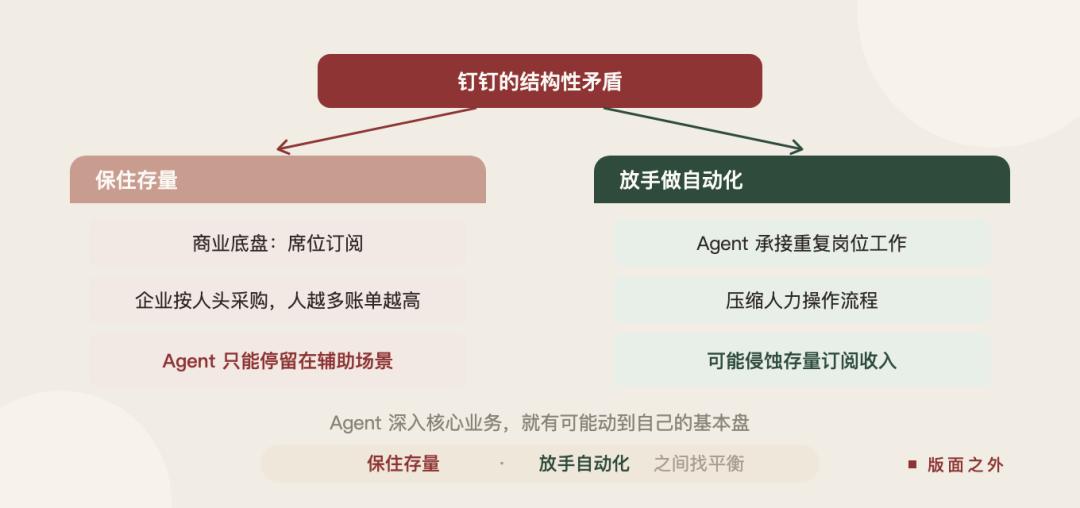
But what is in front of him is a thorny structural contradiction: DingTalk's commercial foundation over the past ten years is built on seat subscriptions, where enterprises purchase accounts by headcount, and the more people there are, the higher the bill. The core value of Agent is precisely to undertake repetitive and standardized post work and compress manual operation processes.
Once Agent is deeply embedded in the core business, it may erode the existing subscription revenue. If you want to maintain a stable SaaS basic market, Agent can only stay in low-risk auxiliary scenarios such as document polishing and meeting summaries, and it is difficult to really reach the core of business operation.
He has to find a narrow balance line between retaining the existing business and boldly promoting AI automation.
At the Yunqi Conference in Hangzhou at the end of September, he raised a question: What is the gross profit margin of our company's East China region in the last quarter?
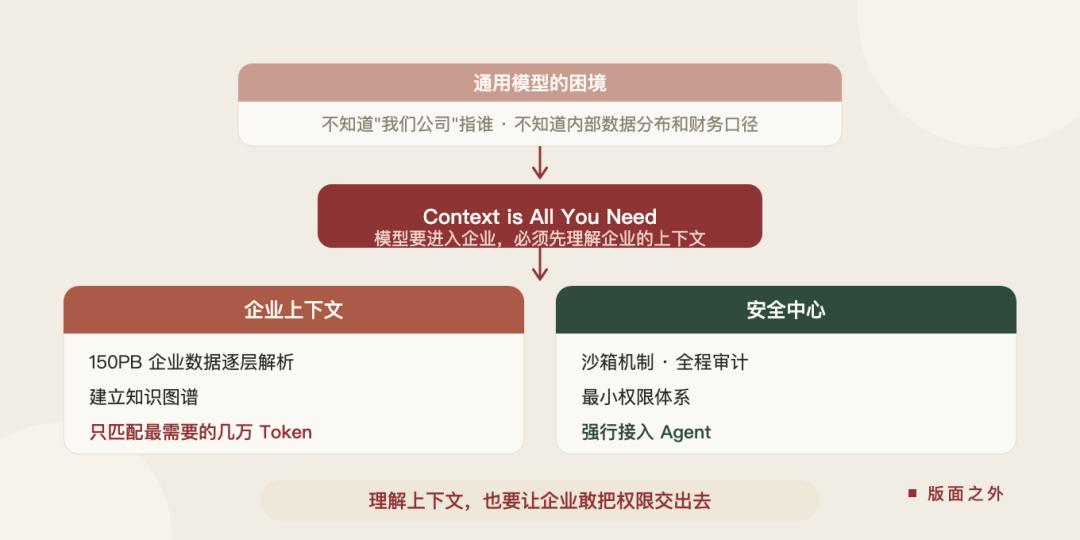
The general model does not know who "our company" refers to, nor does it know the internal data distribution and financial caliber of the enterprise. The model can explain gross profit margin, but may not be able to find the real operating data of a company.
Chen Yusen summed up his judgment in one sentence: Context is All You Need.
For models to enter enterprises, they must first understand the context of the enterprise.
This brought him back to the problem he encountered during the Chaitin Tech period. No matter how strong the technical ability is, it cannot skip the customer's own business rules. The only difference is that products back then needed to understand the security requirements of banks, while today's Agent needs to understand the data, positions and work processes of an enterprise.
Security is also an unavoidable threshold.
Enterprises will not give Agent the permission of core systems just because Agent can complete tasks. Which data can be read, which operations can be performed, and whether exceptions can be traced must all be considered clearly at the beginning of product design.
Chen Yusen, who started his career in security, is no stranger to this.
In order to allow enterprises to dare to let AI handle business, Chen Yusen, who started his career in security, regained the awe he had in the early days in product design.
Qwen Workspace launched "Enterprise Context", which parses 150PB of enterprise data layer by layer and builds a knowledge graph, so that Agent only matches tens of thousands of the most needed Tokens when performing tasks. At the same time, the Security Center forcibly integrates the sandbox mechanism, full-process audit and minimum permission system into Agent.
The Qwen Workspace 2.0 version launched in November further upgraded its positioning from a personal AI office assistant to a Team Agent oriented to individual and organizational collaboration, with the focus shifted to organizational collaboration.
Today's Chen Yusen is no longer just looking for living space for a startup, but carrying Alibaba Group's brand new entry to the enterprise-level market in the AI era.
A few months ago, in that half-mu paddy field on the outskirts of Hangzhou, Alibaba partners including Jack Ma and Wu Yongming went barefoot and transplanted rice seedlings in the mud.
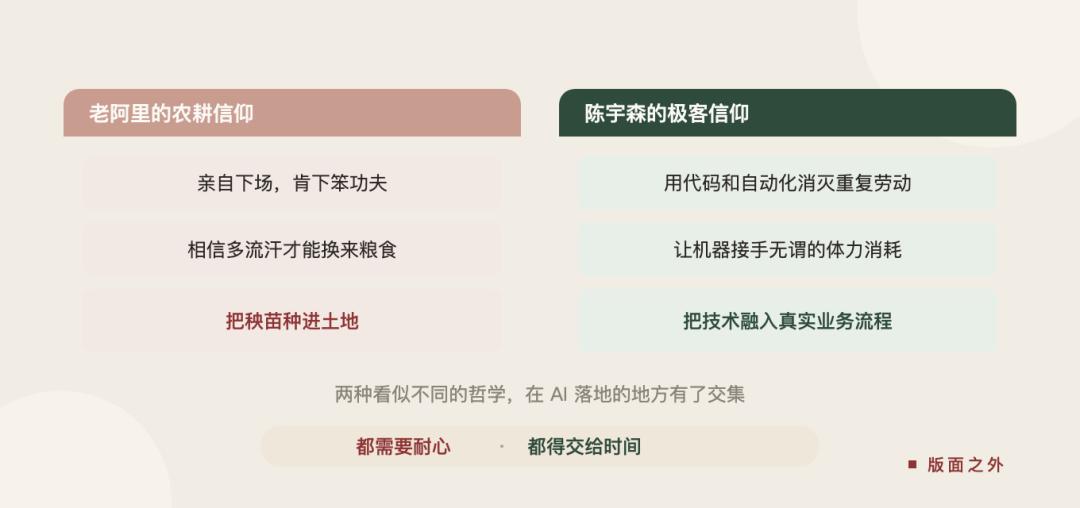
The farming belief of old Alibaba emphasizes going to the front line in person, being willing to put in hard work, and believing that more sweat can bring food harvest. Chen Yusen's geek belief is to use code and automation to reduce unnecessary human consumption, and let AI take over repetitive work.
The two seemingly different philosophies intersect at the point where AI lands.
Transplanting rice seedlings requires patience, and making AI enter enterprises also requires patience. The former is to plant seedlings into the land, while the latter is to integrate technology into real business processes.
As for whether there will be a harvest, it has to be left to time.
Words Beyond The Layout:
The inertia of technicians is to believe that technology can solve problems. But when you really walk into the business world, you will find that there are too many things to understand beyond technology: customer habits, industry rules, organizational boundaries, and those judgments that cannot be replaced by AI.
A person's experience is not only the road he has traveled, but may also become his blind spot when he looks at the next section of the road.
Chen Yusen's several ventures, to a certain extent, are fighting against this inertia. Technology has not become unimportant, but every time a technology wave comes, people are required to re-learn how to use it.
This article is from the WeChat official account "Beyond The Layout", author: Huahua, published with authorization from 36Kr.