Leading photovoltaic giant Tongwei spent 1.4 billion yuan on pig farming, and Liu Hanyuan is not content with only one victory.
Pig prices are still hovering at the bottom, pig farming enterprises are busy stopping losses, but Tongwei has decided to invest 1.441 billion yuan to take over a pig enterprise on the verge of debt crisis.
On November 9, according to the announcement of Tech-Bank Food, Tongwei Group has been confirmed as the restructuring industrial investor of the company, and the two parties have signed the "Restructuring Investment Agreement". According to the agreement, Tongwei Group plans to acquire 1.47 billion transferred shares of Tech-Bank Food at a price of 0.98 yuan per share, with a total investment of 1.441 billion yuan. After the restructuring is completed, Tongwei Group is expected to hold 27.8% of the shares of Tech-Bank Food and become the controlling shareholder of the listed company.
This is not an ordinary industrial merger and acquisition. By the end of the third quarter of 2026, Tech-Bank Food had total assets of about 9.118 billion yuan, total liabilities of about 8.925 billion yuan, and an asset-liability ratio close to 98%. For this former leading enterprise in the pig farming industry, the most urgent task at present is not expansion, but how to survive from the debt quagmire.
But Tongwei obviously saw the other side. The pig cycle is still at the bottom, the industry capacity is continuously adjusted, and the former breeding leaders have begun to find new ways out through restructuring. Liu Hanyuan chose to take action at this time and take over Tech-Bank as an industrial investor, which is obviously not just a financial investment.
The photovoltaic industry has not yet emerged from the trough, and the pig industry has fallen into a new round of adjustment. Two industries, two cycles, Liu Hanyuan chose to place new bets in the trough period.
At the bottom of this photovoltaic cycle, he seems unwilling to win only once.
Tongwei and Tech-Bank are actually old friends
Tongwei is not the first industrial capital to take over distressed pig enterprises at the bottom of the pig cycle.
In 2023, Twins Group did a similar thing. At that time, Zhengbang Technology, a former pig farming giant, was deep in debt crisis, suffered huge losses for two consecutive years, its pig breeding business shrank sharply, its liabilities once exceeded its assets, and it even reached the edge of bankruptcy and restructuring.
Twins finally chose to take over. In December 2023, Twins Group officially became the controlling shareholder of Zhengbang Technology, and jointly provided 4.34 billion yuan of restructuring investment funds with 16 financial investors.
This transaction later became a representative case in the restructuring of pig enterprises. Twins did not simply regard Zhengbang as a listed company waiting for debt repayment, but brought its own feed supply system, breeding management experience and industrial resources into it. In 2024, Twins helped Zhengbang resume production at 59 pig farms and 16 feed mills, with 4.1466 million pigs slaughtered in the whole year, operating revenue reaching 8.87 billion yuan, a year-on-year increase of 26.86%, and achieved positive operating profit in the third quarter of that year.
For Twins, the value of this transaction lies not only in obtaining the control of a listed company, but also in revitalizing a large number of previously suspended breeding assets with relatively limited restructuring investment, and rapidly expanding its own industrial scale.
This also shows the market that distressed enterprises at the bottom of the pig cycle do not mean that all assets have lost their value. For industrial capital with feed supply, breeding management and financial strength, the burden that others are eager to get rid of may also become an opportunity for their own expansion.
Three years later, a similar thing happened to Tongwei.
However, the relationship between Tongwei and Tech-Bank is far more complicated than a single restructuring investment.
As a giant that started with feed and then crossed into the photovoltaic industry, Tongwei began to cooperate with Tech-Bank as early as 2021. At that time, Tech-Bank was in the stage of business adjustment, hoping to divest feed assets and concentrate resources on developing pig breeding. Tongwei hoped to expand the scale of its feed business. The two sides hit it off, and Tongwei acquired a number of aquatic feed and pig feed enterprises under Tech-Bank for 1.271 billion yuan, and agreed to carry out long-term pig feed supply cooperation.
After this transaction, the connection between the two sides did not break off.
In 2024, Tech-Bank transferred 30% of the equity of its core pig breeding platform Shiji Bio to Tongwei Agriculture at a price of 1.65 billion yuan. After the transaction is completed, Tongwei will further enter the field of core pig breeding, and Tech-Bank will get cash back by selling equity.
From feed to breeding, and then to the current pig farming, the industrial relationship between Tongwei and Tech-Bank has actually lasted for five years. However, in the past, Tech-Bank kept selling part of its assets to Tongwei, and now it is Tongwei's turn to prepare to incorporate Tech-Bank into its industrial map as a whole.
But interestingly, Tongwei did not show an eager attitude to buy the dip this time.
The restructuring process of Tech-Bank has actually lasted for quite a long time. Previously, the company had signed restructuring investment agreements with other industrial investors and financial investors, but the relevant investors later withdrew one after another, and the restructuring work once stagnated. It was not until November this year that Tongwei finally became the new industrial investor.
Judging from the transaction arrangement, Tongwei has also left a lot of leeway for itself.
The 1.441 billion yuan is not directly used to purchase shares from the original shareholders of Tech-Bank, but obtained through the transfer of shares from capital reserve. Tech-Bank plans to transfer about 3.066 billion shares, of which 1.47 billion shares will be conditionally transferred to Tongwei, and the remaining shares will be used to pay off debts. The investment fund paid by Tongwei will also be mainly used for bankruptcy expenses, common benefit debts and creditor's rights repayment, rather than directly entering the pockets of original shareholders.
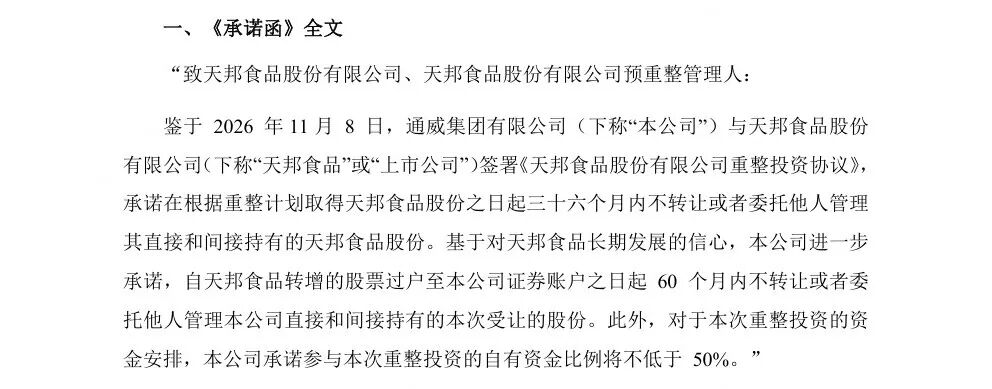
It is more noteworthy that Tongwei has not promised to unconditionally bear all the capital gaps of Tech-Bank. It requires financial investors to participate together and undertake the responsibility of making up for the investment funds that cannot be in place on time; at the same time, Tongwei promises that the proportion of its own funds for this restructuring investment will not be less than 50%, and it has voluntarily extended the lock-up period of the obtained shares to 60 months. According to the agreement, Tongwei also needs to pay an investment deposit of about 288 million yuan in advance, accounting for 20% of the total investment amount.
This means that although Tongwei is willing to take the role of industrial investor, it does not intend to take all the risks on itself. It needs other investors to contribute capital together, needs the court to finally approve the restructuring plan, and needs the original assets of Tech-Bank to truly resume operation after restructuring.
To a certain extent, this transaction is similar to Twins' restructuring of Zhengbang: both are industrial capital acquiring the existing assets of distressed enterprises through restructuring during the industry trough. But Tongwei's strategy obviously puts more emphasis on the synergy between industrial chains and the control of investment risks.
After all, Tongwei itself has not yet emerged from the trough of the photovoltaic industry. The capacity and capital pressure formed by continuous expansion in the past few years still exists, and the group level has continuously suffered large operating losses. In this context, 1.441 billion yuan is not a number that can be completely ignored.
Rather than saying that Liu Hanyuan is taking a big gamble on a financial investment at the bottom of the pig cycle, it is better to say that he is using a relatively prudent way to reoccupy a piece of agricultural industrial territory for Tongwei.
Liu Hanyuan is still looking for the next card of photovoltaics
If the restructuring of Tech-Bank is a step for Tongwei to re-integrate the agricultural industrial chain, then the ongoing acquisition of Qinghai Lihao is another bet by Liu Hanyuan in the photovoltaic industry.
In fact, this is not the first time that Tongwei has tried to acquire competitors during the trough of the photovoltaic industry.
In August 2024, Tongwei Co., Ltd. announced that it plans to acquire no less than 51% equity of Runyang Co., Ltd. through capital increase and equity acquisition at a price of no more than 5 billion yuan.
Runyang used to be one of the top three enterprises in the world in terms of photovoltaic cell shipments, and has layout in multiple links of the photovoltaic industrial chain. But as the industry entered a cycle of overcapacity, this former star enterprise also fell into operating difficulties, with pressure on the capital chain and some production bases suspended.
For Tongwei, which was also in the industry trough at that time, this was originally a very attractive transaction: with an investment of no more than 5 billion yuan, it had the opportunity to obtain the control of a former global leading cell enterprise.
But this acquisition, which was highly expected by the outside world, was not finally reached.
In February 2025, Tongwei announced the termination of the intentional capital increase to Runyang, on the grounds that after multiple rounds of due diligence and business negotiations, all parties to the transaction still failed to reach an agreement on some business terms.
Although Tongwei withdrew, the story left by Tongwei to Runyang did not end.
As early as when Tongwei proposed the acquisition, Yueda Group under Yancheng State-owned Assets had already participated in it, invested 1 billion yuan in advance, and gradually intervened in the operation and management of Runyang. The original arrangement was that after Tongwei completed the transaction, it would acquire the equity obtained by Yueda's previous capital increase.
After Tongwei withdrew, Runyang continued to rely on state-owned assets support and supplier debt-to-equity swap for relief.
In February 2025, Jiejia Weichuang and Autowell subscribed for Runyang's shares with 720 million yuan and 180 million yuan of creditor's rights respectively, and obtained a total of about 10.11% of the equity. Since then, equipment enterprises such as Tuosida, Roboteck, Gaote Co., Ltd. and Jingshan Light Machinery have also participated in capital increase or debt-to-equity swap one after another.
The former equipment suppliers have successively become shareholders of Runyang. By the end of June 2025, the total amount of debt converted into shares involved by the six equipment enterprises reached 1.31 billion yuan, plus the 1 billion yuan previously invested by Yueda, Runyang has obtained a total of about 2.31 billion yuan of capital and debt relief support.
However, these capital and debt adjustments did not make Runyang quickly get out of the trough. In 2025, Runyang achieved an operating revenue of 11.407 billion yuan, but still had a net loss of 1.601 billion yuan.
In a sense, Runyang's subsequent experience also explains why Tongwei did not insist on completing that acquisition: although the assets at the trough of the photovoltaic industry are cheap, the debts, operating losses and continuous investment that need to be undertaken after taking over are not necessarily easier than the acquisition price itself.
However, giving up Runyang does not mean that Liu Hanyuan has given up mergers and acquisitions.
In 2026, Tongwei turned its attention to Qinghai Lihao. Unlike Runyang, which spans multiple links of the photovoltaic industrial chain, Lihao mainly focuses on polysilicon business, and currently has an annual production capacity of 150,000 tons of photovoltaic high-purity crystalline silicon. For Tongwei, which itself is one of the global leading polysilicon enterprises, this is a more familiar industrial asset.
In March this year, Tongwei disclosed the transaction plan for acquiring 100% equity of Lihao Qingneng, and the estimated total transaction consideration is no more than 4.8 billion yuan. If the transaction is successfully completed, Tongwei will further expand the scale of silicon material production capacity on the original basis, and integrate Lihao's resources in green energy, high-purity crystalline silicon and other aspects.
But like Runyang, Lihao is also in operating loss.
In 2025, Lihao Qingneng had a net loss of 379 million yuan; in the first three quarters of 2026, the loss further expanded to 676 million yuan. Under the background that the photovoltaic industry has not yet resumed profitability, this acquisition also means that Tongwei needs to bear considerable operating pressure.
Therefore, even if the two parties have launched the transaction, Tongwei is not in a hurry to finalize the final plan.
In September this year, Tongwei announced that due to changes in the market environment of the photovoltaic industry, all parties to the transaction still have differences on specific terms, and it is temporarily unable to promote the review of the shareholders' meeting according to the original plan. Although the transaction subsequently passed the anti-monopoly review of concentration of operators, the price and specific plan still need further negotiation.
By the end of October, Tongwei adjusted the pricing benchmark date for issuing shares to purchase assets, and lowered the issue price from 15.20 yuan per share to 9.12 yuan per share. As of the beginning of November, the two sides have not finalized the final transaction plan.
From Runyang to Lihao, Liu Hanyuan's M&A attempts in the photovoltaic industry have always been accompanied by repeated negotiations and trade-offs. Even if he is optimistic about the long-term value of the assets, he will not force a shot to complete the acquisition if the transaction conditions are not appropriate.
But more noteworthy than this prudence is his unstopping willingness to expand.
In the past two decades, Liu Hanyuan brought a feed enterprise into the photovoltaic industry, and finally pushed Tongwei to an important position in the global photovoltaic industrial chain. Today, the era of high growth in the photovoltaic industry has temporarily come to an end, and overcapacity and price competition are testing every enterprise again.
Liu Hanyuan once again chose to look for opportunities when the industry was at its most difficult.
Whether it is the uncompleted Runyang, the ongoing Lihao, or Tech-Bank that has just signed the restructuring agreement, these transactions all show that Liu Hanyuan is not satisfied with maintaining the industry position that Tongwei has already achieved.
After all, Liu Hanyuan, who has won once with photovoltaics, seems unwilling to win only once.
This article is from the WeChat official account "Super Focus foci", written by Sean, and published with authorization from 36Kr.