The platforms are even more eager to "change" the Double 11 Shopping Festival than the general public.
Double 11 has just turned 18, and the e-commerce platforms that raised it from scratch have already started figuring out how to dismantle it.
On October 15 this year, Tmall and JD held their Double 11 launch events on the exact same day by coincidence. In previous years, this was almost the most passionate pre-battle mobilization of the year for the two e-commerce giants: discounts, subsidies, traffic, transaction targets... Any side that failed to show unprecedented overwhelming momentum would be considered the loser.
But this year, the two platforms clearly have new plans in mind.
Tmall announced that 1 million brands and 72 million products will participate in the promotion. But compared with discounts, Jiang Luo, President of Tmall, prefers to talk about how AI can discover unexpressed consumer demands and help brands unlock new business opportunities. Even Tokens, which used to be mainly targeted at programmers and enterprise customers, have become new products for this year's Double 11. Li Jiaqi sold 100,000 copies of the Qianwen Office Monthly Card with a total equity of 2 trillion Tokens in half an hour on November 2.

JD is not willing to fall behind either. Apart from direct price cuts, it has launched more than 100 consumer services and over 200 productive services for enterprises, ranging from home appliance installation to housekeeping maintenance, from logistics to industrial services, as if it wants to take over all possible and impossible businesses in the retail industry.
For years, platforms have been building Double 11 into a public-facing transaction performance. But this year's launch event looks more and more like a business showcase for the next round of competition. Platforms have not stopped investing in Double 11, but have begun to use Double 11 to invest in the future.
The ones who feel lost are consumers, who used to be held in the palm of the entire e-commerce industry and served with the utmost care, yet still constantly complained.
It should be noted that 11 years ago, when Tmall and Hunan TV first jointly created the "Tmall Double 11 Gala", Jack Ma shared the stage with Daniel Craig, the lead actor of 007, and the big screen even displayed the words "Bond Girl — Jack Ma".
It's just a pity that Jack Ma appeared on stage in a formal suit, which somewhat failed to meet the audience's expectations.
But after all, apart from the Tmall Gala, where else can you find a top internet tycoon with a fortune of hundreds of billions putting on a show to entertain the public at an entertainment gala?
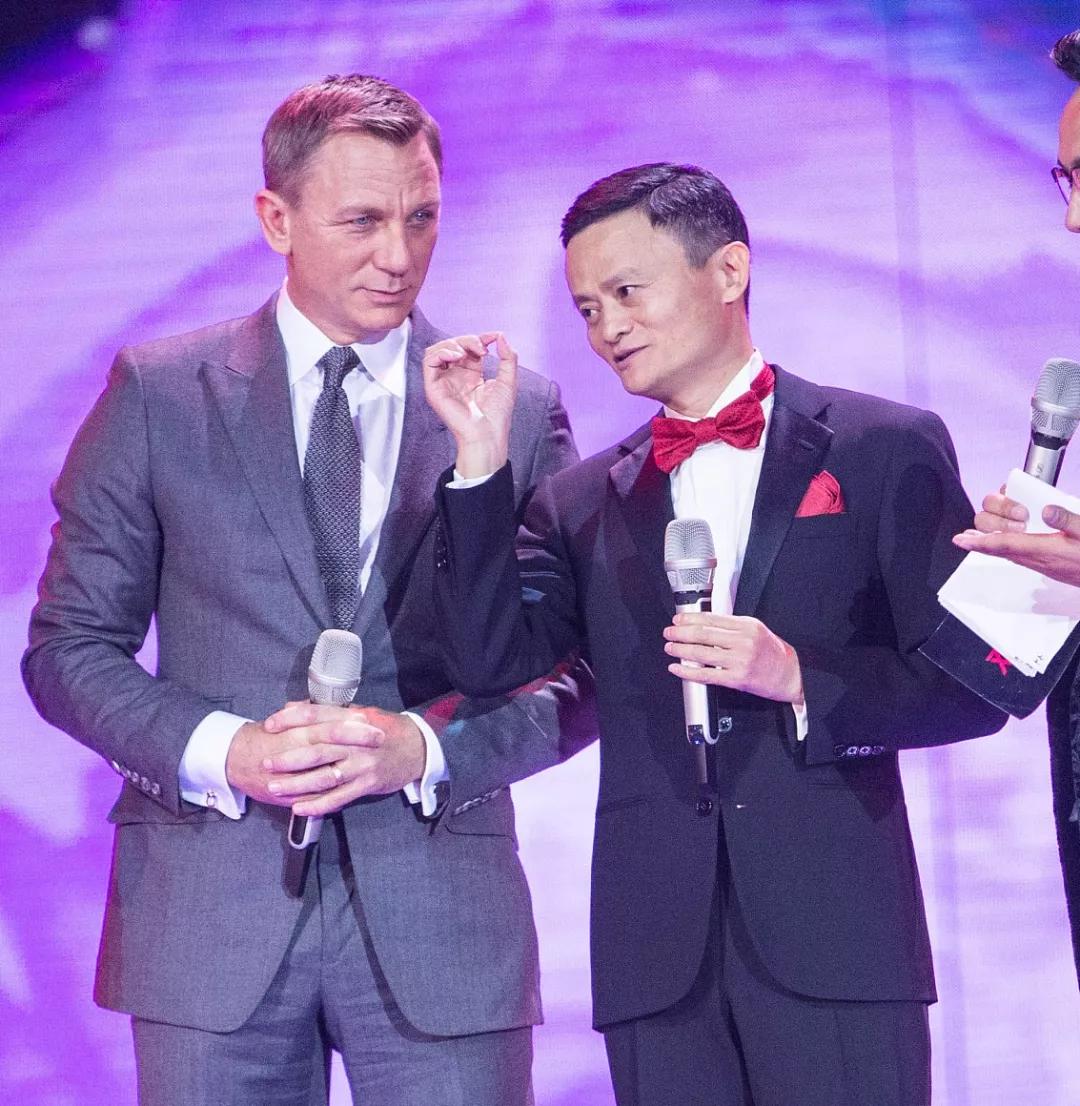
It is no wonder that in the past two years, many people have posted on various social media platforms lamenting that Double 11 no longer has the festive atmosphere it used to have, and we used to treat it as grandly as the Spring Festival.
In 2015, the then-newly rising top-tier idol group TFBOYS sang the song Big Dreamer on the stage of the Tmall Gala; in 2018, Mariah Carey performed Hero; in 2019, Taylor Swift also made an appearance.
From domestic top stars to international superstars, it almost felt like the whole world was celebrating the fact that Chinese people had enough money to shop. Even the age-old Chinese greeting "Have you eaten?" was replaced by "Have you bought anything?" under the vibe of November 11.
But brand reputation is brand reputation, and business is business.
This year, platforms continue to hold galas and distribute red envelopes, enjoying the nationwide awareness accumulated from 18 years of building this shopping festival; on the other hand, they are personally dismantling the most important old business rules.
The time-limited discounts that consumers once had to stay up late to snap up have now been replaced by spot sales starting as early as October; the ten-billion-yuan subsidy has become a permanent channel, with promotions running in live streaming rooms every day; the cross-store full reduction and deposit pre-sale mechanisms that were designed in the past to encourage consumers to buy more items are also being gradually simplified by platforms.
Consumers have got used to waiting for Double 11, but platforms increasingly do not want consumers to only shop on Double 11. Creating the festival and dismantling the festival serve the exact same purpose.
The group of people who most want to dismantle Double 11 are now right in the middle of Double 11, bustlingly searching for their next business opportunity.
Platforms Want to Dismantle Double 11 Even More Than Consumers
Double 11 is a rather ingenious business invention. Its most powerful advantage is not low prices, but making hundreds of millions of people willingly wait to spend money on the exact same day.
As a festival, it essentially sells a kind of temporal scarcity. Platforms concentrate discounts, traffic and merchant resources on a single node, while consumers exchange waiting for low prices. This also makes factories, warehouses, logistics and payment systems operate around the same peak, making the consensus that "Double 11 offers the lowest price of the whole year" something that does not need repeated explanation to consumers.
But waiting itself goes against human nature.
Then Pinduoduo emerged, adopting a supply-side reform mindset, launching the permanent "Ten Billion Yuan Subsidy" against the annual grand event Double 11 that had been built with huge investment, and putting forward the slogan "Enjoy 618 every day, celebrate Double 11 every night".
Then Taobao, JD and other platforms, while acting dismissive of the market outside the Fifth Ring Road, honestly followed suit.
After all, the simple wish of the public is that happiness does not require waiting, and the public will vote with their money.
But the arrival of AI pushed this matter to another stage in 2026.
For all e-commerce business owners selling accessories, image production is a huge money pit. Shooting angles, light and shadow effects, model matching, and post-retouching presentation all require meticulous work. Lin Muyun, owner of Zhuoheng Jewelry, said he spent more than 2 million yuan on this every year. Until AI came along, employees started taking photos of products with their mobile phones, uploading them to the platform, selecting scenarios and models, and automatically generating product images.
2000 images can be produced in a single day.

Zhuoheng Jewelry store in Yiwu
There are many business owners like Lin Muyun in Yiwu, Zhejiang Province. He said that the content production cost has now dropped to less than 80,000 yuan, a decline of more than 96%. It can be seen that AI is forcing the marketing capabilities of merchants of all sizes to be leveled to the same baseline through technological equalization.
The same logic applies to customer service teams.
According to official information, the new version of AI Shop Xiaomi launched by Taobao and Tmall this year has released a very competitive price: the average cost of each consultation for traditional human customer service is about 2 yuan, while the AI standard version costs 0.2 yuan per consultation, and the advanced version only costs 0.5 yuan.
If a store receives 10,000 consultations per month, the total cost for full human customer service is about 20,000 yuan.
If the standard AI version is used, the basic cost for 10,000 consultations is only 2,000 yuan. Even if 30% of the consultations still need to be transferred to human agents, which adds up to 6,000 yuan at 2 yuan per consultation, the total cost is only 8,000 yuan.
That saves 12,000 yuan a month, which amounts to 144,000 yuan a year.
Compared with the surge in efficiency brought by AI, the traditional Double 11 bill is becoming increasingly unattractive.
Yu Yaming, a home furnishing merchant in Ganzhou, Jiangxi Province, has a not-so-pretty account to calculate.
Normally, the daily advertising cost of his three stores is about 6,000 yuan. During the 2026 Double 11, the maximum daily investment exceeded 20,000 yuan, meaning an extra 14,000 yuan was spent every day for the festival. Assuming that for every 100 yuan of new net sales, 20 yuan can be retained after deducting the cost of goods and performance to cover the additional advertising cost, the extra 14,000 yuan spent every day needs to bring in at least 70,000 yuan of new net sales to break even.
If only 10 yuan can be retained, merchants need to make an extra 140,000 yuan in sales.
During the entire Double 11 period, the total sales of one of Yu Yaming's single stores was only 157,000 yuan. This calculation only made sense back in the days when Double 11 could drive order volumes 5 to 10 times higher than usual.
Behind merchants' growing reluctance to go all out for Double 11 is the continuous decline of return on investment. At this point, the shift from "creating the festival" to "dismantling the festival" has become inevitable.
Behind the fact that platforms want to abandon Double 11 even more than consumers is that the marginal value of the old ritual is declining, while the strategic value of new entry points is rising.
In short, platforms believe that investing in AI is far more cost-effective than investing in festival marketing and dazzling subsidies.
What Merchants Are Facing Is Not Easy Wins, But A New Set of Screening Mechanisms
AI has turned merchants' operational capabilities into year-round non-stop daily services, but the accompanying pain is that the apparent cost savings do not necessarily lead to higher final profits.
I have recently been reviewing many cases of AI reducing operating costs, and I often come across data with a strong touch of black humor. For example, a domestic beauty brand once used AI to produce short videos, cutting the production time from 15-30 minutes to 6 minutes, reducing time cost by about 70%. The click-through rate of AI-edited mixed videos reached 10.25%, which is 2.4 times that of human-edited videos.
This fits perfectly into the efficiency narrative of the AI era, doesn't it?
The problem is that the order conversion rate brought by AI videos is only 67.3% of that of human-edited videos.
In plain language, after all that effort, the return on investment has barely caught up with the level of human operation.
And this does not even include the cost of purchasing AI services and Tokens.
Beneath the overwhelming wealth narrative of how to make money with AI lies human beings' guard against AI. It can figure out how algorithms make recommendations, but it is clearly still not skilled enough at convincing humans to make payments.
Worse still, after AI leads to excess productivity in commercial advertising, merchants have started a new round of cutthroat competition to grab consumers' attention.
And one thing the internet industry is best at is putting a price tag on attention.
According to the research report released by iResearch in October 2026, for every 100 yuan of paid GMV generated by Douyin e-commerce merchants in 2025, the comprehensive expenditure on advertising, influencers and transaction services was about 30 to 60 yuan; for Taobao and Tmall, it was about 10 to 22 yuan, and for JD, it was about 6 to 20 yuan.
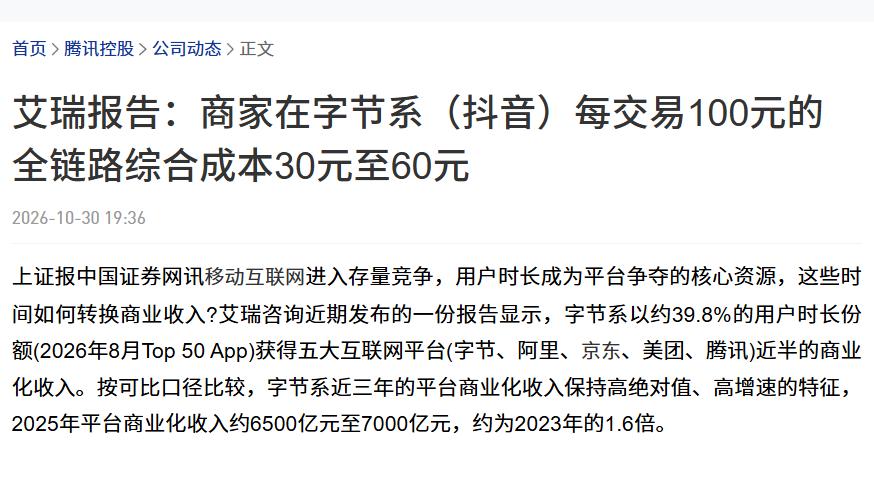
Among them, for every 100 yuan of transaction volume on Douyin e-commerce, the corresponding advertising expenditure is about 10 to 12 yuan, the service expenditure for influencers and MCNs is 18 to 48 yuan, and the transaction commission and technical service fee are 2 to 3 yuan.
Merchants have not made more money, they just reallocated the money that used to be paid to photographers and designers to streamers and traffic platforms. The efficiency dividend has not even been warmed up before it is divided up by the next round of competition.
My designer friends are quite dissatisfied with this. They curse that streamers are evil resellers. But the sad part is that streamers are not the only players on this road.
In August this year, Douyin Local Life launched a charging policy for specific channels such as Doubao. According to the accommodation category rate displayed in the merchant background, the comprehensive rate for transactions completed through the main Douyin site is about 8%; for transactions completed through Doubao, the total cost is 12%, consisting of 11.4% software service fee plus 0.6% payment processing fee.
That means for a hotel that completes an order with a billing base of 1000 yuan, the channel fee on the main site is 80 yuan, while the fee on the Doubao channel is 120 yuan. This calculation is only particularly cost-effective on the condition that Doubao can bring in new customers.
From photographers to streamers, from search boxes to dialog boxes, the technological revolution has indeed reduced certain operating costs, but it has not freed merchants from the fate of paying for their business.
For platforms, the greater opportunity of this technological revolution is not at all about cost reduction, but about re-deciding who will get to collect the money in the future.
AI Will Not Kill E-Commerce, But It Will Redistribute "Who Gets to Make Money"
If you are going to kill the goose that lays golden eggs with your own hands, you naturally need to plant another cash cow that can make even more money.
Over the past 18 years, e-commerce platforms have organized consumers, merchants and products in one huge market. Merchants keep bidding to compete for limited customers, and platforms have built a huge advertising and transaction service business in this competition.
Double 11 is nothing more than turning this money-making machine up to full power.
But as traffic growth slows down, traditional e-commerce advertising and marketing services no longer expand at a high speed as they used to, so platforms have to figure out their next business.
First, let's look at Alibaba, the creator of Double 11.
In fiscal year 2026, Alibaba Cloud Intelligence Group recorded a revenue of 158.132 billion yuan, a year-on-year increase of 34%. Meanwhile, the adjusted EBITA of Alibaba's China E-Commerce Group dropped from 193.223 billion yuan to 107.509 billion yuan, a decrease of about 85.7 billion yuan or 44%. Alibaba mainly attributes this to investment in instant retail, user experience and technology.
The traditional e-commerce business still generates hundreds of billions of yuan in operating income, and the