The performance of the North American film industry has hit a new record high. Where exactly are we falling behind?
In early November, the financial reports of the U.S. film industry for the first three quarters were all released, with cinema chains, projection formats and studios all performing strongly. Among them, AMC, Cinemark and IMAX all posted record-high Q3 revenues in their corporate histories. The third-quarter financial reports of A-share listed film and television companies have been fully disclosed, with 6 out of 7 recording revenue declines. According to data from Beacon Professional Edition, the total national box office in the first three quarters reached 29.581 billion yuan, down by about 29.5%, while the box office in October alone was 2.046 billion yuan, the lowest figure since statistics began in 2014.
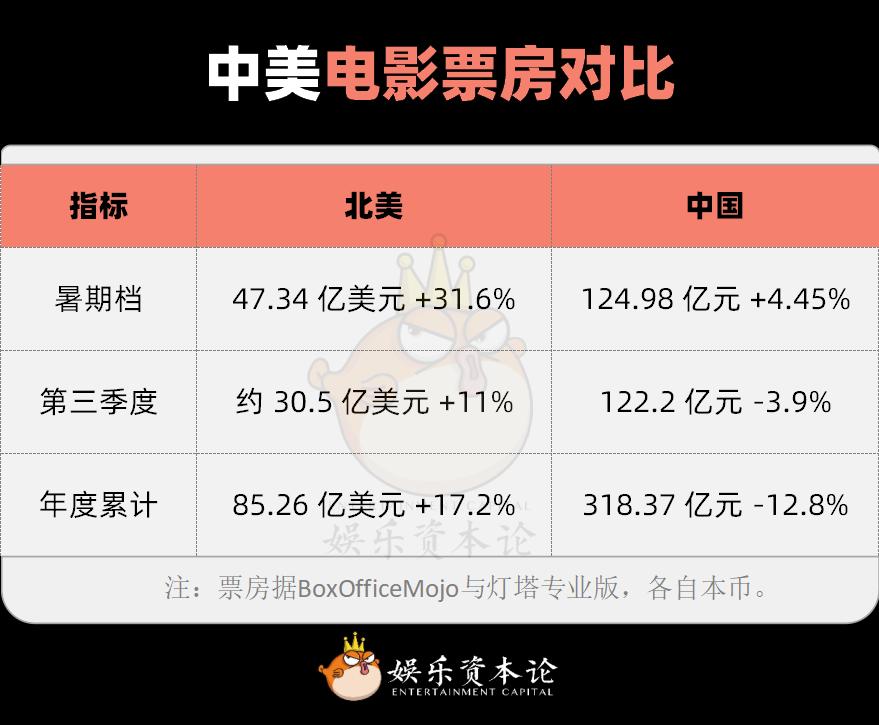
As of November 10, the cumulative annual box office in North America has reached 8.526 billion U.S. dollars. According to forecasts, North America will definitely return to the 10-billion-dollar era in 2026, which is also the first time it has exceeded 10 billion U.S. dollars since 2019.
What has led to this starkly contrasting situation?
The entire U.S. film industry is on the rise, with Gen Z's return as the core driving force
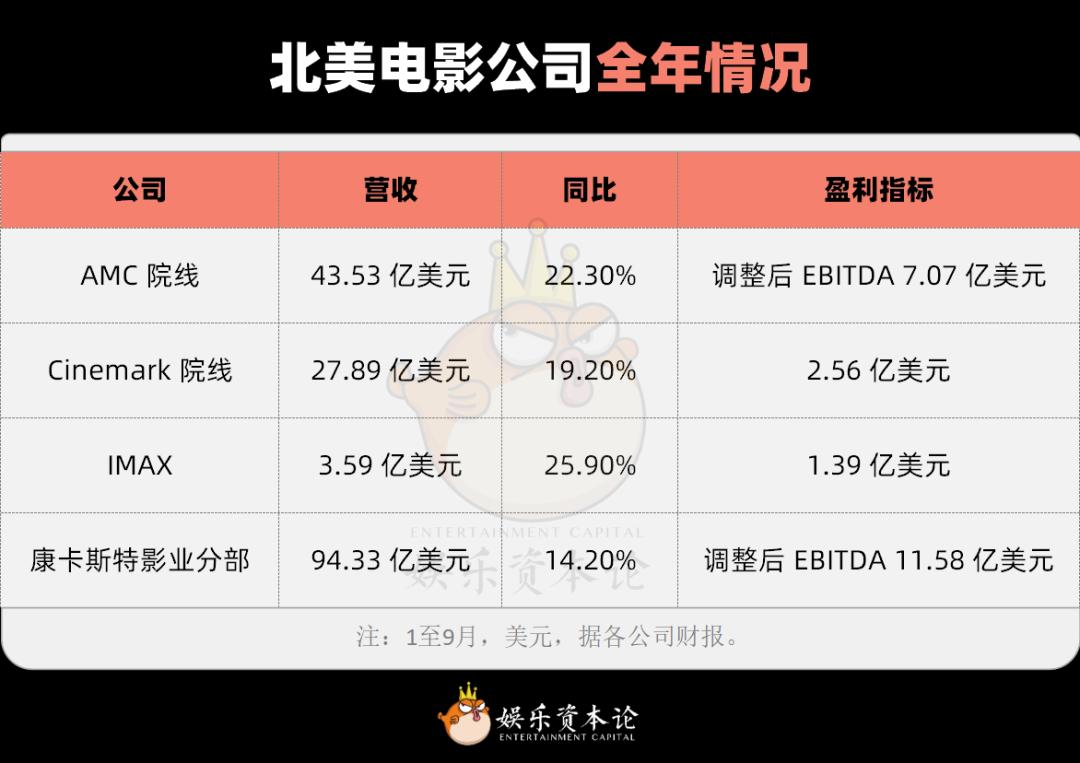
According to the financial reports of various companies, their revenue growth rates outperformed the overall box office market: IMAX's global box office totaled 1.257 billion U.S. dollars in the first three quarters, with *The Odyssey* alone contributing 538 million U.S. dollars. In Comcast Pictures' segment financial report, theatrical distribution revenue reached 2.217 billion U.S. dollars, up 83.3%. According to its financial report, Sony's film division revenue for the three months ended September 30 was 513.7 billion yen, up 48%.
Behind these achievements, the group that North American cinema chains have been waiting for the past two years is now voluntarily returning to theaters. In a survey Fandango distributed to 5,000 audiences in April this year, 87% of Gen Z respondents said they had been to cinemas in the past year, and these people go to cinemas an average of about 7 times a year. This group has reincluded going to the cinema in their daily consumption lists.
More solid evidence can be found on the box office charts. According to the BoxOfficeMojo annual chart, *Obsession* grossed 263 million U.S. dollars, and *The Backrooms* grossed 198 million U.S. dollars. The directors of both films are from YouTube, young creators who grew up on content platforms. These creators know the rhythm of storytelling, know when the audience will get distracted, and know how to convert the attention they accumulated online into offline movie tickets.

The accounting books of cinema chains are also changing accordingly. According to Cinemark's financial report, the box office of premium formats increased by 50% in the third quarter; IMAX, with less than 1% of the global screen count, captured 6.7% of the global box office in that quarter. Profit indicators are shifting from the number of screens to the output efficiency of each individual screen, and the new generation of young audiences are willing to pay a premium for better audio-visual experience and larger screens.
However, the 87% figure does not mean a full-scale recovery. The North American market is still dominated by top blockbusters, with one or two hit films propping up an entire quarter, while the living space for mid-tier films continues to shrink. The growth of premium formats essentially concentrates limited movie-going frequency on more expensive tickets, with the average ticket price rising, but the number of moviegoers does not necessarily increase in tandem.
For film producers, the real takeaway from this survey is this: Gen Z's attendance is won by content that resonates and a solid viewing experience, not by nostalgic gimmicks. Their attention has never disappeared, it has only become more selective.
Seven Chinese film and television companies: only one records revenue growth, what cinemas lack is good films
While Gen Z in North America is returning to cinemas, the third-quarter financial reports in China paint a different picture. In the first three quarters, among the seven film and television companies, only Huace Film & TV posted positive revenue growth, reaching 1.212 billion yuan, up 16.5%, with attributable net profit of 177 million yuan. It is still supported by its drama segment, as making money from selling TV series is more stable than making money from movie ticket sales.
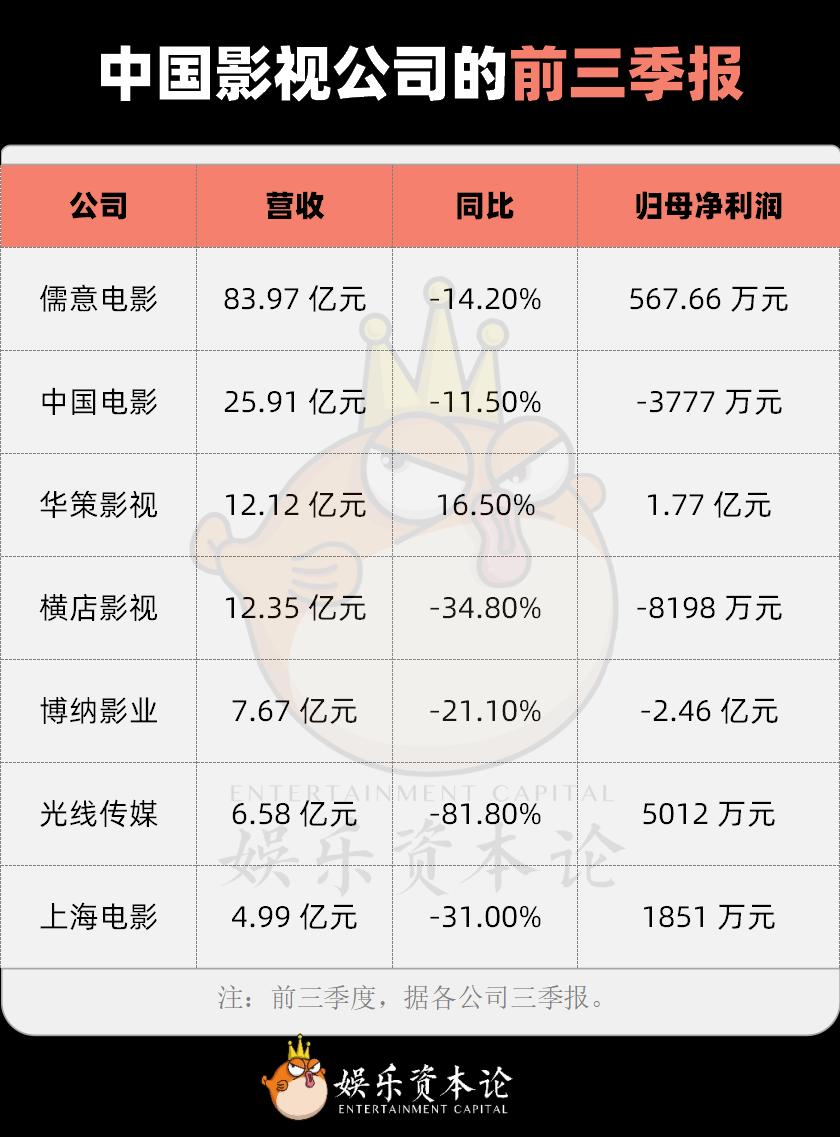
Box office giants are facing tighter operating conditions. Ruyi Pictures recorded revenue of 8.397 billion yuan, down 14.2%, with attributable net profit of only 5.6766 million yuan. Fortunately, it rebounded in the third quarter alone: its non-recurring net profit reached 160 million yuan, up 22.08% year on year. Films including *Eight Immortals* and *Welcome to the Dragon Restaurant* made up for part of the losses, barely keeping its full-year book in the black. China Film's revenue stood at 2.591 billion yuan, down 11.5%, with attributable net loss of 37.77 million yuan, turning from profit to loss: the cumulative box office of its produced films reached 16.923 billion yuan, but distribution advances and rents ate up all the profits. Hengdian Pictures' revenue dropped by 34.8% with a loss of 81.98 million yuan. Its cinema chains are mostly located in lower-tier cities, but box office revenue is concentrated in first- and second-tier cities. Enlight Media's revenue fell by 81.8%, weighed down by the high base from last year's *Nezha: The Devil's Birth 2*. Bona Pictures posted revenue of 767 million yuan, down 21.1%, with a loss of 246 million yuan, and its new AI-produced film *Sanxingdui* even disappointed its shareholders.

Compared with the U.S. market driven by Gen Z's return, the structure of Chinese movie audiences is completely different.
Group movie-going is a form of offline socializing for Gen Z in the United States. In China, the average age of moviegoers is going up — according to the closing data of Beacon Professional Edition for the 2026 summer season, the proportion of ticket buyers under 25 years old is only 11%, down 4 percentage points year on year, less than half of the figure in 2022; the 25-29 age group accounts for 20%, down another 3 percentage points year on year; the proportion of people over 40 years old has risen to 26%, the highest in nearly five years.
Our correspondent found that the more worrying trend is that the entire Chinese film industry has fallen into "de-socialization": according to data from Beacon, the proportion of people watching movies alone in China has risen for four consecutive years, reaching 28% this year, while the proportion of pairs watching movies together has dropped from 65% in 2021 to 57%. Young people in North America regard going to the cinema as a gathering activity, while more and more young people in China are going to watch movies alone.
However, another set of data from Beacon shows that young people have not completely left the cinema, they just treat going to the cinema as a one-off event. The gap between "preference" and "necessity" for film genres is the most telling: young people's preference for thriller and horror films is only 14%, but the necessity rating is 37%, a gap of 23 percentage points — they say they don't like this genre, but they still buy tickets when such films are released. This demand was fulfilled this year by *The Backrooms* and *Obsession*, which grossed 184 million yuan and 215 million yuan respectively in China, with the proportion of audiences under 25 nearly twice the overall market average. A more extreme example is *Here Comes the Cow*, which has the highest proportion of audiences under 19, with its screening share rising from less than 1% to 7.88%, earning nearly 60 million yuan entirely through fan-made secondary content and viral memes.
For the same generation of Gen Z, going to the cinema has become a habit in North America, while in China, going to the cinema is treated as a special event. How to win young audiences back from new content formats such as short dramas has become the biggest challenge for Chinese filmmakers.
This article is from the WeChat Official Account "Yule Ziben Lun" (ID: yulezibenlun), written by the Yuzijiang Team, and published with authorization from 36Kr.