Stock up on great goods in previous years, hoard computing power this year: The booming Token enters mass consumption.
A term that originally belonged exclusively to engineers has appeared on the most popular mass-market e-commerce shelves and livestreaming rooms across China, and been added to ordinary people's shopping carts. This in itself is a signal that it is accelerating its march into mass consumption scenarios.
50% off for Zhipu weekly pass, 50% off across all MiniMax monthly passes, 70% off for Qoder Pro, 67% off for Qwen Work monthly pass...
On November 11, the Double 11 Shopping Festival — China's largest grand shopping event and barometer of consumer trends — officially celebrated its 18th "coming-of-age ceremony". For the first time as a mass consumer product category, Token entered livestreaming rooms and e-commerce platforms. On the exact day of Double 11, multiple official flagship stores directly offered 30% and 50% discounts, further promoting Token to mass consumers with "super low prices".
Prior to this, Token had become the most high-profile topic of this year's Double 11. After going viral across multiple trending search lists, the transaction volume of the Token category on Taobao surged 450% month-on-month on the first day of Double 11 sales. On November 2, Li Jiaqi's livestream sold 100,000 copies of Qwen Work monthly passes in half an hour, corresponding to a total AI computing power quota of roughly 2 trillion Tokens.
Multiple observers believe that compared with traditional "high-sales categories" such as apparel, 3C digital products, food, and beauty, the sales volume of Token is still relatively small. However, a term that once only belonged to engineers, appearing on China's most popular mass-market e-commerce shelves, entering China's most popular mass-market livestreaming rooms, and being added to ordinary people's shopping carts, is in itself a signal that far exceeds the event itself:
On the demand side, computing power has officially bid farewell to the era of only geeks being early adopters, and begun to move towards mass consumption; on the supply side, Tmall is becoming a key consumption entrance for the concentrated debut, transaction and experience of AI products.
Zhang Yi, CEO of iiMedia Research, judged that this is more like a C-end market enlightenment movement under the Token economy, pulling AI commercialization and B-end technical narratives into the context of mass consumption, making Token a consumer product that ordinary users can also stock up on. Chen Duan, Director of the Digital Economy Integrated Innovation Development Center of Central University of Finance and Economics, believes that this is a "landmark event of AI commercialization extending from the B-end to the C-end".
Now that the enlightenment phase is complete, the next question to answer is: How far is Token from becoming a truly daily consumer product?
Tmall has become the primary scene of Token consumerization
Token, namely word token, is the smallest basic unit for large language models to process natural language. Every call to write copy, generate PPT, create videos, and sort out documents with AI consumes Tokens. It is to AI what electricity is to computers; without Tokens, all kinds of AI tools cannot operate.
As AI continues to penetrate daily work and life, students, white-collar workers, and self-media creators have all begun to use large language models at high frequency, and turning to AI for help for various matters has become a new habit, making Token consumption scenarios ubiquitous.
When Token officially entered the Double 11 e-commerce shelves and livestreaming rooms, ordinary consumers had a very distinct intuitive feeling: computing power has become cheaper, and buying Tokens has also become much simpler.
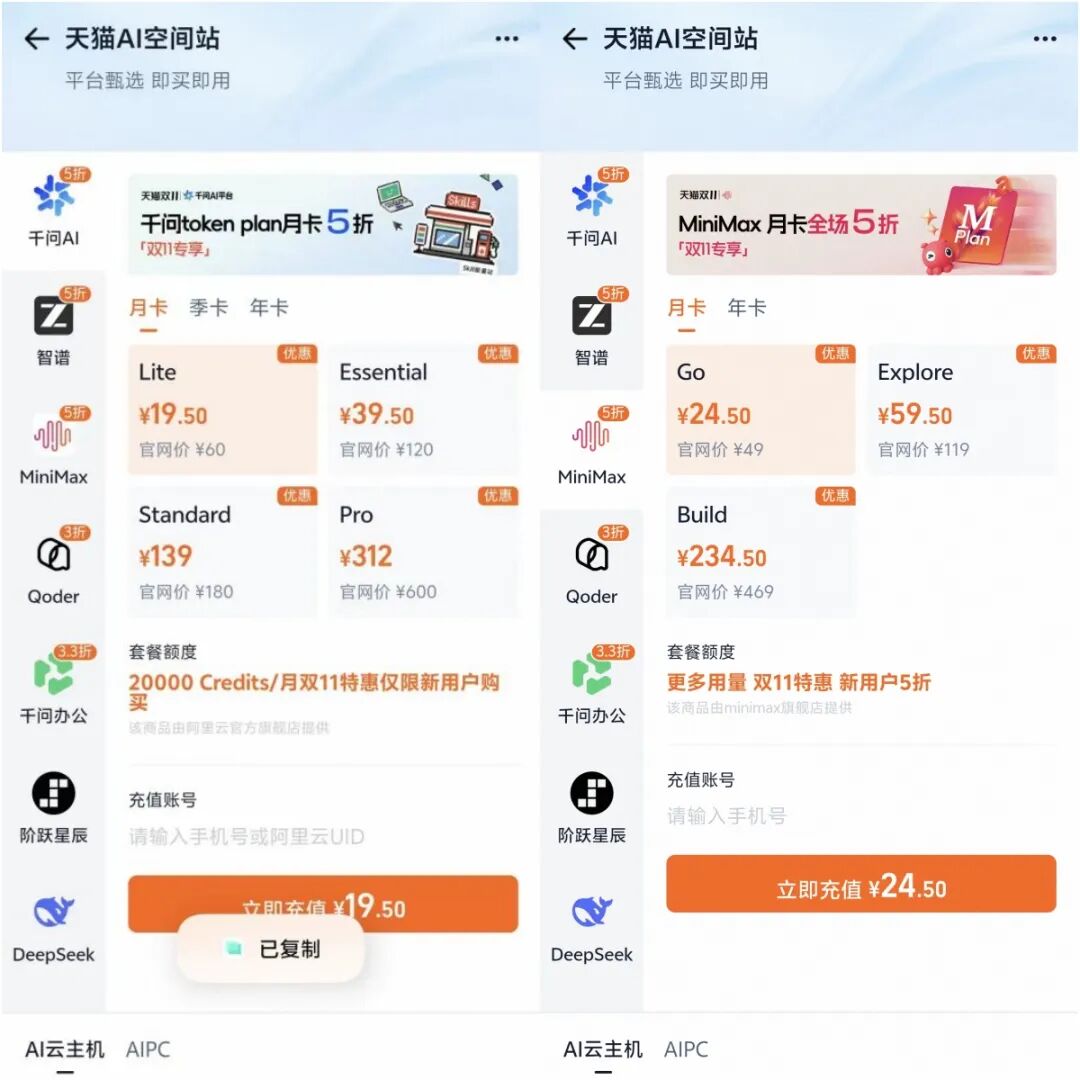
"It is really much more cost-effective than usual." 37-year-old Zhou Zhengkang is an ordinary white-collar worker who is used to editing and making family short videos with AI in his spare time. During this year's Double 11, he bought multiple Token packages from Alibaba Cloud, MiniMax, and Qwen AI Lite in one go, spending a total of more than 200 yuan.
"Now even people with zero foundation can make videos with AI. The real threshold is the continuous computing power cost. Stocking up during the promotion discount means I don't have to budget carefully for the next several months." Zhou Zhengkang gave an example that the Alibaba Cloud Token Plan Personal Edition Lite he selected is compatible with 22 large language models, with a monthly payment of only 19.5 yuan, far lower than the regular daily price on the official website.
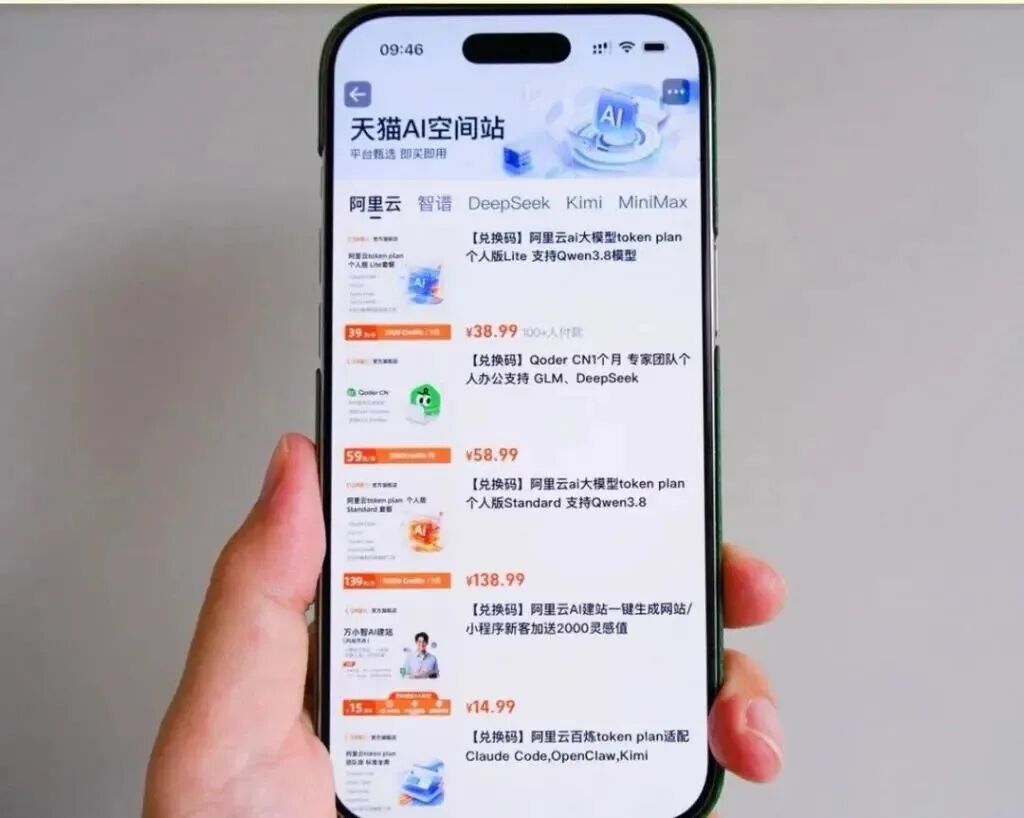
29-year-old Jiahui bought the DeepSeek standard monthly pass, which originally cost 59 yuan and was priced at 39.8 yuan during the Double 11 promotion. What impressed her besides the discount was the convenience of the purchase process. Searching for "Token" directly on Tmall leads to the "AI Space Station" page, which gathers computing power packages from multiple domestic large language model manufacturers; in the Taobao Recharge Center, AI recharge is placed in the same column as mobile top-up, data plan purchase, and utility bill payment, with all brands' packages and promotion discounts clearly visible at a glance.
"After placing the order, the quota is directly recharged to your own account, and you can use it on the corresponding large model official website or tool, which is almost no different from topping up your phone bill." Jiahui said.
Behind the orders of these two ordinary consumers is the country's first large-scale computing power retail shelf built by Tmall since September.
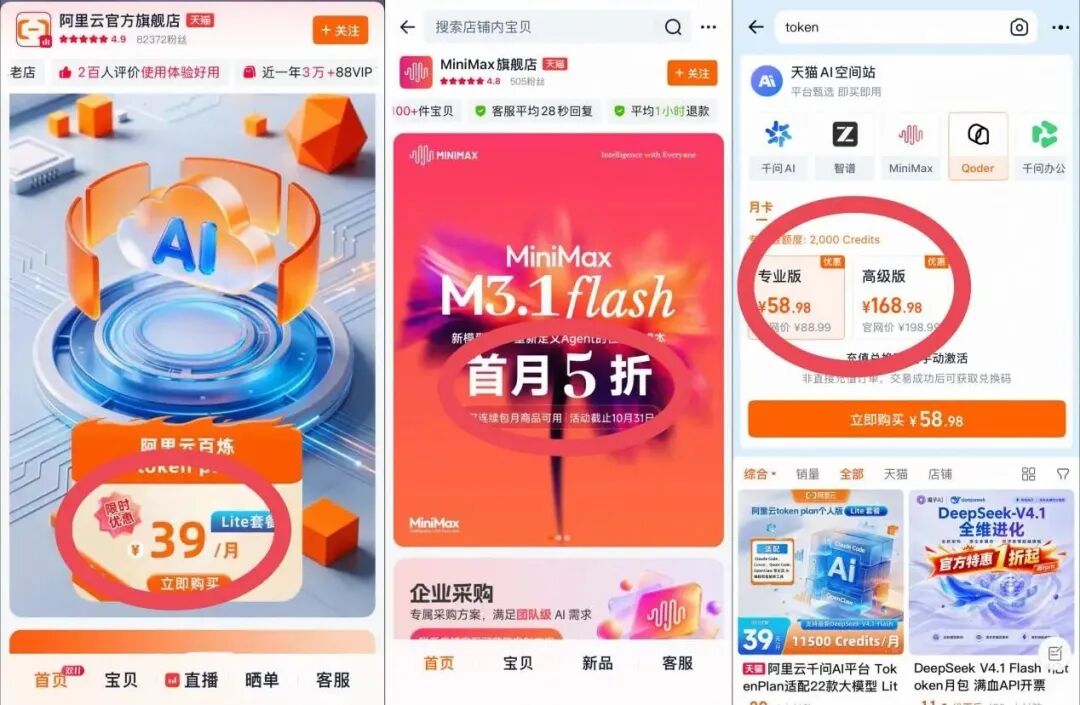
On September 2, Zhipu's first official flagship store landed on Tmall; on September 3, the Tmall Token Recharge Center was launched, with first access to leading large language model manufacturers such as Alibaba Cloud, Zhipu, Kimi, MiniMax, and DeepSeek; on October 13, MiniMax opened the brand's first official flagship store during the Double 11 warm-up phase.
Up to now, many manufacturers including Alibaba Cloud Bailian, Qwen Work, Qoder, Zhipu, MiniMax, Moonshot AI, and Stepfun have settled in the Tmall AI Token Station, selling Tokens through two channels: shelves and livestreaming rooms.
The e-commerce of Token is not an independent action of Tmall alone, but a new direction jointly explored by e-commerce platforms. In the view of "Polar Business", the particularity of Tmall is that it has made Token an independent promotion category for the first time, promoting the perception of "buying computing power as easily as topping up phone bills" to ordinary consumers, making e-commerce platforms the primary scene of Token consumption.
From the perspective of buyer profiles, current C-end Token consumers are roughly divided into three categories: the first category is high-frequency production users such as small and medium merchants, independent creators, and self-media designers, with stable computing power demand and the strongest willingness to pay; the second category is students, researchers, and knowledge enthusiasts, who mostly use it for assisted learning, document sorting, and light creation, belonging to medium-frequency users whose payment depends on actual needs; the third category is ordinary early adopters, who use large language models to write copy, make plans, and get answers to questions, focusing on lightweight experience.
Zhou Zhengkang belongs to the "production-oriented early adopter" between the first and third categories, while Jiahui is closer to users transitioning from the second category to the first. The common point of the three groups is that they don't care about the model benchmark scores and parameters, they only care about "what AI can actually do for me, and whether it can help me get the work done at low cost".
Livestreaming rooms and shelves undertake completely different conversion divisions of labor. The core value of livestreaming rooms is to become a public translation field for technical jargon, translating obscure professional terms such as API Key, inference upper limit, and console into expressions that ordinary people can understand, such as monthly pass, annual pass, subscription package, and "as simple as topping up phone bills".
The Token livestream in Li Jiaqi's livestream room is the best example. What is shown in the camera is not boring parameters, but real scenarios: workplace presentation materials, document sorting, PPT generation, sorting of children's homework and test papers, custom training mini-games, and even a simple instruction from enthusiasts can generate a global fishing map accessible to multiple people, landing the value of Token in specific life and work scenarios one by one. Without such scenario-based interpretation, Token would still be a strange concept familiar only to the programmer circle for most ordinary people.
After the livestreaming room uses the 0.01 yuan experience monthly pass to lower the threshold and attract a large number of users to try for the first time and establish preliminary awareness, the shelf undertakes subsequent repurchases of various users to meet long-term and stable computing power demand. Low-priced products are responsible for popularizing public awareness, and regular subscription packages complete the business closed loop. In essence, it is still a large-scale computing power consumption awareness cultivation for the C-end, stepping out of the small group of professionals.
Manufacturers aim for user awareness, and the platform completes the closed loop of AI ecological services
A key question is: Why did the new form of "Token e-commerce" first grow in the Chinese e-commerce market? Why did large language model manufacturers and Tmall choose to move forward in partnership?
From the perspective of business model, at present, most overseas C-end computing power consumption is dominated by fixed monthly subscriptions such as ChatGPT; the earlier package models of domestic large language model manufacturers generally have the problems of high pricing and complex purchase links, and the threshold for computing power to enter the public has always been very high.
Due to long-term high income dependence on B-end customers and developer groups, commercialization has always been the biggest challenge for large language model manufacturers. Zhipu's API revenue in the first half of 2026 was 825 million yuan, accounting for 86.5% of total revenue, and this proportion was less than 16% a year ago; MiniMax's B-end revenue has also risen sharply, accounting for more than 60% of total revenue.
In the large language model industry, there is a widely recognized consensus formula that the commercial value of AGI = upper limit of intelligence × scale of Token consumption. To expand the Token consumption volume, we cannot only rely on B-end project-based delivery, and must build the user base of C-end users.
In fact, China has the world's largest group of C-end computing power demand users. As of July this year, the daily average Token call volume in China exceeded 500 trillion, an increase of more than 5000 times compared with the 100 billion scale at the beginning of 2024. The "Generative Artificial Intelligence Application Development Report (2026)" released by the China Internet Network Information Center shows that the scale of generative AI users in China exceeded 700 million in the first half of this year, which means almost one in every two Chinese people is using generative AI.
According to the diffusion of innovations theory, when the technology penetration rate crosses the 50% critical point, practicality and cost-effectiveness are needed to accelerate mass consumption. Double 11, as the promotion node with the highest domestic attention and concentrated release of consumption potential, has naturally become the core scene for Token to penetrate the public with low thresholds.
Therefore, for large language model manufacturers, the core demand for moving Tokens from the official website background to e-commerce platforms is not just short-term sales, but to supplement C-end awareness and seize the incremental AI consumer market.
The key here is how to bring model capabilities to a wider group of high-quality consumers. And Tmall has the highest-quality consumer groups in China — according to Alibaba's financial report disclosure, as of the end of June this year, Tmall's 88VIP members are about 64 million, whose annual per capita consumption is 9 times that of non-members, and they purchase an average of 19 categories and services, and the accumulated member assets are impossible to replicate. This means that large language model manufacturers can master Chinese consumption data and high-net-worth user portraits at a lighter cost, making penetration into the C-end twice the result with half the effort.
This can be corroborated by the Zhipu case. Within 48 hours after Zhipu settled in Tmall, the brand search volume surged 50 times month-on-month, driving the transaction volume of Taobao AI Token and other subscription products to rise by more than 160% month-on-month. Compared with short-term GMV, this data better illustrates the real goal of manufacturers, which is to complete the first round of awareness touch for the C-end public.
In addition to traffic support and user awareness accumulation, brand merchants opening stores on Tmall also attach great importance to the improvement of brand value — which is the key for large language model manufacturers to support subsequent AI hardware and build an ecosystem.
Tmall just meets this demand. As the core position of brand assets in various fields, from physical goods to digital content and technology products, many brands have converted traffic into long-term brand assets under Tmall's operating mechanism. This year, Tmall has clearly shifted its strategy from traffic thinking to retention thinking. For the large language model industry, it is also easier to find a suitable growth path, such as better running through the "API + subscription" model through full-domain content marketing, while focusing on the long-term value, repurchase and operation certainty of enterprises.
From Tmall's perspective, Token complements the service closed loop of its own AI ecosystem. Previously, AI hardware such as AI PCs, AI glasses, and AI headphones have formed stable tracks on Tmall; but without Tokens and large language models, AI hardware is easily reduced to a mere concept. Even if the graphics card is installed locally, complex reasoning still relies on cloud computing power.
In this regard, Si Dengyu, General Manager of 3C Digital Division at Tmall, has a very clear logic. In his view, Token can reconstruct the business model of AI hardware, and hardware brands no longer can only earn the price difference of hardware. The three AI computers pre-installed with Qwen Work and attached with member rights that were simultaneously launched in Li Jiaqi's livestreaming room are the implementation of this logic — Token is not an attached gift of hardware, but an extension of the commercial value of hardware.
It is worth mentioning that this also helps to solve the existing industry pain points of Token and promote the transparency of computing power consumption.
Previously, each large language model manufacturer set prices independently, the Token measurement standards were not unified, and the cross-platform circulation barriers were prominent. While the threshold of the transaction link is lowered, commercial transparency is also continuously improved. In April this year, Tmall issued the "Release Specification for AI Software and Application Products", which clearly requires merchants to mark the Token quota, model version, and API validity period, which is a pragmatic step taken by the platform within the scope of its rights and responsibilities.
"This attempt is of positive significance for both Tmall and large language model manufacturers." Some e-commerce industry observers believe that the platform and manufacturers jointly run through the commercialization path of computing power for ordinary consumers, verifying the public's willingness to pay for AI productivity.
Logic Change: The Opening of a New Wave of AI Mass Consumption
However, although Token has become a hit relying on the Double 11 promotion, whether it can make users repurchase for a long time and form a stable consumption awareness still needs time to observe.
Cui Lili, Vice Dean of the Digital Economy Research Institute of Shanghai University of Finance and Economics, judged on this: Whether it can achieve sustainable operation in the long run depends on the user