More than 70% of newly launched quantitative private equity funds have posted underwhelming performance.
Since the start of this year, the private equity market has delivered an impressive performance on the issuance side.
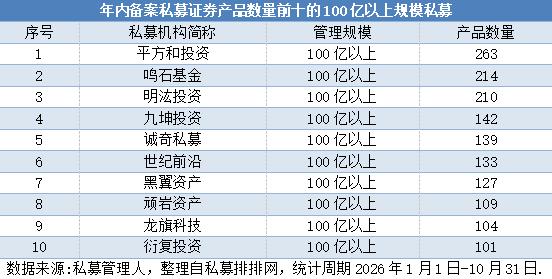
According to data from Simuwang, the enthusiasm for filing private equity products has been surging since the beginning of the year. As of October 31, 2026, a total of 12,673 private equity securities products have completed filing, representing a year-on-year increase of 27.20%, and the number has exceeded the total filing volume of the whole of last year. On the list of filing volumes, the top 10 positions are all occupied by quantitative private equity institutions.
However, on the performance side, a landscape of approaching severe winter is gradually unfolding, and a large number of newly issued quantitative long products this year have suffered net value losses.
The strong sales performance and poor performance have formed a sharp contrast in the newly issued quantitative private equity products.
Filing Boom
According to data from Simuwang, 12,673 private equity securities products completed filing in the first ten months of this year. In terms of strategy distribution, equity strategies remain the absolute mainstay of the market. The number of private equity products with equity strategies filed within the year reached 8,399, accounting for as high as 66.27%, with a year-on-year increase of 28.44% compared with the same period last year.
It is worth noting that multi-asset strategies are sought after by the market, with 1,927 filings within the year, accounting for 15.21%, representing a year-on-year increase of 33.26%.
In this issuance feast, 10-billion-yuan private equity firms have shown strong capital attraction capabilities. As of October 31, among the 2,664 private equity securities managers that have filed products since the beginning of this year, 125 10-billion-yuan private equity firms have filed a total of 4,404 products, accounting for 34.75% of the total market volume. On average, each of these 125 giants filed 35.23 products, far exceeding the industry average of 4.76 products.
From the perspective of the filing volume ranking, the names of leading quantitative firms clearly occupy the top ten positions on the list. Pingfanghe Investment ranks first with 263 filings; Mingshi Fund follows closely with 214 filings; Minghuo Investment also exceeds 200, reaching 210 filings; Jiukun Investment has 142 filings within the year.
Performance Setbacks
However, in sharp contrast to the booming issuance side is the performance of newly issued quantitative products within the year. After capital flows into these products, investors not only fail to get the expected returns, but also suffer deep net value drawdowns.
According to data from the Howbuy Fund Research Center, as of October 30, the quantitative long index products have fallen by 11.41% since the beginning of this year, down 13.93% in the past month, and the yield in the past year is -9.58%. It is worth mentioning that the cumulative 12-month yield of this index once reached 16.95% in early May, but the subsequent continuous adjustment of the stock market eroded all the previous gains of such products.
Moreover, the reporter of the Economic Observer sorted out based on Wind data and found that as of November 6, among the 314 newly established quantitative long funds in 2026 with disclosed data, 234 products have negative returns since their establishment, with a loss ratio as high as 74.52%. The average yield of these new products is -8.11%, and the median yield is -6.93%.
Among them, the worst-performing 6 series products of Industrial Trust Evolution CSI 500 Index Enhancement were established from April 15 to June 8, 2026, and their yield declines within the year all exceeded 34%. For example, as of October 30, the No.3 Industrial Trust Evolution CSI 500 Index Enhancement has a yield of -36.79% since its establishment.
Even the 10-billion-yuan quantitative giants with top filing volumes have not been completely spared. Third-party data shows that Pingfanghe Dingsheng CSI 1000 Index Enhancement Phase A No.126 has a drawdown of 27.84% since its establishment in April this year; the Class C share of Dividend Technology Rotation Balance No.2 under Longqi Technology has fallen by 27.92% since its establishment in March this year; the Class A share of Century Frontier Quantitative Preferred Phase 1 No.36 also fell by 27.48%.
This kind of net value pain has to some extent turned into anxiety for some clients. A market practitioner from a leading Shanghai-based quantitative private equity firm admitted to the reporter that the net value fluctuation of quantitative products has been quite obvious recently, and clients' attention to excess return drawdowns has increased significantly. In the past, clients paid more attention to how much profit the products could make, but now the most frequent questions are why there is a drawdown and whether the performance can recover later. Distribution channels not only need to do a good job in explaining and maintaining existing clients, but also need to be more cautious in screening new products.
The Disappearing Alpha
Why did the performance of quantitative long products suffer widespread Waterloo in such a big issuance year this year?
GF Securities pointed out that this round of excess return drawdown is not caused by a single factor, but by the superposition of three factors: the expansion of private equity product scale, the reversal of market style, and the shrinking of trading volume.
"The expansion of quantitative private equity scale will erode the excess return of strategies to a certain extent. Capital flows into similar strategy tracks, with highly overlapping factor libraries and converged position adjustment rhythms. The rising trading congestion directly dilutes the Alpha return (excess return exceeding the market benchmark) per unit of capital," GF Securities believes.
Secondly, the extreme reversal of market style has led to the resonant decline of multiple factors.
GF Securities believes that the essence of this round of excess drawdown is the short-term failure of the single-factor risk control method of quantitative strategies under the extreme situation where the market style reverses after high congestion and some factors decline synchronously. From the performance of Barra (a set of common characteristics used to explain the differences in stock returns) style factors, the beta and momentum factors that performed strongly in the first half of the year reversed and fell in July, with a monthly decline of 6.4%. At the same time, the linkage between style factors increased, and a resonant decline occurred. The correlation coefficient of returns between beta, momentum, liquidity and residual volatility factors rose to around 0.4.
"Most managers adopt single-factor exposure limits for style risk control, which implicitly assumes that there is a certain degree of independence between factors and risks can be hedged through diversification; but when multiple factors decline in the same direction, the constraints at the single-factor dimension cannot identify the common exposure at the portfolio level, and risk control measures will fail periodically," GF Securities further analyzed.
In addition, market trading volume is the "fuel" for the operation of quantitative models. The average daily turnover of A-shares remained at a high level of 2.5 trillion to 3 trillion yuan for a long time in the first half of the year, but it quickly fell below 2 trillion yuan after entering July.
GF Securities believes that in the shrinking volume environment, the bid-ask spread widens and the order book thins, so the same position adjustment and turnover requires higher transaction costs. At the same time, it also affects T0 (same-day reverse trading) trading strategies. The return of T0 strategies relies on the effective capture of intraday volatility and sufficient trading volume support. When trading volume shrinks significantly and the intraday volatility range converges, the available spread space is also compressed.
It should be noted that the volume shrinkage in July was more of a passive contraction caused by chip accumulation and insufficient undertaking in the process of rapid market decline, and its depth exceeded the normal fluctuation range, making it difficult for quantitative strategies to cope through conventional trading rhythm adjustment.
Seeking a New Steady State
In fact, China's private equity industry is moving towards a new stage dominated by quantitative institutions. Data from Simuwang shows that by the end of September 2026, the number of 10-billion-yuan private equity firms in China has increased to 159, of which 75 are quantitative private equity firms occupying the main position. However, after the scale carnival, how to repair performance and adapt to the new market ecology has become the Sword of Damocles hanging over every quantitative institution.
A senior practitioner from a Beijing-based quantitative private equity institution said that from historical experience, the recovery of quantitative excess returns is highly dependent on specific market environments; first, market volatility needs to return to the normal range; second, market trading activity must stabilize at a level that can support the operation of the existing management scale; third, the capital side needs to return to structural balance.
"In the first half of this year, the siphon effect of the artificial intelligence technology sector on market capital led to the narrowing of market breadth and the decline of stock selection effectiveness. But when the one-sided grouping dissipates, the market transitions to style rebalancing and returns to a rotation market with diversified growth, the advantage of quantitative long products that capture individual stock Alpha through factors and data can be more effectively exerted," the senior practitioner of the quantitative private equity institution said.
Wang Yamin, founder of Hainan Turing Fund, said that in the future, we should focus on the market trading volume and whether the market breadth can be expanded. If trading volume continues to be sluggish and market rotation accelerates, the previously crowded growth, momentum and other factors may reverse, amplifying the portfolio's risks in market value exposure and liquidity. In this regard, quantitative strategies should strictly control style exposure, refrain from betting on large-cap, small-cap and micro-cap exposure, and improve the ability to avoid liquidity depletion and extreme drawdown risks.
Wang Yamin reminded that "quantitative investment should adhere to risk control discipline, strive to obtain excess returns, rather than actively expose to risks."
This article is from the WeChat Official Account "Economic Observer", author: Hong Xiaotang, published with authorization by 36Kr.