Anthropic's listing countdown: Can its trillion-dollar valuation hold up?
On Tuesday local time (November 10), Anthropic updated its prospectus and launched its IPO roadshow, planning to list on Nasdaq as early as November 19 under the ticker symbol ANT, with Goldman Sachs and Morgan Stanley leading an underwriting syndicate composed of 22 investment banks.
The 42-minute roadshow video, 57-page PPT, and two revised versions of the S-1 laid Anthropic fully under the spotlight for the first time.
This is the first time a cutting-edge U.S. AI lab has independently accepted public market pricing, and it is also the most high-profile offering this year following SpaceX.
01 The Largest IPO in History, Valuation Has Taken a Rollercoaster Ride
According to the second revised prospectus, Anthropic is offering 825 million Class A common shares this time, with a price range of $70 to $78 per share, of which the company issues about 801 million new shares, and the seven co-founders each sell about 3.38 million old shares, totaling about 23.65 million shares, accounting for 2.9% of the issuance volume. There is also an over-allotment option of 124 million shares.
For Anthropic's this offering, industrial investors are actively subscribing: Google and Nvidia each subscribe for $100 billion, AMD invests $25 billion, Broadcom, Micron and Microsoft each subscribe for $10 billion, and TSMC subscribes for $5 billion. This list is almost exactly the upstream supply chain of Anthropic.
When the two parts are combined for calculation, the total maximum financing scale is about $904 billion, exceeding the $862 billion record set by SpaceX in June this year, making it the largest stock offering in history.
However, the company's valuation has experienced a rollercoaster ride. When the company submitted its confidential filing in August this year, the rumored target valuation in the market was still $2 trillion. After the AI sector corrected in early November, expectations were revised downward all the way to $1.2 to 1.3 trillion.
If calculated at the midpoint of this pricing range of $74 (with about 13.1 billion share capital), the market value is about $970 billion; calculated at $78, the upper limit is about $1.02 trillion; the fully diluted valuation after including dilution factors such as options, RSUs, and convertible bonds is about $1.33 trillion to $1.41 trillion.
Compared with the highest market value rumored in the market, the valuation has been discounted by 50%. But compared with the last actual private placement price of the company, the H-1 tranche in May is equivalent to about $58.6 per share, and the midpoint of $74 is still about 26% higher.
However, according to people familiar with the matter, due to strong subscription intentions during the roadshow, Goldman Sachs and Morgan Stanley are considering raising the offering price above $78, and the target valuation may rise to $1.5 trillion or higher. Some analysts said frankly that the valuation is nearly 20% lower than expected, which leaves room for investors to push up the price through bidding.
02 Annualized Revenue as of the End of October Is About $810 Billion
According to the prospectus, Anthropic's revenue in Q3 2026 was $169.56 billion, a year-on-year increase of 1127%, and the cumulative revenue in the first three quarters was $332.42 billion. The slope of the revenue curve is still steepening, and the annualized revenue as of October 31 is about $810 billion, which is $100 billion more than that at the end of September, an increase of 14% in one month.
In terms of customer structure, there are more than 11,900 enterprise customers who paid more than $100,000 in the past 12 months, compared with only more than 950 a year ago, more than 1,900 customers who paid more than $1 million, and about 250 customers who paid more than $10 million. The net revenue retention rate is about 900%.
On the profit side, Anthropic's gross margin since the beginning of this year is above 85%, compared with only 29% in the same period last year, the computing power profit margin is 43%, the adjusted operating profit margin is 12%, operating cash flow is $65.69 billion, and free cash flow is positive.
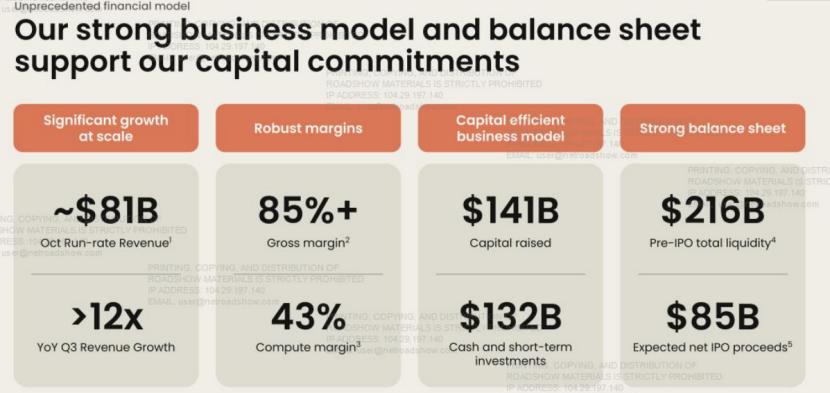
Figure: Key financial data, Source: Roadshow PPT
However, under the GAAP standard, the company recorded an operating loss of $5.67 billion in Q3, while it made a profit of $9.74 billion in Q2, and the net loss in the first three quarters was $1.04 trillion. Of this amount, $943 billion comes from the fair value change of financial instruments such as convertible bonds, which is a book figure brought by the rise in valuation, does not consume cash, and will disappear after conversion into shares upon listing.
The roadshow's guidance for long-term adjusted operating profit margin is above 35%, much higher than 15% in Q3. Among them, the computing power and infrastructure expense ratio will drop from about 58% in Q3 to 45%-50%, the sales and marketing expense ratio will drop from 14% to 7%-10%, and the personnel and other expenses will drop from 13% to 7%-10%. The sum of the midpoints of the three intervals is about 64.5%, which exactly corresponds to a profit margin of about 35.5%.
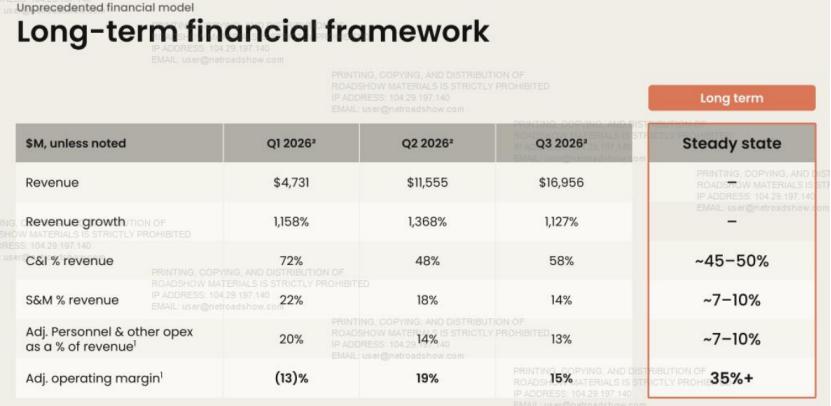
Figure: Long-term guidance believes that an adjusted operating profit margin of 35% can be achieved, Source: Roadshow PPT
The underwriter Goldman Sachs' model gives more long-term guidance, with revenue exceeding $6 trillion in 2030, making it one of the largest enterprises in the world, but free cash flow in 2027 will be about -$657 billion, and it will not turn positive until 2030.
03 Betting on Uncertain Growth With Determined Costs
To understand Anthropic, the most critical set of figures is hidden in the risk factors section of the prospectus.
At present, the total amount of signed computing power-related commitments of the company is about $9.009 trillion. Of this amount, about $4.516 trillion needs to be paid before 2030, and about $707 billion will be paid in the next 12 months, equivalent to 87% of the $810 billion annualized revenue at the end of October.
The company's cash on hand plus short-term investments is about $1.318 trillion, and the total commitments are 6.8 times the liquidity. In addition, there are arrangements with unfixed amounts of $1.5 trillion to $1.75 trillion that have not been included.
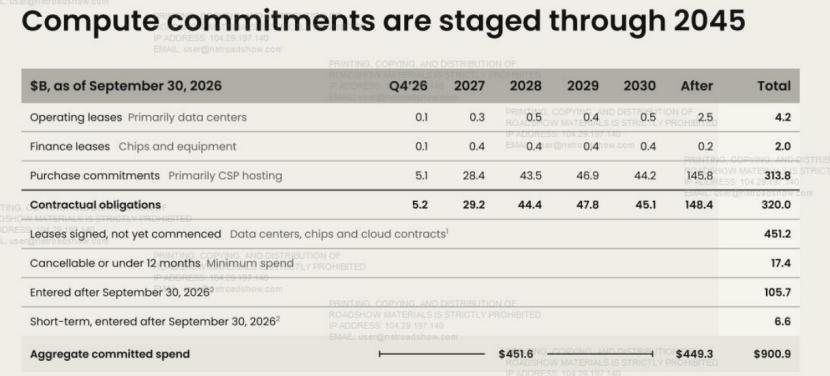
Figure: Long-term computing power investment guidance, Source: Roadshow PPT
The prospectus also points out the problem of maturity mismatch. On the expenditure side, most computing power contracts are multi-year with fixed amounts; while on the revenue side, customer revenue is billed by usage and can be reduced at any time.
This is the core proposition of this investment, using determined long-term costs to bet on uncertain demand growth.
Anthropic's coping strategy is a multi-chip strategy, that is, training and inferring on the four major chip families of AWS Trainium, Google TPU, Nvidia GPU, and AMD GPU at the same time, treating cross-supplier and cross-architecture chips as an interchangeable unified computing power pool, and purchasing only based on cost performance.
The company first accessed AMD GPU this year. The work that used to take dozens of engineers several months can be completed by the Mythos model in three days, and almost 100% of the computing kernels are ported or written by Claude itself. Anthropic Direct leases chips directly outside cloud procurement and runs them in customized data centers to reduce total ownership cost. The computing power doubling factor focuses on that total effective computing power equals physical computing power multiplied by the doubling factor, and the doubling factors are stacked layer by layer.
The financial confirmation is that the company's revenue has increased by more than 45 times in the past 6 quarters, while the computing power cost has only increased by 10 times, and the revenue created by each dollar of computing power has increased by more than 4 times.
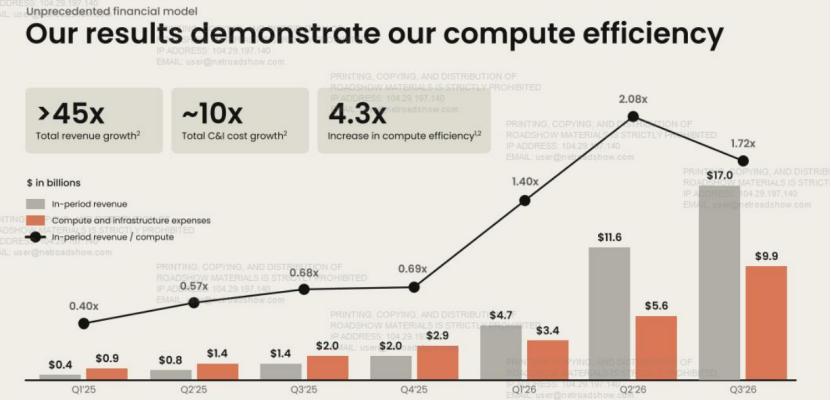
Figure: Growth rate of revenue and cost, Source: Roadshow PPT
There is another little-noticed but extremely ambitious fact that Anthropic itself is the No. 0 customer. The amount of Claude used by the company's employees has increased by more than 250 times in one year, and the average daily code contribution per engineer is 45 times that of 2024, and more than 90% of the company's code is written by Claude. It first proved that AI can make money on itself, and then sold this story to customers.
This article is from the WeChat Official Account "Gelonghui New Stocks", written by Fage Talks New Stocks, published by 36Kr with authorization.