Hesai: The guidance is on the soft side, has the top leading player in the industry begun to lose momentum?
Overall, Hesai delivered a performance characterized by "favorable pricing, weak shipment volume, and soft guidance": its revenue fell below the lower end of the guidance, shipments were significantly lower than guidance, and the 4Q revenue guidance was about 20% lower than market expectations; however, the comprehensive average selling price (ASP) of LiDAR rose month-over-month for the first time after consecutive declines, and gross margin also beat expectations. The details are as follows:
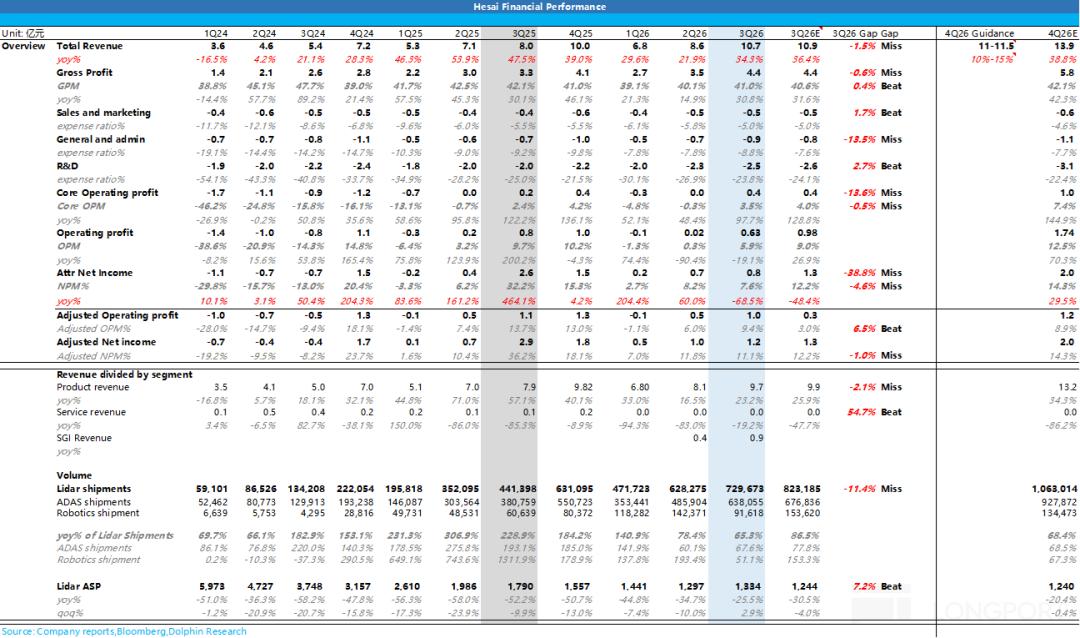
① Total revenue below guidance: Total revenue in Q3 reached 1.068 billion yuan, a year-on-year increase of 34.3%, which was lower than the lower end of the company's guidance of 11.0-11.5 billion yuan (a gap of about 3%), marking the first time in recent quarters that it failed to meet guidance.
By business segment, revenue from SGI's new business (Kosmo and actuator modules) was 91 million yuan, nearly doubling month-over-month. The cumulative revenue in the first three quarters reached about 135 million yuan, exceeding the full-year target of 100 million yuan set at the beginning of the year. Revenue from core LiDAR business was 978 million yuan, with a year-on-year growth of only 22.9%, mainly due to LiDAR shipments significantly lower than expected.
② LiDAR shipments far below expectations: In terms of shipment volume, 729,700 units were shipped in 3Q, representing a year-on-year increase of 65%, but lower than the guidance of 800,000-850,000 units and market expectations of 823,000 units. Breakdown as follows:
a. 638,100 units of ADAS LiDAR, up 68% year-on-year, slightly lower than the expected 677,000 units; this is mainly related to downstream customer vehicle sales falling short of expectations, and many automakers have lowered their 2026 sales targets;
b. Only 91,600 units of robot LiDAR, down 36% month-over-month, far lower than the expected 154,000 units. The main reason is that a major downstream customer encountered its own operational problems, dragging down the low-priced JT series (mainly used for lawn mowers), while shipments of LiDAR for Robotaxi and humanoid robots met expectations.
③ But prices stopped falling and rebounded: In terms of unit shipment price, the comprehensive average price was about 1,334 yuan, up about 3% month-over-month and down about 26% year-on-year, significantly higher than the expected about 1,210 yuan.
However, the rebound mainly came from changes in product mix: the management stated that robot LiDAR accounts for about 50% of total LiDAR revenue. Based on this reverse calculation, the unit price of robot LiDAR is about 5,300 yuan, and the unit price of ADAS LiDAR is about 770 yuan. The reduction in low-priced lawn mower LiDAR and the increase in high-priced Robotaxi LiDAR pushed up the comprehensive average price, while the ADAS unit price itself remained at a low level.
④ Gross margin beat expectations, standing at 41%: The 3Q gross margin was 41.0%, higher than the expected 39.9%, up 0.9 percentage points month-over-month and down 1.1 percentage points year-on-year (due to the rising proportion of low-margin products). Under the circumstance that shipments fell short of expectations, the rebound in unit price (more high-priced Robotaxi and humanoid robot LiDAR) and cost reduction from technology supported the gross margin.
⑤ Operating profit was lower than expected, SGI losses widened: 3Q operating profit was 63 million yuan, lower than the expected about 98 million yuan.
Operating profit of the LiDAR segment increased by 88% year-on-year to 145 million yuan, with a profit margin of about 15%. The drag came from SGI: although revenue nearly doubled month-over-month to 90 million yuan, losses also widened to about 83 million yuan. This means that the profit driver has changed from the previous "trading price for volume" to "stable price in core business and cash burn in new business", and the short-term flexibility depends on the investment pace of SGI.
⑥ The sharp year-on-year decline in net profit was mainly affected by one-time gains: GAAP net profit was 81 million yuan, lower than the expected 132 million yuan. The 69% year-on-year decline was mainly due to a 185 million yuan one-time gain in the same period last year. After excluding this factor, GAAP net profit increased by about 14% year-on-year.
Core Viewpoints from Dolphin Analyst:
Overall, this quarter is characterized by "favorable pricing, weak shipment volume, and soft guidance": revenue and shipments both failed to meet guidance, gross margin and unit price beat expectations, and operating profit was dragged down by SGI losses.
More critical is the 4Q guidance: revenue of 11.0-11.5 billion yuan is about 19% lower than the market expectation of about 13.9 billion yuan, with a year-on-year increase of only 10%-15% and a month-on-month increase of only 3%-8%, which basically dashed the logic of volume release in the peak ADAS season in the second half of the year. Calculated based on the LiDAR unit price of around 1300 yuan, 4Q shipments are about 750,000-800,000 units, lower than the market expectation of 1.06 million units.
Calculated at the midpoint of the 4Q revenue guidance, the full-year revenue in 2026 will be about 3.73 billion yuan, a year-on-year increase of about 23%, about 11% lower than the lower end of the initial 42-4.6 billion yuan guidance, and also lower than the market expectation of 4.11 billion yuan. Full-year shipments of about 2.6 million units (up 60% year-on-year) are also lower than the guidance of 3 million to 3.5 million units; the net profit in the first three quarters is about 170 million yuan, and the full-year net profit is most likely to be around 250 million yuan, making the full-year target of 500 million to 700 million yuan basically unachievable.
At the earnings call, the management only gave three full-year calibers: 2026 SGI revenue of 200-300 million yuan, gross margin close to 40%, and operating expenses increasing by about 20% year-on-year (all increments come from SGI, and LiDAR business expenses decrease year-on-year). The company no longer proposes the targets of 3-3.5 million units of shipments and 500-700 million yuan of net profit, which is equivalent to admitting that these targets are abandoned. For the weak performance in 4Q, the company attributed it to "mild downstream demand".
Therefore, Hesai's problem has changed from "prices falling too fast" last quarter to "prices have stabilized, but volume has not kept up". According to the management, the stall in shipments is caused by two factors: the sluggish domestic auto market and automakers lowering their sales targets, as well as the single customer incident of the JT series, rather than the overall weakening of demand.
Dolphin Analyst believes that market share loss also has an impact: in September, Hesai's long-range ADAS share in China was 43%, continuing to decline from 55% in March. Xiaomi introducing Hesai's competitor Suteng as a second supplier and Huawei's blind-spot LiDAR catching up are both diverting market share. The management did not respond positively, only stating that it "does not want to exchange price for sacrificing quality".
For Hesai, this is an unavoidable growing pain to go through the price war cycle and secure its position in the next-generation sensor ecosystem:
① The stop of unit price decline is the most important positive signal this quarter:
Last quarter, Dolphin Analyst's core concern was that the unit price was declining too fast (down 35% year-on-year in 2Q). The rebound of the comprehensive unit price this quarter mainly comes from product mix adjustment. The real positive signal is the management's statement on price: based on the contracts already signed for next year, ADAS price competition is becoming more rational, and the price and gross margin of ATX in 2027 will "further stabilize", which is consistent with Dolphin Analyst's judgment that "price deflation will switch to steady annual decline in 2027".
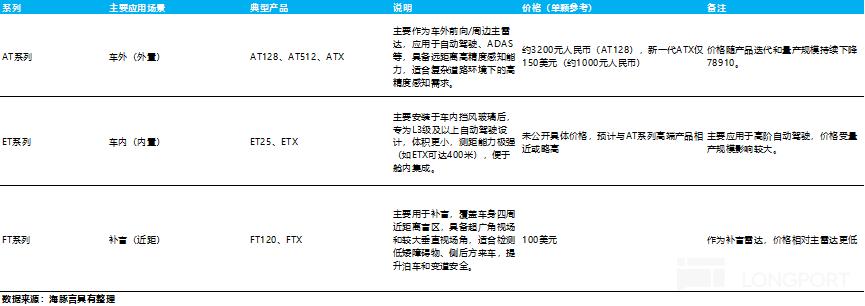
The support comes from high-end products and multi-LiDAR configuration: the high-priced ET series has won designated projects from 5 global automakers (leading European automaker, Cadillac, Geely, Great Wall, and a leading new energy vehicle brand), with orders in hand exceeding 1 million units, and its selling price is higher than ATX; the ET model equipped with self-developed Picasso chip is under customer verification.
The FT blind-spot LiDAR has won designated projects from Leapmotor and leading European automakers, and L3 is promoting the configuration to shift to "high-end main LiDAR + multiple blind-spot LiDARs". However, core components and ASICs are almost self-developed, and the space for cost reduction through technology is narrowing. Future gross margin will rely more on price stability and product mix improvement.
② Shipment growth stalls, full-year shipment target is basically unachievable:
ADAS business: 3Q shipments reached 638,100 units, up 31% month-over-month, but lower than guidance. In terms of new designated projects, the AT series has won the designated project from Wuling and entered mass-produced Wuling models; the mass production timeline for export model designated projects from 7 automakers (including Chery) has not been announced, and the company only described them as "0 to 1" increments; in addition, the company has obtained designated projects from 10 global automakers through joint ventures, which are expected to achieve volume release next year.
Robot business: 3Q shipments reached 91,600 units, down 36% month-over-month, mainly dragged down by the single customer issue of the JT series;
However, the cumulative shipments in the first three quarters reached 352,000 units, more than doubling year-on-year. The revenue of high-end products (Pandar, OT, QT, XT) increased by more than 60%, and robot LiDAR has accounted for about 50% of total LiDAR revenue. The growth drivers come from the expansion of Robotaxi fleets (62% global market share in 2025, ranking first), the deployment of multiple LiDARs per humanoid robot (JT128 shipments are expected to reach six figures next year), and physical AI scenarios such as industry and retail (including JD's plan to deploy 4 million devices in 5 years). The management judges that the robot LiDAR market is at least 10 times the size of the ADAS market.
③ SGI new business continues to exceed expectations, but losses are widening:
3Q SGI revenue was 91 million yuan, nearly doubling month-over-month, and the cumulative revenue in the first three quarters reached about 135 million yuan; the company reiterated its full-year guidance of 200-300 million yuan (requiring 65-165 million yuan of revenue in 4Q). Among them:
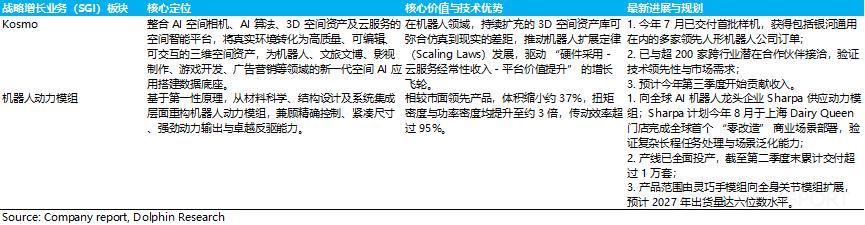
a. Actuator modules: 3Q shipments reached 23,400 units, up 97% month-over-month, with cumulative shipments of about 35,000 units and a monthly production capacity of 10,000 units. Shipments in 2027 are expected to reach six figures, accounting for the vast majority of SGI revenue this year.
Sharpa, the largest customer, has entered commercial deployment, and its full-body robot D01 and dexterous hand W02 both use Hesai's actuator modules. Key components are self-developed, with torque and power density about 3 times that of leading products, and the company is in negotiation with multiple humanoid robot companies.
b. Kosmo (3D world data engine): It has generated revenue in 3Q. This year, hardware is the main revenue source, and next year, revenue from software subscriptions and 3D asset licensing will increase significantly, and the gross margin is expected to exceed 40% after scaling up. Partners include Pixar RenderMan (film and television), Galaxy General and Dexmal (robot training), and AutoNavi (spatial commercial pilot with 1,000 sites).
However, SGI's loss widened from 64 million yuan in 2Q to about 83 million yuan. As customer demand is faster than expected, the company has increased investment, which will still suppress profits in the short term.
Fortunately, the 2027 target is clear: SGI revenue is about 100 million US dollars (about 700 million yuan), accounting for more than 10% of total revenue. It is expected to break even in the same year without a significant increase in capital expenditure.
④ Gross margin and expenses:
The 3Q gross margin was 41.0%, better than expected. The increase in the proportion of high-margin robot LiDAR, coupled with cost reduction from self-developed chips, offset the scale loss caused by insufficient shipments.
The management stated that the full-year gross margin in 2026 will be close to 40%, and will remain generally stable in 2027.
In terms of expenses, both R&D and administrative expenses increased by about 28% year-on-year, with increments coming from SGI and professional service fees. After excluding SGI, LiDAR business expenses decreased year-on-year; the operating profit margin of the LiDAR segment is about 15%, and the core business remains profitable.
Judging from the current stock price, Dolphin Analyst estimates that Hesai's 2026 revenue will be about 3.7 billion yuan, a year-on-year increase of about 23%; GAAP net profit is about 250 million yuan (calculated at the midpoint of 4Q guidance and 40% gross margin, it is about 80 million yuan), far lower than the initial guidance of 500-700 million yuan.
Looking forward to 2027, although the management has not given specific guidance, Dolphin Analyst assumes that LiDAR sales will increase by 28% year-on-year to 3.33 million units, and the unit price will decrease by 7% year-on-year to 1246 yuan. With the contribution of about 700 million yuan in SGI revenue, total revenue will increase by 30% year-on-year to 4.86 billion yuan.
In terms of profit, if SGI achieves break-even as scheduled, offsetting the loss of about 250-300 million yuan this year, coupled with the resumed growth of LiDAR profit, the net profit will be about 600 million yuan, a year-on-year increase of 174%.
Based on the closing price on November 11, Hesai's market value is about 15.1 billion yuan, corresponding to a 2026 P/E ratio of about 60 times, and about 36 times after deducting about 6.1 billion yuan of net cash; corresponding to the 600 million yuan net profit in 20