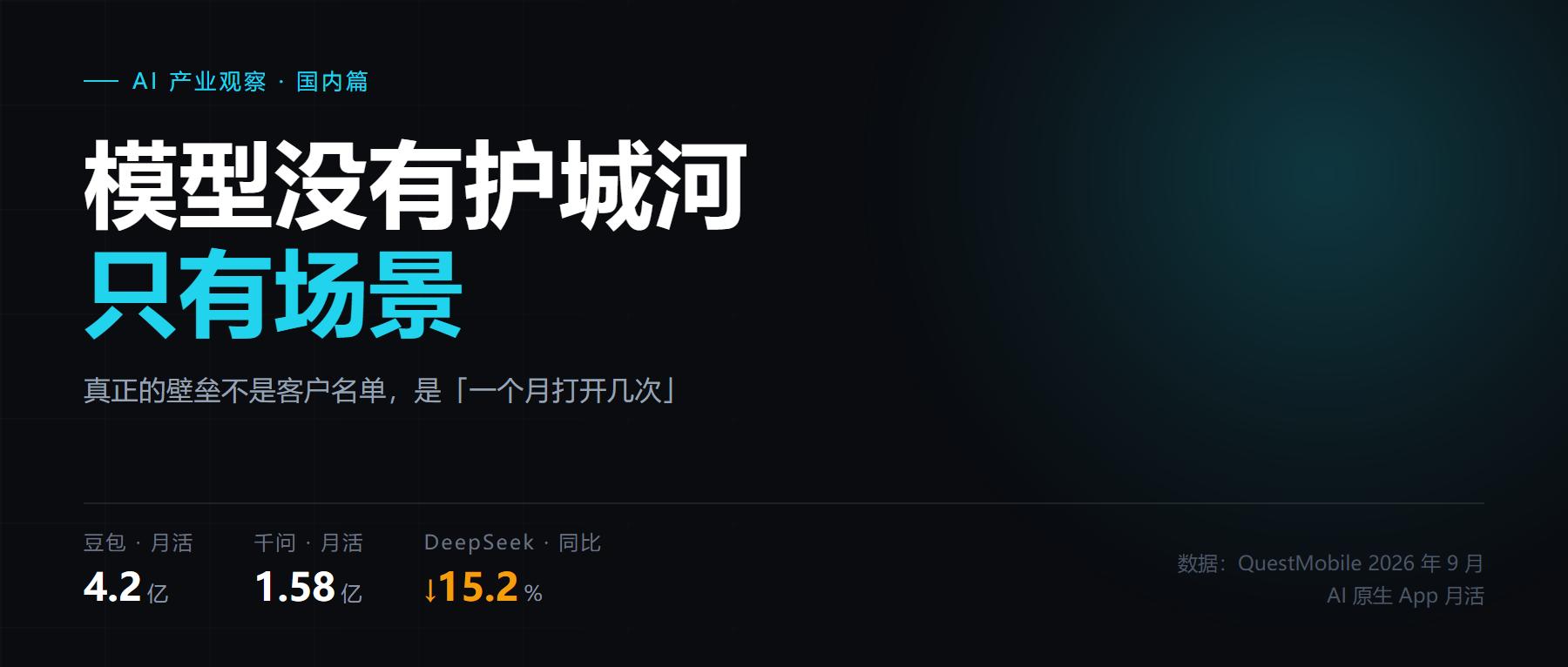
Large models have no moat, only scenarios.
The top-ranked domestic AI application is not the one with the most powerful model. Users are still leaving the platform that boasts the strongest model.
The cheapest model is losing users instead
Data from QuestMobile for September 2026 shows that the top four AI-native apps by monthly active users are Doubao with 420 million, Qwen with 158 million, DeepSeek with 123 million, and Yuanbao with 37.33 million (QuestMobile Autumn Report). The year-on-year growth rates are +143.6%, +5076.6%, -15.2%, and +13.6% respectively.
DeepSeek is the one with the best model reputation among these platforms, and also the cheapest one, but its monthly active users dropped by 15.2%. During the same period, the calling price of domestic large models kept falling: in April, DeepSeek cut the input price of V4-Pro from 10 yuan to 1 yuan, and the output price from 20 yuan to 2 yuan; by October 2026, the Token price had dropped by 84% compared with the benchmark in March 2023 (third-party price tracking).
The more powerful and cheaper the model is, the less likely users are to stay on your platform. This scenario has already played out in the United States, and it is unfolding even faster in China.
The entry point is indeed changing. In August 2026, the average monthly usage times per user of AI-native apps reached 85.1, up 67.1% year on year; during the same period, comprehensive information apps fell by 7.6%, and search engines fell by 21.7% (QuestMobile). It is a real trend that users are moving to the dialog box.
Having a large user base does not mean you can retain them
So is "holding customers" enough? Domestic data shows it is not enough.
In the first quarter of 2026, the average activity rates of Doubao, Qwen and DeepSeek were 33.5%, 17.1% and 21% respectively (QuestMobile Q1 Report). Qwen has 158 million monthly active users, but its activity rate is only half of that of Doubao; by September, Doubao's average monthly usage per user reached 72 times and 132.5 minutes. Qwen ranks second in user scale, but there is a big gap in usage frequency. On the contrary, DeepSeek has an average monthly usage of 65.9 times and 136.7 minutes per user, which is longer than that of Doubao, but its monthly active users are only one third of Doubao's (QuestMobile). Deep users, small scale.
Users installing your app does not mean they will use it every day. Users who install but do not use the app are the most expensive type of customers.
The same is true for the payment side. By the end of June 2026, Meitu had 18.44 million paid subscription users, with a subscription penetration rate of 6.5%; the consumption of AI computing power points increased by more than 46% month-on-month for two consecutive quarters, with a cumulative increase of about 113% in half a year (company interim report). The figures are not bad, but the 6.5% penetration rate indicates that the vast majority of users are still staying within the free quota. The charging method is also changing: Meitu originally only sold subscriptions, but now it adds AI computing power points that are charged according to actual usage, and the month-on-month growth in both the first and second quarters of 2026 exceeded 46% (company interim report). Subscriptions sell "availability", while computing power points sell "actual usage".
Kingsoft Office is another sample. WPS AI has more than 80 million monthly active users, and WPS 365 has maintained a growth rate of over 60% for five consecutive quarters (company disclosure). However, JPMorgan Chase's research report in November pointed out that every task of the AI business consumes tokens, so the growth rate of revenue and profit will be significantly separated; in the same quarter, Kingsoft Office's revenue increased by 16% year on year, but the adjusted net profit only increased by 8% (Zhitong Finance). There are enough users, but the revenue does not keep up.
The office track is also segmented. In September 2026, Tencent WorkBuddy had 32.35 million monthly active users, Baidu Dazi had 9.77 million, and Qwen Office had 7.9 million (QuestMobile). Office scenarios have clear tasks and deliverables. Whoever occupies the entry point will get paid users first.
Revenue comes from scenarios, not models
The companies that actually make profits are those that embed models into specific practical tasks.
Kling is a clear example. Its annual recurring revenue exceeds 100 million US dollars, 70% of which comes from overseas markets, 70% comes from professional consumer subscriptions, mainly from self-media creators and advertising and marketing practitioners who pay by package; the remaining 30% comes from B-end API calls (Guosen Securities). These users do not use it to chat, but to deliver videos every day.
The group of companies that expanded overseas can better illustrate this point. Manus achieved an annual recurring revenue of 400 million US dollars, Genspark about 250 million US dollars, Meshy 60 million US dollars with a gross margin of 85%, PixVerse more than 40 million US dollars, and Fish Audio with 22 employees generated 21 million US dollars (industry statistics). None of these 15 emerging companies make money from advertising, all of them rely on subscriptions, pay-as-you-go billing or enterprise authorization (Tide Surge AI).
Their common feature is not a more powerful model. Manus sells "give a goal, and it will finish the work for you"; Meshy sells a process in the 3D production workflow; Fish Audio sells the dubbing task. Users pay for them because these tasks have to be done every day.
Looking back at the domestic market, the total annual recurring revenue of the top 20 domestic AI products is only 400 to 500 million US dollars; the top one PictureThis has 143 million US dollars (AI plant recognition, mainly sold overseas), and Meitu Xiuxiu has 103 million US dollars (Guojin Securities). The domestic paid market is small, and most profitable products earn revenue from overseas users.
There is an extra threshold in China: ecosystem
In the US market, independent applications survive by the fact that "switching to another workflow is too troublesome". In China, there is a harder threshold: where does the traffic come from.
Doubao can reach 420 million monthly active users relying on ByteDance's recommendation and Douyin's traffic diversion; Qwen's monthly active users increased by more than 50 times in one year, relying on Spring Festival activities that directly bind users to real transactions on Taobao and Alipay (QuestMobile). Independent applications do not have such an ecosystem, and their customer acquisition cost is so high that it is difficult to achieve positive returns.
Therefore, domestic AI applications only have two choices: go overseas to get subscriptions from places with stronger willingness to pay; or integrate into the ecosystem and become a function in a super app. Those that stay in the middle, with neither ecosystem support nor overseas revenue, face the greatest difficulties.
The same is true for the enterprise software sector. Kingdee International's subscription ARR year-on-year growth rate in the third quarter was 19.3%, and the contract value of AI native products is rising; Yonyou Network's AI-related revenue increased significantly, but the group's total revenue only increased by 1.3% (JPMorgan Chase). AI is replacing the original projects, not generating a completely new revenue stream out of thin air.
The moat is "how often users use it"
Putting these facts together, we can see what the real moat looks like.
It is not the model. The price of models has dropped by more than 80% in one year, and the capabilities of different models are catching up with each other closely, no one has exclusive advantages.
It is not just the customer base. 100 million users who install the app but never use it are not worth as much as 100,000 users who open it once a day.
It is the scenario: how many times it is used a day, how much work it can solve at one time, and how much reconfiguration is needed to replace it. Kling's users need to deliver videos every day, Meshy's users need to output models every week, and users of contract review tools need to process every contract. These usage frequencies and actions are the factors that retain users.
The sentence from JPMorgan Chase is accurate: the token price of different platforms is similar, the real difference lies in pricing power: if you can give customers a new reason to pay, price according to labor cost, and charge extra for heavy usage, the cost can be passed on; if you only add AI to the original membership rights to retain users, you have to bear the cost yourself (Zhitong Finance).
Where does pricing power come from? It comes from scenarios. If you save the time of a full-time position for the customer, you can dare to price according to the cost of that position; if you only add a button to the customer's toolbox, you can only follow the membership fee discount.
The three layers are very clear: those who sell model calls see their price drop by 80% a year; those who sell membership rights see users install the app and leave it idle; those who sell scenarios have users come back every day.
The cheaper the model is, the more valuable the scenario is. After this round of development, the companies that can stand firm in China will not be model companies, nor the companies with the longest customer list, but the companies that turn AI into a process that someone must go through every day.
To judge this, you do not need to see how lively the press conference is. One number is enough: how many times users open this product in a month. This number is more honest than any press conference.