Shawn Kim, the "Memory Grim Reaper" from Morgan Stanley, has issued another warning that the real bomb is the "2028 Profit Cliff", and he has comprehensively lowered the target prices of memory stocks.
Shawn Kim, an analyst at Morgan Stanley, has issued another warning to the memory industry, this time targeting the sector's "2028 profit cliff".
In the latest research report released on November 9, Shawn Kim comprehensively cut the target prices of Samsung Electronics and SK Hynix, and upgraded Samsung Electronics to the new top pick, replacing SK Hynix. He wrote in the report: "The concerns over memory are less about the delay in data center construction or AI demand after the US midterm elections, but more about the risk of the '2028 profit cliff' narrative — the market is skeptical about the sustainability of memory growth momentum, as supply is starting to catch up with demand."
He believes the focus of market debate has shifted from near-term fundamentals to the "2028 profit cliff" — the superposition of multiple pressures including the successive commissioning of new production capacity at the end of 2027, delayed data center construction, and narrowing HBM premium has cast doubt on the sustainability of the memory supercycle. Based on this, Shawn Kim sharply compressed the long-term profit margin assumptions for SK Hynix and Samsung toward their historical averages, directly lowering the output values of the two companies' valuation models.
This is not the first time Shawn Kim has issued a warning during a high-boom phase of the memory industry. As Wall Street CN noted, he released "Memory, Winter is Coming" in August 2021, which accurately foresaw the two-year semiconductor down cycle that followed; in September 2024, his report on the possibility of HBM oversupply was regarded as one of the triggers for the sharp drop in Samsung and SK Hynix's stock prices that year; on July 21 this year, he released another report warning that the AI-driven carnival in the semiconductor memory industry is approaching an inflection point, and memory contract prices are expected to peak in the fourth quarter, after which the stock prices of SK Hynix and Samsung Electronics saw another sharp drop.
These feats also earned him the nickname "Grim Reaper of South Korean Semiconductors" in the South Korean market. This report is yet another warning from him against the backdrop of ongoing defoaming of memory AI trades.
Valuation Reset: Sharp Target Price Cuts, Samsung Upgraded to Top Pick
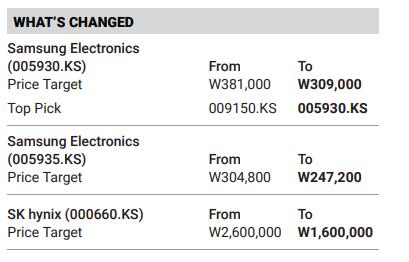
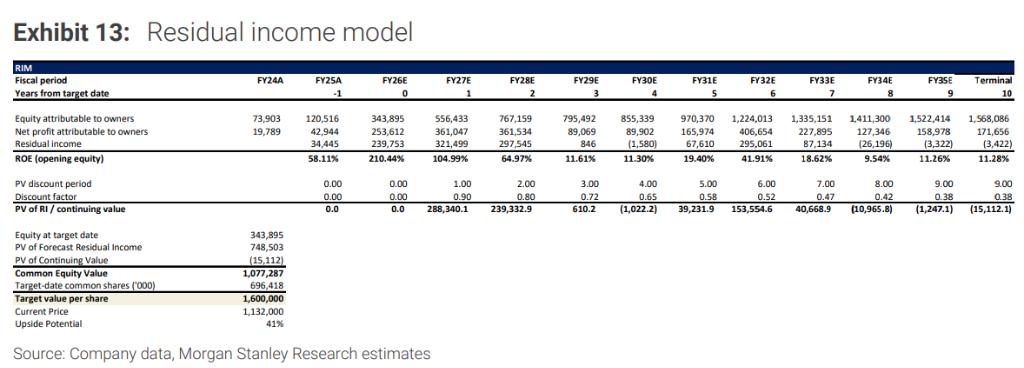
Shawn Kim's adjustments this time are significant. The target price for SK Hynix is cut by 38% from 2.6 million KRW to 1.6 million KRW, corresponding to a 2027 expected price-to-book ratio of about 1.8x, which still implies about 41% upside from the current reference price of 1.132 million KRW, maintaining the Overweight rating.
The target price for Samsung Electronics' common stock is cut by 19% from 381,000 KRW to 309,000 KRW, while the target price for its preferred stock is cut from 304,800 KRW to 247,200 KRW. Both maintain the Overweight rating, and Samsung Electronics' common stock is upgraded to the new top pick.
The core driver behind the target price cuts is Shawn Kim's sharp downward revision of the two companies' long-term sustainable profit margin assumptions. Shawn Kim previously assumed that the long-term sustainable profit margin of DRAM would be about 60% before 2035. This time, he lowered the average DRAM operating profit margin of SK Hynix from 2029 to 2035 to about 32% (close to the 31% historical average from 2010 to 2025), while that of Samsung is lowered to about 39%. At the same time, the premium of HBM over regular DRAM is assumed to gradually narrow from 20 percentage points in 2029 to zero in 2033.
The report also raised the two companies' near-term earnings forecasts for 2026-2028, mainly benefiting from the reduction in share count brought by share repurchase programs. SK Hynix's 2026-2028 EPS forecasts change by -1%, +22% and +29% respectively; Samsung's 2026-2028 EPS forecasts are raised by 3%, 16% and 26% respectively.
"2028 Profit Cliff": Four Overlapping Pressures
Shawn Kim clearly pointed out in the report that the "2028 profit cliff" is the core debate in current memory investment. He listed four key factors that put pressure on long-term profit margin assumptions.
First, supply response is faster than expected. New production capacity will be put into operation successively around the end of 2027. The recent higher shipment guidance for the fourth quarter and faster process migration mean more bit supply than previously expected. The entry of Chinese suppliers into the consumer market will also create additional pressure on bulk memory pricing.
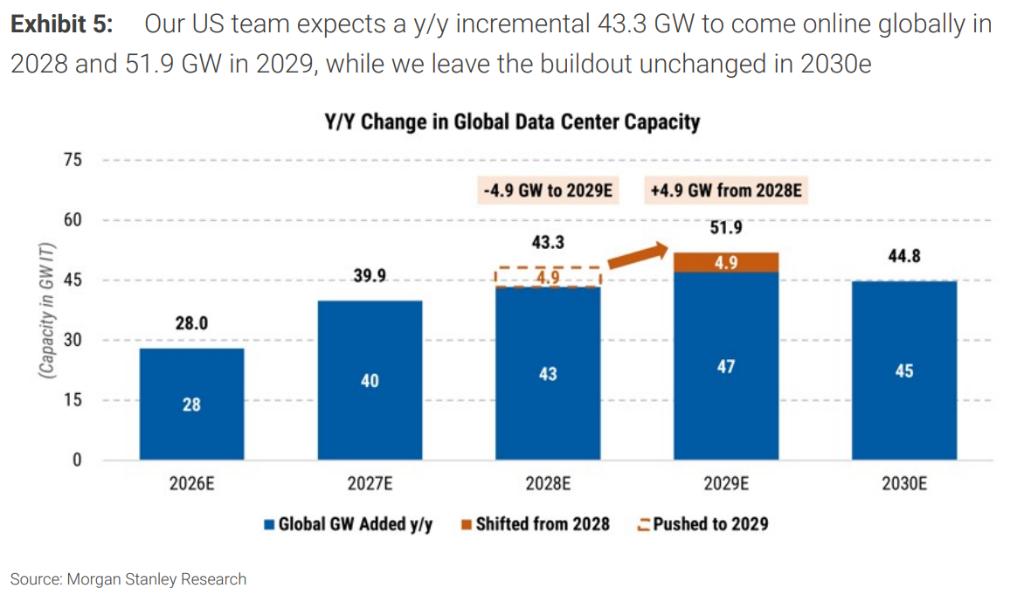
Second, data center construction delays in 2028. Morgan Stanley's global thematic research team has postponed about 5GW of U.S. data center projects from 2028 to 2029. Accordingly, the year-on-year growth rate of global new data center capacity in 2028 is lowered from about 21% to 9%, and rebounds to 20% in 2029. This may weaken the supply tightness and pricing power of memory.
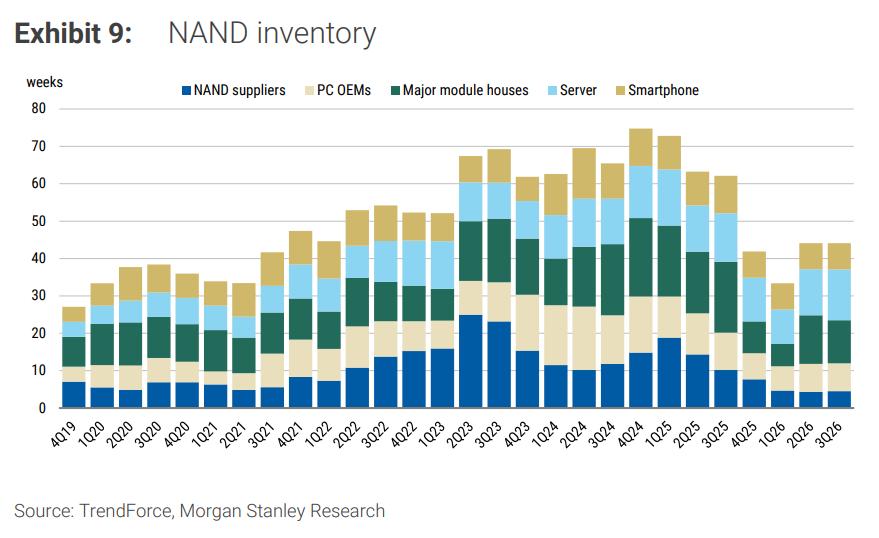
Third, BOM cost constraints limit memory growth. Memory already accounts for about 60% of the bill of materials (BOM) cost of AI servers, which is forcing buyers to downgrade high-density 96GB/128GB configurations to 64GB RDIMM. NAND spot prices have fallen by about 20% in the past two weeks, with 512Gb TLC wafer prices falling to around $15, down 27-29% from the March high and below the July-August low, bringing additional pricing risks to the contract market.
Fourth, the HBM premium is narrowing. Morgan Stanley lowered SK Hynix's HBM operating profit margin forecast from 78-80% to about 70%, and Samsung's from about 80% to 65-72%. As competition intensifies and regular DRAM prices normalize, the possibility that HBM can sustain high premiums continues to decline.
Cycle Positioning: Valuations Have Adjusted, But Earnings Cuts Are Yet to Come
Despite the warning, Shawn Kim is not comprehensively bearish. He made a detailed judgment on the current market position in the report.
The report points out that since the peak in June, the 12-month forward P/E ratio of the PHLX Semiconductor Index (SOX) has halved from 26.3x to 13.4x, which is one of the largest valuation compressions since the burst of the dot-com bubble, while the market consensus EPS has risen by 24% over the same period. The current forward P/E ratio of about 13x is basically in line with the median trough valuation (13.4x) of all previous down cycles, and is at the lowest level since the Fed's rate hike trough in October 2022.
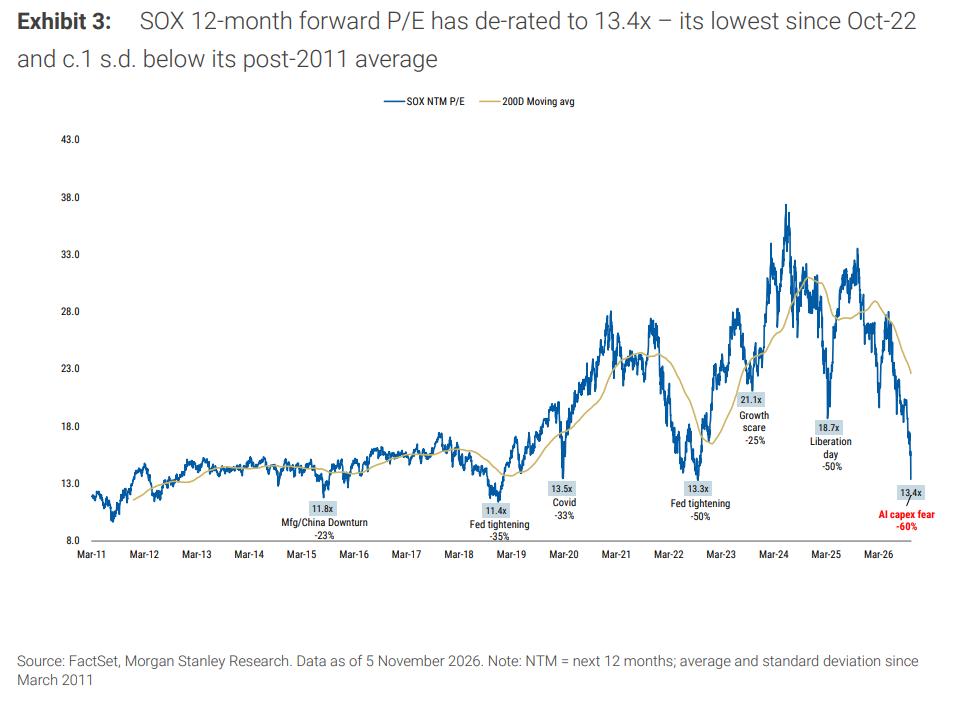
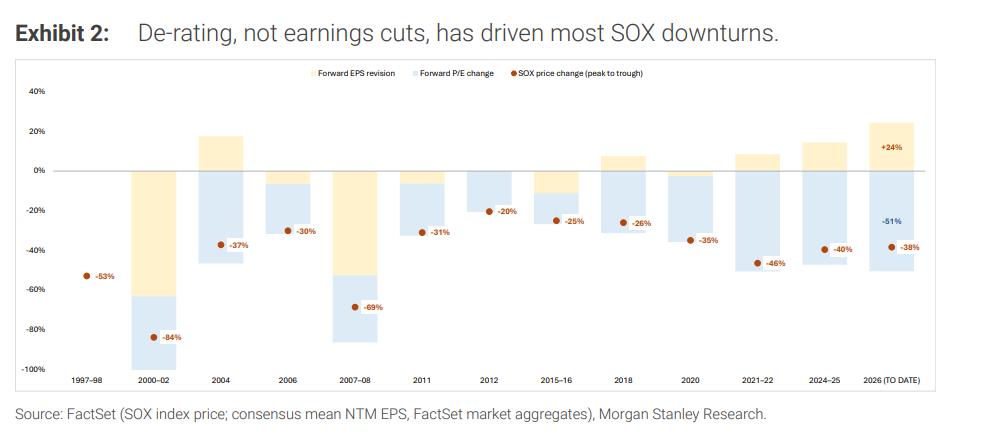
Valuation has done what it should do. The variable now is the earnings line. Kim reviewed 11 SOX down cycles since 2000 and found that 9 of them were mainly driven by valuation compression rather than earnings cuts. Only during the two real demand collapses in 2000-2002 and 2007-2008 did earnings see a deep downward revision of more than 50%.
The second wave of decline requires 2028 earnings forecasts to be cut in half as they were in 2000-2002 and 2007-2008 — which is not our base case, but this is exactly why the earnings reduction phase, not valuation, is what needs the most attention right now.
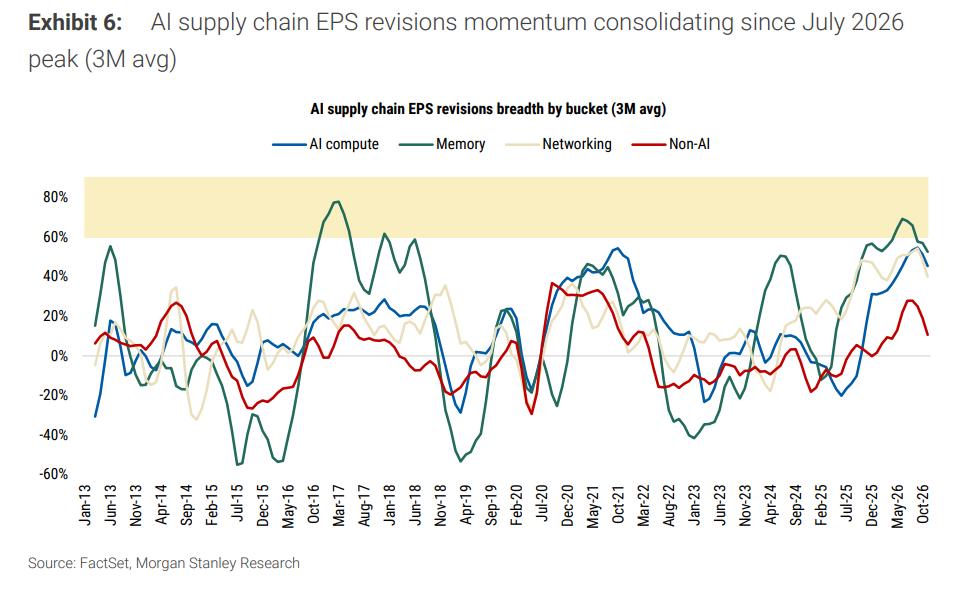
Kim also pointed out that the breadth of AI supply chain EPS revisions has continued to narrow since its peak in July 2026 — the 3-month average for the memory sector fell from 69% to 53%, AI computing from 55% to 45%, and networking from 54% to 40% — but it is still positive, meaning earnings forecasts are still being raised, just at a slower pace.
Samsung vs Hynix: Quality Reigns Supreme at the End of the Cycle
In terms of stock selection, Kim upgraded Samsung Electronics to top pick, with the logic that at the late stage of the cycle, preference is given to "the largest, most capital-rich, and most scaled tech leader".
The report believes that Samsung's HBM market share is expected to overtake in 2027 — according to TrendForce forecasts, Samsung's 2027 HBM shipments will grow by about 82% to 21 billion Gb (accounting for about 39% of the market share), surpassing SK Hynix's 20 billion Gb (about 37%).
At the same time, Samsung's more diversified business structure (including the potential recovery of non-memory businesses) provides additional support. At the current reference price of 188,700 KRW, Morgan Stanley's target price of 309,000 KRW implies about 64% upside.
SK Hynix maintains an Overweight rating, and Kim believes its HBM leadership, strong 2027 earnings, and long-term agreements (LTAs) that protect it through 2028 still constitute support. But the report clearly states that the target price cut "reflects the shortened period of excess profits after 2028".
The report also describes the worst-case scenario: if AI financing costs rise or AI monetization progress falls short of expectations, buyers may suspend procurement, and the committed production capacity will face the risk of insufficient demand.
This article does not constitute personal investment advice, does not represent the platform's views. The market is risky, investment requires caution, please make independent judgments and decisions.
This article is from the WeChat Official Account "Wall Street CN Max", author: Long Yue, published by 36Kr with authorization.