Morgan Stanley visualizes the impact of the "Blue Tide": 20% of new data center projects may be postponed to 2029, and 40% of the shipped chips "cannot be powered on" before 2028.
According to the latest research from Morgan Stanley, political resistance triggered by the US midterm elections is substantially changing the construction pace of AI data centers. Around 20% of new US capacity originally scheduled to go online in 2028 will be postponed to 2029, and roughly 40% of chips deployed in the US between 2026 and 2028 face the risk of failing to get power supply in time.
This judgment will have a ripple effect on the technology supply chain, data center financing market and the overall AI capital expenditure cycle.
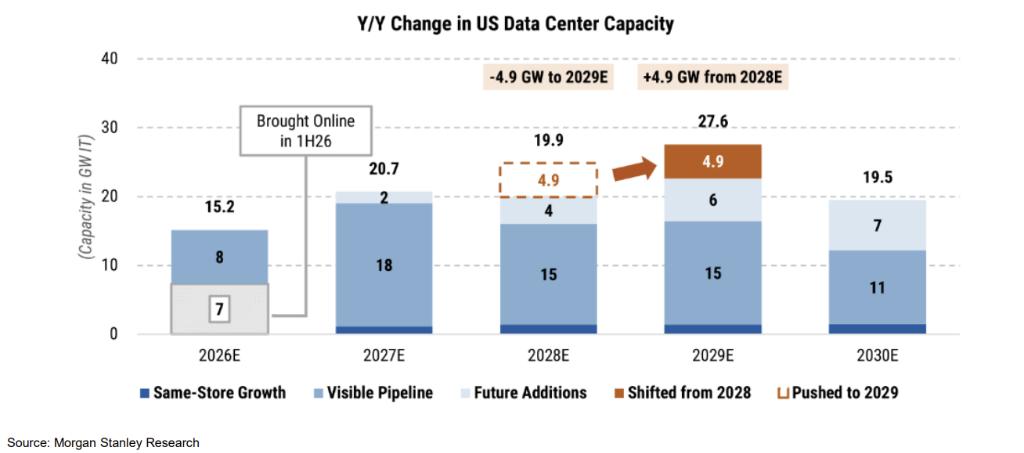
According to Morgan Stanley's report dated November 9, Morgan Stanley estimates that approximately 5GW of US data center projects will be postponed from 2028 to 2029. After adjustment, the annual new capacity of US data centers will drop by 4% year-on-year in 2028 (while the global total will still grow by 9% in the same period), and rebound by 38% in 2029 (with a 20% global growth). There is a net potential power supply gap of 44 GW for the 116 GW power demand corresponding to US chip shipments from 2026 to 2028, accounting for about 38% to 40%. The main reasons include insufficient grid capacity, uncompleted projects under construction, and power supply delays related to the midterm elections.
The report clarifies that policy tools that can actually restrict project progress are mainly in the hands of state and local governments, and the political landscape at the federal level has limited direct impact on specific projects.
Morgan Stanley believes that newly elected governors are unlikely to interfere with projects already under construction, so project expectations for 2027 remain unchanged; but some projects in Texas and Ohio originally scheduled for 2028 may be postponed as governors negotiate with legislative bodies to formulate new requirements.
The four main resulting impacts are: more scattered data center site selection (including shifting overseas), rising premium for existing capacity, risk of phased gap in the technology supply chain in 2028, and the overall extension of the AI capital expenditure cycle.
01 Political Resistance Changes Construction Pace, 2028 Becomes a Watershed
The Morgan Stanley report points out that opposition to the expansion of AI and data centers is a clearly divisive issue for voters in this midterm election. A survey conducted by the institution in August 2026 shows that 72% of potential voters consider the candidate's stance on AI "very important" or "relatively important", and this proportion is as high as 76% among people aged 18 to 34.
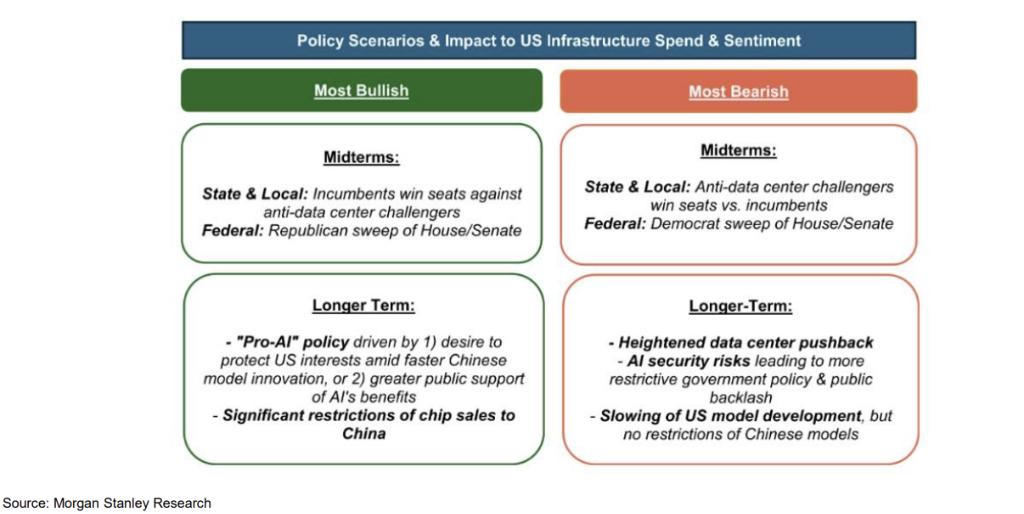
However, the report emphasizes that whether campaign propositions can be transformed into actual project restrictions is still constrained by procedural factors. Although the Democratic Party has achieved important victories in gubernatorial elections in key states such as Texas and Ohio, the control of state legislative bodies is still divided between the two parties, and the unilateral propositions of governors cannot bypass the legislative process to be implemented directly.
Interference in projects under construction is expected to be limited. The report judges that new governors are more likely to exert influence by cooperating with legislative bodies and formulating new approval requirements for data center developers, rather than halting construction directly. This logic makes the report maintain the construction expectation for 2027, and focus the pace adjustment on new projects starting in 2028.
02 Power Supply Gap is a Deeper Restricting Variable
Beyond the political level, the report lists insufficient power supply as the core constraint restricting chip deployment from 2026 to 2028.
According to Morgan Stanley's waterfall model, the total power demand corresponding to US chip shipments from 2026 to 2028 is 116 GW; after deducting 25 GW that can be covered by data centers under construction and 21 GW of available grid capacity, plus the additional 6 GW gap caused by power supply delays related to the midterm elections, the potential power supply gap reaches 76 GW.
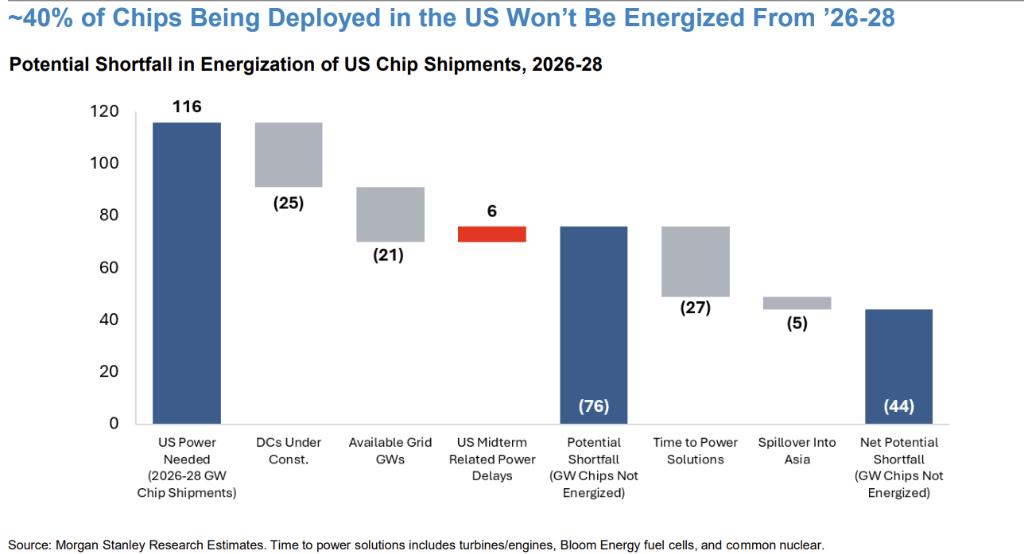
On this basis, alternative power supply solutions such as turbines, Bloom Energy fuel cells and nuclear power can alleviate 27 GW, and transferring deployment to Asia can reduce another 5 GW, finally narrowing the net potential gap to 44 GW, accounting for about 40% of the total 116 GW demand.
03 The US Remains the Largest Market, but Overseas Demand Undertaking Rises
Morgan Stanley estimates that the leading position of the US market will not be fundamentally changed by the results of this midterm election. Taking 2025 as the benchmark, the US is expected to add about 103GW by 2030, China about 55GW, and Europe about 13GW.
However, the midterm election results may further push US developers to turn their attention overseas. Morgan Stanley believes that Southeast Asia (+6 GW), India (+7 GW), Europe (+12 GW), Australia (over +4 GW), Japan (+2 GW) and South Korea (+2 GW) are feasible regions that can reasonably undertake US data center capacity. The report also points out that new capacity in Europe is expected to mainly serve local European demand.
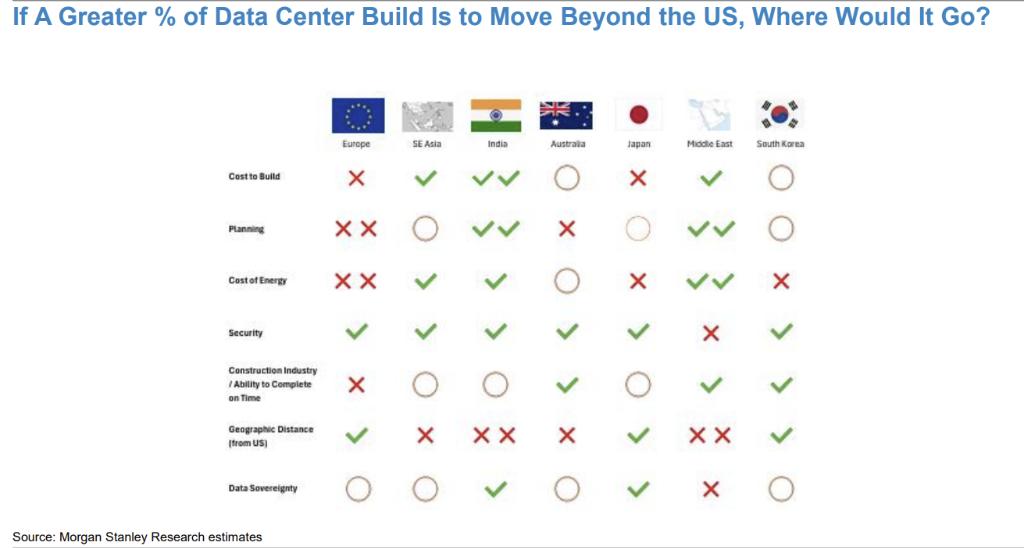
When choosing overseas construction sites, construction cost and electricity price are the two most important considerations. The report estimates that data center construction costs are rising at a rate of more than 10% per year, driven by factors including energy crisis, rising interest rates, grid investment demand and rising labor costs. GPUs account for about half of the total capital expenditure per GW of AI data centers, making it the single item with the highest weight in capital allocation.
04 Capital Expenditure Forecasts for Hyperscale Tech Firms Remain Unchanged, Quality Differentiation Emerges in Credit Market
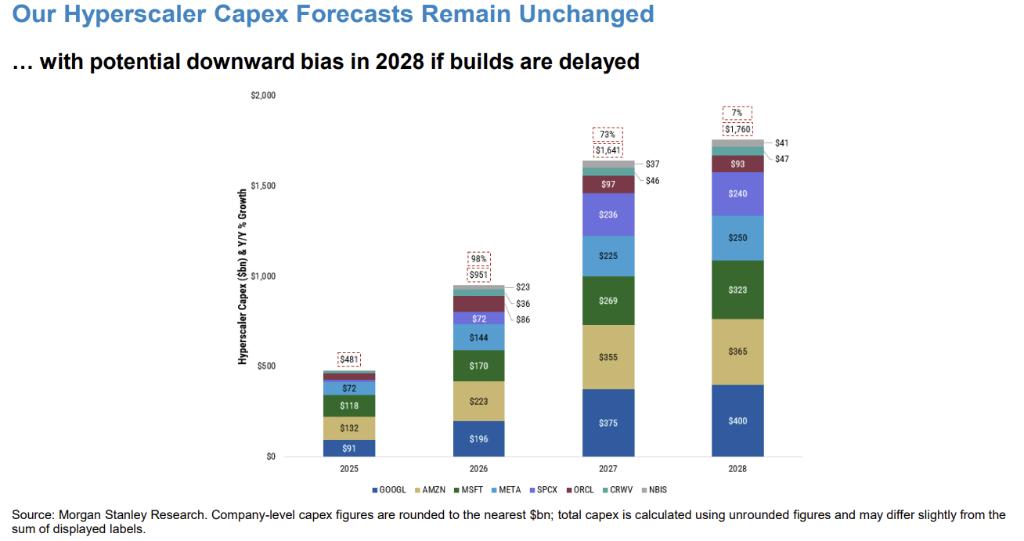
Morgan Stanley maintains its unchanged capital expenditure forecasts for hyperscale technology companies such as Google's parent company GOOGL, Amazon, Microsoft and Meta.
According to its estimates, the total capital expenditure of the above institutions will grow from about 481 billion US dollars in 2025 to about 951 billion US dollars in 2026, about 1.64 trillion US dollars in 2027, and further increase to about 1.76 trillion US dollars in 2028. The growth rate will slow down sharply from 98% in 2026 and 73% in 2027 to 7% in 2028. The report also points out that if the construction delay in 2028 comes true, there is a possibility of downward revision of capital expenditure that year.
At the credit market level, the report observes obvious quality differentiation within AI financing. Bond issuance by high-quality hyperscale technology companies has rebounded recently, but their credit spreads have widened to the widest level of the year, higher than the broad investment-grade bond index, even though their credit ratings are generally higher. At the same time, debt issuance for data center construction, which is more sensitive to interest rates, has slowed down significantly, and related bonds have continuously underperformed same-rating indexes since summer.
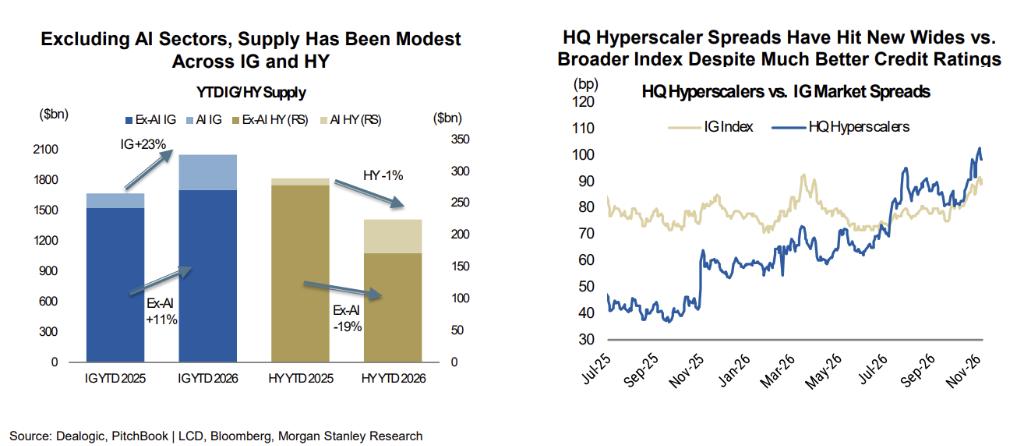
Morgan Stanley expects that chip financing transactions and shorter-term bond issuance by hyperscale technology companies will increase. As the market re-evaluates the risk premium of data center construction, data center bonds are expected to remain highly volatile. If the construction pace slows down, the pressure on new financing supply may be alleviated to a certain extent.
This article does not constitute personal investment advice, does not represent the position of the platform. The market is risky, and investment requires caution. Please make independent judgments and decisions.
This article is from the WeChat Official Account "Wall Street CN Max", Author: Xu Chao, published by 36Kr with authorization.