Why did the second-generation upgraded Leqi lose to Thunderbird during the Double 11 Shopping Festival?
The technical dilemmas and the privacy regulatory challenges.
This year's Double 11, which player in the smart glasses industry is having a tough time? The answer might be Rokid.
The company just held a launch event at the end of October, unveiling its brand-new second-generation AI glasses, only to find itself outperformed by its old rival TCL RayNeo in the Double 11 sales report.
In JD.com's Double 11 opening sales report, RayNeo iO overtook Rokid's Rokid Glasses to become the top-selling waveguide smart glasses model. In terms of overall brand sales, RayNeo also surpassed Rokid to take the top spot in the industry.
As the second-highest seller during the Double 11 period, Rokid is far from being weak in strength. After all, data from Counterpoint Research in the first quarter of 2026 shows that Rokid led the global waveguide AR glasses market with a 41% market share.
The reason why its sales fell short of RayNeo's is probably not poor product performance, but the two companies have completely different understandings of smart glasses.
In the future, will the cool faction represented by Rokid win, or the lightweight faction represented by RayNeo prevail? The sales volume of a single Double 11 event can hardly give a definite answer, and the conclusion can only be drawn after the industry is fully developed.
01 Green Glow in Wearers' Eyes
Rokid's sales defeat by RayNeo during this year's Double 11 does not seem to stem from weak product performance, but from its overly fancy product technologies.
After all, many users are attracted by all kinds of novel features after putting on Rokid AI glasses, but meanwhile they are easily embarrassed and caught in awkward social situations by the green reflection on the lenses.
Pan Ge found that many first-generation Rokid AI glasses users have reported that when using the screen display function, the glasses easily reflect green fluorescence at certain specific angles and in specific environments, making the wearer look exactly like a villain in sci-fi movies.
Especially in indoor spaces with low natural light and at night, this reflection phenomenon becomes even more obvious. People who do not want others to notice they are wearing Rokid smart glasses may be exposed in a second by the green glow, no matter how perfectly they disguise themselves in other aspects.
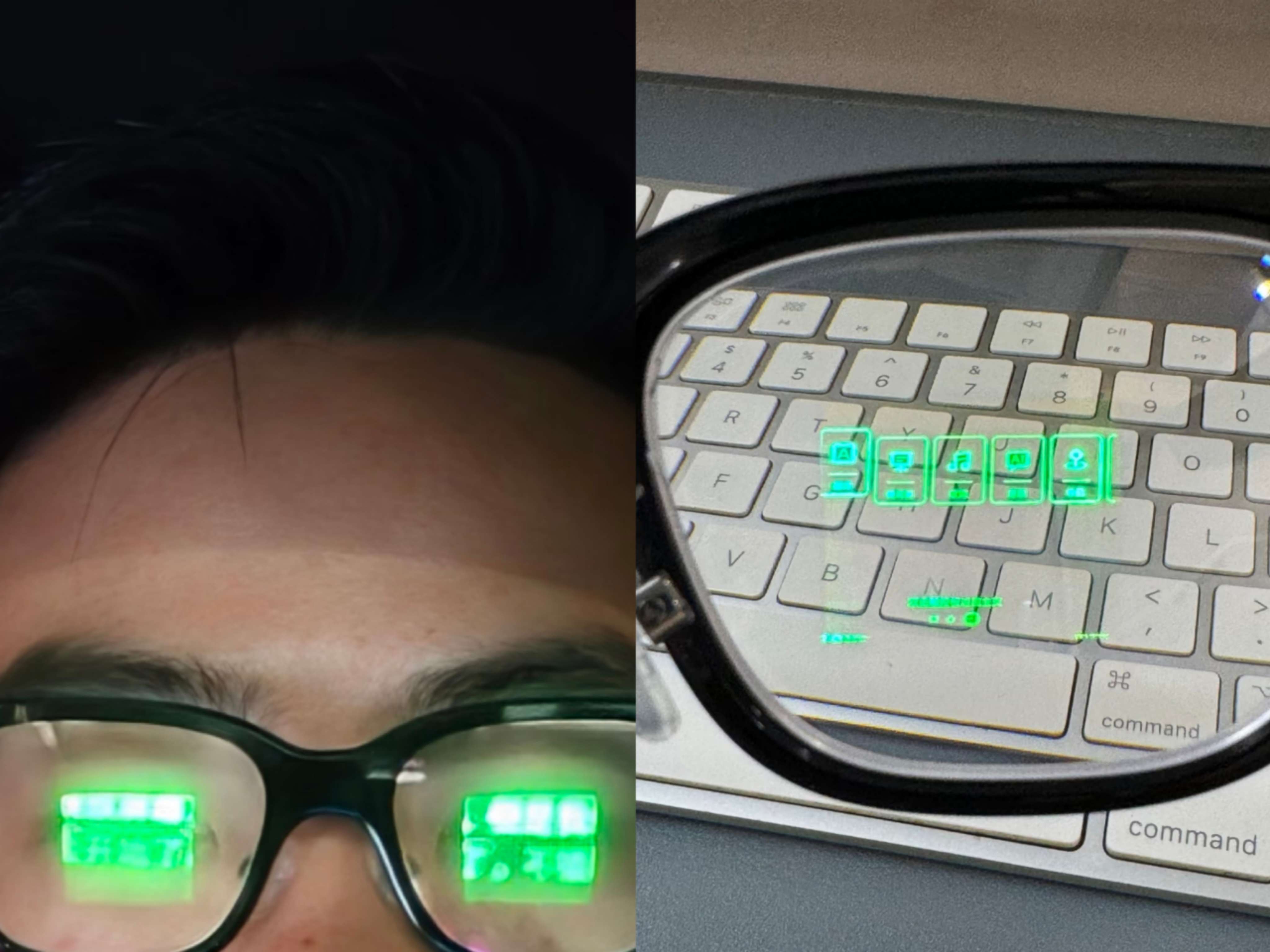
As the leading player in the waveguide smart glasses track, why does Rokid fail to meet users' demand for low-profile use, but often leave them with a green glow in their eyes?
Pan Ge learned that this is not a deliberate move by Rokid to seek attention, but a common problem for glasses with on-lens displays.
When content is displayed on smart glasses lenses, part of the light enters the wearer's eyes to form an image, while the other part leaks out from the outer side of the lens. If the optical design of the glasses does not properly handle this light leakage, people facing the wearer can see the green glow in their eyes.
A Rokid employee told Pan Ge: "Limited by the technical principle, the light leakage problem is indeed quite obvious at present. The second-generation product has made some optimizations in optics, and this problem will be improved to some extent."
Since the light leakage problem is unavoidable, why have many manufacturers unanimously adopted the suggestive green for the screen display?
For example, one user once called out to Rokid founder Zhu Mingming: "Can you stop showing me green stock charts? It makes me feel creepy." Another netizen said: "Every time I put on my Rokid AI glasses to handle work, people around me will sing Stefanie Sun's 'Green Light' for me."
For this question, there seem to be three main reasons:
First, among the current mainstream waveguide display technologies, green light has the highest transmission efficiency and the lowest loss. Second, the human eye is most sensitive to green light, so under the same energy condition, green is the brightest and clearest, which is more conducive to extending the product's battery life. Finally, the monochrome green optical engine module has a smaller volume, which facilitates the lightweight design of smart glasses.
Fortunately, the second-generation AI glasses released by Rokid come in two versions: a full-color 16.77 million color variant and a monochrome green variant. Users who previously always had a hint of green in their eyes now have a colorful set of options.
02 The Camera That Makes People Feel Unsafe
Rokid AI glasses with a glowing green tint make some socially anxious users too embarrassed to try them. On the other hand, ordinary people may also feel deep hostility when seeing someone wearing Rokid glasses. Why is that?
The root cause probably lies in the built-in camera of Rokid AI glasses, which supports real-time photo taking and video recording. Ordinary people facing a Rokid user can easily feel enormous pressure.
Netizen Liuliu told Pan Ge: "There is a colleague in my company who gets along poorly with everyone. He bought a pair of smart glasses not long ago, and now he always wears them at work, often pointing the glasses at us and touching the temple from time to time. I suspect he is secretly taking photos of us, but I can find no evidence."
On the other hand, some other netizens said: "I think the so-called smart glasses are just cameras that can never be turned off. Put yourself in others' shoes: if someone holds a camera up while talking to you, wouldn't you feel uncomfortable too?"
In fact, many people's hostility towards smart glasses is not unreasonable. Those smart glasses equipped with cameras do have the potential to cause harm to society.
For example, in June 2026, a user on the official community of Rokid AI glasses once uploaded a video secretly filming a flight attendant at the boarding gate when he was traveling with Spring Airlines. In addition, there are a large number of shooting contents taken in public places in the community, where the facial features of many passersby are clearly visible.

In July 2026, a student from South China Agricultural University also wore Rokid AI glasses during the final exam, and used it to take photos to search for answers and commit other cheating behaviors.
It can be seen that smart glasses with cameras like Rokid are increasingly likely to become tools for secret photography and cheating. In response to this situation, many people have taken up defensive measures.
For example, in order to prevent illegal acts such as secret photography and cheating, the indicator light on the frame of most smart glasses will always stay bright when the camera is working, so as to send a reminder to people around.
Recently, Apple Inc. even applied for a patent for this scenario: when the smart glasses camera is working, the entire frame will flash brightly, so that people with poor eyesight can also spot it in a second.
Not only that, some people have also developed applications to identify smart glasses. An app called "Nearby Glasses" has become an anti-secret-photography radar on ordinary people's mobile phones. As soon as smart glasses with cameras appear around, it will send an alert on the mobile phone.
Although smart glasses manufacturers and third parties have set various restrictions, some illegal users have also come up with many strange operations to break through these blocks.
On e-commerce platforms, some merchants sell smart glasses light-shielding stickers. When the camera indicator light is blocked, the glasses can continue to shoot and record videos normally, and the system will not send any prompts or alerts.
03 Two Different Development Paths
Wearers feel embarrassed because of the green glow, and people around them feel scared because of the camera. Rokid AI glasses seem to fail to satisfy either side.
So, is there any smart glasses that can avoid these shortcomings as much as possible? Products without cameras may be a good choice.
Pan Ge found that RayNeo, which overtook Rokid during the Double 11 period, has achieved good sales with its iO series products that are not equipped with cameras. On JD.com, the sales volume of RayNeo iO smart glasses has exceeded 10,000 units, making it the champion of the platform's hot-selling smart glasses list.
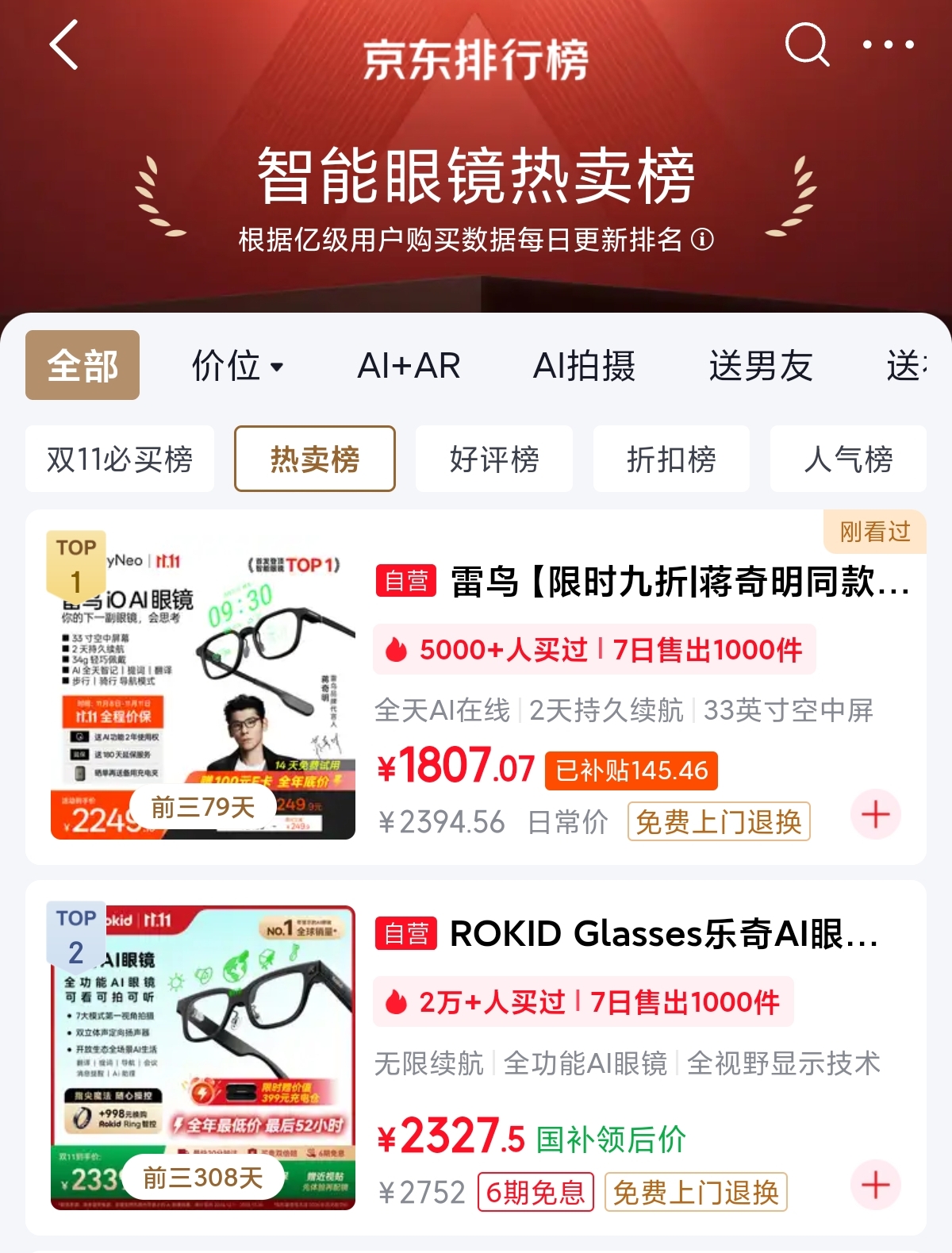
From the perspective of their respective development directions, RayNeo is more like a pair of thinking glasses, with relatively lighter weight, relatively fewer functions and relatively longer battery life, so users will not feel much burden when wearing it.
In contrast, Rokid is more like a display worn on the eyes. Although it is equipped with all kinds of intelligent AI and AR functions, it is heavier, has shorter battery life, and will bring some pressure to users.
For example, from the perspective of battery life, netizen Xiaoxue told Pan Ge: "The first time I went out wearing Rokid, I recorded a video while riding a bike, and it ran out of power in more than 20 minutes, and I didn't bring a charger with me."
Netizen Ahu also told Pan Ge: "If I wear Rokid AI glasses in daily life, I have to charge it at least three times a day, for about 10 minutes each time. Sometimes I have to hang a power bank to charge it while wearing the glasses."
The shape of hanging a power bank on AI glasses seems a little strange. To avoid this awkward look, Rokid has also prepared a special charging case for users troubled by battery life anxiety.
On the other hand, to help users operate the glasses without embarrassment, Rokid also launched an interactive ring at its recent launch event. Users can slide on the ring or snap their fingers to control the AI glasses silently.
It can be seen that the differences in product design between Rokid and RayNeo represent the two companies' different understandings of smart glasses. This difference in concepts is very likely to affect the market share of the two companies in the future.
IDC data shows that in the first half of 2026, the global shipment of smart glasses reached 7.11 million units, a year-on-year increase of about 70%. It is expected that by 2029, the global shipment of smart glasses will exceed 40 million units.
Among them, Rokid has become the industry leader in waveguide smart glasses by relying on full AI and AR functions and an open ecosystem. RayNeo has captured a 34% share of the smart glasses market by leveraging its advantages in price, battery life and lightweight design.
Perhaps for Rokid at the current stage, RayNeo's sales volume will not bring it much pressure. After all, the demand for smart glasses has just been unleashed, and it still takes time to find out which of the two concepts is the correct one.
This article is from the WeChat official account "Zinc Consumption Research Center", written by Pan Ge, and authorized for release by 36Kr.