T-Head is set to go public, which is the first major outcome of Alibaba's AI business.
As widely expected by the market, Alibaba is planning to spin off its chip subsidiary T-Head for a Hong Kong listing.
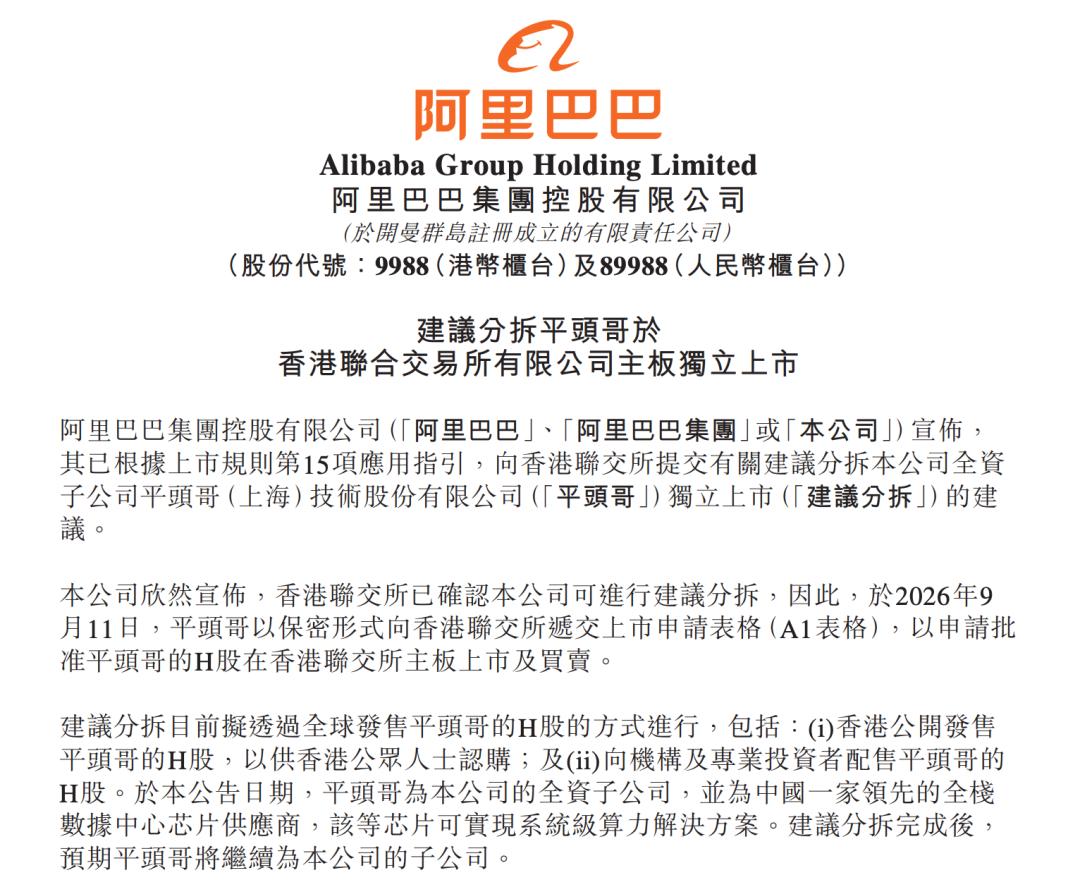
On the evening of November 10, Alibaba released an announcement stating that it plans to spin off its semiconductor firm T-Head for an independent listing on the Main Board of the Hong Kong Stock Exchange. T-Head had already submitted its listing application confidentially as early as September 11 this year.
According to media reports, T-Head is targeting a Hong Kong listing next year, with a potential fundraising size of USD 2 billion to USD 3 billion. However, Alibaba has not yet disclosed the specific offering scale and listing timeline.
In March this year, Alibaba CEO Wu Yongming revealed that T-Head's annualized revenue from chips has reached the 10-billion-yuan level.
One step ahead of T-Head is Kunlunxin, a chip firm under Baidu. Back in January this year, Kunlunxin submitted its listing application to the Hong Kong Stock Exchange confidentially. Apart from Alibaba and Baidu, Tencent and ByteDance are also accelerating the R&D and deployment of self-developed chips.
A
According to Alibaba's announcement, T-Head plans to issue H shares on the Main Board of the Hong Kong Stock Exchange, consisting of a public offer to Hong Kong retail investors and an institutional placement.
Upon completion of the spin-off, T-Head is expected to remain a subsidiary of Alibaba, though the final shareholding ratio of Alibaba has not been finalized.
Alibaba explained that the spin-off will help investors separately evaluate the value of the group and T-Head, and attract capital that specifically targets the semiconductor sector. After the listing, T-Head will also be able to independently access the equity and debt capital markets.
Over the past few months, T-Head has significantly stepped up its business moves.
In August, Alibaba adjusted its reporting segments, merging the Cloud Intelligence Group and T-Head into the "AI Cloud and Computing Power Services" segment. On September 22, Wu Yongming unveiled the new generation Zhenwu V900 chip at the Yunqi Conference. Alibaba stated that the performance of this chip is three times that of the previous generation M890, making it the most powerful domestically developed Chinese AI chip in terms of computing performance at the time, with mass production scheduled for the first quarter of next year.
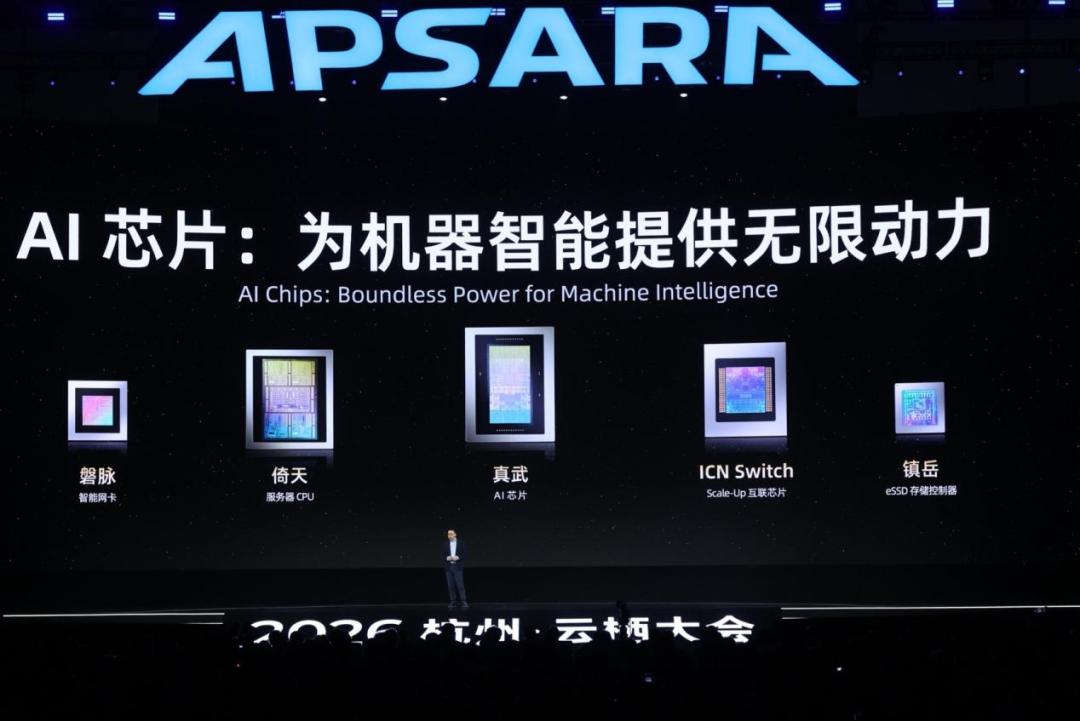
Looking back, T-Head had already submitted its listing application to the Hong Kong Stock Exchange before unveiling the V900 chip at the Yunqi Conference.
When Alibaba made the news public, global AI stocks had just experienced a round of sharp fluctuations. On November 5, the Philadelphia Semiconductor Index fell by around 12%; by November 9, some domestic computing power chip stocks rebounded, with Enflame Technology surging more than 17% intraday, Cambricon rising over 6%, and MetaX and Moore Threads following the upward trend.
The Hong Kong Stock Exchange's rules allow confidential submission of listing applications, and stipulate that relevant information must be made public under specific circumstances. Alibaba did not specify the exact reason for this disclosure. However, when the news was announced, global semiconductor stocks had just gone through a round of fluctuations, and some individual stocks had already rebounded. The recovering market sentiment may also help investors re-evaluate the valuation of the semiconductor business.
Kunlunxin, which has also applied for a Hong Kong listing, has had its application submitted for more than ten months. In May this year, it completed the filing of its listing tutoring for the Sci-Tech Innovation Board, advancing its listing plans on both the Hong Kong Stock Exchange and the Sci-Tech Innovation Board simultaneously. In early November, there were market rumors that its Hong Kong IPO might be postponed, which Baidu later denied, stating that the company is still in the confidential application stage.
For Kunlunxin, whose application has been submitted for more than ten months, the arrival of T-Head may serve as a reference for its pricing. The two companies have similar business lines, both backed by large internet giants, and have applied for listing one after another, which is expected to attract more investor attention.
As more information is disclosed in the follow-up period, investors will also be able to compare the products, customers and revenue of the two companies, providing references for valuation judgment.
B
Large tech giants are accelerating their progress in self-developed chips. Alphabet's Q3 financial report this year shows that TPU system sales have become one of the driving forces for Google Cloud's revenue growth. On November 9, Google added two new systems for its 8th-generation TPU, bringing the total number of systems for this generation to four, which are designed for different scenarios such as training and inference.
The head of Google's AI infrastructure revealed that TPUs currently have nearly 100 external customers. Last October, Anthropic announced an expansion of its cooperation with Google Cloud, planning to use up to 1 million TPUs, with the entire expansion plan valued at hundreds of billions of dollars.
Chips from domestic large tech giants are also iterating rapidly, and T-Head has made relatively fast progress in commercialization.
Founded in 2018, T-Head initially focused on serving Alibaba's internal business. Now it has launched the Zhenwu AI chip, Yitian server CPU, ICN interconnection chip, Panmai smart network card and Zhenyue storage controller, making it one of the few domestic vendors that simultaneously deploy core chips for computing power, storage and network.
As of April this year, the cumulative shipment of the Zhenwu series AI chips has exceeded 560,000 units. T-Head's PPU was also one of the domestically produced GPU chips with the highest shipment volume in 2025. By early August, T-Head's Zhenwu chips had more than 650 customers. After the segment adjustment in August, the revenue of the "AI Cloud and Computing Power Services" segment that includes T-Head reached RMB 48.437 billion in that quarter, representing a year-on-year increase of 45%. Alibaba has not disclosed T-Head's revenue separately.
Tencent and ByteDance are also accelerating their layout in this field, though at the current stage they are mainly pushing forward chip R&D and product deployment, and have not disclosed any plans to spin off their semiconductor business for listing.
Tencent previously announced three self-developed chip product lines: Zixiao for AI inference, Canghai for video transcoding, and Xuanling for smart network cards. Now Tencent Cloud has already provided cloud instances equipped with the Zixiao C200 chip.
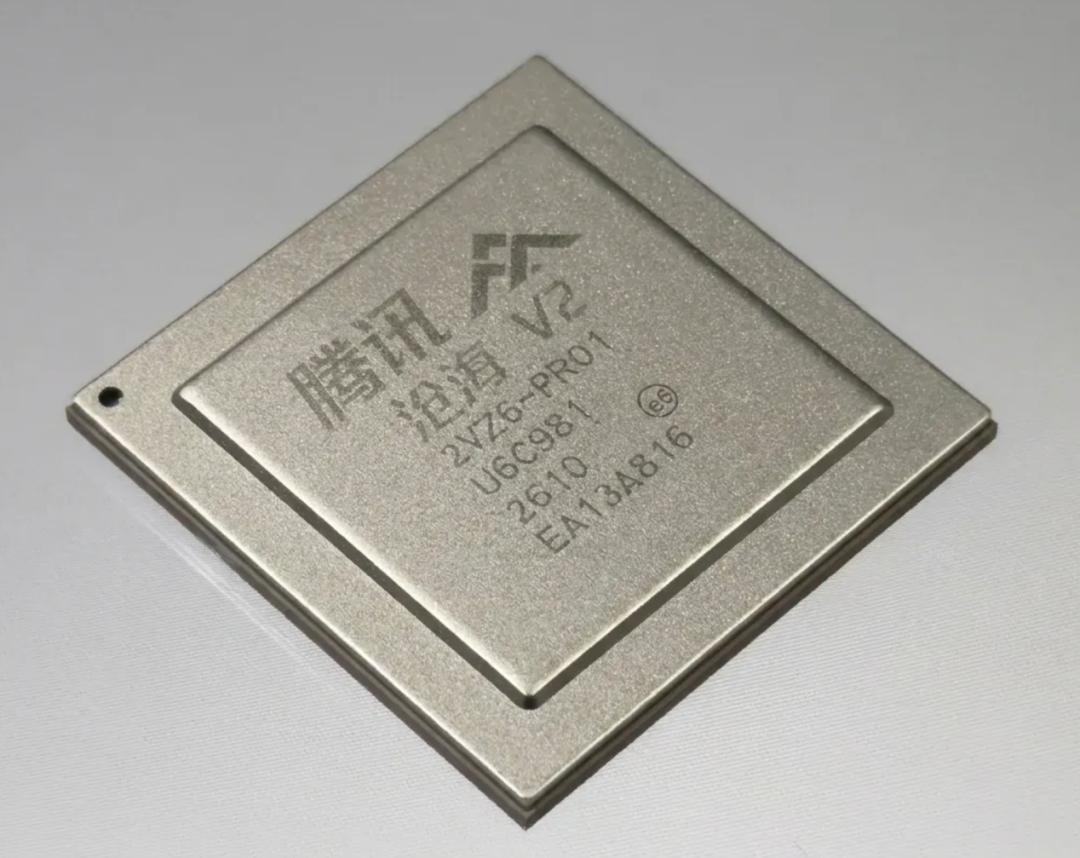
In July this year, Tencent launched the Zixiao 2.0, whose training performance is 4 times higher than the previous generation. The chip is mainly used for its own business, and Tencent plans to expand the deployment scale of its self-developed chips to the 100,000-card level by the end of the year.
The Canghai chip has already been put into use in Tencent's video business. According to Tencent Cloud's disclosure in May this year, the Canghai V1 has been deployed in more than 100,000 units in scenarios including Tencent Cloud, in-house live streaming and cloud gaming; the new generation Canghai V2 has been lit up and entered the mass production cycle.
ByteDance has disclosed relatively less information about its chip business. While carrying out independent R&D, it is also seeking external cooperation.
Reports in May this year stated that ByteDance is developing server CPUs, and is considering both Arm and RISC-V architecture routes. In October, another media report said that ByteDance is in-depth negotiations with MediaTek on the supply of customized data center chips, and no public information is available on whether the two sides have finally reached a deal. If the cooperation is reached, ByteDance is likely to become MediaTek's second largest ASIC customer after Google.
The large tech giants' investment in computing power has also brought more attention to supporting enterprises such as server and data center vendors. In addition to T-Head, Super Fusion, a firm engaged in server and computing power infrastructure business, is also preparing for a listing recently.
According to the prospectus, Super Fusion recorded a revenue of RMB 37.286 billion in the first half of this year, representing a year-on-year increase of 20.78%; of which, revenue directly or indirectly from internet customers reached RMB 25.061 billion, accounting for 67.27% of the total revenue. As of the end of July, the company's pending orders stood at RMB 30.113 billion.
According to IDC data cited in the prospectus, Super Fusion ranked second in terms of shipment volume in China's server market in 2025. On November 12, its IPO application on the ChiNext Board will be reviewed by the Listing Committee of the Shenzhen Stock Exchange, with a planned fundraising of RMB 80 billion.
China's integrated circuit exports are also growing. Customs data shows that China's integrated circuit exports in October reached approximately USD 39.594 billion, representing a year-on-year increase of 137.1%.
From chips to servers, large tech giants and computing power enterprises are all striving for greater development.
This article is from the WeChat Official Account "Alphabet List" (ID: wujicaijing), written by Si Bo, and republished with authorization from 36Kr.