Headhunters may have already started scouting potential candidates for NVIDIA's new CEO, including Lisa Su. A massive 550 million stock option deal has been exposed, so where is the key important defensive support zone below?
On Tuesday US Eastern Time, the three major U.S. stock indexes closed lower across the board.
The most immediate trigger for today's market slump is that U.S. inflation data exceeded expectations, coupled with a dense wave of hawkish remarks from Federal Reserve officials that have kept the market on edge.
The U.S. CPI rose 0.4% month-on-month in October, higher than the expected 0.3%; the core CPI climbed 0.3% month-on-month, which is not only above the expected 0.2%, but has also stayed at the high level of 0.3% for three consecutive months.
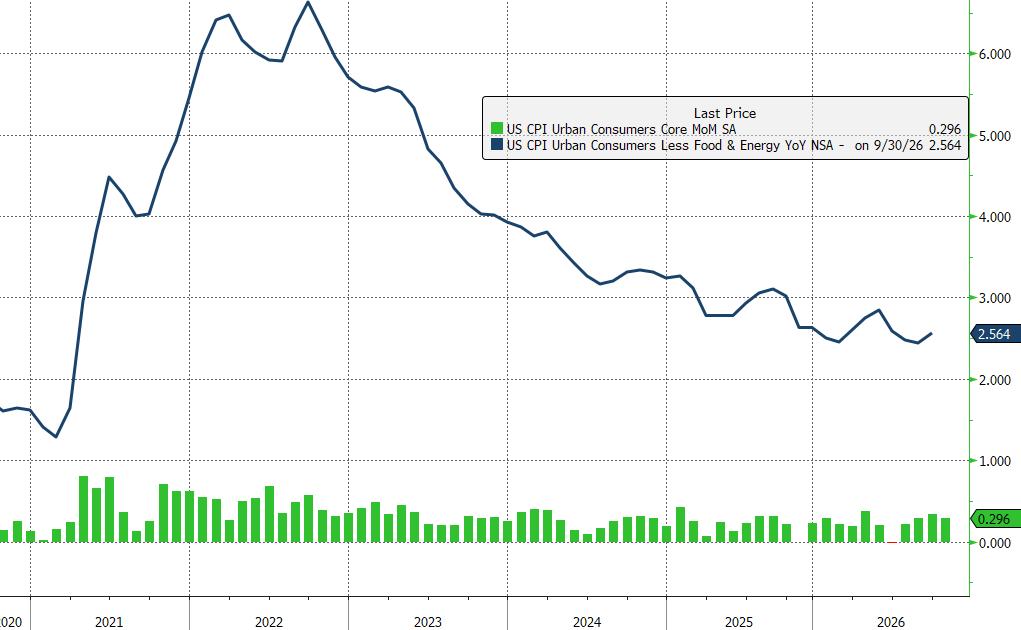
This reading exactly hit the "warning line" previously set by Fed Governor Christopher Waller — he explicitly stated that if core CPI reaches or exceeds 0.3%, the Fed should consider raising interest rates by 50 basis points at the December meeting.
Shortly afterwards, Dallas Fed President Lorie Logan and Kansas City Fed President Jeff Schmid made successive statements, warning that the current policy rate is still too loose, and they do not rule out accelerating the pace of policy tightening in the winter.
The bond market sounded the alarm first. The yield on the 2-year U.S. Treasury note surged by about 18 basis points in a single day to 4.73%, marking the largest one-day increase since April 2025; the 10-year yield rose to 4.99%, once breaking through the 5.00% mark during intraday trading.
The sudden spike in risk-free rates not only indiscriminately discounted the future cash flows of high-valued tech growth stocks, but also directly pushed up the high financing costs of data centers and AI computing power infrastructure.
NVIDIA: The CEO himself is starting to be priced in
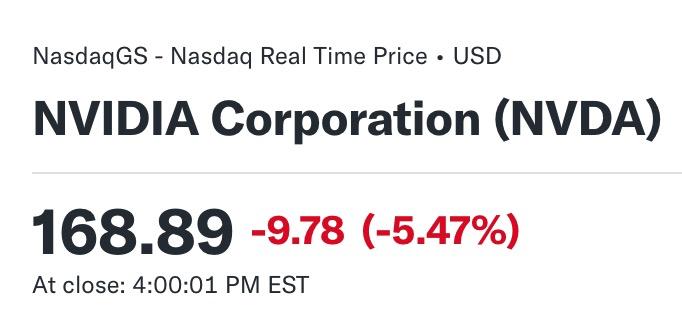
NVIDIA closed down more than 5% again on Tuesday. Calculated from its peak of $243 in October, its decline has exceeded 31%, its market value has evaporated by about $1.82 trillion, and its year-to-date gains have completely turned negative.
The direct triggering factors are two reports.
The Information stated that a network associated with people close to Jensen Huang allegedly facilitated the flow of at least $7.5 billion worth of NVIDIA chips to Chinese companies, involving about 240,000 AI chips, including restricted models.
Bloomberg reported on the same day that about 50,000 NVIDIA chips "disappeared" from the inventory data submitted to U.S. authorities, involving Singaporean firm Megaspeed which is under investigation for the flow of chips; NVIDIA later stated that the hardware was stored in an additional warehouse, but did not provide detailed accounts.
These two reports alone cannot prove that Jensen Huang acted knowingly, nor can they prove that NVIDIA deliberately circumvented export restrictions. But the market never prices in "proven facts", but "probabilities that are being reassessed".
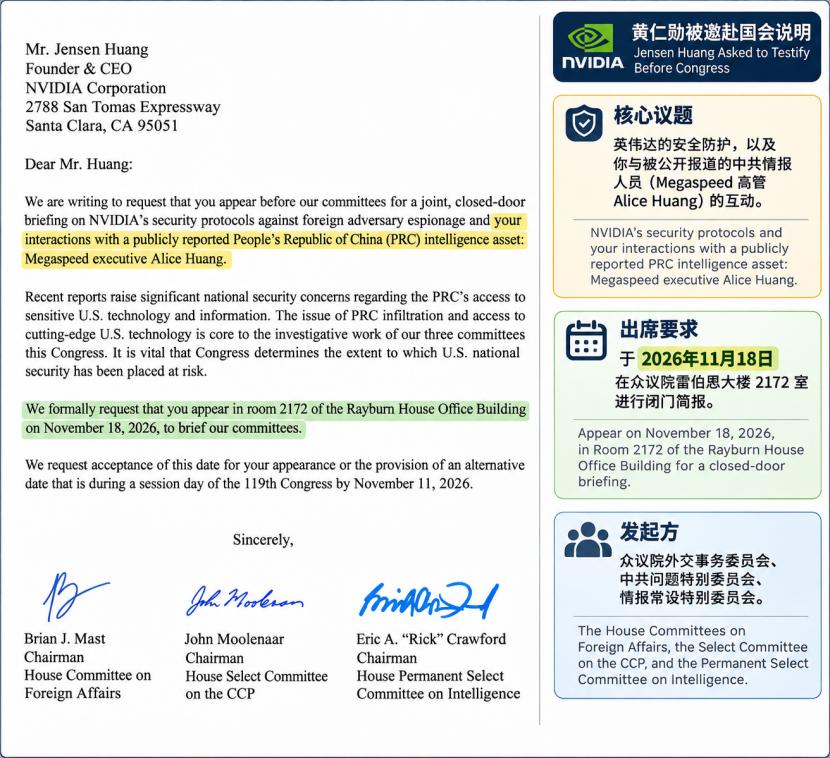
A more critical change took place in Washington. Three influential committees of the U.S. House of Representatives have requested Jensen Huang to attend a closed-door briefing on November 18 to explain his communications with Megaspeed executive Huang Le, as well as NVIDIA's security policies to guard against foreign operations.
House Democratic Leader Hakeem Jeffries further called for a full briefing on the matter and advocated tightening sales restrictions on chips to China.
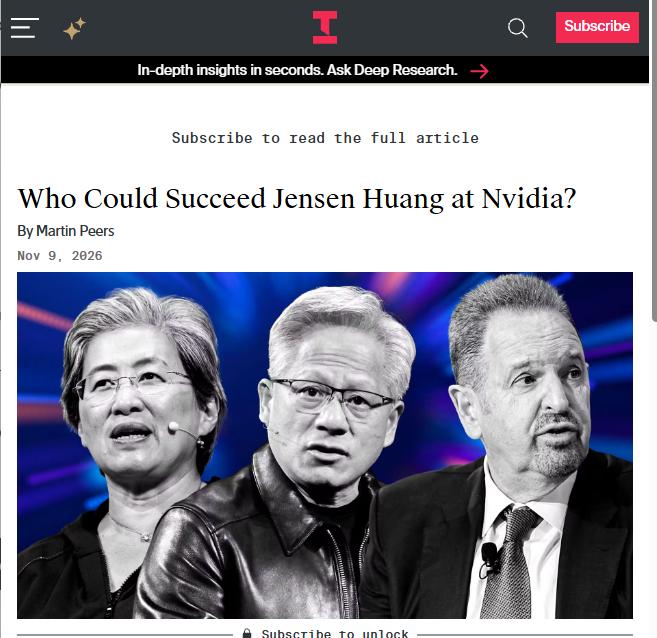
NVIDIA's board of directors has launched an independent investigation. Jensen Huang will remain in his position during the investigation, but "the CEO's tenure" has changed from a tail-end hypothetical scenario to a discussable variable on traders' desks.
Analytical articles point out that headhunting firms may have already started scouting for candidates across the industry, and potential candidates include heavyweight figures such as Lisa Su, CEO of Advanced Micro Devices (AMD), and Rene Haas, CEO of chip design firm Arm Holdings (ARM).
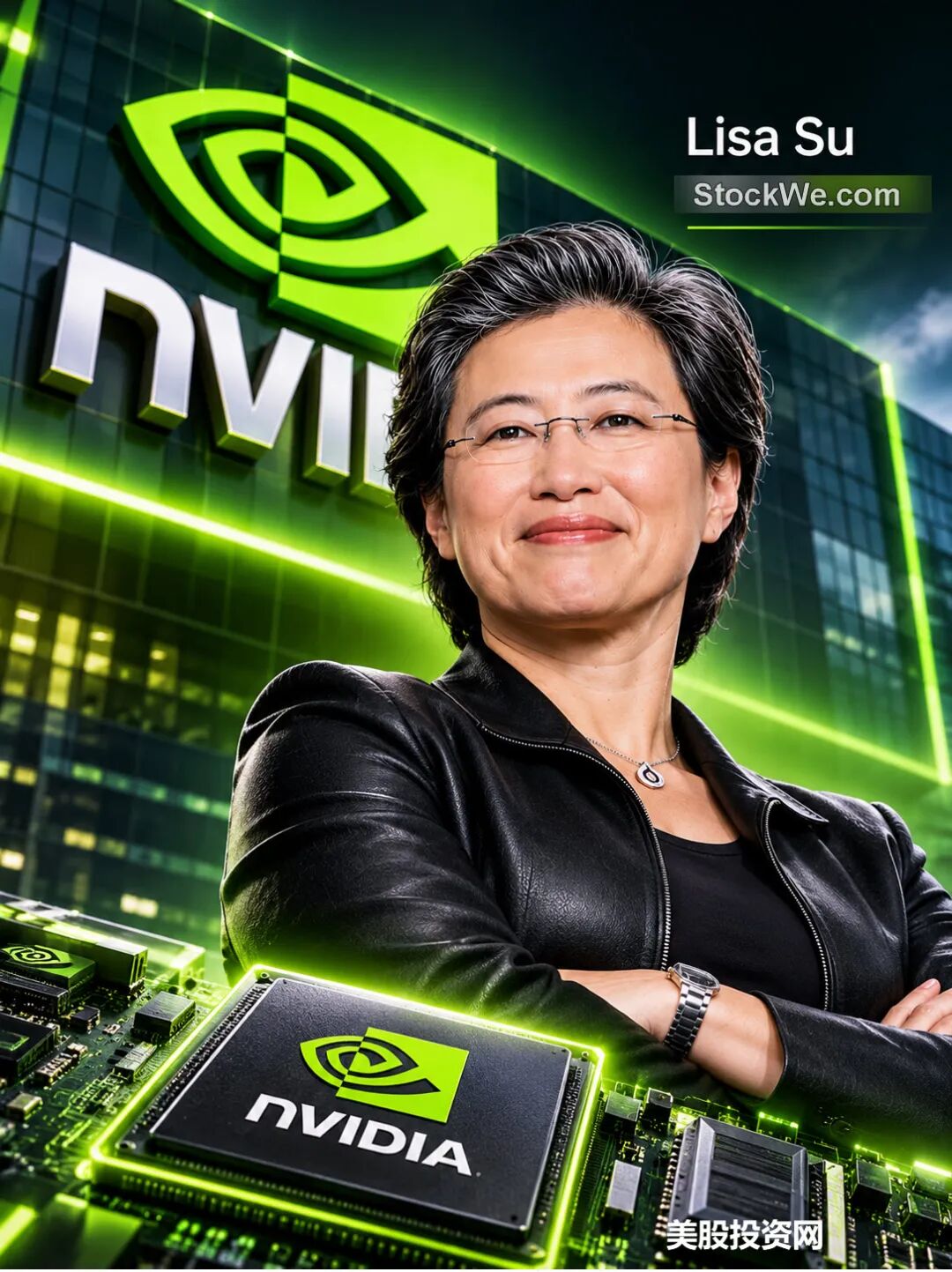
Lisa Su is a professional manager rather than the founder of AMD. Therefore, in terms of corporate governance and legal identity, it is indeed possible for her to leave AMD and take over as CEO of NVIDIA (NVDA).
According to U.S. Stock Investment Network, if NVIDIA CEO Jensen Huang leaves his post, it may trigger a chain reaction across the entire artificial intelligence (AI) industry and drag down AI trading and financing activities. Brian Colello, senior stock analyst at Morningstar, wrote in a report on Monday: "We have always believed that NVIDIA and Jensen Huang are at the core of the AI ecosystem.
His departure may lead to reduced trading activities and financing in the AI sector, intensified regulatory efforts, and a stronger political backlash around artificial intelligence," he added, noting that NVIDIA's investigation of Jensen Huang "could lead to" the CEO's departure.
How much of NVIDIA's current roughly $4 trillion market value is built on the premise that "Jensen Huang is irreplaceable"?
This question has never been unpacked before, but now it has been forcibly brought to the table. As long as the briefing on November 18 cannot be wrapped up cleanly, this valuation discount will hardly be eliminated at one go.
According to the large option order data from U.S. Stock Investment Network and its affiliated U.S. stock big data platform StockWe, on November 10, there was a very obvious capital game in the NVIDIA options market. The 21 large transactions in this chart alone involved option premiums exceeding $550 million.
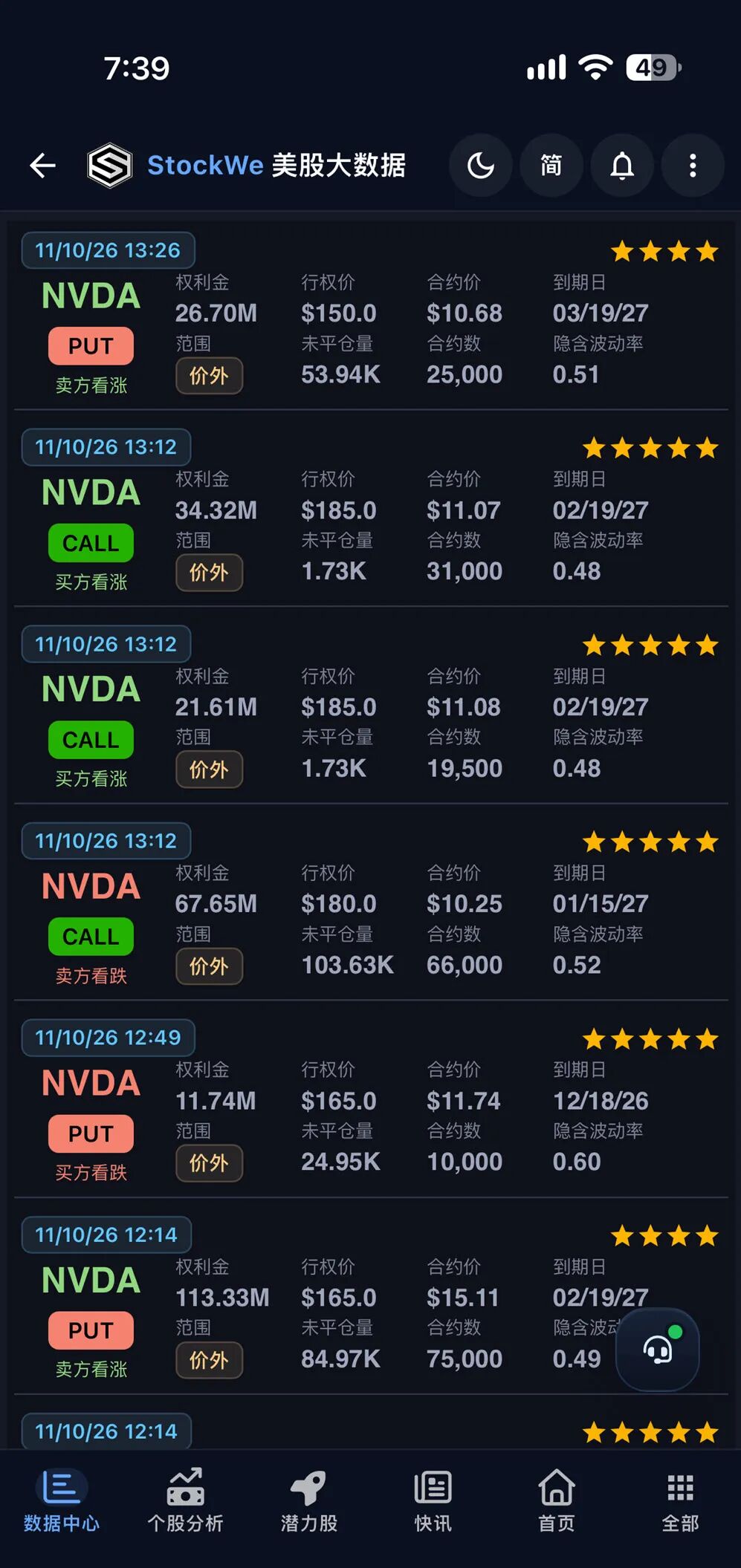
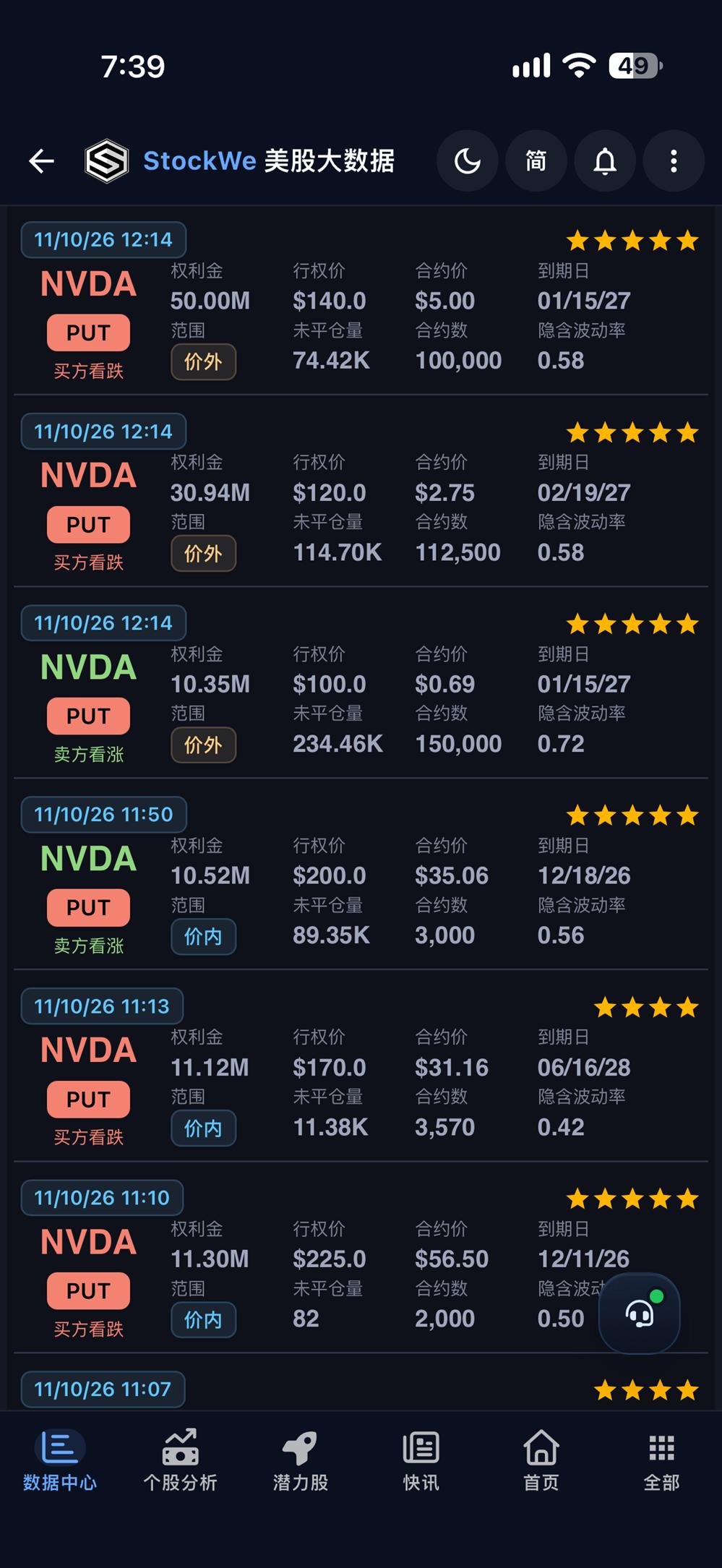
Judging from the capital layout, the market is not uniformly bearish on NVIDIA.
Some large funds are collecting premiums by selling PUTs, especially the PUTs expiring in February 2027 with a strike price of $165, whose single transaction premium reached $113 million.
This type of transaction means the seller is willing to assume the obligation to buy NVDA at $165 in the future. After deducting the premiums received, the corresponding break-even price is about $149.89.
At the same time, some funds are buying $185 CALLs, betting that NVIDIA will rise again in the future.
But on the other side, the size of defensive capital is also considerable.
A large number of long-dated PUT buy orders appeared in the market, among which the single premium for $140 PUT expiring in January 2027 reached $50 million; multiple large transactions also appeared consecutively for $140 PUT expiring in June 2027.
This shows that some funds are buying protection against possible further declines in NVIDIA's stock price in the coming months. At the same time, large sell orders also appeared for CALLs with strike prices such as $180 and $195, reflecting that some funds remain cautious about future upside space.
U.S. Stock Investment Network believes that the most notable point of this batch of transactions is that the funds are not only engaged in short-term games around the next few days, but have placed a large number of positions in 2027 and even later expiration months.
Some people are willing to take over the risk of taking delivery of stocks near $150, while others are willing to spend tens of millions of dollars to guard against the stock price falling to a lower level. This is not a uniform institutional bottom-fishing, but large funds are repricing around NVIDIA's valuation and risks over the next year.
In the short term, I will focus on observing the two lower price zones of $140 and $120. Relatively concentrated large PUT buy orders have appeared near $140, which is the current risk defense position worthy of attention; if NVIDIA continues to weaken, $120 will be the next downward observation zone that needs vigilance.
Anthropic: The trillion-dollar anchor is much lower than rumors
On the same day, Anthropic submitted an updated IPO prospectus to the SEC, with the IPO price range locked at $70-$78 per share, U.S. stock ticker "ANT", and plans to issue about 801.4 million shares, with a maximum basic fundraising of $644 billion.
Calculated at the upper limit of $78, the corresponding market value is about $1.02 trillion; after including employee options, restricted stocks and reserved shares for charitable donations, the fully diluted valuation is about $1.4 trillion.
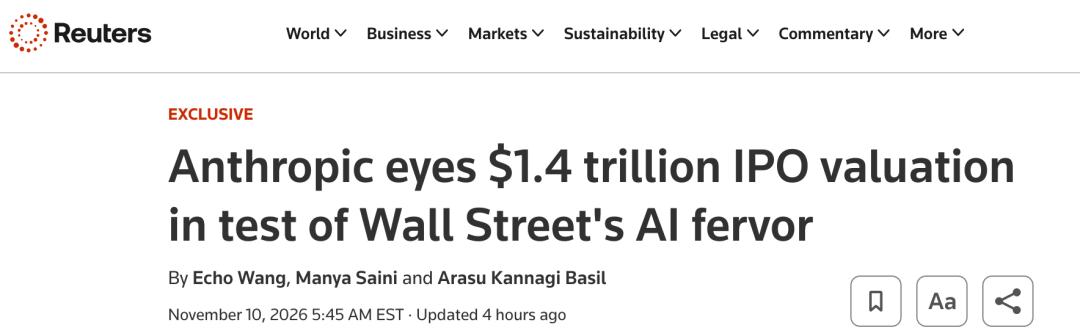
In any year, this is a giant IPO. But compared with previous market expectations, the gap is also clear: Anthropic's latest private placement valuation in May this year was $965 billion, while the market once discussed an IPO target as high as $2 trillion.
The landing point from the 2 trillion level to the 1 trillion level not only cuts down the numbers, but also the default assumption that "AI narratives can unconditionally get extreme premiums".
The financial data in the prospectus provides a more solid reference.
Q3 revenue was close to $17 billion, compared with only $1.4 billion in the same period last year; the annualized revenue as of the end of October was about $81 billion.
However, total operating expenses in Q3 jumped to $17.5 billion, a year-on-year increase of 292%, slipping from operating profit of $974 million in Q2 back to an operating loss of -$567 million. The drag items include $5 billion in short-term computing power contract costs and $2 billion in non-cash charitable expenditures. Price cuts for some new models and customer discounts also reduced Q3 revenue growth by about $600 million.
The supporting arrangements are worth looking at separately: Alphabet, NVIDIA, AMD, Broadcom, Micron, Microsoft and TSMC will collectively invest $26 billion in private placement, subscribing at the same price as the IPO.
This is not a simple financial investment, but an interest network centered on Anthropic's computing power demand that has all settled on the eve of the IPO. Anthropic's total commitments for computing power and chips are as high as $8.95 trillion, of which about $700 billion needs to be paid within one year ending in September 2027.
Choosing to force the listing after AI stocks have just gone through a round of sell-offs is itself a signal: the company believes that $1 trillion is an anchor that can be held even against the wind. Whether the market agrees or not will be answered on the pricing date of November 18.
CRWV's debt and regulatory approval pressure remain unresolved
CRWV released its Q3 earnings report after market close on Tuesday. The market consensus expected revenue of $3.54 billion, a year-on-year increase of about 160%; adjusted loss per share was about $1.21-$1.54, and the net loss was significantly larger than the $110 million in the same period last year.
After the earnings report was released, the after-hours stock price surged by more than 6%.
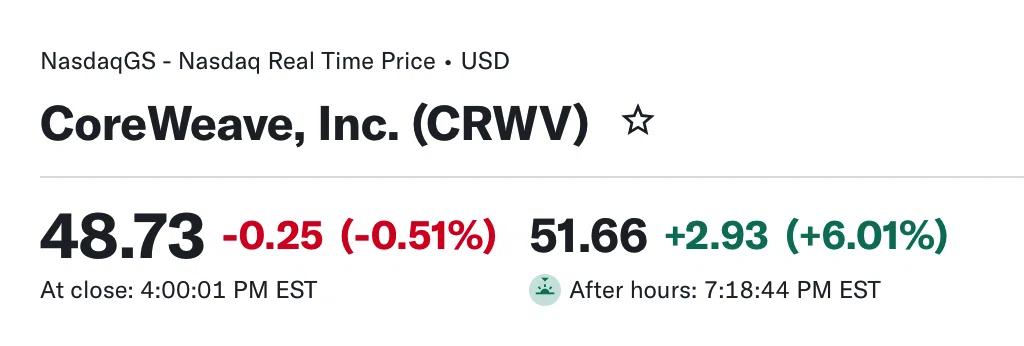
This 6% increase is the direct vote cast by the funds after listening to the earnings call. Although the loss margin was higher than expected, the market was completely impressed by its extremely strong demand side and the CEO's optimistic statements.
The management threw out a series of "explosive" data on the earnings call:
Production capacity is completely sold out: The company said its production capacity "has been basically sold out until 2027", and even all the 2028 production capacity it has offered so far has been sold. What's more exaggerated, qualified demand is 10 times the available production capacity in 2027, and demand in 2028 is also several times the supply. The company believes there is no major risk in 2027 deliveries.
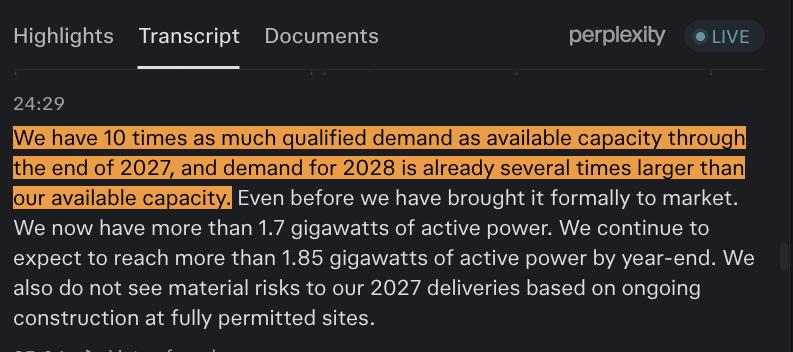
Guidance is sharply raised: Based on deployed capacity and backlog orders, CRWV directly raised its ARR (Annual Recurring Revenue) guidance, expecting the annualized run-rate revenue to reach $20 billion to $21 billion by the end of 2026.
Extremely high customer quality: By 2027, more than 75% of its committed capital expenditure is associated with investment-grade and enterprise customers, and only about 2