Anfu, Dongshan and Fosun have all followed suit, but why can't China develop its own Berkshire Hathaway?
In October, global AI assets collectively corrected. The PHLX Semiconductor Index fell by more than 15% in a single month, while the Nasdaq 100 Index dropped by nearly 7%.
On the other side, Berkshire Hathaway, the representative of the "old era", saw its stock price hit a record high on October 22. In the past month, its Class A shares have risen by more than 12%, while the S&P 500 fell by 5.5% in the same period; since the beginning of the year, it has risen by 13%, also outperforming the S&P 500's 7.8%.
Most explanations for this combination on Chinese Internet platforms are: value investing is making a comeback, and Buffett has won again.
In fact, this is not accurate. Berkshire has long been no bystander to AI. After Buffett stepped down as chairman, Google rose to become one of its top three heavyweight holdings, and in the third quarter, it invested more than 10 billion US dollars in AI-related assets — while Google has fallen by more than 24% since June, already falling below its cost price.
This shows that Berkshire's new high is not a victory of "staying away from AI", but a victory of its own mechanism. Thus, the old question resurfaced: Why is there no Berkshire Hathaway in China?
In fact, there are quite a few Chinese companies that want to learn from Berkshire. Guo Guangchang publicly stated that he wants to build a Chinese version of Berkshire; Youngor has operated the "three-carriage" business model of clothing, real estate and investment for more than 20 years; Yuan Yonggang, a representative of industrial capital, used a series of mergers and acquisitions to push Dongshan Precision to a market cap that once exceeded 500 billion yuan, and also established Anfu Technology in the process.
Contrary to common sense, China is not short of "Buffetts who can dig out good companies". In the highly volatile A-share market, there are still many investors who can achieve long-term returns of more than 15% annualized, with stock-picking capabilities no weaker than Buffett's.
Therefore, the real crux why many cases are not successful is: Berkshire, this sophisticated machine, requires three conditions to be met simultaneously on the liability side, asset side and governance side; in China, no company can build the same structure, and it is estimated that it will be very difficult to do so in the future.
First, get a clear picture of Berkshire Hathaway
You will never understand Berkshire if you regard it as a "company" or an investment portfolio. In fact, it is composed of three businesses: more than 50 industrial entities & a portfolio of more than 40 stocks, property and casualty insurance business with 14 insurance brands, plus cash reserves.
A more accurate analogy is that Berkshire is a very special perpetual closed-end fund, with an ingenious design in three aspects: the liability side, the asset side, and the management team.
1. Liability side: negative cost, and basically perpetual
The market often says "Buffett uses insurance leverage to trade stocks", which is a misunderstanding. Berkshire's total assets/net assets ratio is about 1.6 times, and the leverage of its insurance segment is about 1.8 times, lower than the 2.4 times average of the US property and casualty insurance industry. Its leverage is not high at all, what is high is the quality of its liabilities.
The insurance business contributes about 1/3 of Berkshire's profits, and is the core source of the company's liability advantage. The cost of float of its subsidiary GEICO (one of the largest auto insurance companies in the US) over the past 20 years is -7.8%, corresponding to a 20-year average combined ratio of 92.2%. Underwriting is profitable in the long run, and policy liabilities can be cleared out in the short term — it invests other people's money, and other people even pay management fees for it.
Coupled with the operating cash flow of the holding company, investment assets and US treasury bond interest, the cost of this part of the capital is also negative.
2. Asset side: rent-generating businesses, and try to acquire them in full
What Berkshire buys are not stocks that will rise, but rent-generating assets, which are roughly divided into three categories:
Regulated monopolies — BNSF Railway (a Class I railway in North America with non-replicable right of way, controlling nearly 30% of the freight volume on the US West Coast), BHE Energy (power grid and power generation, returns are approved by regulators, covering power supply in 16 US states);
Brands with pricing power — Apple, See's Candies, Coca-Cola, American Express, Japanese trading companies;
Locally monopolized services — Clayton Homes, Benjamin Moore, NFM, American Express.
The common features of these assets are: rigid demand, prices determined by regulators or brands, predictable cash flow, and they are acquired in full as much as possible. Whether these assets have high growth is not that important. What matters more is a reasonable purchase price and long-term sustainable operation.
For example, UBS's evaluation of BHE is "a largely regulated investment base", and its assumed net profit growth rate for the next five years is only 4%. What it buys is duration and cash flow — using zero-cost capital to buy a lease that can last for 50 years and can also increase in price slightly every year.
Moreover, Berkshire acquired 100% equity of BNSF. For the purpose of holding control and long-term ownership, what it wants is decision-making power, not just dividend rights.
In addition, there is a case that is rarely discussed in the market but I find very interesting: Berkshire's large-scale AI-related assets are not only Google. As early as January 2016, Berkshire acquired PCC, one of the two leading manufacturers of gas turbine blades, for $37.2 billion in cash in a full acquisition, making it a subsidiary and delisting it.
This is the largest acquisition in Berkshire's history. Later, it recorded a goodwill impairment of about $11 billion due to the downturn in the aviation industry. But with the boom of gas turbines for AI power generation and the recovery of aviation demand, the other leading company HWM has a market cap of more than $80 billion in the public market, which means PCC may also reach the same market cap.
Even as a "major mistake" publicly admitted by Buffett, it has actually achieved a return of more than double in 10 years; Buffett's negative cost advantage on the liability side and redundant cash allow him to withstand drawdowns. More importantly, as a monopolistic asset, payback is only a matter of time.
Therefore, most of the asset categories Berkshire deploys can indeed go through cycles. Matching the negative-cost liability structure, Berkshire always prioritizes stability when buying assets, with the goal of generating rental income, and the purchase price is only used to make the rental yield higher.
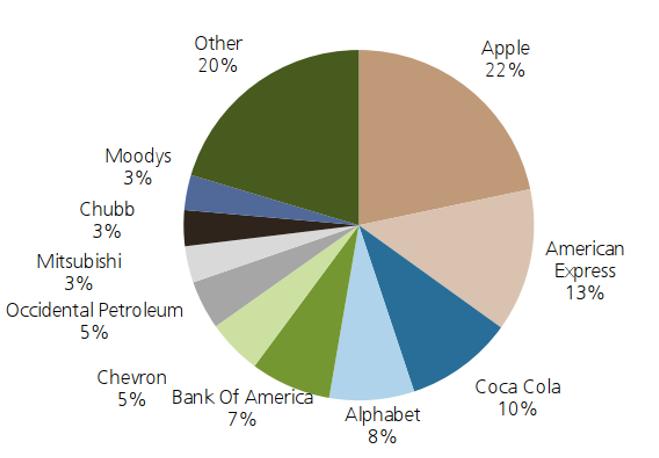
Figure: Berkshire's listed company portfolio Source: public announcements
3. Management team: cross-tenure authorization
The management team is the most discussed topic, and Buffett and Munger are the most famous investors in the world. Let's expand a little bit on the rarely mentioned architectural aspect: cross-tenure authorization.
Berkshire's more than 50 industrial entities are managed by 28 people at the Omaha headquarters. Subsidiaries operate independently, and the group only focuses on capital allocation. The premise of this structure is that the person allocating capital has cross-tenure authorization (Buffett has long held more than 30% of voting rights, with an equity ratio of about 14%), and is not responsible for single-year profits — the proportion of a single asset can break through any upper limit of portfolio management.
Therefore, this management structure further amplifies Berkshire's asset and liability advantages, and finally achieves the miracle of 61,000 times compound returns.
Deconstruction of reasons why Chinese peer companies cannot replicate this model
1. Liability cost blocks the vast majority of players
The vast majority of domestic holding-type companies rely on bank loans, and their capital cost is the interest rate; in the insurance industry, due to extremely fierce competition in policies, the capital cost of China's entire life insurance industry is above 3%.
Therefore, high-cost liabilities will distort investment behaviors, and the primary pursuit will be assets that can bring high capital gains in the short term. Institutions with high cost rates and high leverage are all investment myths in the upward period, but are prone to painful lessons in the downward period.
What risks are you likely to step into if you insist on continuous M&A with high capital cost? HNA Group gave the answer. From 2015 to 2017, HNA completed more than 80 M&A transactions with a total value of more than 40 billion US dollars, covering hotels, logistics and banks; by the end of 2017, its total liabilities reached 123.4 billion yuan; in 2018, it sold nearly 300 billion yuan of assets and divested more than 300 companies; in January 2021, it entered bankruptcy reorganization, with retained debt of about 60 billion yuan in its aviation segment.
Even Fosun Group, which also has a property and casualty insurance business, has a comprehensive interest-bearing debt cost of about +5.0%, which is 12.8 percentage points different from Berkshire's -7.8% float cost. Fosun's annual interest expenditure is about 27.9 billion yuan, more than 16 times its attributable net profit of 1.7 billion yuan in the first half of 2026.
Without cheap capital, M&A is not a compound interest machine, but a meat grinder.
2. Rent-generating assets cannot be acquired in full, nor can they generate high rental yields
On the asset side, China does have many assets that can "generate rent", and some of them are even of better quality. China Yangtze Power has a net profit margin of 40%, and Kweichow Moutai has a gross profit margin of 91%... Many companies are regarded as "money-printing" business models.
But first of all, the controlling stakes of such assets are not for sale. China Three Gorges Corporation and its concert parties hold more than 50% of the shares, and Moutai Group holds about 54% of the shares. These shareholding ratios are not financial holdings, but the state's control over energy, resources and brands.
In the secondary market, you can only be a minority shareholder, cannot enter the board of directors, cannot replace the management, let alone get the decision-making power of "how to use this rental income". (GL Ventures tried to take controlling stake in GREE, but ended up with indigestion.)
In addition, in order to ensure people's livelihood in China, the rental yield of such monopoly businesses is actually capped. The on-grid tariff of China Yangtze Power is approved by the price authority, the long-term agreement coal price of Shenhua is locked by policies, domestic mobile package tariffs are the lowest in the world, and expressway tolls are strictly controlled: the rental yield is kept near the average social return.
Although both are called "regulated", the US model is "guaranteed bottom", while the Chinese model is "capped". These are two completely different rental structures. When Berkshire buys BHE, regulators provide a predictable rate of return; when you buy China Yangtze Power, regulators set electricity tariffs that cannot be raised arbitrarily. The former is a lease, while the latter is a public utility.
Finally, there are differences brought by valuation. Buffett repeatedly emphasizes buying at low prices, because he has massive capital, and the liability side can wait for opportunities indefinitely. However, domestic investment institutions and holding-type companies are assessed on an annual basis, and are not allowed to remain inactive for many years. As a result, the safer rent-generating assets are recognized, the more they are pushed to high valuation premiums by capital.
3. Different boundaries of management authorization
Even if there is negative-cost float, you can find similar companies in China. For example, in the property and casualty insurance industry, PICC Property and Casualty had a combined ratio of 97.6% in 2025. Calculated by COR minus 100, the float cost is -2.4%, which is also "negative-cost capital".
Although this sum of money can also be invested in stable rent-generating assets, apart from the aforementioned situation that you cannot take controlling stake and can only hold minority shares, the bigger problem is that the capital allocation authority of the management team is limited.
Due to solvency and regulatory requirements, PICC Property and Casualty can only allocate a limited amount of assets to equity assets, and the latest proportion is around 16%. This figure is actually close to the 19% average of the US property and casualty insurance industry, but both are significantly lower than Berkshire's level of more than 50%.
PICC Property and Casualty is an excellent property and casualty insurer, but it is not, and is not required to be, an investment holding company. Accounting rules further amplify this constraint. Since 2023, listed insurance companies have implemented the new financial instrument standards, a large number of equity assets are classified as FVTPL, and every fluctuation in the fair value of stocks directly enters the income statement, which is linked to performance assessment. Therefore, insurance institutions are institutionally more inclined to hold low-volatility assets, instead of holding concentrated positions like Berkshire.
Analysis of domestic cases: all can only replicate one aspect of Berkshire
1. Fosun International: the closest imitator, lost to high liability cost
Fosun is the only company in China that was built publicly according to Berkshire's logic: insurance provides capital, investment provides returns, it mainly learns from the liability side, but the resource endowment gap is huge.
Citigroup wrote directly in its report: "When making acquisitions, Fosun pools its own funds with premiums from its insurance companies… premiums are long-term and provide a low cost of capital." It uses premiums and its own funds to make acquisitions, as premiums are long-term and low-cost. This is Fosun's version of the Berkshire model.
The quality of its insurance business is actually not bad: in the first half of 2026, the insurance segment recorded revenue of 22.807 billion yuan and attributable profit of 1.245 billion yuan; Fosun Portugal Insurance ranks first in the Portuguese market with a 30.1% market share; the combined ratio on the underwriting side is about 90%, which is profitable.
But the scale is not enough. Berkshire's float is 171.6 billion US dollars, corresponding to 1.2 trillion US dollars in total assets; Fosun's total half-year premium is 53 billion yuan, but the group's total debt is 218 billion yuan. Premiums can only cover a small part of the M&A capital, and the rest must rely on debt.
Thus the whole story slides to the opposite side:
The funding gap is filled with interest-bearing debt. When the interest-bearing debt peaked in 2020, the financing cost was 5.0%, which was 12.8 percentage points different from Berkshire's -7.8%;
Asset duration is long while liability duration is short. Once the financing environment tightens, assets must be sold: in 2022, it exited with contracted transactions of over 40 billion yuan and recovered 29.3 billion yuan; in 2023, contracted transactions were nearly 20 billion yuan and recovered 27.3 billion yuan;
Discount is self-reinforcing: PB ratio is only 0.35x, and the measured NAV discount is 74.2%. The deeper the discount, the less possible it is to issue shares; the less possible to issue shares, the more dependent on debt; the more dependent on debt, the deeper the discount.
Fosun's current task is "deleveraging", far from the stage of "compound interest". It precisely proves that without the premise of negative-cost capital, the same "insurance + investment" structure is likely to get the opposite result.
2. The other path is industrial capital: two samples of the Yuan family, Anfu Technology and Dongshan Precision
Industrial capital learns from the asset side — leveraging debt to make M&A. On this path, Anfu Technology and Dongshan Precision, both controlled by Yuan Yonggang's family, have successfully completed "snake swallowing elephant" transactions, attracting extremely high market attention.
