Is AI credit risk shifting upstream? Chip giant CDS spreads exceed those of cloud vendors for the first time in three months
① The CDS spread of U.S. chip giants has exceeded that of cloud vendors for the first time in three months, nearly doubling from the level in early August;
② Goldman Sachs traders pointed out that the proportion of chip-related financing is expected to surge next year, and AI credit risks are shifting upstream;
③ Goldman Sachs estimates that the direct bond issuance scale of hyperscale cloud vendors will reach about 440 billion U.S. dollars next year, with an additional 300 billion U.S. dollars in AI project financing, totaling around 740 billion U.S. dollars.
The market's focus on AI financing is shifting from "how much money do cloud vendors need to borrow" to "who will ultimately bear the risk". Despite the overall credit indices remaining relatively stable after the sharp drop in U.S. stocks a few days ago, the CDS market has recently begun to reprice the credit of chip manufacturers.
According to local media reports on November 10, multiple weekly credit market reports released by Goldman Sachs' trading division last Sunday show that the credit default swap (CDS) basket of chip giants composed of Broadcom, AMD, NVIDIA and Intel has a wider spread than the hyperscale cloud vendor basket composed of Oracle, SpaceX, Meta, Amazon, Alphabet (Google's parent company) and Microsoft, marking the first such occurrence in at least three months.
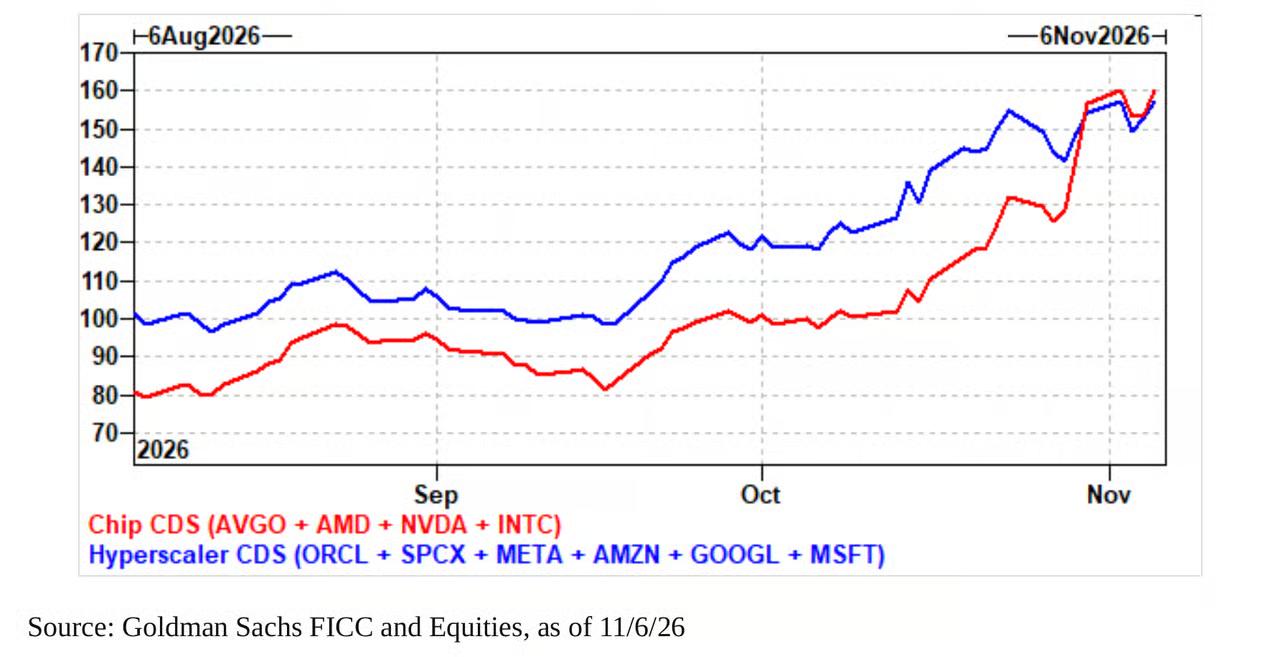
CDS Spread Trend of Chip Giants (Red Line) and Hyperscale Cloud Vendors (Blue Line)
CDS is a type of financial derivative that provides protection against debt default. The higher the spread, the greater the default risk of the bond issuer perceived by the market. In early August, the CDS spread of the chip basket was about 80 basis points, around 20 basis points lower than that of the cloud vendor basket, and it has now nearly doubled to about 160 basis points.
Alisha Pasi, a Goldman Sachs trader, said in the report that the discussion on AI financing is shifting from how much capital is needed to who will ultimately bear the risk, and the risk is migrating.
Undercurrents in the Credit Market
While the credit of chip makers is being repriced, U.S. stocks have just experienced a week of sharp fluctuations. On November 5 after the U.S. midterm elections, the S&P 500 Index fell 4.4% in a single day, the largest drop since April 2025, but the spread of the North American investment-grade CDS index (CDX IG) only widened by 3.5 basis points.
Pasi said that this divergence has not brought confidence to the market, but instead made investors begin to doubt whether the resilience of the credit market can be sustained.
While index fluctuations are limited, hedging transactions are more active than ever. Miles McCarthy, a Goldman Sachs trader, said, Excluding the impact of the September semi-annual contract roll, the past two weeks have been the most active period for AI-related CDS transactions, with weekly turnover reaching 8 billion to 10 billion U.S. dollars, about seven times the level a year ago.
The report points out that the overall credit market remains stable mainly because investors are still buying a large number of bonds of stable companies that are not highly related to AI, while the situation of AI-related bonds is far from calm. According to statistics from Goldman Sachs Research, the global bond issuance scale of hyperscale cloud vendors this year has reached 296 billion U.S. dollars, exceeding Goldman Sachs' previous full-year forecast of 250 billion U.S. dollars, of which 67 billion U.S. dollars have been issued since October 29 alone.
Intensive bond issuance has pushed up financing costs. The average issuance premium of new AI-related bonds in November exceeded 18 basis points, far higher than the average level of 3.4 basis points for new investment-grade bonds so far this year. The latest bond issuances of Meta and Oracle have also reduced or abandoned long-term varieties with a maturity of more than 30 years.
Some AI investment-grade bonds are even priced as high-yield bonds. KC O'Connor, a Goldman Sachs trader, pointed out that the newly issued 5-year BBB- bond of Oracle had a yield of 7.5% last Friday, higher than more than 80% of the bonds in the BB high-yield bond index; the 29 high-yield AI bonds traded by Goldman Sachs fell by an average of 1.67 points last week, while other high-yield bonds rose by an average of 0.36 points.
O'Connor described that the index is like taking "blood pressure lowering drugs", but the tail risk has not disappeared as a result.
Risk Is Shifting Upstream
In the CDS market, the pressure on chip manufacturers is particularly prominent. McCarthy's data shows that in the past two months, the CDS spread of Broadcom has widened by 70 basis points from the low point of the range, AMD and NVIDIA have widened by 55 and 50 basis points respectively, Meta and Alphabet have only widened by 15 basis points, and Microsoft has remained basically flat.
According to reports, the CDS spreads of Oracle and SpaceX are 310 basis points and 285 basis points respectively, still the two highest in this field, but the recent new spread widening has been significantly concentrated on chip suppliers. In the week ending November 5, the three companies with the largest spread widening in CDX IG were all chip manufacturers, among which Intel widened by 40 basis points, AMD by 26.5 basis points, and Broadcom by 17.6 basis points.
The reason why chip manufacturers have become the new pressure point is closely related to the changes in the AI financing structure. McCarthy pointed out that the market expects the proportion of chip-related financing in AI debt issuance to rise sharply in 2027, and this expectation has begun to be reflected in CDS prices.
According to Goldman Sachs statistics, the scale of publicly announced computing power financing collateralized by project assets next year has exceeded 150 billion U.S. dollars. Pasi believes that this will be the next wave of AI financing, and related debts may expand significantly in 2027, covering multiple markets including investment grade, high yield, private credit and structured financing. She said that investors will then need to distinguish whether the debt repayment guarantee comes from corporate guarantees, rental income or the collateral assets themselves, and consider the risk of asset depreciation that may be caused by technological iteration.
The report analysis points out that the collateral for this type of financing is GPUs with a continuously shortening service life, and chip manufacturers themselves are providing financing for customers to purchase chips. Once chips depreciate, chip manufacturers may find it difficult to stay out of the trouble.
Who Will Pay the Bill in the End?
Media reports point out that in the past two months, the CDS market has shifted risks from cloud vendors who write checks to chip manufacturers who receive payment, from bonds supported by the balance sheets of companies such as Microsoft to project financing collateralized by GPUs and power contracts.
Cloud vendors are still the main borrowers of AI debt at present. According to Goldman Sachs statistics, after the overall free cash flow of cloud vendors turned negative in the third quarter, about 36% of the capital expenditure in 2026 has been completed by borrowing, and the direct bond issuance scale of hyperscale cloud vendors next year is expected to be about 440 billion U.S. dollars.
However, more and more financing is bypassing the cloud vendors' own balance sheets. There will be another about 300 billion U.S. dollars in AI project financing distributed in the investment-grade and high-yield markets next year, totaling around 740 billion U.S. dollars for the two parts.
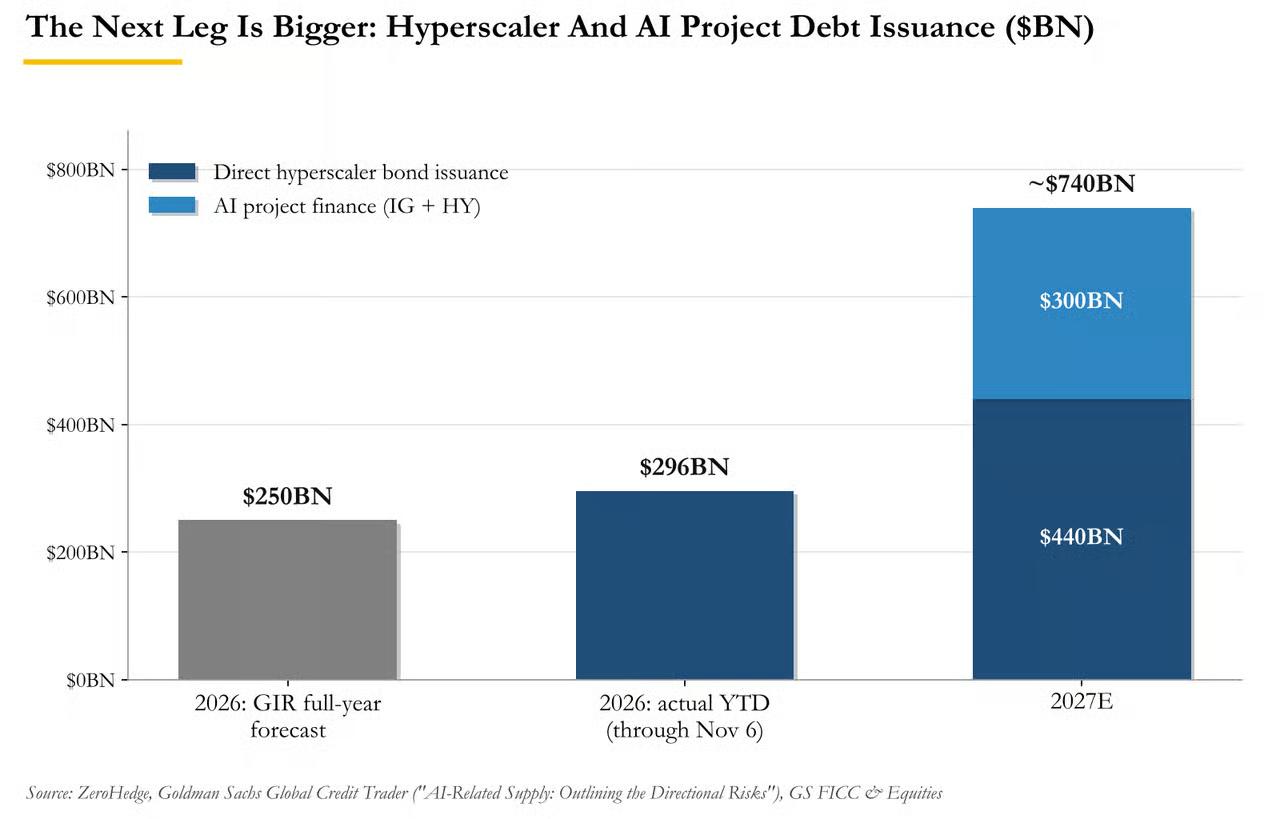
The total of direct bond issuance by hyperscale cloud vendors and AI project financing next year is estimated to be about 740 billion U.S. dollars, far exceeding the 296 billion U.S. dollars of bond issuance since the beginning of this year
Amanda Lynam, an analyst at Goldman Sachs, also counted that the off-balance sheet commitments of hyperscale cloud vendors amount to 3.6 trillion U.S. dollars, of which 685 billion U.S. dollars will mature by the end of 2027, and these commitments are not directly reflected in the cloud vendors' statements.
Bond investors may feel the pressure first. Goldman Sachs expects that credit spreads may continue to widen before the beginning of December, the U.S. investment-grade spread may rise above 93 basis points, and the high-yield spread may exceed 335 basis points, exceeding the high point in March this year.
Goldman Sachs traders hold different views on the market outlook. The most optimistic one, Avishek Biswas, believes that the market is entering a stage of "highly uncertainty" rather than "high risk". The current economic data has not shown obvious deterioration, but the prospects of AI and cloud vendors are still difficult to judge.
The report points out that historical experience shows that when the hedging market is so active, hedgers have often perceived risks that have not yet been reflected in the index. The credit market may have been calm last week, but with about 740 billion U.S. dollars of AI debt queuing up for issuance in 2027, this calm is unlikely to last for long.
This article is from "CLS.cn", written by Li Ying, authorized for release by 36Kr.