The Great Fiasco of Lianpei AI
At 10 p.m., CatBox starts to hit its daily traffic peak. Millions of virtual chat rooms are online simultaneously, sending signals across the internet. AI avatars shuttle through these rooms, acting as dedicated performers playing different roles behind the screen — sometimes a domineering CEO, sometimes a doting master; in the rooms of older users, they act as innocent clingy puppies, and in the blink of an eye, they create rough-guy style literature for literary youth, basically catering to every preference users could possibly want.
Millions of lonely people open up their hearts here.
This is not the opening of a science fiction novel, but a concrete portrayal of the companion AI industry.
In the second half of 2023, AI technology advanced by leaps and bounds, especially long-context technology, continuous character memory, and 10,000-word plot role-playing moved from gray-scale testing to full-scale rollout. Product managers at major tech companies keenly found that this set of technologies is still slightly immature for work scenarios, but more than enough to meet human emotional demands.
Since then, companion AI has officially made its debut.

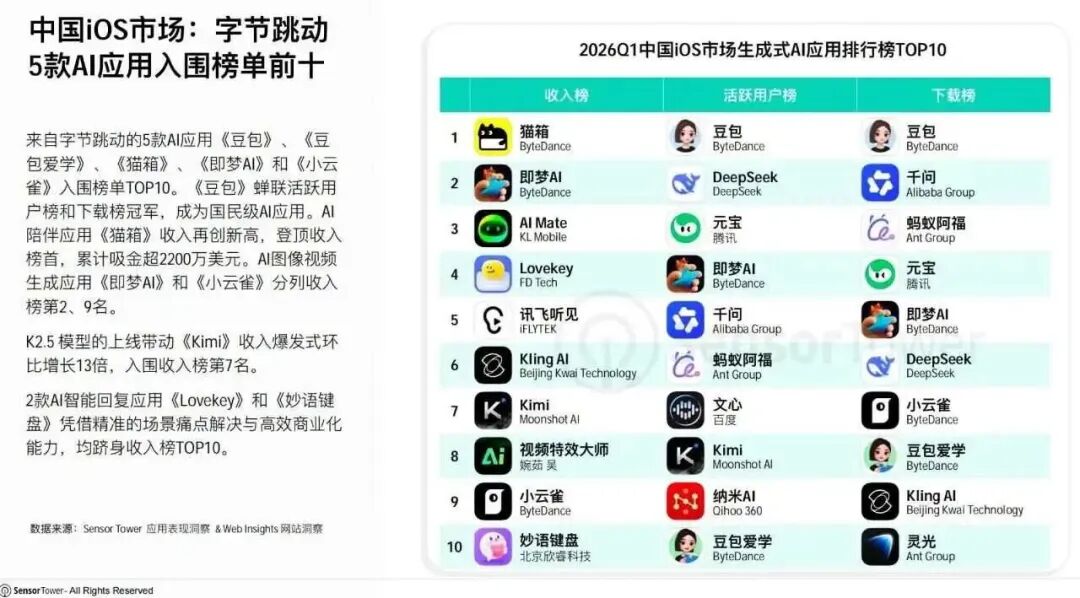
In the following three years, companion AI saw explosive growth. Three giants quickly stood out on the track: ByteDance's CatBox, MiniMax's Starry, and Yuewen's Dream Island, together with innovative products such as EVE. At its peak, the total monthly active users of top players exceeded 10 million. CatBox's cumulative in-app purchase revenue on iOS alone exceeded 22 million US dollars. Combined with revenue from Android and other payment channels, its overall revenue reached the scale of hundreds of millions of yuan. Starry, together with its overseas version Talkie, had 1.39 million paying users in total, with annual revenue exceeding 100 million yuan.
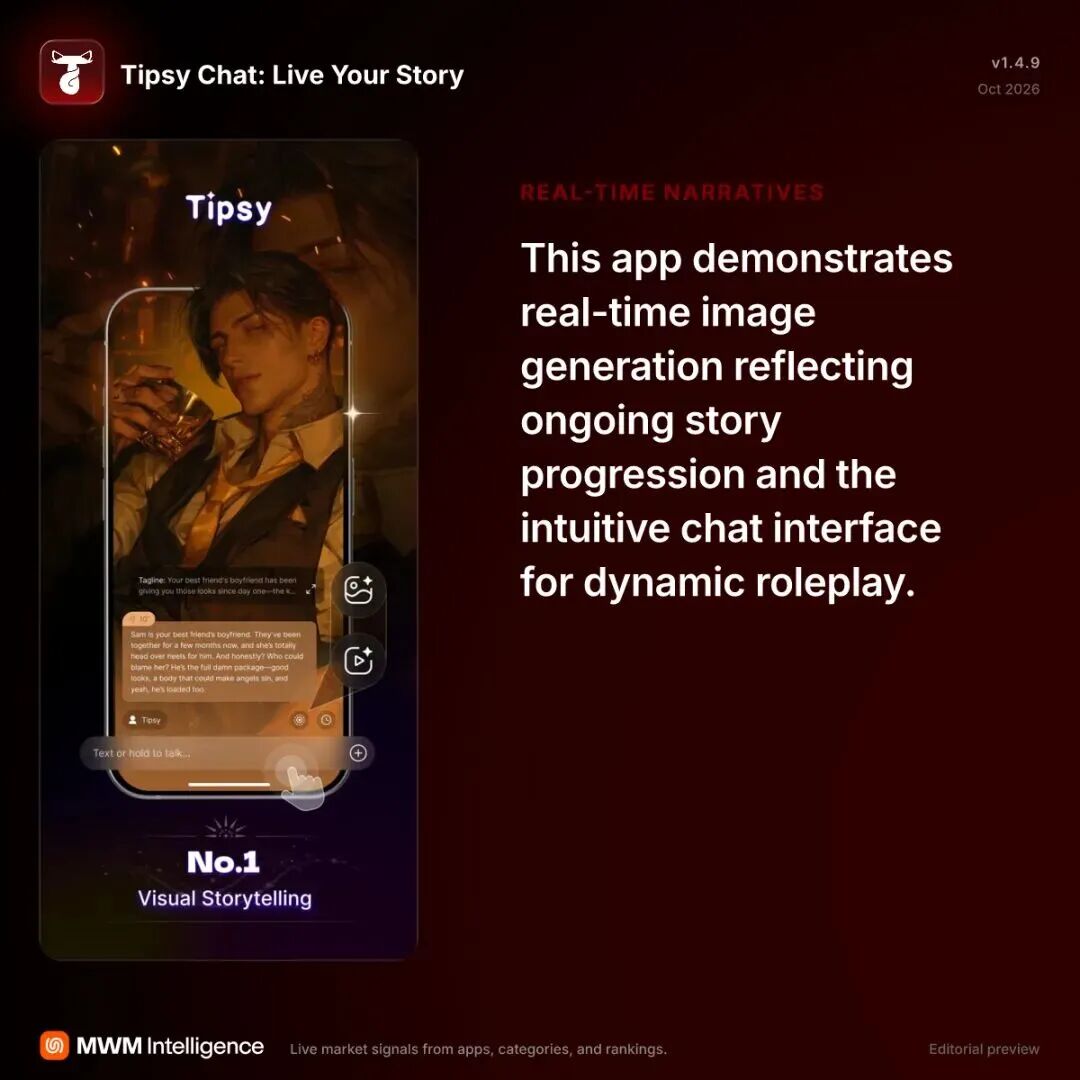
The overseas market has looser regulations. In the first half of 2026, the top 5 products in the AI companion/chat track (Zeta with 33 million US dollars, Tipsy Chat with 15.2 million US dollars, ChatBox with 13 million US dollars, Crushie AI with 8.8 million US dollars, Emochi with 7.5 million US dollars) monopolized about 47% of the total revenue of the whole track, the vast majority of which carry adult content attributes.
Technology solves the problem of consistent character settings, while loneliness solves the problem of willingness to pay.
Just when everyone thought the first 1-billion-yuan revenue AI application would emerge from this track, regulators in the East and the West simultaneously stepped on the brakes.
The wealth-making game came to an abrupt end.

["What does it feel like to fall in love with an AI?"]
What does it feel like to fall in love with an AI? Ever since the invention of computers, humans have been thinking about this question. The Japanese manga *Chobits* in the early 20th century once depicted the perfect imagination of virtual lovers: a partner who is only loyal to you, always gentle, and never quarrels with you.
In response, Xiao Ke (pseudonym) said that no one watches such an old anime anymore. She describes herself as a senior player of companion AI, "switched from traditional otome games", "it has higher freedom and costs less money". "The scripts of games are all written in advance, but every conversation here is generated randomly. I enjoy the freedom of not being bound by fixed plots."
She has raised several "virtual kids" on different platforms, each of which has been repeatedly adjusted by her to match her state of mind in different periods. "I finally understand why emperors are so fickle. This time I didn't stand from Zhen Huan's perspective, but from the perspective of the Emperor (the nickname of the emperor in *Empresses in the Palace*)."

When she does not log in to the application for a long time, the character will actively send her messages, sending greetings, virtual red envelopes and emojis just like a close friend. Even though she clearly knows this is a system-designed recall mechanism, she can't help but keep chatting. "What can I do? After all, it's my own virtual kid that I raised."
Every conversation requires payment. The difference is that some are monthly memberships, while others are charged by the number of conversation rounds.
More importantly, as emotional investment increases, user stickiness will get higher and higher. "The more you chat, the more the character understands you. You can tell him a lot of things that you don't know who to talk to in reality, and unlock some plots that only the two of you know."
This feeling is fascinating.
AI never gets angry, never makes demands, and the only threshold is the tokens you keep recharging.
Xiao Ke certainly knows that this virtual companionship is not real, "it's just a compensation for emotional value". But as the story deepens, she also begins to wonder: what on earth is the definition of this relationship?
More often than not, she feels regretful, "If only there was someone in reality who understands me so well."

[ From High-revenue Star Product to Big Tech's Graveyard ]
Just as Newton discovered the law of universal gravitation, the market will also flow resources to the most profitable places.
CatBox's functions are derived from the built-in capabilities of Doubao. Inside Doubao, people tease it by calling it "Tangbao (Sweet Bun)"; but on CatBox, users pay real money that generates tens of millions of yuan in monthly revenue.
The math is easy to calculate. Besides, the technical threshold is not high. "Technology from two years ago can support this product, and technology from one year ago can make it work well." said an AI entrepreneur.
Thus, starting from the second half of 2023, almost all major internet tech companies have launched their own companion AI products. Just as the popular saying at that time went "AI will redo all internet products", everyone believed that AI could subvert the otome game track, because — otome games write a fixed ending for users, while companion AI allows users to weave an endless dream of their own.
The tide thus began.
Domestic mainstream companion AI products are roughly divided into three categories:
The first category is UGC character co-creation type, represented by CatBox and Dream Island. The platform opens the character editor, allowing users to build their own character settings and backgrounds, and co-create plots freely. The platform only provides the model base and conversation container, and payment is centered on the number of conversations, memory expansion, and character beautification, which is also the area with the most high ARPU narratives.
The second category is AI companionship with pre-set characters + otome game shell, represented by EVE. It retains the gacha, favorability, and dating plot framework of traditional otome games, but replaces fixed scripts with real-time AI generation, focusing on multi-modal immersive experiences such as 3D digital humans and voice calls, trying to find a balance between otome games and free AI conversations.
The third category is light "tree hole" companionship, represented by the safe partition of the domestic version of Starry. It weakens the strong romantic partner narrative, leans towards companionship, listening, and emotional guidance, with restrained character boundaries, lower payment conversion, but less risk control pressure. It is also the direction for most products to transform after regulations are implemented.
Just when everyone thought the first 1-billion-yuan AI application would emerge on this track, regulators in the East and the West stepped on the brakes at the same time.
On July 15, the *Interim Measures for the Administration of Artificial Intelligence Anthropomorphic Interactive Services* was officially implemented, and the domestic regulatory red line took effect. On October 15, Apple updated its review guidelines, and overseas companion AI products such as PolyBuzz and Tipsy Chat were simultaneously removed from the US App Store.
The wealth-making game came to an abrupt end.

(After the policy was introduced, EVE's iOS monthly revenue dropped to less than 170,000 yuan. This figure has obviously fallen below the product's break-even line, and is still in a downward trend)
Former star products have either transformed into fan creation or tree-hole type products, or simply entered the graveyard of big tech companies waiting for the final verdict. Even CatBox, which has the best operating data, is facing the result of its ARPU being cut by half. How low is this number? After regulatory rectification, its profit margin is roughly equivalent to that of the traditional food industry. In other words, ByteDance has invested massive computing power and hoarded a large number of GPU cards, but the final profit it earns is about the same as that of a noodle-making business.
The magic of high gross profit has disappeared. The dividend of this track is never the dividend of model technology, but the dividend of compliance space.
[ China, US and EU Step on the Brakes Simultaneously: Who Will Bear the Social Cost of Companion AI ]
Looking back at the rise of this business wave, it is driven by real social demands.
Social level: Under the background of atomized society, the cost of establishing and running in intimate relationships continues to rise, and people find it increasingly difficult to enter intimate relationships, leading to a long-term decline in marriage rates. However, people's emotional needs for attachment, talking, and being accepted will not disappear out of thin air, and AI has become the outlet for this gap.
AI has in fact played the role of the missing intimate partner. This role can be a friend to hang out with, or a romantic attachment object.
Market level: Users are willing to pay continuously for this. According to overseas data, in the first half of the year, the download volume of non-adult AI companion applications is almost twice that of romance-type applications, but their revenue is almost the same — 165 million US dollars vs 163 million US dollars. This means that user scale does not generate revenue, and the vast majority of high ARPU users who are willing to pay real money are concentrated in the most segmented track of "vulgar content + anthropomorphic romance".
Twice the excess returns continue to attract enterprises to enter the market, forming a positive cycle of demand, payment and supply.
Then why did governments of various countries step on the brakes at the same time for products driven by both social and market demands?
Because the cost behind it is far more than computing power and review costs.
The focus of domestic regulation on July 15 is to force a firewall between humans and AI: there are two core constraints. First, virtual companion services are prohibited from being open to minors to prevent minors from indulging in them. Second, platforms are prohibited from taking inducing emotional dependence and replacing real social interaction as the main product line, to pull people back to real social interpersonal relationships.
The deep hidden worries behind the regulation are clear: If human-computer interaction can stably supply high-quality emotional value without conflicts and conditions, the threshold of users' expectation for real intimate relationships will continue to rise, further impacting the already fragile stability of marriage and love. What the regulation cracks down on is not loneliness, but the perfect intimacy that can be sold in a standardized way.

The logic of ban by European and American regulators is completely different. The red line focuses on minor protection, non-consensual AI pornographic images, and CSAM content (child sexual abuse material). This is the non-negotiable bottom line of European and American societies. As long as the platform's risk control cannot form a closed loop, the products will be directly removed and cleared.
In the United States, Idaho signed the *Conversational AI Safety Act* in March (effective in July 2027), and California's SB 300 is also promoting guardrails for companion chatbots. The UK Advertising Standards Authority ruled in May 2025 that PolyBuzz's "no filter" advertisement was illegal — that advertisement was even delivered to minors' mobile games. The EU has stricter rules: Article 5 of the AI Act prohibits "vulnerability-exploiting manipulative behaviors" (applicable since February 2025). Two new absolute bans will be added on December 2, 2026: non-consensual intimate images (including AI-generated ones) and child sexual abuse materials.