Google has been sued, and the Court of Justice of the European Union has made its first landmark ruling to draw a clear distinction: AI "input" is legal, while AI "output" may constitute infringement.
Over the past two years, almost all copyright disputes surrounding generative artificial intelligence have unfolded at the "training" stage. Publishers, writers, photographers and musicians have repeatedly demanded answers from AI: are my works quietly included in the training of large AI models? This debate has shaped the basic narrative of landmark cases such as Bartz v. Anthropropic, Thomson Reuters v. ROSS, and The New York Times v. OpenAI, and has also spawned a complete set of response solutions including licensing negotiations, collective management mechanisms and machine-readable opt-out agreements.
But in 2026, high-quality public corpora have been almost completely crawled by AI models, and the benefits of continuing to pile up corpora are diminishing, the contact point between AI and copyright has begun to shift to the "output" end. When users ask questions to generative AI, the system will retrieve online content in real time, insert original text fragments into the context, and reorganize to generate answers. This process is called Retrieval-Augmented Generation (RAG). Users get a "summary" that best meets their current needs, while publishers lose a click, ad exposure and the connection with readers that should have belonged to them.
On November 3, 2026, Maciej Szpunar, Advocate General of the Court of Justice of the European Union (CJEU), issued a non-binding opinion on the first generative AI copyright case submitted to the court — Like Company v. Google — whose core judgment is:
AI training may be legal, but output may be infringing.
I. The LikeCompany Case: The CJEU System Distinguishes "Input" from "Output" for the First Time in a Serious Manner
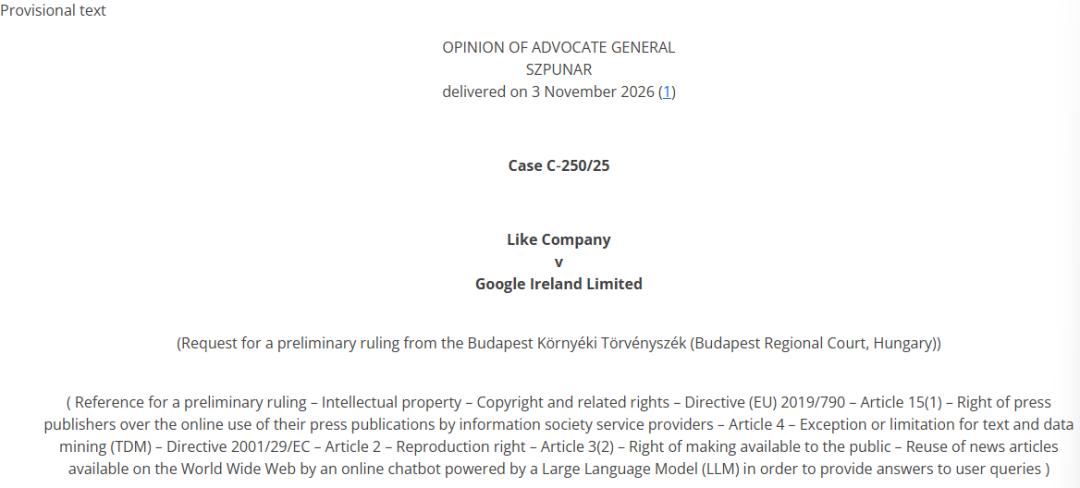
The case itself is not complicated. Hungarian publisher LikeCompany accuses Google's Gemini of accessing its news articles in real time when answering user questions and generating summaries highly similar to the original texts, thus eliminating the need for users to visit the original site. Google's defense follows its usual stance: the model only learns language rules, and the output is original expression; publishers already have the right to choose and opt out through control mechanisms.
Szpunar splits the case into two layers, and deliberately prevents the two layers from overshadowing each other.
The first part is the training session: it is suggested that the case should not be accepted, rather than directly approved.
The first layer is training. Szpunar holds that this case lacks the factual basis to prove that the relevant articles have indeed entered the training set, so the issues related to training are not admissible. But he also gives a collateral judgment: under the exception framework of Text and Data Mining (TDM), using copyright-protected content to train models can in principle be allowed — provided that the content is legally accessible, the right holder has not effectively reserved rights, and the developer has taken technical measures to prevent verbatim recall.
This layer is actually quite friendly to large tech companies. It is equivalent to acknowledging that simply feeding public works to the model does not constitute infringement per se.
The real focus is on the inference end, where Szpunar puts forward two test elements:
1. Whether the acquisition method is legitimate. If Gemini bypasses paywalls or other technical protection measures to read articles, even if the original text is "publicly searchable", no implied authorization is generated. The Advocate General explicitly rejects the logic that "no barrier means consent" — this is a direct negation of industry practice.
2. Whether the output constitutes an "expressive substitute". Verbatim reproduction is not required here. As long as the expressive form of the original work can be identified through side-by-side comparison, and users no longer need to open the original text after reading the AI answer, the rights of news publishers may be infringed. In other words, copyright protects specific expressions. Once AI repackages the "specific expressions" to take over the market of the original work, the exclusive rights of the right holder will be undermined. Conversely, merely conveying the same facts in a different form of expression does not constitute infringement per se; individual words and extremely short fragments are also outside the scope of protection.
It needs to be emphasized that this red line is a "situation test", not the conclusion of this case. Szpunar's opinion draws the standard, but the facts of this case still need to be determined by the Hungarian court in combination with the facts.
The significance of this opinion lies in the first confirmation at the level of EU law that reproduction during training and reproduction during inference are two different types of use; the former can in principle apply the exception rules for "text and data mining" (TDM) in the EU Copyright Directive for the Digital Single Market (DSM), while the latter must be separately evaluated under the right of expression.
II. The "Training Opt-Out Token" of the Four Major U.S. Tech Giants
Just one week before the release of the LikeCompany opinion, on October 30, 2026, OpenAI, Google, Microsoft and Anthropic jointly announced their support for a new type of "policy token" mechanism. Websites only need to add a line of __usage_ai-training declaration in robots.txt to prohibit all mainstream AI crawlers from using their content for training at one go, without having to configure GPTBot, ClaudeBot, Google-Extended one by one.
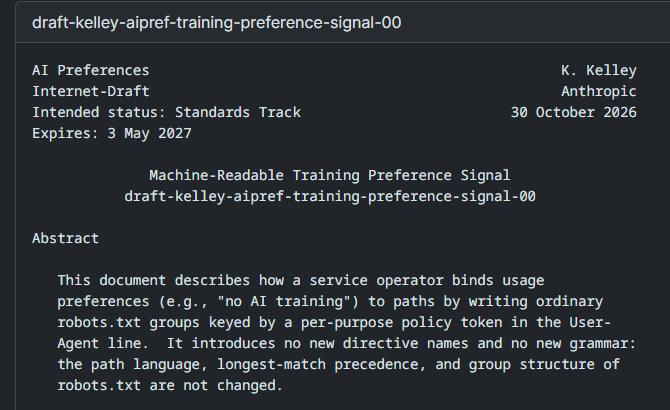
From the perspective of technical governance, this is indeed a progress. It integrates the opt-out mechanisms scattered among the four companies into a unified machine-readable, cross-crawler effective mechanism, moving the governance interface from "bilateral" contracts to the public agreement layer.
But the key point is that this mechanism only covers training, not search, let alone calls during inference. In other words, the four major giants exchange "concessions at the training end" for "freedom at the inference end". Now the business model of the AI industry is shifting from "training models" to "inference services", and what is really valuable for AI is to integrate publisher content into answers in real time. At least for now, the gesture of training opt-out is low-cost, while AI companies still actively retain the most valuable inference rights.
It is worth noting that the EU AI Act itself also adopts a dual-track approach to the copyright obligations of AI companies.
According to Article 53 of the AI Act and the General Purpose AI Code of Practice (GPAI Code of Practice), signatories need to fulfill five core copyright obligations. The fourth item is "reducing the probability of generating copyrighted content", which has written the copyright risks at the inference end and output end into mandatory obligations, though it does not specify how RAG should be regulated.
Combined with the signal from the LikeCompany opinion, the EU will not be satisfied with compliance at the "training end", and the next step will definitely question whether the output content is infringing. The retrieval logs, citation ledgers and output source traceability of generative AI will gradually change from technical operation and maintenance data to compliance evidence assets.
III. The Inflection Point of Copyright Compliance for Chinese Tech Companies: From Training to Inference
The opinion in the LikeCompany case and the training opt-out token of the four major giants, on the surface, are legal games within the European and American markets. But for Chinese AI enterprises that are accelerating their global expansion, the two events together point to an unavoidable trend: the focus of AI copyright compliance is shifting from the "training end" to the "inference end" — this change is a direct compliance variable.
Over the past two years, most enterprises' copyright compliance has focused on the training stage: data source classification, authorization chain sorting, disclosure of training summaries, etc. Chinese models going global have made substantial progress in compliance construction at the training end. Some models have begun to disclose training content summaries according to the EU GPAI template, publicize crawler identifiers, and establish data governance processes. These actions are still necessary, as they constitute the basic threshold for entering the EU market.
However, if you only focus on the training end, you may miss the upcoming next wave of regulation.
The core contribution of Szpunar's opinion is not that it makes a final ruling on a specific case, but that for the first time at the level of EU law, it splits "reproduction during training" and "reproduction during inference" into two independent legal acts, and draws a verifiable imputation path for the latter. The underlying logic of this path is: the model can learn knowledge, but cannot act as a substitute for expression; it can retrieve information, but cannot take over the market. If the output of AI begins to systematically replace the functions of original works — whether it is news reports, academic papers or literary creation — the traditional tools of copyright law will still be activated.
At the same time, although the training opt-out token jointly launched by the four U.S. giants is a positive technical governance signal, it deliberately avoids the issue of invocation at the inference end. After publishers opt out of training, their content may still be retrieved, excerpted and reorganized into answers in real time. This structural asymmetry of "training can be opted out, while inference is uncontrollable" will sooner or later become the focus of the next round of disputes.
For Chinese enterprises, this means that the focus of compliance should be expanded or even shifted. Transparency at the training end is the admission ticket, but the real competitive barrier may lie in the "auditability of the inference process" — that is, whether it can prove that its model clearly knows whose content it borrowed, how much it borrowed, and whether it crossed the boundary in every answer.
Before a set of detailed inference compliance standards is introduced, enterprises should actively seek to understand and respond to such demands from publishers, which is also a strategic window worthy of serious attention.
This article is from the WeChat Official Account "Internet Law Review", written by Zhang Ying, and authorized for release by 36Kr.