To turn eVTOL from a product into a tradable commercial commodity, Zero Boundary Aviation, a transaction and air transport capacity service provider, has completed a multi-million RMB angel round financing | 36Kr Exclusive
36Kr learned that Anhui Tianze Zero Boundary Aviation Co., Ltd. (hereinafter referred to as "Zero Boundary Aviation"), an eVTOL transaction and capacity service provider, has recently completed a multi-million-yuan angel round of financing, which was exclusively invested by Shanghai Huxiang Investment Management Co., Ltd. The funds raised in this round will be mainly used to promote the construction and operation of the verification base, improve the OC operation system, expand the cooperation network of OEMs, build digital platforms and professional teams, etc.
In May this year, the Civil Aviation Administration of China released a set of data: 19 unmanned aircraft in China have completed type certification, and more than 70 models are under certification. The rollout of aircraft is just around the corner, but the corresponding air routes for them have not yet been planned. A more pragmatic question has come to the fore: after the aircraft are manufactured, who will buy them, who will fly them, and who will provide underwriting for every flight?
This is a gap that lies between products and commercial commodities.
"OEMs are responsible for turning technology into products, manufacturing safe, reliable and cost-controllable aircraft. Operation follows a totally different logic, which has to deal with a wide range of issues including safety responsibility, airspace coordination, local resources, fleet scheduling, customer payment terms and many other problems." said Wu Zhenya, founder of Zero Boundary Aviation.
In other words, to turn eVTOL into a real commodity, what is needed is no longer the extension of manufacturing capacity, but the operation capability that enables it to be put into real scenarios and realize a closed commercial loop. Zero Boundary Aviation is exactly targeting this segment: it does not manufacture aircraft, but focuses on continuous operation and asset circulation after delivery, to make the aircraft truly operational and financially viable.
Before Taking Off, Figure Out How to "Land" First
The origin of Zero Boundary Aviation traces back to the history of investment promotion. In the process of promoting the settlement of OEMs and carrying out cooperation with local governments, a practical problem emerged: local governments have scenarios and budgets, and OEMs have products, but a professional role is needed to fill the gap in between for transaction organization and continuous operation. That is how Zero Boundary Aviation came into being.
"The process for OEMs to turn technology into products has already seen fierce competition." said Wu Zhenya, "But the next competition in the low-altitude economy will not be about who manufactures more aircraft, but about who is the first to realize normalized operation within the safety boundary. Every additional compliant flight route operated by enterprises will give the government more confidence to open up more airspace."
The first move of Zero Boundary Aviation is to organize financial leasing transactions. In September this year, Zero Boundary Aviation signed a tripartite strategic cooperation agreement with AutoFlight and Wanjiang Financial Leasing, which covers the procurement of 30 V2000CG Carryall eVTOLs. The first batch of 5 units will be delivered within this year, among which 2 units have been delivered in September. This is also the first time that ton-class eVTOL enters the market as an asset that can be purchased by installment.
Financial leasing is nothing new in the aviation industry, but eVTOL is an exception — it has no operation history, no residual value curve, so risk control pricing cannot be carried out. The solution to break this deadlock is to separate the ownership, capital flow and operation right: financial institutions directly grant loans to OEMs, and local customers obtain the right to use the aircraft with small rent; Zero Boundary Aviation provides underwriting through repurchase and operation services, so as to encourage financial institutions to provide loans.
"The financialization of heavy assets follows its own historical path. For aircraft, ships and construction machinery, a group of companies must first continuously generate stable rental income, then the residual value curve and secondary circulation market will gradually come into being." In Wu Zhenya's view, what the eVTOL market lacks now is the first set of fully recorded real cash flow.
Therefore, leasing out the aircraft is only the first step. The more critical proposition is how to make it generate value in a city after delivery, and turn it into a sustainably manageable asset.
Around this proposition, Zero Boundary Aviation has built a digital base consisting of "airOS" and "Zero Boundary Flight Select", which converts the originally hard-to-quantify aircraft operation and asset transactions into a monitorable, priceable and replicable standard system, based on which it provides four types of services for local customers.
The first is model selection and delivery acceptance. Based on the digital transaction platform "Zero Boundary Flight Select" and AI transaction agent, it helps customers match the needs of real scenarios from a large number of aircraft models, and control the delivery standards.
The second is financial scheme design. It matches the asset structure of purchase or lease for customers with different budget structures, so as to ease the cash flow pressure of customers.
The third is to build the operation system. It collaborates to obtain OC certification, provides operation services such as fleet scheduling and safety management, so that the aircraft can have the basic conditions for continuous operation.
The fourth is data feedback. The airOS platform structurally stores the flight duration, task frequency, maintenance records and operation cost of each aircraft. For the regulatory side, these data can provide reference for the safe low-altitude operation of cities; for OEMs, real route feedback helps support product R&D iteration; for the financial side, continuous flight data and rental cash flow can be converted into quantifiable asset credit, so as to accumulate pricing basis for the new eVTOL asset class.
"Therefore, what customers buy is not just an aircraft, but a complete set of operation service solutions that can take off, be well managed and be financially viable." said Wu Zhenya. At the moment when eVTOL lacks a real commercial closed loop, this solution addresses two key points: it solves the "affordability" problem through financial leasing, and solves the "trustworthiness" problem through the operation system and digital base, providing a practical reference sample for the low-altitude economy to move from manufacturing to commercial realization.
Walk Through the Tough Road First
Zero Boundary Aviation puts its first batch of verification on two bases.
The joint venture located in Binzhou, Shandong Province is the first move of Zero Boundary Aviation. Zero Boundary Aviation and AutoFlight have jointly established a regional operation platform in Binzhou, which is also the only external joint venture of AutoFlight. After the first batch of Carryall cargo eVTOLs are delivered, normalized logistics flights will be carried out around coastal and industrial park scenarios.
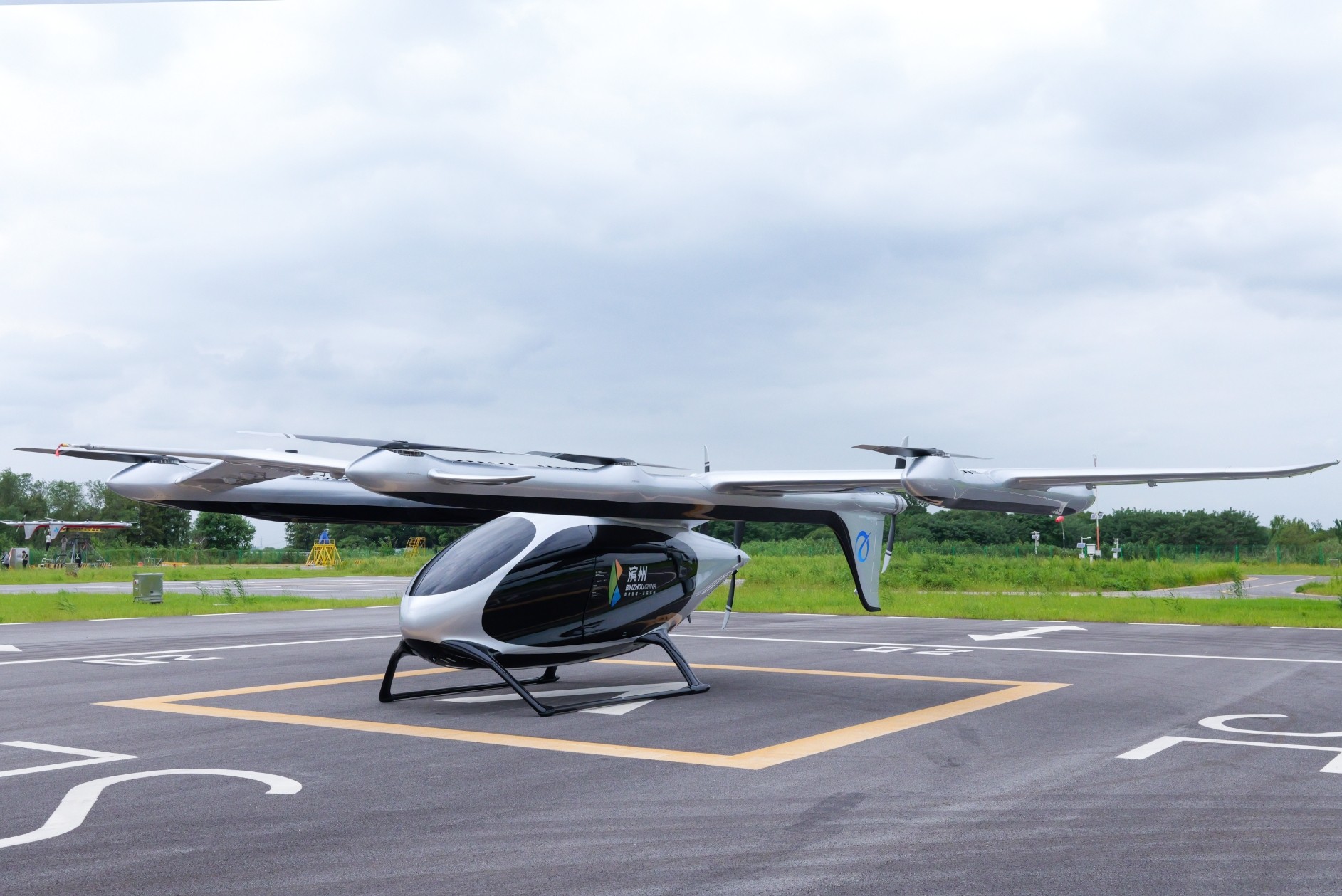
Carryall cargo eVTOL delivered at Binzhou Base
The other base is located in Yulin, Shaanxi Province. Zero Boundary Aviation, together with local state-owned investment platforms and scientific research institutions, introduces multiple aircraft through leasing, mainly to verify how the assets are leased, priced, and how they are repurchased or transferred when the lease term expires.
The two bases have different focuses, but point to the same proposition: how a city can achieve normalized operation from scratch, and whether this system can form a replicable operation and cost model.
The experience obtained in real scenarios, ranging from route organization, safety record, anomaly handling to the finally accumulated operation data, will also become the reference and empirical evidence required for airspace management coordination and the formulation of local regulatory standards.
"We want to walk through the tough road first." said Wu Zhenya, "When a city confirms that normalized operation is controllable and predictable through these cargo flights, it can open up larger airspace and approve more scenarios. Zero Boundary Aviation hopes to act as a pathfinder in this process, rather than just a profit-seeking enterprise."
This model has also begun to bring actual revenue. According to Wu Zhenya, with the Yulin project and the state-owned assets leasing and operation services previously launched in Henan, Anhui and other regions, the total annual revenue of Zero Boundary Aviation has reached tens of millions of yuan this year.
Based on the operation status of the two bases, Zero Boundary Aviation plans to continue expanding urban nodes in 2027 to further expand the verification scope. For the selection of new nodes, Wu Zhenya mainly has four considerations: whether there is real and continuous task demand, whether local policies and industrial supporting facilities are supportive, whether the airspace allows normalized flights, and whether there are partners who can take charge of local resources.
"We give priority to scenarios with rigid demands for logistics, inspection or emergency rescue, such as islands, coastal areas and sparsely populated regions. Such areas have high transportation costs and few alternative solutions, so customers are more willing to pay for higher transportation efficiency." he said. This choice also echoes the regulatory development path of "carrying cargo before carrying passengers, covering suburbs before covering urban areas".
In the long run, Zero Boundary Aviation hopes to gradually transform from the current model of self-purchased aircraft and scenario verification to platform-based operation. After the operation data and commercial model are fully verified, aircraft assets can be held by local platforms, general aviation companies or other customers. Zero Boundary Aviation, as the platform party, will be responsible for connecting air routes, capacity supply and paying buyers, and provide services such as capacity scheduling and operation control. "The ultimate goal is to become the 'DiDi' in the low-altitude travel field."
In Wu Zhenya's words, the low-altitude economy is not a money-making industry at present, but it will definitely be a high-value industry in the future. What Zero Boundary Aviation needs to do now is to verify the "high value" judgment through real scenarios, and gradually explore a set of urban aviation commercial system that can be verified by the market and priced by capital.