"Chatty" Fable 5.2: Anthropic is the one who mentioned the price cut, I never agreed to that.
Ahead of its IPO, Anthropic released Claude Fable 5.2 and Mythos 5.2.
Both models are built on the same base, with the core difference lying in security permissions: Fable 5.2 is targeted at general users and comes with cybersecurity and biological domain safety protection restrictions; Mythos 5.2 is only open to audited institutions, with relevant restrictions lifted to support compliant cybersecurity and life science research.
The biggest upgrade of the new version lies in long-task scenarios, especially those related to robot training. Meanwhile, the token price of Fable 5.2 is 20% lower than that of Fable 5.1.
Besides, Fable 5.2 has also made significant improvements in aesthetics and design compared with Fable 5.1.
Within half an hour after the release of Fable 5.2, some developers used this model to create an FPS game with extremely exquisite visuals.
However, the independent evaluation agency Artificial Analysis published a long post complaining that while Fable 5.2 does have higher intelligence level and cheaper token price, the average cost per task has increased. What Artificial Analysis finds most unacceptable is that Fable 5.2 is far more "verbose" than previous versions.
Where exactly does the performance improvement come from?
Let's start with the benchmark scores.
The RoboDojo Sim for robot control surged 2.35 times directly from 27.6% to 64.9%; chart recognition rose from 44.8% to 73.4%; remote professional tasks increased from 17.9% to 41.3%; scientific research terminal performance went from 52.6% to 74.6%; FrontierCode 2.0 improved from 32.4% to 49.1%; HLE with tools rose from 65.6% to 74.2%.
For Computer Use, OSWorld 2.1 only increased slightly from 83.5% to 89.3%; for knowledge work AA-Briefcase, the score only went up from 61.5% (ELO 1669) to 66.1% (ELO 1785).
In other words, Fable 5.2 sees huge performance gains on long tasks that take longer time and require more tools. For questions that can be answered in a single round, there is barely any improvement.
So how long can these long tasks be?
Anthropic released a set of controlled experiments: they used 1000 Fable 5.2 agents and spent nearly 30 hours completing the formal proof of Fermat's Last Theorem. In comparison, a previously unreleased version, paired with a dedicated "plug-in" (purpose-built harness, a customized tool scheduling framework) and full guidance from researchers, still took 11 days to complete the exact same work.
Besides, Fable 5.2 only consumed one-third of the action tokens that the unreleased version used.
When 1000 Opus 5.5 agents were used for the same task, the results showed that only 26% of the task was completed after 18 hours, and 27% after 30 hours, before the task got stuck completely.
In addition to obvious long tasks such as mathematical reasoning, among all long task benchmarks in the performance table released by Anthropic, RoboDojo Sim is the item with the largest performance gain. Tech blogger @himanshu specifically posted a reminder that two areas deserve special attention in Fable 5.2: robot control and protein design.
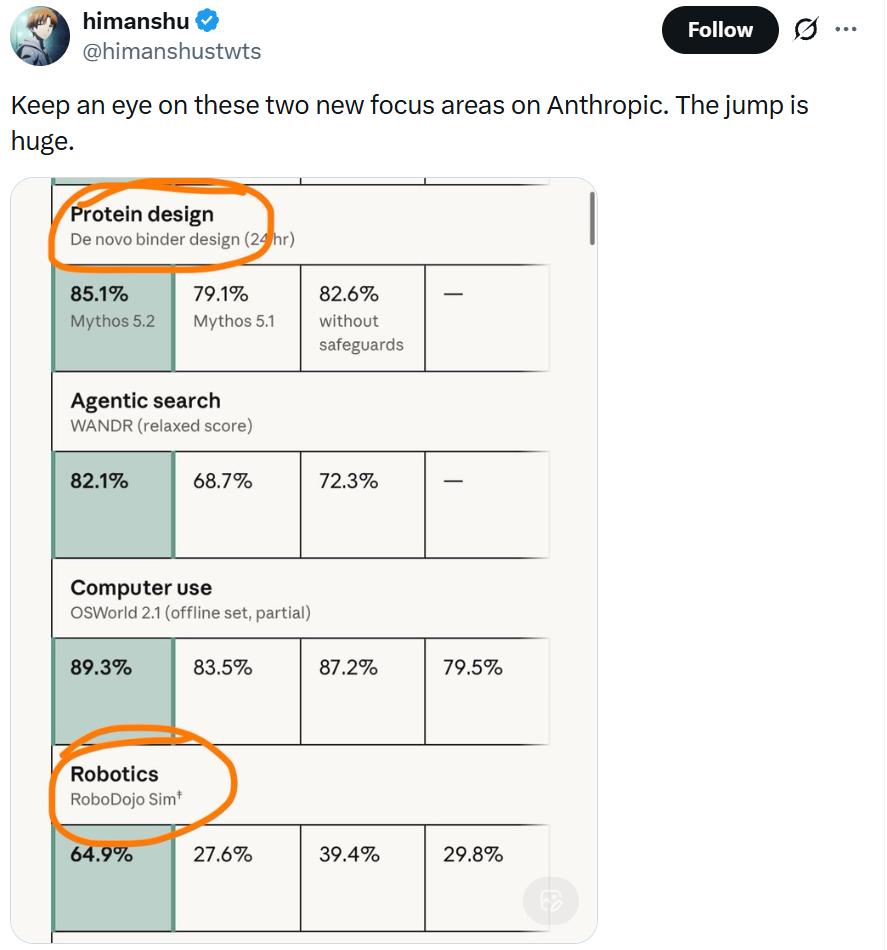
This public benchmark includes 42 simulation tasks and 18 real robot tasks for dual-arm robots, where the model can only perceive the environment through camera footage. The five evaluation dimensions are generalization, memory, precision, long-horizon execution, and open-vocabulary instruction following.
It tests the model's ability to observe the scene, remember previous steps, and continuously complete a series of actions. If the robot "deviates" from the correct path during the process, it must correct the error on its own.
Anthropic officially stated that this model outperforms "most AI systems built specifically for robot control", because all these tasks are completely unseen by the robots in the real world.
In the past, it was widely believed that robots needed specially trained embodied intelligence models to solve problems such as spatial understanding and motion planning. However, Fable 5.2 is a general-purpose model, which can be directly used by any company to train robots. This significantly lowers the training threshold for embodied intelligence companies.
In the programming field, where Anthropic excels the most, the official blog released a chart showing the scores of several of the most powerful large models on the FrontierCode 2.0 benchmark.
Anthropic also ran benchmark tests on Fable 5.2 at different effort levels, and the results were so unexpected that I even suspected there was a typo when filling in the form at one point.
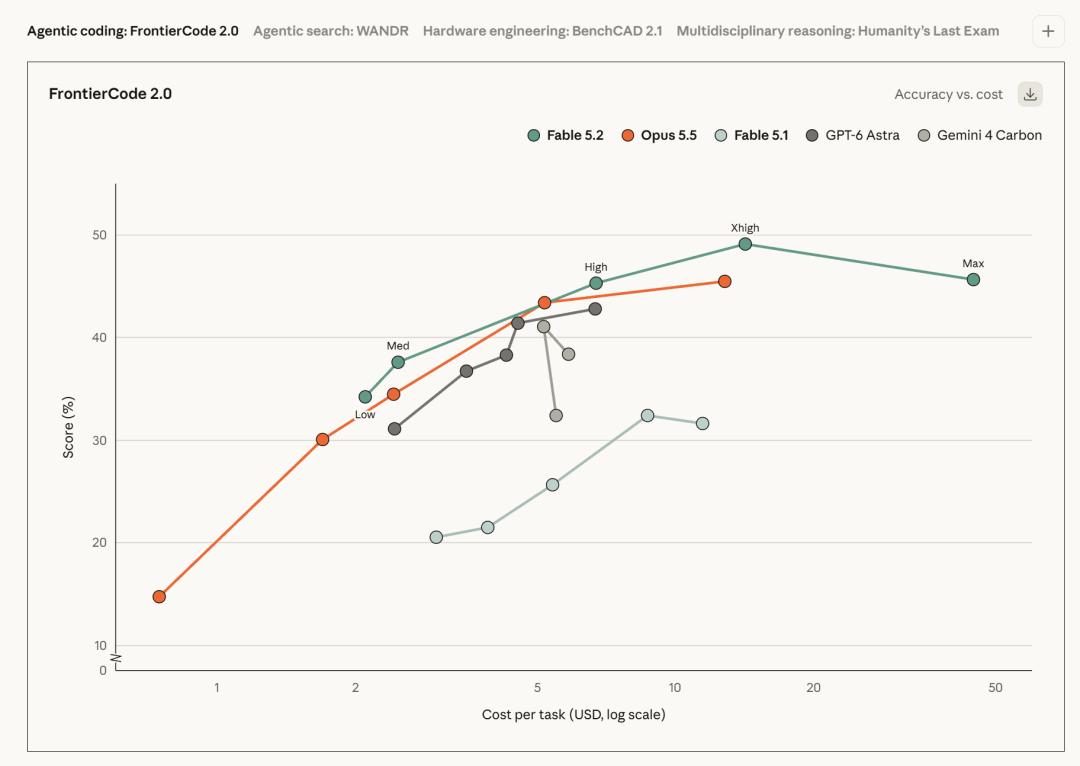
The Xhigh mode of Fable 5.2 ranks the strongest in the world, with a score of 49.1% and a cost of $14.19 per task. However, when the effort is adjusted to the highest Max level, the score drops instead to 45.6%, with an average cost of $44.70 per task.
This means that spending more time thinking and consuming more tokens does not lead to better performance than the Xhigh mode.
The official explanation from Anthropic is: high effort leads to over-deliberation.
Anthropic believes that higher effort may "collect more context than required by the task and over-deliberate" when handling routine work, and the model is also equipped with prompts to prevent "over-planning". FrontierCode tests whether a patch is qualified enough to be merged into a real repository. Since the required context already exists in the diff, turning a two-line fix into a claim-driven refactoring will be judged as unqualified in this benchmark, which is why the Max mode score is lower than that of Xhigh.
In addition, Anthropic also mentioned that another possible reason is that the model spends too much time thinking and fails to submit the result before the time limit, and timeout will lead to score deduction.
The biggest feature of Fable is... low cost?
The token price of Fable 5.2 has dropped from $10 per million input tokens to $8, and the output price has dropped from $50 to $40, a 20% reduction; the output speed is up to 30% faster than that of Fable 5.1.
The fast mode is priced separately: $16 per million input tokens and $80 per million output tokens, which doubles the price, but the token generation speed can be up to 2.5 times faster.
The cache read price is $0.20, compared with $1 for Fable 5.
Anthropic stated that when the effort of Fable 5.2 is turned to High, its performance is comparable to Opus 5.5 at the maximum Max level, and the cost per task is only about half of the latter.
However, Anthropic did not explain why it cut prices throughout the official announcement.
So where does this 20% price cut come from?
On September 12, Dario Amodei published the article "We Must Pace the Frontier", stating that slowing down "does not mean stopping model training or technological progress, but ensuring that the company has enough time to align models and add safety guards to them".
10 days later on September 22, Anthropic released Opus 5.5 with a 20% price cut to $4 and $20, claiming that its operating cost is about 40% lower than that of Opus 5. About two hours later, OpenAI released GPT-6 Sol and Luna, which are about 50% lower than the promotional price of GPT-5.6.
Ara Kharazian, an economist at Ramp, said: "This is not a technological innovation. It is essentially a price war that drives down AI prices as well as the company's own profit margins."
Another thing that draws widespread attention is that the version number is 5.2, while the previous Opus has already been updated to version 5.5. The New Stack commented, "It's really a bit unexpected that it wasn't named Fable 5.5". However, Anthropic has not given any explanation for the version number.
Less than an hour after the release of Fable 5.2, counterintuitive results came out.
The independent evaluation agency Artificial Analysis published a long post, stating that they tested Fable 5.2 on the Intelligence Index v5, and the model took the top spot with 65 points at the Max level, 6 points higher than Opus 5.5's 59 points, and about 15 points higher than the previous generation Fable 5.1's 49 points, winning the highest score in 5 out of 9 evaluation items.
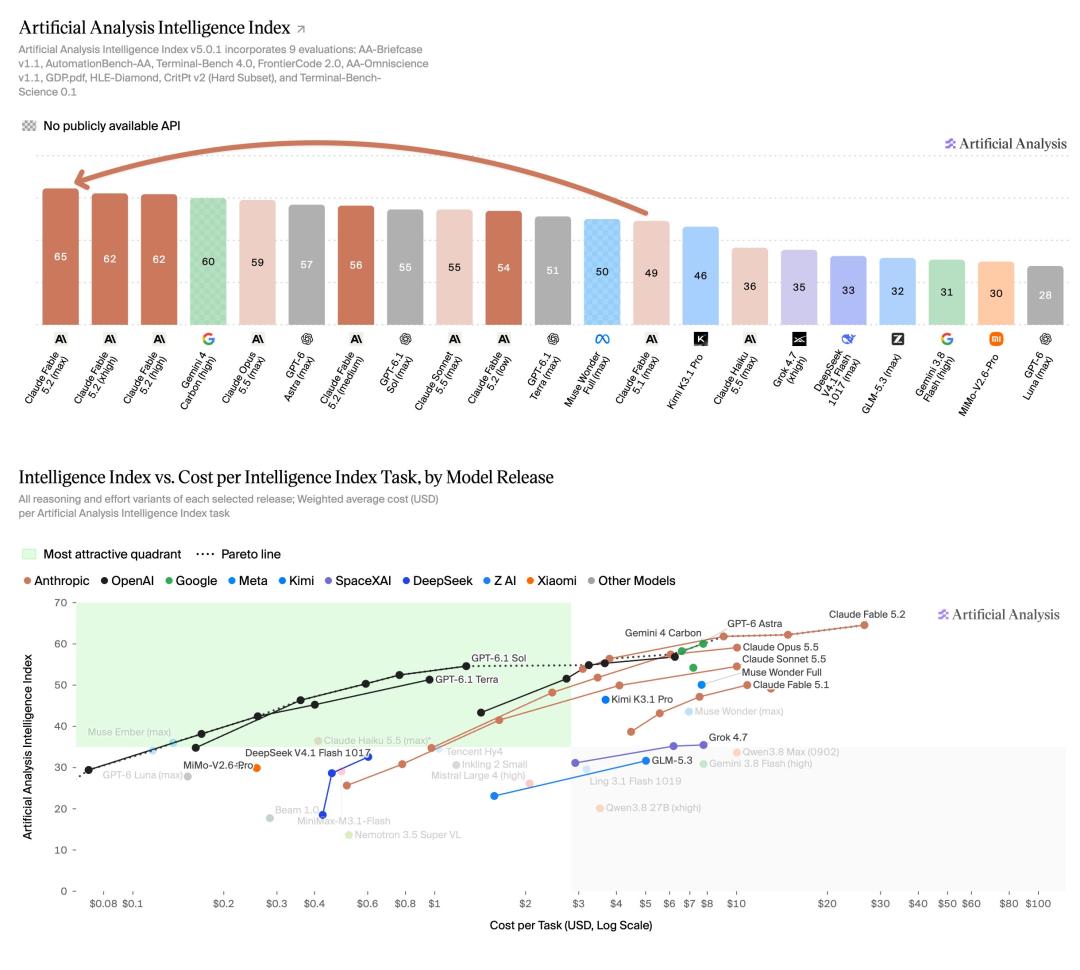
Don't rush to conclusions. The Fable series has always been the intelligence ceiling of large models, which is beyond doubt. Artificial Analysis then wrote that the Max mode costs an average of $26.5 per task, about 2.6 times that of Opus 5.5 at Max level ($10), and about twice that of Fable 5.1.
The unit price has been reduced by 20%, but the total cost has doubled. Artificial Analysis also added a follow-up note, saying that Fable 5.2 generated about 275 million tokens in the evaluation, while the median of similar models is only 72.8 million, "it is far too verbose".
The last point: while performance scores can be measured by numerical values, Anthropic stated that Fable 5.2 has also been upgraded and iterated in design aspects.
As a result, less than half an hour after the release of Fable 5.2, some people in the community tried to use Fable 5.2 to develop an FPS game.
The demo already has complete firearms, shooting feedback and scenes. Some netizens in the comment section said that the game is good enough to be released directly.
If you only know what kind of game you want to play and haven't even written the first line of code, you can let Fable think a few more steps for you.
This article is from the WeChat official account "Letter AI", written by Miao Zheng, and published with authorization from 36Kr.