Car buyers are getting increasingly older, what is the point of the auto industry still hyping youthfulness?
"Some take knowledge as electricity, some take passion as light", "Youth is an attitude: no internal friction, no bowing to pressure", "You don't have to rush when you are young, every step you take to set off is happiness"
All the above are slogans adopted by some domestic automaker brands around this year's Youth Day, such as Exeed, Geely China Star, BYD and others, in their seasonal marketing campaigns. The core idea is to build emotional connections with young people, promoting a collective shift away from the "striving and inspirational" narrative to the resonance of "relaxation" and self-identity.
Less than a month later, on the eve of Children's Day, other brands began to follow the trend. For example, Chery partnered with Sohu to hold a QQ3-themed event at Chengdu Xichen Paradise Walk, whose slogans at that time included "Who isn't a baby", "Reject excessive work-related weariness", "Specialize in curing all kinds of mental internal friction of contemporary young people" and so on.
Two weeks later, in mid-June, as the World Cup was around the corner, brands including Geely Galaxy, Xiaomi, Deepal, GAC Aion took the stage, and the topic naturally shifted to the World Cup. Marketing moves like "Dami joins Xiaomi", "Give away a car for every goal scored" came one after another, including becoming Xiaohongshu's chief World Cup partner, appointing Rice of Arsenal as experience officer, and giving away one-year car usage right for each goal scored by the Portugal national team.
After listing all these marketing moves, don't take it for granted that the practice of building common ground and connecting emotions with young people only exists in May and June. Looking back, it started from the beginning of this year; looking forward, it will last through July, August, September and October, achieving full coverage throughout the whole year without dead ends.
The author believes that one major feature of China's auto market in 2026 is that all vehicle groups and auto brands have anticipated the situation they are facing long ago, and have fully recognized the reality from the very beginning. The reason to prove their early anticipation is that the marketing activities targeting young car owners like the ones mentioned above are far more than the few cases listed earlier. In fact, these activities have hardly stopped throughout the whole year from the start of the year to after the National Day. In any case, no matter whether it works or not, the activities have to be carried out, and selling one more car counts.
The reason why it is said that they have fully recognized the reality from the very beginning is that there was a major move in the auto market at the start of this year — reducing the down payment or even offering zero down payment, and providing ultra-long loan plans.
Shortly after the start of this year, a number of brands seemed to have reached a consensus to extend the auto loan term to seven years. For example, Tesla launched a series of plans including a 79,900-yuan down payment and 1,918-yuan monthly payment for Model 3, and 2,263-yuan monthly payment for Model Y, which was further converted into 74 yuan of daily payment in its promotion. Li Auto also launched plans starting from 32,500 yuan of down payment with extended repayment cycles. The Teana of Dongfeng Nissan went even further, offering zero down payment, 8-year loan term and 55 yuan of daily payment. Even BYD Ocean Network once offered an extremely low price starting from 29 yuan of daily payment.

Figure丨At this time, there is no need to tangle over any "transformation" concepts, selling more cars is the real priority
Such models of ultra-low down payment and ultra-long repayment cycles became popular rapidly once they emerged, and soon almost all brands chose to follow up. Admittedly, splitting the monthly payment into tiny amounts through financial means can be regarded as a sign that the price war in China's auto market has reached its extreme. However, the other implied meaning behind it is also clear — automakers and dealers are very clear about the payment capacity of all social groups, and such measures are targeted at young people who have just worked for a few years and have little savings.
Although the industry is still talking about young people and "youth-oriented" strategies, and all seasonal marketing measures have been put in place, some of this year's research reports are still boasting that post-95s have firmly taken the largest group of car buyers, the proportion of post-00s has tripled in three years, and online discussions about "work-weary aesthetics" are also very heated. However, financial measures are far more honest than marketing rhetoric. Pressing the monthly payment to more than 1,000 yuan and extending the loan term to 8 or 9 years has already revealed the essence of the matter —
Whether traditional automakers or new EV forces, no matter they truly believe or pretend to believe, the auto "youth-oriented" trend that they have been advocating together for nearly a decade has completely come to an end. For domestic automakers, young car owners are essentially the group that "even a mosquito's leg counts as meat".
At the end of 2026, Research on the Main Consumer Group of China's Car Buyers
Let's start with the conclusion. According to statistics, the average age of new car buyers in China is increasing year by year. The "youth-oriented" wave that automakers began to imagine ten years ago has not arrived, and according to the current trend, it will never arrive.
Here are some specific data. First of all, we need to make it clear that to judge who buys the car, we should see who signs the purchase contract, not who is the main driver of the car. According to the age trend of the signatories of car purchase contracts, the average age of car buyers has been rising all the way in the past decade.
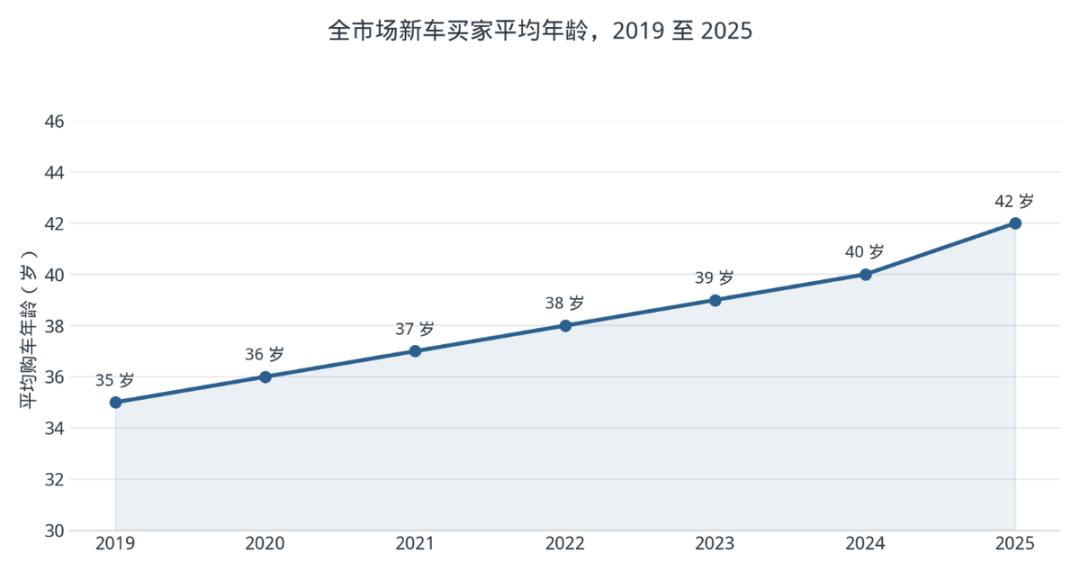
CNR reported in 2024 that during the ten years from 2014 to 2023, the average car purchase age rose from 32 to 40. Especially from 2019 to 2024, the average age of car buyers increased by one year per year from 35, and finally reached 40. In April this year, China Auto News reported that in 2025, the average age of first-time car buyers was 42, 2 years higher than that of 2024.
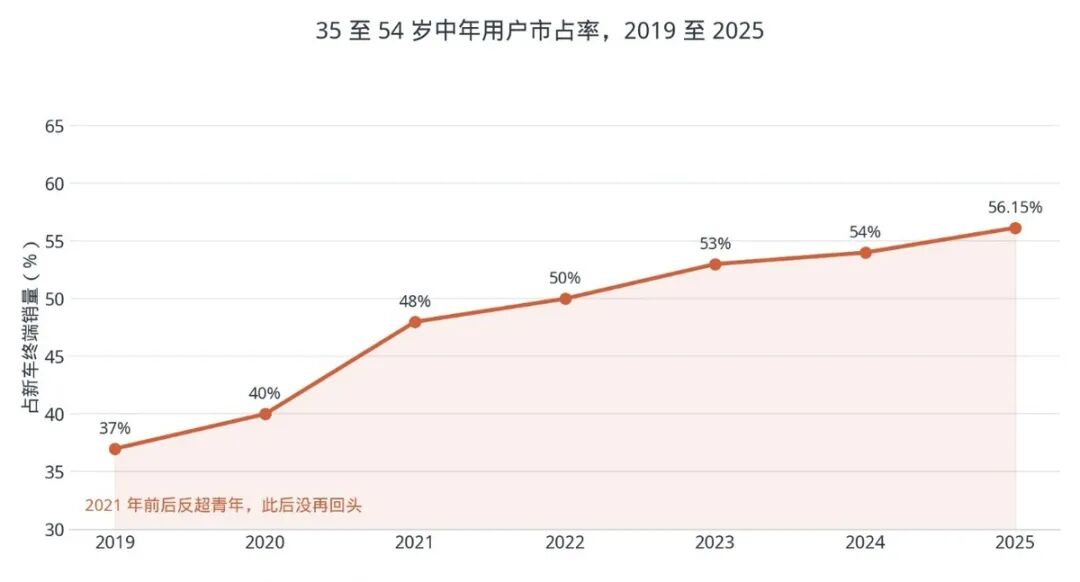
As the average age rises, the age structure of car buyers is also changing. According to an annual report that breaks down sales by age of end consumers, the market share of middle-aged users aged 35 to 54 was only 37% in 2019, rose to 48% in 2021, 53% in 2023, and reached 56.15% in 2025. The middle-aged group has surpassed the youth group around 2021.
In terms of total car purchases, the number of young people under 35 years old dropped from 10.63 million units, accounting for about 50% of total sales in 2020, to 7.07 million units in 2025, accounting for only about 30%. As for the group aged 25 to 29, the number dropped directly by half from 3.96 million units in 2020 to 1.8 million units. Some institutions have concluded that the declining marriage rate in recent years is the main cause of this phenomenon, because the group with the highest concentration of car purchases for marriage has seen the sharpest decline in statistics.
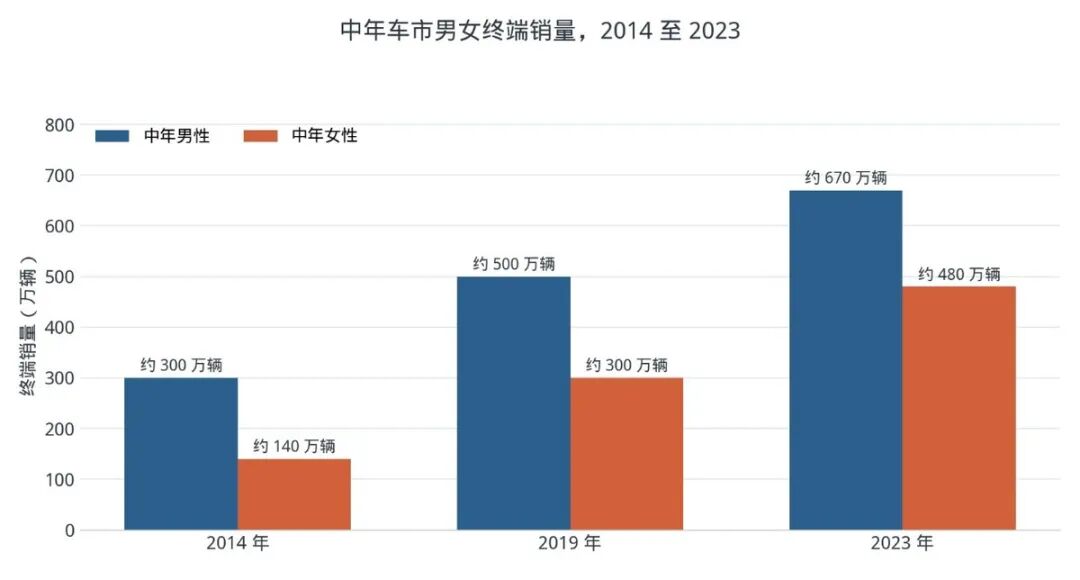
Here we might as well count the gender ratio. In 2023, the male to female ratio in the middle-aged car market was about 6:4, with nearly 7 million units of terminal sales for middle-aged men and nearly 5 million units for middle-aged women. Looking back to 2014, the two figures were 3 million units and 1.4 million units respectively. Both groups are growing, and the absolute number of male consumers has always been larger.
The change took place in the younger group. A car user trend study reported by CNR in February 2025 wrote very directly that the proportion of users under 30 years old decreased rapidly starting from 2022, and the age group of 31 to 40 also declined significantly in 2023, with a more obvious drop among men under 40. Meanwhile, the replacement ratio from the China Passenger Car Association rose rapidly from about 40% from 2019 to 2022 to 45% in 2023, and the proportion of users over 41 years old increased accordingly.
Can we draw a conclusion from this that men have not withdrawn from the car market, but young men who have just entered society temporarily choose not to buy cars?
The 2026 statistics only cover the first nine months so far, so we can only make partial sorting.
In the article on the age difference of car owners between China and the EU published by People's Daily Online and China Youth Network in November, one part says that this year 73.18% of new energy consumers are aged 31 to 40, and post-00s account for more than 10% for the first time. Another part cites a German newspaper saying that the average age of Chinese new energy car owners is 34, and that of the EU is 56. Comparing the two, we can only say that China's car market has just entered the middle-aged stage, which is much better than Europe, especially Germany.
To sum up, to understand why the average age is rising, we need to connect several facts together.
The first reason for the rising age is the shrinking youth population. In the early 1990s, more than 24 million people were born each year, and by the end of the 1990s, the number dropped to 18 million. In the 10 years of post-00s, the annual birth population was around 16 million. When they reach the age for car purchase, the number of people entering the market is much smaller.
Similarly, the time point of first-time car purchase is also pushed backward. The replacement subsidy makes families that already own cars become the main incremental source. The situation where parents pay the down payment and children pay the monthly payment, or old cars are transferred to younger family members, are all counted in sales, and the payer has crossed a generation.
Finally, the author wants to emphasize in particular that the actual data of young people's car purchases is even worse than the current statistics, after excluding the part of cars bought for online ride-hailing services. Production tools and private vehicles are completely different things. Ignoring this difference will create a group of young buyers that do not actually exist.
The So-Called "Youth-Oriented" Strategy Is Essentially a False Proposition
Why has it become increasingly difficult for young people in their twenties to buy their first car in the past decade? In fact, this question itself is problematic — there is never a problem of "becoming increasingly difficult", it has never been easy from the very beginning.
In February this year, the media intensively reported on 7-year low-interest auto loans. Among the cases, I think one is very illustrative.
Xiao Fang, an auto mechanic, earns less than 5,000 yuan a month. Seeing that all his colleagues have cars, he bought a used car with 20% down payment, with a monthly payment of 1,700 yuan and an annual interest rate of 7.67%. The total interest for seven years is more than 10,000 yuan. He said he signed the contract to order the car on impulse at that time.
But after picking up the car, the cost is far more than the bare car price. Taxes, insurance, and basic car supplies such as floor mats, car clothing and other items also cost money. His passion for the new car only lasted for a month or two, then Xiao Fang found the problem. When he commutes to work, if there is a traffic jam, driving is even slower than riding an electric bike, and he has to spend extra money on fuel. On rest days, he has a small social circle and prefers to stay at home playing mobile games, so the car is rarely used. If he drives out for fun, the fuel cost plus parking fee seems not worthwhile at all. Even if he does not use the car, he still has to pay the monthly payment, leaving almost no savings every month. To save money, Xiao Fang even skipped breakfast...
After two months of suffering, Xiao Fang whose quality of life plummeted realized: Others buy cars with their savings, am I stupid to buy a car on debt? He made up his mind to sell the car, and got back half of his down payment after paying off the auto loan.
In a report from a well-known media in Shanghai, I saw another example. Yang, who had just worked for a year, also wanted to buy a car after seeing his colleagues owning cars. Fortunately, his family is in good condition, and his parents, who care about their son, paid the down payment for him, and the rest was paid in installments.
But the problem is that Yang does not work in his hometown, but chose to stay in Shanghai after graduation, which means he has to rent an apartment. Therefore, although Yang's salary is quite good for a new workplace entrant, after deducting the car loan and rent every month, he still has to count every penny carefully.
Even many times, to save the 10-yuan-per-hour parking fee, Yang did not park the car in the paid parking space, but parked it on the roadside without marked lines. Therefore, during dinner parties, he had to keep an eye on the traffic police's car moving messages, and once he received the message, he had to rush out of the restaurant to move the car.
If the above cases are not enough to explain the problem, I might as well talk about my own experience of buying my first car.
It was more than ten years ago, when I was just over 30 years old, and it was the beginning of the full popularization of automobiles in China. At that time, I was a bit overambitious, so I chose the flagship version of a well-known A-class family sedan from a joint venture brand. With all kinds of taxes and license plate fees added, the total landing price was about 200,000 yuan.
The down payment basically emptied all my savings accumulated over the years, and I took a 24-month interest-subsidized installment plan through the activities of the bank and the brand, paying less than 4,200 yuan per month. Adding the monthly fuel cost, parking fees at the company and home, the cost of parking outside and the monthly apportionment of regular maintenance costs, the car brought an extra expense of nearly 6,000 yuan per month.
At that time, my take-home salary was only about 10,000 yuan. Fortunately, I did not have to make a living in a different city, so I saved the large expense of rent