When AI starts to revive old games in batches
Recently, a wave of old games has been making a collective comeback.
Take *Million Arthur: Arcana Blood* for example. Since September, this vintage game, playfully dubbed the "late pioneer of gacha games" by many players, has re-entered gamers' field of vision. On platforms like Bilibili, a large number of users have re-uploaded actual gameplay videos of *Million Arthur: Arcana Blood*, and various revived versions of the game have instantly struck a chord with countless "old otaku" gamers.
In the bullet comments, nostalgic players began to look back on the past as the game that introduced them to gacha games, meme-savvy players left sarcastic comments like "You didn't invite me when the server launched", and long-time IP fans couldn't help but ask "Is there any chance for *Million Arthur: Valkyrie* to make a comeback too?"...
After the initial shock, more casual players started to imagine: If *Million Arthur: Arcana Blood*, which shut down 10 years ago, can be revived, is there a chance for other games that have been discontinued over the years to get a new lease of life?
As a result, more and more discontinued games have been swept up in this trend, and all kinds of "beloved old favorites" have been recreated by gaming influencers one after another.

In a series of retro-style demo videos, people have started to define this phenomenon as the "Great Revival Era".
With AI stepping in, the time to revive a game drops from 1000 hours to 20 minutes?
In fact, reviving old games is nothing new.
For a long time, there has been no shortage of nostalgic players in gaming communities at home and abroad. With specific reverse engineering methods, tech enthusiasts can gradually restore the look and feel of classic games, and port works that were tied to old media to new hardware platforms. They have their own unwritten community rules, and have benefited many ordinary players outside their circle.
But obviously, this revival method is not only highly difficult, but also requires a huge amount of energy, so it is destined to be a niche hobby for a small group of "folk experts". What the current "Great Revival Era" has changed, however, is the technical threshold and labor cost of reverse engineering.
Not long ago, an engineer posted on an overseas community and sighed: "I spent 3 years doing reverse engineering to rebuild a defunct MMO game, but now AI can do the same thing in a single day."
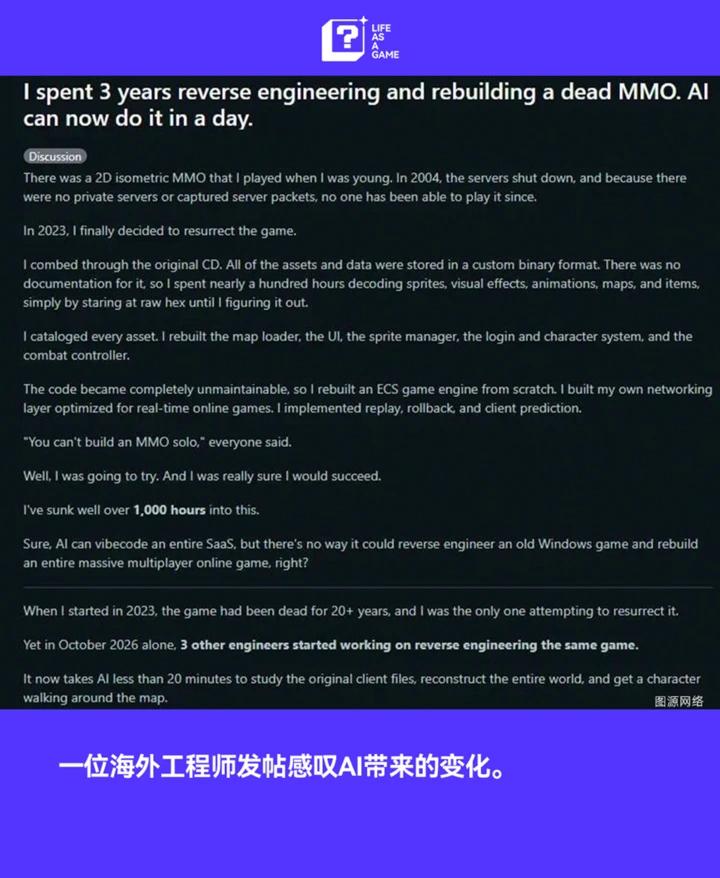
According to the engineer, he started trying to revive an old game that shut down in 2004 back in 2023. To do that, he carefully checked the original disc, spent nearly 100 hours decoding sprites, visual effects, animations, maps and items, rebuilt the map loader, UI, character system and more, and even reconstructed an ECS game engine from scratch because the original code was too unmaintainable to use...
After several years, he has invested more than 1000 hours in this project in total. However, the arrival of AI was completely unexpected.
The poster wrote: "In October 2026 alone, 3 other engineers started working on reverse engineering the exact same game. Now AI only needs less than 20 minutes to go through the original client files, rebuild the entire game world, and make characters walk around the map."
It is no exaggeration to say that due to the rapid evolution of AI technology, the entire established order in the field of game decompilation has been completely overturned. Now, reviving a game no longer requires a tech guru, but just a sincere "wish" to a large language model.
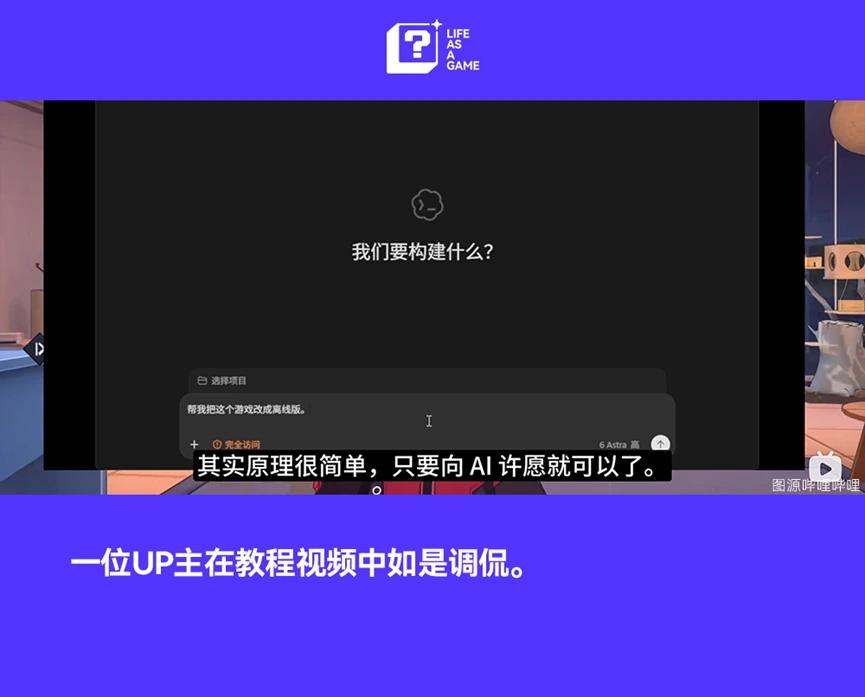
Specifically, based on different degrees of "revival", current AI-powered game revival can be roughly divided into three categories.
First, the simplest category requires modifying the game client, temporarily putting aside full gameplay, with the main goal of displaying content materials such as characters, animations, and storylines on demand, which is equivalent to a custom "gallery" for veteran players to store their memories. Second, the relatively more complex category requires restoring the client, aiming to replicate the single-player version of the game, which is the revival mode that most people imagine. Finally, the most tricky category requires players to restore the server side, so as to "relaunch the server" in a sense, and realize advanced functions such as multiplayer online connection.
But generally speaking, no matter which game players want to revive and how they want to revive it, as long as the game installation package can be traced, AI can almost handle the vast majority of technical difficulties.
Therefore, as various popular science tutorials go viral, more and more ordinary players have the idea of fulfilling their old dreams, and successful cases have sprung up like mushrooms after rain.
*Mystery of the Archives*, *Ark Order*, *Dengeki Bunko: Crossing Void*, *Witch's Weapon*, *Azur Lane: Crosswave*, *Merc Storia*, *Girls Cafe Gun*... In just two months, countless revived versions of old games have emerged, and almost none of the classic gacha games are missing from the list.
A Bilibili content creator who just hit 100 followers said that he also made a "wish" to AI after watching related videos, and successfully revived his favorite game from 10 years ago in just one day. He revealed that since the game is quite small, only around 200MB, the revival cost is not high, and the AI computing power only cost him 40 yuan.

Examples of such "wish fulfillment" have made more onlookers eager to try. People ask for guidance and recommended models in the comment sections, and "handcrafting your childhood" has never seemed this easy.
With the threshold gone, is reviving games becoming a business?
Beyond the excitement, new problems have started to emerge.
Although AI has seemingly greatly lowered the threshold for reviving games, for a total beginner with no programming background, getting their hands on these technical tasks can still be intimidating. That's why we can see many players treat gaming influencers as "wishing wells", leaving the names of specific games in the comment sections, hoping that the "experts" will pick their favorite game to revive.
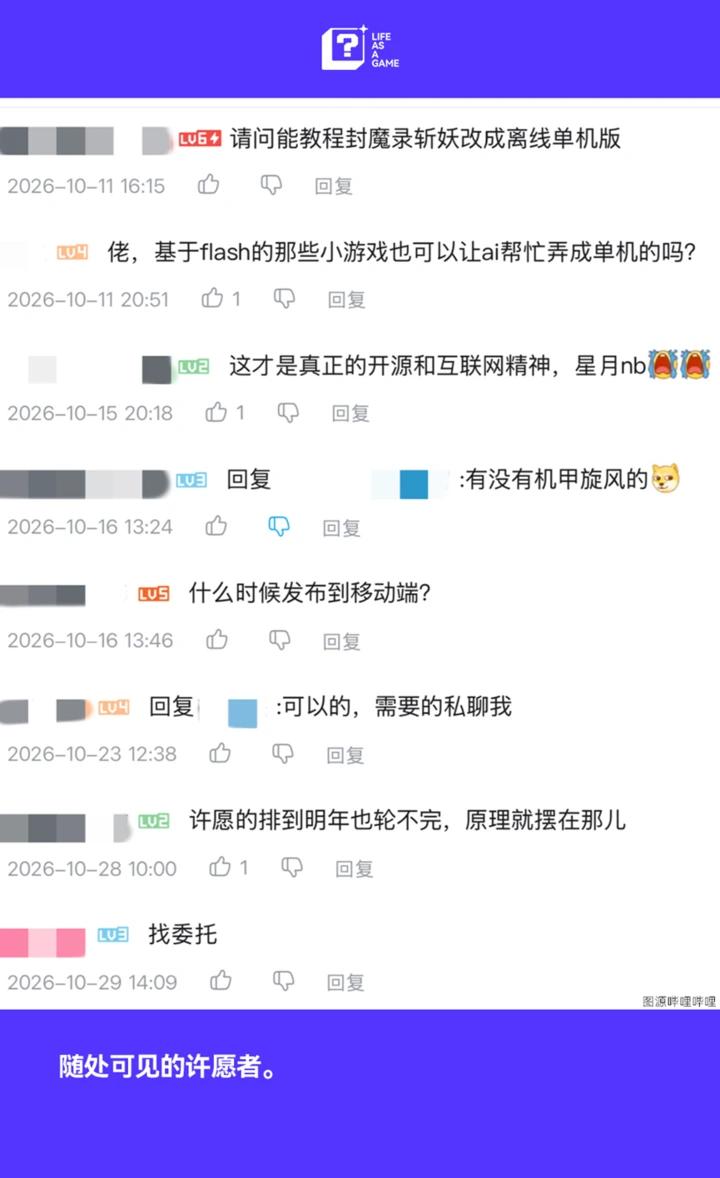
Where there is demand, there is business. To fulfill those "wishes" that big influencers have no time to attend to, a paid model of taking "commissions" to revive specified games has come into being. On third-party trading platforms, the price tag for such services can reach hundreds or even thousands of yuan.
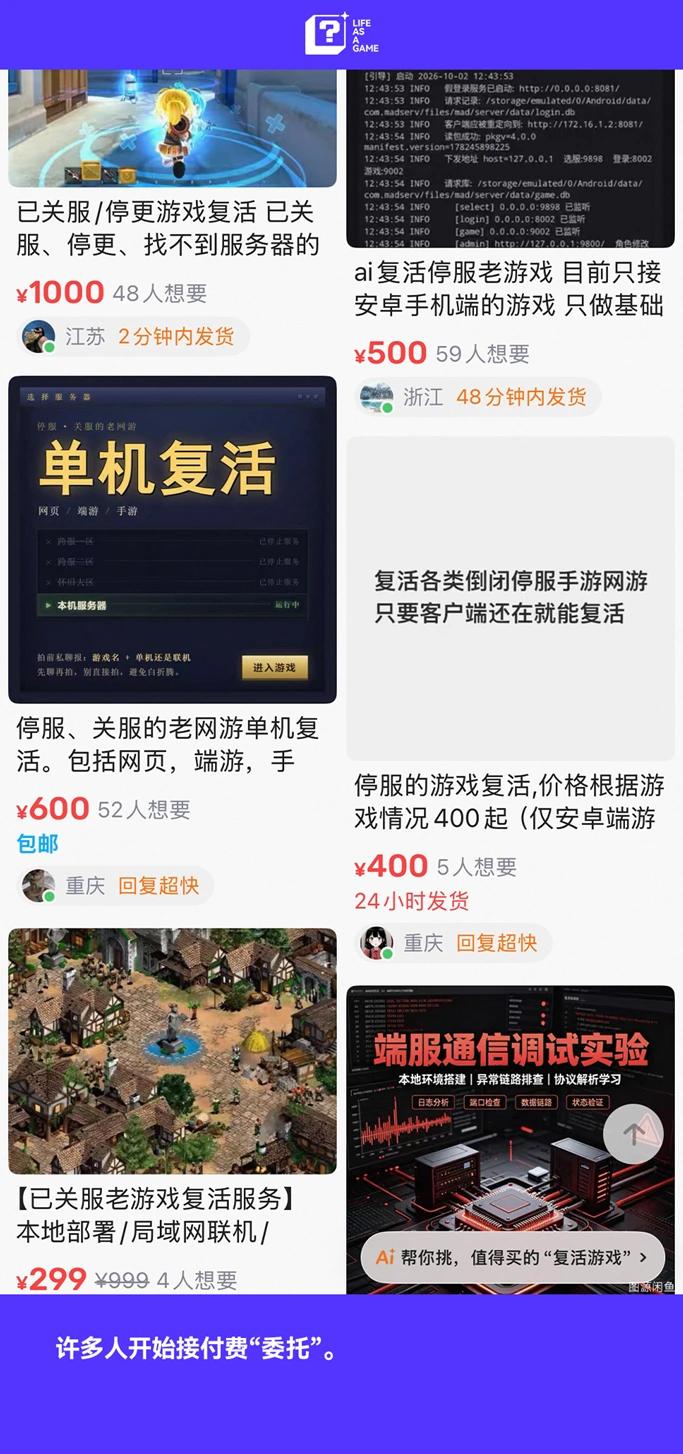
If "commissioned revival" can barely be regarded as a gray "knowledge payment" practice, reselling revived game installation packages is far more blatant and greedy.
Take *Mech Storm*, a game with extremely high revival demand in player communities, as an example. A large number of product links selling the revived version of this game have appeared on third-party trading platforms. Sellers use "nostalgic childhood memories" as their promotional slogan, with prices ranging from 0.1 yuan to 5 yuan.

The problem is, even if the game has been shut down, the developer that poured painstaking efforts into it still holds a series of legitimate rights. Resellers have not spent a single cent on developing the game, and most likely are not the people who actually revived the game, yet they blatantly list and sell the installation packages for profit, which has undoubtedly crossed the proper business bottom line.
From this perspective, we can hardly ignore the series of infringement risks brought by AI-powered game revival.
On one hand, the revived version of the game developed by players for non-commercial passion in the community may be copied and reused by ill-intentioned people in the blink of an eye, and turned into pirated resource packages for sale and profit.
On the other hand, after AI breaks the technical threshold, the difficulty of building unofficial private game servers has been greatly reduced. The "server restoration" type of game we mentioned above is in a sense a prototype of private servers.
And private game servers are precisely one of the infringements that game developers hate the most.
In March this year, miHoYo's legal department released the *2025 miHoYo Intellectual Property Protection and Rights Protection Annual Report*, which mentioned that miHoYo took "heavy action" against private server issues, assisted the police in arresting 6 criminal suspects who produced and sold private servers, and shut down 7 online shops selling private servers for games including *Genshin Impact* and *Honkai: Star Rail*, with the involved amount exceeding 2.6 million yuan.

Of course, this does not mean that players' nostalgic behavior of reviving games already constitutes a crime.
In fact, the vast majority of players revive games out of personal interest, and there are almost no precedent for accountability in past judicial practices for such personal experience scenarios. What really needs to be guarded against is that lawbreakers use revived games to provide online services to the public, or even charge fees for profit.
It is the difference in scope between the two that determines whether AI-powered game revival is "dream fulfillment" or "infringement".
It is worth noting that as the AI decompilation wave becomes more and more fierce, not only old games are facing the crisis of "revival infringement", even unfinished new games are not spared.
On October 16, the independent game *Drunkard Goddess' Wine Trick* urgently canceled its public release on the eve of the demo version announcement, and changed to a closed demo session. The game team stated in their official statement: "We are worried that someone will use the public content of the demo version as a basis, use AI and other means to imitate and replicate the game's presentation and content in a short period of time, and release related works before the official launch of our game."
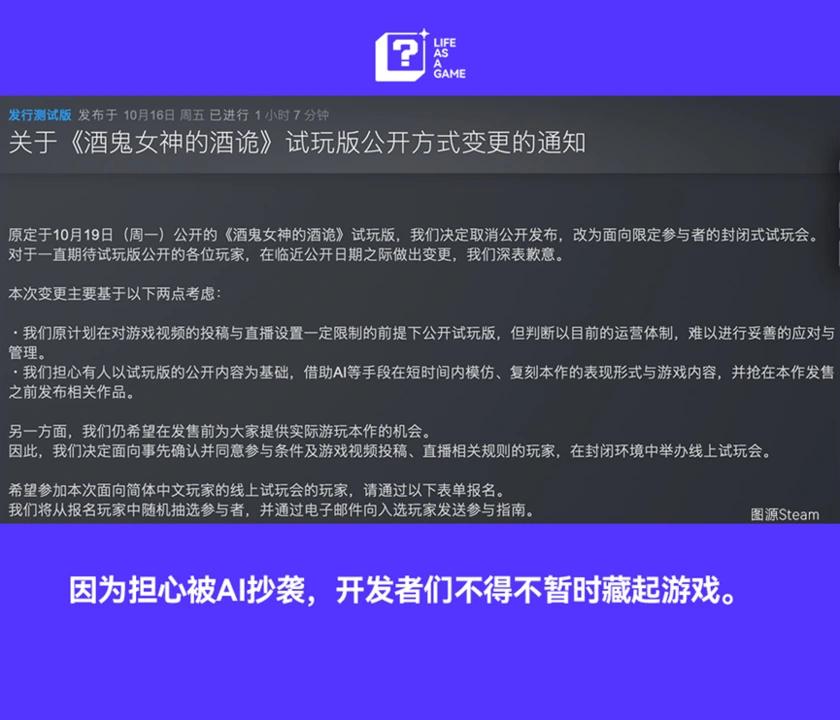
The developers' concerns are not unfounded. Since the beginning of this year, new independent games such as *Bills Must Be Paid* and *1,000,000 POTATOES* have encountered AI plagiarism that beat them to release, which once caused a huge stir and had very negative impacts.
AI, this double-edged sword, is probably sharper than we imagined.
Behind the revival, what do players really want?
Subtly, in the discussion of whether AI-powered game revival constitutes infringement, industry practitioners and players seem to be on opposite sides.
Some people point out that the boundary between revived versions and private servers is blurred, and criticize: "These are blatant infringements of the intellectual property rights of various companies. If private servers run rampant then, it is not worth advocating at all."
But many others believe that the developers acted unfairly first, and players are just victims of game shutdowns. When faced with infringement accusations, they retort: "If the developer does not act honorably, players will help them act honorably."
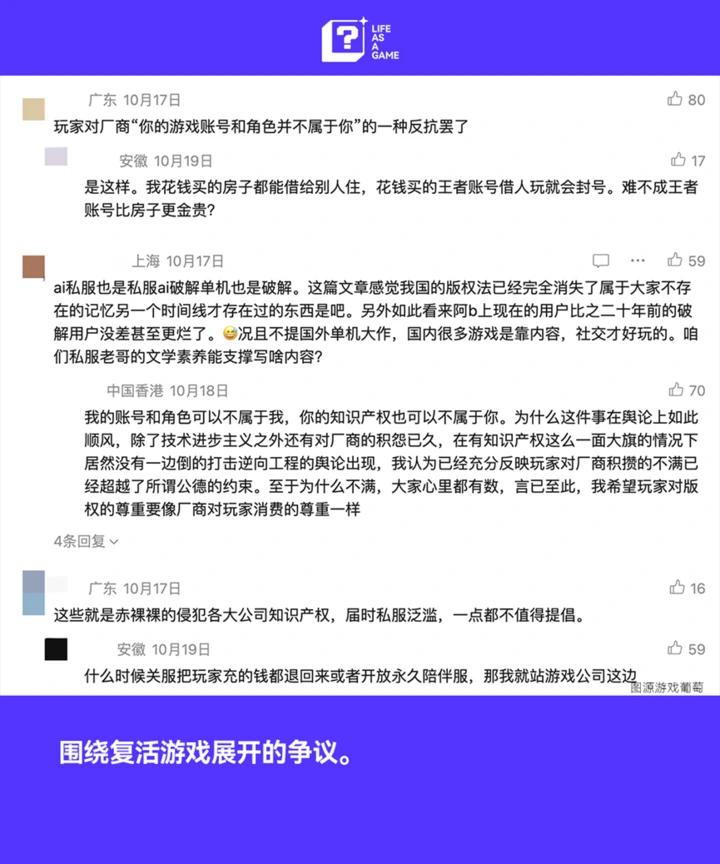
From this, we can catch a glimpse of another contradiction in this revival boom, that is, the proper settlement of games as a form of digital assets.
Looking across various communities, a considerable part of the games that have been revived one after another these days belong to the gacha game category, which shows how fierce the competition in the gacha game market was back then. It is a pity that after the track is finally reshuffled and cools down, a large number of game works with different features are destined to leave the center of the stage and head for the lonely end of shutdown.
For ordinary players, this seems to be an undeserved disaster. Even if they have invested a lot of time, emotion and money in a game, as long as the developer issues a shutdown announcement, everything will be forcibly reset to zero.
In this sense, the reason why players are willing to defend AI-powered game revival is that no one spoke up for them back when the game "died". Eventually, driven by technological equalization, those suppressed voices from the past are echoing even louder at present.
Objectively speaking, in the face of cruel market competition, game developers' decision to shut down servers is understandable. But the core players' feelings for the games are not imaginary. The key point is that under the general background where the global digital industry governance system lags behind industrial practice, players' ownership of digital property is actually suspended, and their emotional demands can hardly get due respect from the game official.