Public announcement of Jiangxi's mechanism-based electricity price bidding! Photovoltaic power witnesses output growth and price drop, while wind power price rises instead. The 0.352-yuan photovoltaic price is not the market price, but the quota price.
The clearing price of new energy bidding in Jiangxi reflects the congestion level rather than the real market electricity price.
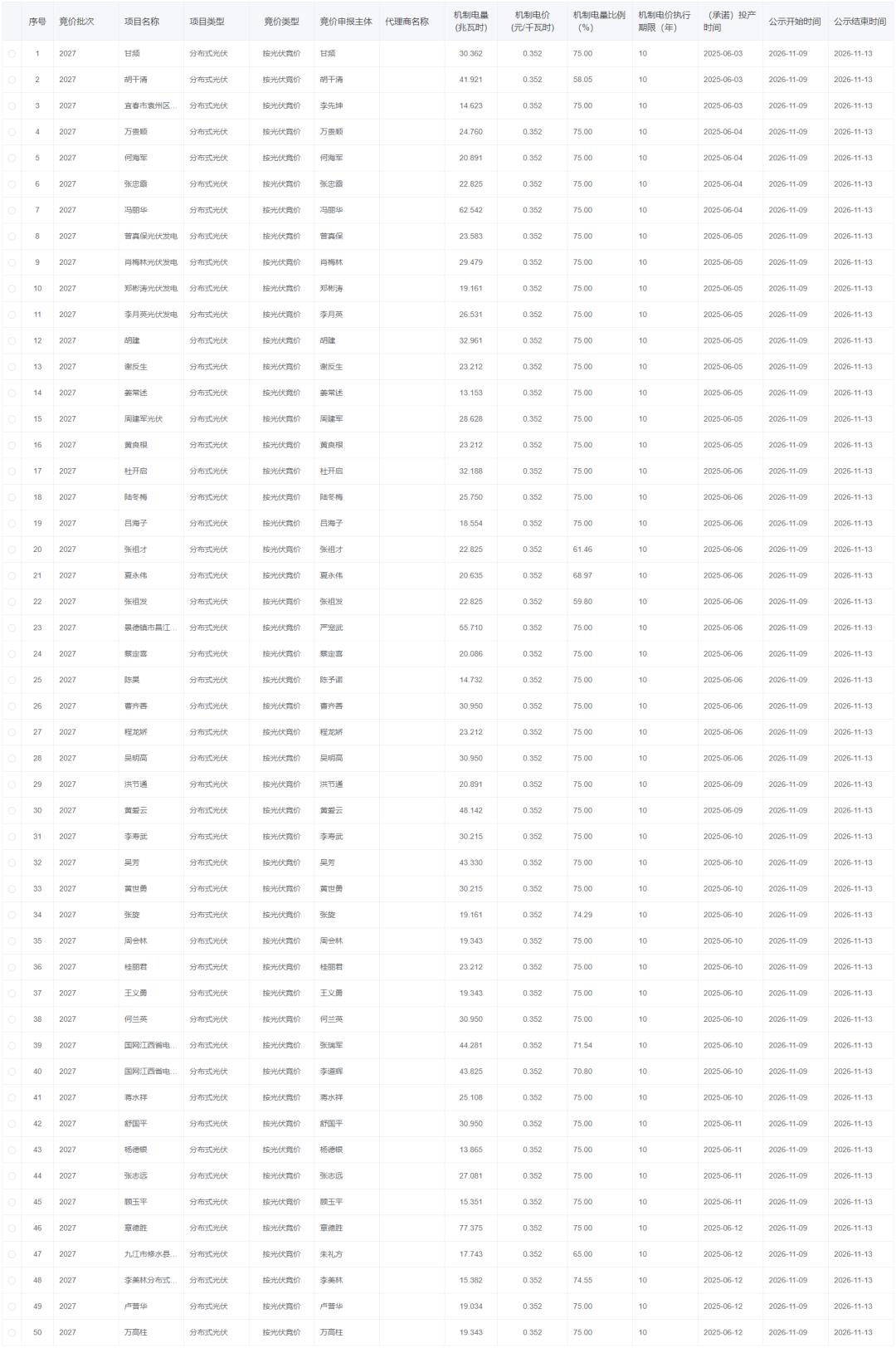
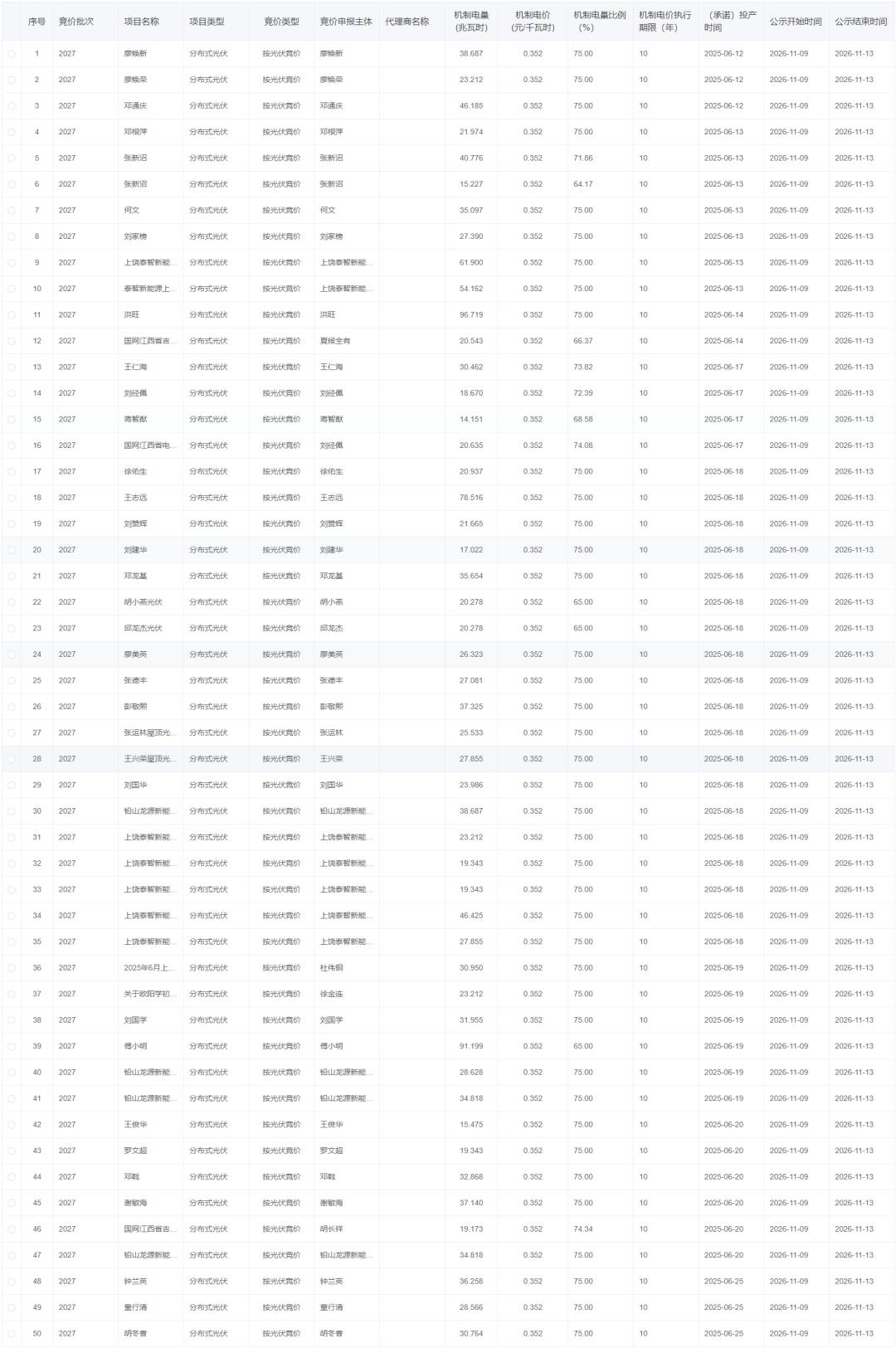
Energy Vision learned that on November 9, State Grid New Energy Cloud publicized the bidding results of the 2027 new energy mechanism electricity price in Jiangxi Province: 26,965 photovoltaic projects obtained 2.925 billion kWh of mechanism electricity with a clearing price of 0.352 yuan/kWh; 6 wind power projects obtained about 958 million kWh with a clearing price of 0.377 yuan/kWh.
This set of figures is most easily interpreted as a price signal — the volume of photovoltaic power rises while its price falls, and the wind power price rises instead. But what this table actually answers is another question: Who is eligible to get a ten-year price guarantee.
0.352 yuan/kWh is not the price set by the market for photovoltaics, but the difference settlement benchmark squeezed out when 26,965 projects compete for the 2.925 billion kWh mechanism electricity quota. The similar bidding in Guangdong on October 30 was more crowded: 76,589 projects declared 112.36 billion kWh, competing for 7.934 billion kWh of mechanism electricity, and 16,224 projects were not selected.
A figure generated by quota competition will be used as the benchmark for ten-year difference settlement next. Whether this caliber is valid is more worthy of discussion than how many cents it has dropped. The public notice period will end on November 13.
This public record is not about price
It is about the number of queuing participants
In the public list, the wind power list has only six lines, which can be fully displayed on one screen, and the 6 bidders are mainly project companies under the central state-owned enterprise system.
The photovoltaic list has more than 26,000 lines, and the entries of individual owners are followed by specific electricity volumes of dozens of MWh, with agent names appearing repeatedly; according to the statistics of Zhihui Photovoltaic, there are only 6 centralized photovoltaic projects in it.
The two groups of projects face the same quotation upper limit of 0.379 yuan/kWh, but the results show that one group closes to the upper limit for transaction, while the other is 2.7 cents lower.
The difference does not lie in the conversion efficiency of wind turbines and modules, but in the ratio of the number of bidders to the scale of mechanism electricity: one side has 6 bidders, the other side has 26,965 projects, and a large number of the latter have their electricity volume and quotation declared by aggregators. Reading 0.352 yuan/kWh as the market's recognition that photovoltaics are only worth this price is equivalent to taking the length of the list as the cost curve.
Another set of results can also be calculated from the public data: 2.925 billion kWh divided by 26,965 projects, with an average of about 108,500 kWh per project; in the previous round, 749.87 million kWh of photovoltaic power in Jiangxi corresponded to 2,857 projects, with an average of about 262,500 kWh per project.
The scale of mechanism electricity has increased to nearly four times, the number of declared projects has increased to more than nine times, and the guaranteed electricity that a single project can lock in has shrunk by nearly 60% as a result. What determines the price here is not the supply-demand relationship, but the degree of congestion.
Submitting a low quotation is the only rational choice given by the rules
To judge what this price can explain, we need to first see clearly how it is generated.
The mechanism electricity price is not a subsidy, but a ten-year price guarantee. When the average market transaction price is lower than the mechanism electricity price, the power grid will make up the difference; when it is higher, the power generator will refund the excess part. The National Development and Reform Commission described this difference settlement method as "refund for excess and supplement for deficiency" in its press briefing.
Document No. 136 stipulates that selected projects shall be determined according to the quotations from low to high, and the mechanism electricity price shall be determined in principle according to the highest quotation of selected projects. The detailed implementation rules in Jiangxi call this marginal clearing. This is the benchmark price for off-market difference settlement, not the unified settlement price for the grid-connected electricity of the projects.
The parameters of this bidding in Jiangxi come from the notice issued by the Provincial Development and Reform Commission on September 20 and made public on September 21: the upper limit of quotation is 0.379 yuan/kWh, the lower limit of declaration adequacy rate is 120%, the scale of bidding electricity will be automatically reduced when the standard is not met, the declared electricity volume and electricity price will be automatically sealed after submission and cannot be changed, and the implementation period is ten years.
In this design, the quotation determines whether you can be shortlisted, and the mechanism electricity price is uniformly determined according to the highest quotation among the selected projects. Lowering the quotation alone will not reduce your own settlement income. The superposition of the lower limit of adequacy rate and the sealing rule makes it not advantageous to quote truthfully according to the cost when competing for shortlisting.
The quotation distribution of the concurrent bidding in Guangdong is more direct: projects with a quotation of 250 yuan/MWh or below contribute 55.24% of the winning electricity volume, and projects with a quotation exactly at the lower limit of 200 yuan/MWh account for 25.11%, both of which are electricity volume proportions. The mechanism electricity only covers part of the grid-connected electricity, and the actual settlement electricity price is close to but not equal to the mechanism electricity price. The sealing rule of Jiangxi cannot be applied to Guangdong.
At least for the part of mechanism electricity, the quotation is separated from the cost and the final income, and it more reflects how many people want to enter.
This figure will not only stay in the public table. It is the benchmark for ten-year difference settlement, and project income calculation, the upper limit of the next round of bidding, and financing arrangements based on electricity fee cash flow may all take it as a reference.
Once it is interpreted as the price acceptable to the market, the more crowded the provinces with declarations are, the lower the quotation will be; the lower quotation will be more easily taken as a reference by other provinces, and the downward pressure will be transmitted along this reference. The price signal that should have reflected the value of electricity may in turn shape the judgment on the value of electricity here.
The value of electricity itself has not disappeared, it is only not reflected in the bidding session. The press briefing of the National Development and Reform Commission states clearly that photovoltaic power generation is concentrated at noon, the supply increases significantly at noon and the price decreases obviously, and there is almost no power generation output during the evening peak. 0.352 yuan/kWh does not mean that photovoltaics are worthless, but that the electricity concentrated at noon is worthless.
The contract term is also written in this price. The results of the UK's AR7 announced in January 2026 extended the contract term of some technical categories from 15 years to 20 years for the first time; the modeling estimation of the UK government's final impact assessment believes that only the extension of the contract term can reduce the execution price of fixed offshore wind power by about 12%, and this estimation is based on the premise of sufficient auction competition.
Jiangxi gives a ten-year term, and 0.352 yuan/kWh includes both the congestion degree of 26,965 bidders and the parameter of ten years, but there is no independent pricing of the market for midday electricity.
A price that will govern for ten years
Should it be used as the market price
On November 6, the National People's Congress website of China published the "Renewable Energy Law (Revised Draft)" for public comments. The draft no longer retains the full guaranteed acquisition system, lets the market form the electricity price of market transaction electricity, and writes the sustainable development electricity price settlement mechanism for renewable energy into the law.
WAN Jinsong, Member of the Party Leadership Group and Deputy Director of the National Energy Administration, proposed in an article published in "Economic Daily" two days later to scientifically evaluate and optimize the sustainable development electricity price settlement mechanism for new energy, indicating that this set of arrangements is still being tested.
The direction of legislation is to return the pricing power to the market, and the mechanism electricity price is more close to a policy tool to stabilize expectations. Directly interpreting the clearing price of a quota bidding as the market price is equivalent to interpreting the tool for stabilizing expectations as a market conclusion.
Projects that can truly change the value of midday electricity did not participate in this pricing. The notice from the Jiangxi Provincial Development and Reform Commission clearly states that the bidding entities do not include new energy power generation local consumption projects such as source-grid-load-storage and green power direct connection; the 2027 bidding announcement in northern Hebei also excludes the grid-connected electricity of such projects from the implementation scope of the mechanism electricity price.
Among the 93 AI + energy pilot projects to be included in the list publicized by the National Energy Administration on November 5, green power direct connection, zero-carbon parks and virtual power plants are all on the list. This round of bidding in Jiangxi precisely excluded the local consumption projects encouraged by policies from the scope of bidding entities.
Moving the electricity from noon to the evening peak and consuming the electricity locally changes when and at what price the electricity is used; what the bidding solves is only who can get the ten-year guarantee. The two things are written into the same policy system, but they are not on the same form.
The photovoltaic clearing price dropped by 2.7 cents from the previous round of 0.379 yuan/kWh — this figure is exactly the same as the upper limit of this round of bidding, but the comparison here is the photovoltaic clearing price of the previous round.
The public notice period ends on November 13, and the shortlisted projects will be implemented for a 10-year term thereafter. The next round of bidding will be held next year. What is worth paying attention to is not how many cents 0.352 yuan/kWh will drop further, but whether this mechanism will separately count and publicize the bidding clearing price and the average market transaction price, and whether Jiangxi will include local consumption projects and projects equipped with energy storage into the scope of the next round of bidding.
Neither of these two questions has been answered in this public notice.