From being sold by the box to being sold by the jin, the price of domestic blueberries has been cut by half.
The blueberries that used to be sold by the box, often costing dozens of yuan per box, are experiencing an unprecedented price correction.
According to Yicai, the overall price of Yunnan blueberries this year has dropped by about 50% compared with last year. Years of continuous price cuts are completely changing the consumption attributes of this "noble fruit".
As the weather cools, domestic blueberries are placed in prominent positions in supermarkets in Shanghai. The retail price of medium and small-sized Yunnan blueberries is about 50 yuan per jin, and that of large-sized ones is about 80 yuan per jin, which is further lower than in previous years. A wholesaler at Shanghai West Suburb International Agricultural Products Trading Center said that last year, a box of 1.5kg large blueberries cost more than 200 yuan, but this year the price has dropped to more than 100 yuan. The same trend applies to online channels.
JiEMIAN News checked data from Manmanmai and found that the price of blueberries on JD.com and Taobao is generally on a downward track. One type of blueberry was priced at 40 yuan for four boxes at the beginning of this year, but now it only sells for 19.8 yuan.
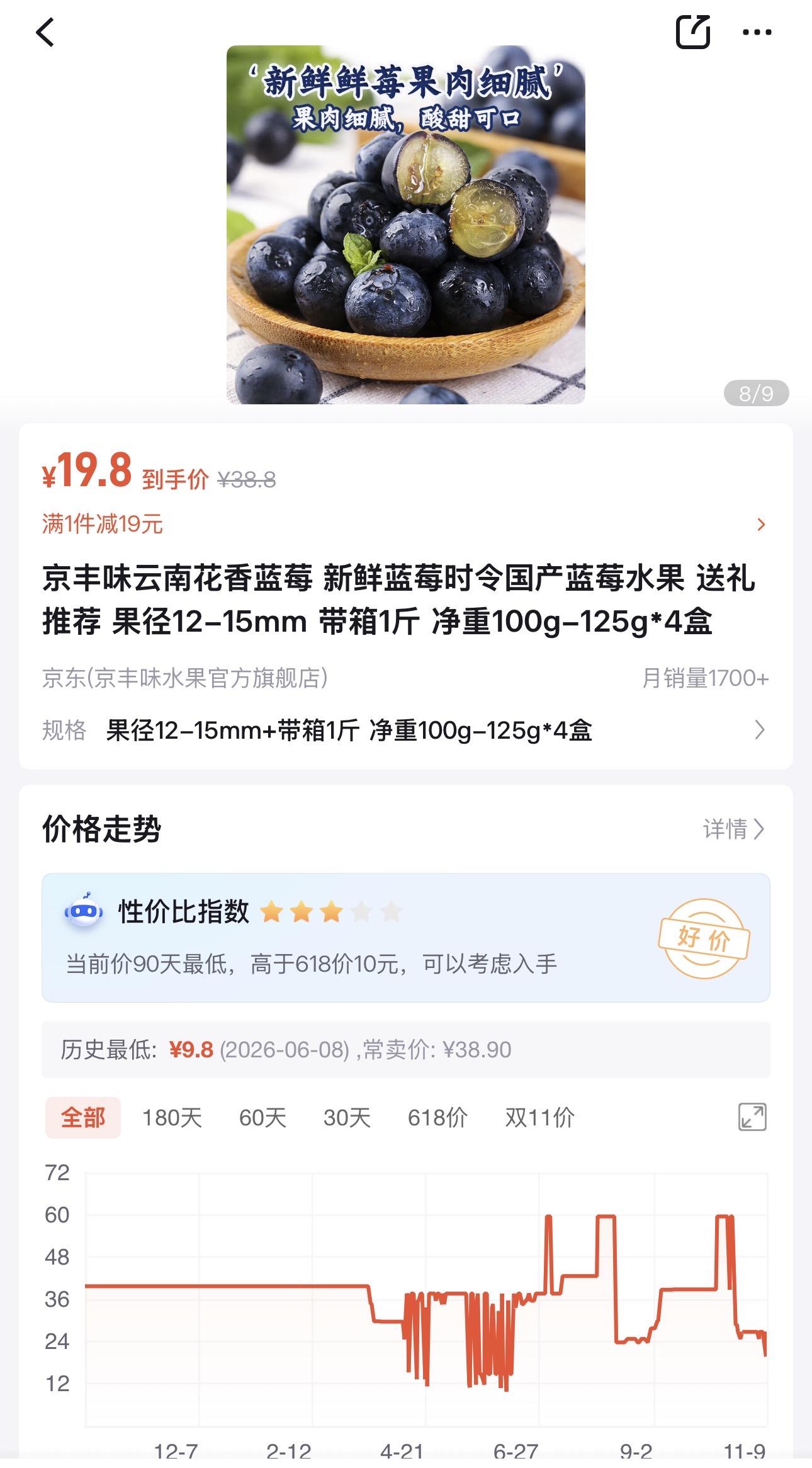
A customer service staff of a Taobao store mainly selling Yunnan blueberries told JiEMIAN News: "Some varieties have indeed seen their prices drop by more than half compared with the same period last year. The price of blueberries now follows the market trend, and the current price is even cheaper than that at the end of last month."
In addition to the drop in retail prices, the central price at the wholesale end has also been significantly lowered. The national wholesale price monitoring of agricultural products by Foodmate shows that from September to October 2026, the average wholesale price of fresh-eating blueberries in multiple wholesale markets across the country remained at around 55 yuan per kilogram, and the bulk purchase price in some major producing areas has further declined.
The data from the producing areas outlines a clear three-year price decline curve. Monitoring by agricultural big data platform Yimutian shows that the opening price of the popular L25 Huaxiang blueberry was 150 to 180 yuan per kilogram in 2024, dropped to 100 to 120 yuan per kilogram in 2025, and the current purchase price at the producing areas is only about 50 yuan this year, with a fluctuation of 10 to 30 yuan depending on fruit diameter and quality. The price has dropped sharply for three consecutive years, with a decline of about 50% this year. An analyst from Yimutian said bluntly: "From the overall trend, the price has been declining continuously in recent years. Varieties like L25 have a very large decline every year, and the price has dropped by almost 50% this year."
Behind the "avalanche" of prices is the explosive growth of domestic blueberry production capacity. Public data shows that China's blueberry output reached 347,000 tons in 2020, surpassing the United States for the first time to rank first in the world; by 2025, the national planting area reached 1.58 million mu, with a total output of 810,000 tons, and the market size exceeded 50 billion yuan.
As the largest producing area, Yunnan has expanded particularly rapidly: its planting area increased from about 100,000 mu in 2021 to 300,000 mu in 2025, and its output jumped from 45,000 tons to 349,000 tons. The growth rate far exceeds the growth rate of planting area, and the per unit yield has increased significantly. Relying on the low-latitude plateau climate, combined with modern facilities such as substrate potted planting and integrated water and fertilizer management, the yield per mu can exceed 2,000 kilograms, more than twice that of traditional planting. It can also realize off-season supply from November to May of the next year, filling the gap of fruit supply in winter and spring.
The industry generally believes that the price drop is a sign of the market becoming more mature. More affordable prices will help blueberries reach a wider range of consumers, opening up larger market space for the entire category. At the same time, the purchase price of raw fruit for deep processing has dropped from 20 yuan per kilogram to 3 to 4 yuan, opening up profit margins for deep processing enterprises such as fruit wine and juice producers, which is expected to become a new outlet for digesting excess production capacity. From being "sold by the box" to "sold by the jin", domestic blueberries are completing the transformation from a light luxury fruit to a mass consumer product through a "halved" price cut.
This article is from "JiEMIAN News", author: JIANG Yiman JYM, published with authorization from 36Kr.