In 2027, a fierce battle in the AI office sector is imminent.

By / Zero Degree
Source / Node Finance
On November 9, Alibaba Qwen Office 2.0 was officially released.
This upgrade brings a notable change: it is no longer just an AI assistant serving individual users, but starts to support multi-person and Agent collaborative work. Users can directly add AI to work groups and let it participate in team tasks.
Just a few days ago, on November 6, the official version of Huawei Xiaoyi Work was launched on the HarmonyOS PC app store. On October 30, Tencent announced four key upgrades for the enterprise version of WorkBuddy. In September, Feishu released version 8.0 to further strengthen its Agent capabilities.
Putting these timelines together, an interesting phenomenon can be observed: several leading domestic tech companies are unanimously shifting the focus of AI competition to the office scenario.
If 2023 and 2024 saw major tech firms competing on large model capabilities, and 2025 was the year of competing on AI application implementation, then in the second half of 2026, the competition has entered a new stage — who can truly take over part of the work workload?
I hold a judgment that in 2027, AI office will most likely become one of the most important and fiercely contested application battlefields for major domestic tech companies.
Why will AI office become a must-win battlefield for major tech firms in 2027?
First, let's look at the market data.
The "2026 Q3 AI Application Market Development Report" released by QuestMobile shows that as of September 2026, the monthly active user scale of domestic AI office products reached 142 million, a year-on-year increase of 50.6%.
The same report shows that in September 2026, the total active user scale of WorkBuddy reached 32.353 million, Baidu Dazi reached 9.77 million, and Qwen Office reached 7.905 million.
This set of data at least indicates that AI office has gone beyond the early technology trial stage and started to enter a broader user market.

Of course, these are statistics from third-party monitoring calibers, which do not represent the scale of paying users, nor can they be directly equated with the number of enterprise customers.
But the trend is quite clear: AI is evolving from a chat tool to a work tool.
Why has the office scenario become the core of competition for major tech firms?
I believe there are three reasons.
First, office is a scenario with extremely high usage frequency.
Drafting proposals, making PPTs, sorting meeting minutes, analyzing spreadsheets, consulting materials, and processing emails happen every day. Compared with many low-frequency AI applications, office scenarios naturally have much higher usage frequency.
Second, office scenarios have clear commercial value.
Enterprises can calculate whether AI can help an employee save two hours of work, whether it can reduce repetitive labor for a department, and whether it can shorten the delivery cycle of a project.
Third, office scenarios have huge commercialization space.
Individual users are willing to pay for efficiency, and enterprises are also willing to pay for organizational efficiency. Especially when AI starts to integrate into enterprise knowledge bases, business systems and internal processes, it is no longer just a software subscription, but has the opportunity to become part of the digital infrastructure of enterprises.
Node Finance believes that the value of AI office is shifting from personal efficiency tools to enterprise operation tools. Whoever takes the lead in opening up the work chain among individuals, teams and organizations will have the opportunity to build competitive barriers for the next-generation office platform.
In the past, when we used AI, most of the time we asked it questions and then completed the follow-up work on our own.
Now, the situation is changing.
We expect AI to break down tasks by itself, call tools, process files, analyze data, and finally deliver results directly.
The change from answering questions to completing tasks seems small, but in fact it means the transformation of the entire AI application business model.
Six major tech firms, six different competitive routes
If we look at the domestic AI office market as a whole, Tencent, Alibaba, ByteDance, Baidu, Huawei and Kingsoft Office are all working on AI office products, but their resource endowments and entry points are not the same.

Tencent: Moving from communication entry to enterprise-level Agent
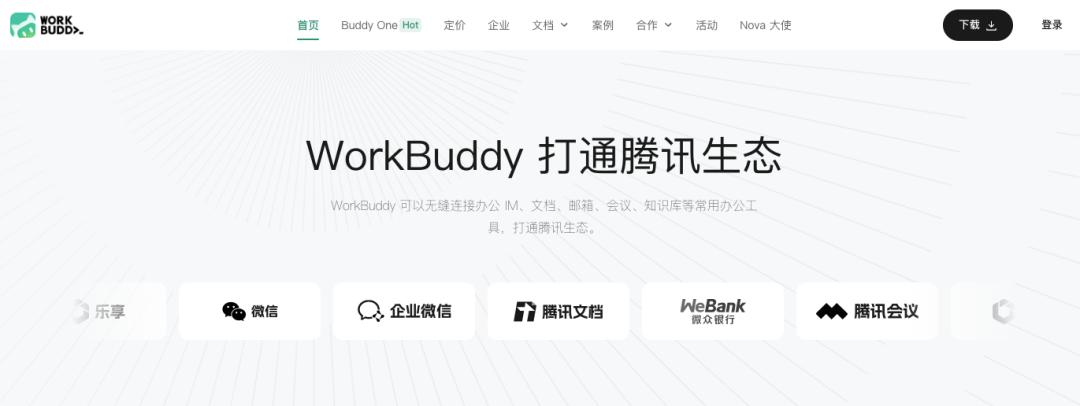
When it comes to Tencent's AI office layout, the most noteworthy part is the integration of WorkBuddy and WeCom.
On October 14, Tencent announced that WeCom and WorkBuddy have achieved two-way deep integration. WorkBuddy can access the WeCom address book, and call work contexts such as messages, documents, meetings, and cloud disks within the scope of enterprise authorization.
This move is of great importance.
Because a lot of work in enterprises originally happens in communication: demands are raised in groups, tasks are assigned in groups, and results also need to be fed back in groups.
If AI can understand these communication contents, and further complete file processing, information sorting and task execution, it will have the opportunity to turn the communication entry into a work entry.
On October 30, Tencent brought four upgrades to the enterprise version of WorkBuddy: open platform, enterprise-level security, observability center, and hosted intelligent agent WMA.
Tencent disclosed that since WorkBuddy was launched in March, it has completed more than 9 billion cumulative user task requests, covering more than 50 industries and 50% of China's top 500 enterprises.
It needs to be emphasized that 9 billion is the cumulative number of task requests, not the number of users.
Tencent's advantage lies in the ecological connection capability formed by WeChat, WeCom and cloud services.
But it also has problems to solve: there is still a gap between the chat scenario and the actual business process. The fact that AI can understand a conversation does not mean it can accurately complete complex tasks such as approval, finance, and sales.
What Tencent needs to prove next is whether it can truly convert the information in communication into organizational productivity.
Alibaba: Moving from DingTalk collaboration to team Agent
On November 9, Alibaba Qwen Office 2.0 was officially released, which is a very noteworthy product move in the current AI office track.
The keyword of this upgrade is Team Agent.
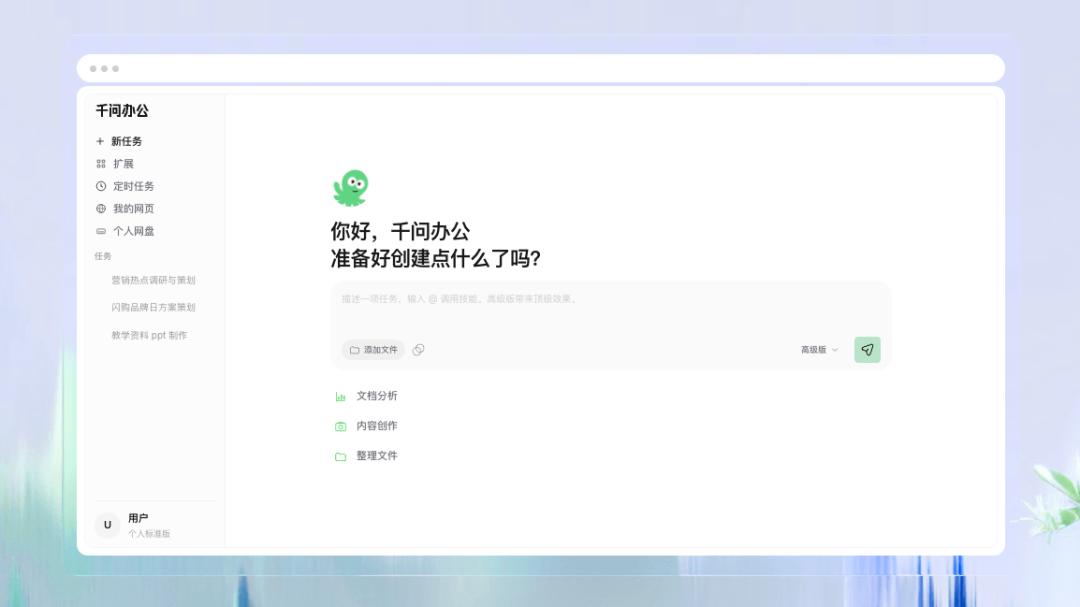
The new version supports multi-person and Agent collaborative work. Users can bring Agents into work groups, and adds capabilities such as human-AI co-creation, material space, automatic tasks, and three-terminal interconnection.
This means that Alibaba hopes AI is no longer just an individual's assistant, but a collaborator of the team.
Where is Alibaba's advantage?
It is DingTalk.
After years of development, DingTalk has precipitated enterprise infrastructure including organizational structure, approval, meetings, documents, attendance and collaboration. If AI can enter these scenarios, it will have the opportunity to obtain a more complete enterprise context.
For example, after a meeting ends, AI can not only generate meeting minutes, but also extract tasks, associate responsible persons, and track project progress.
This is the office intelligence that enterprises really need.
Previously, Alibaba disclosed that Qwen Office had more than 30 million users in its first month of launch, of which enterprise users accounted for more than half. But this number is the cumulative user caliber for the first month of launch, and cannot be directly compared with QuestMobile's monthly active data.
The problem Alibaba needs to solve is how to further convert product capabilities into stable enterprise delivery capabilities.
Enterprises will not pay for a long time just after experiencing a new function. Whether complex processes can run smoothly, permissions can be well managed, and tasks can be completed stably determines whether it can enter the core business of enterprises.
ByteDance: Can model capabilities and organizational collaboration form a joint force?
ByteDance's layout in the AI office field has actually formed a multi-level product system.
One end is Doubao Work, and the other end is Feishu and Doubao Work Partner.
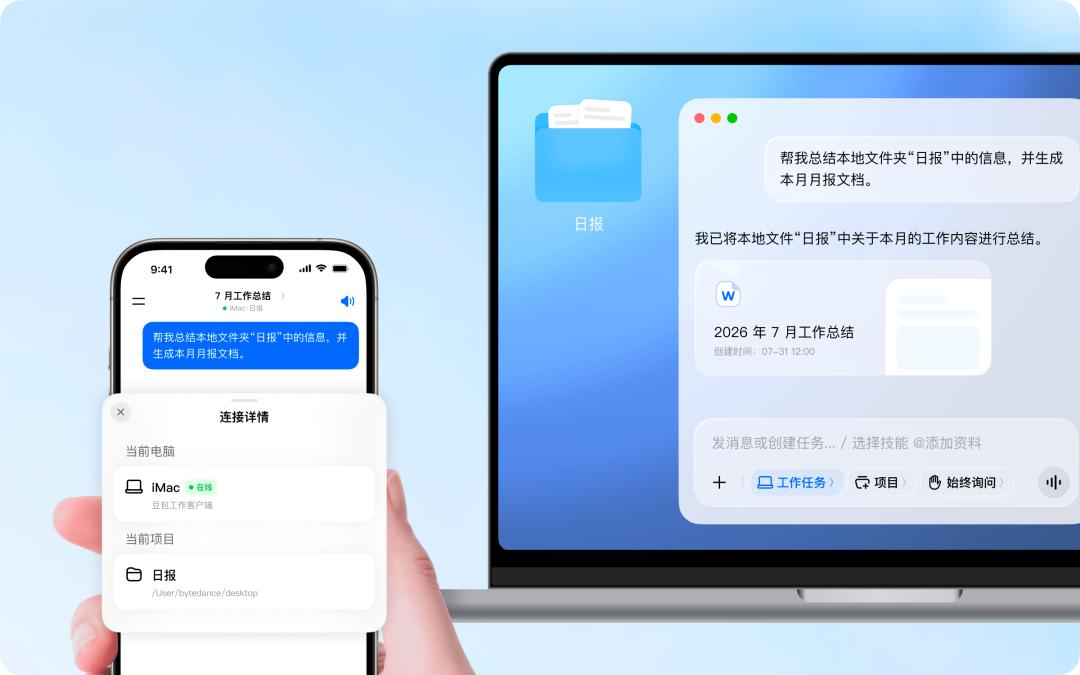
In August 2026, Doubao Work was officially released, emphasizing starting from the goal, automatically breaking down tasks, calling tools, processing files and completing delivery.
Since August 14, the original aily of Feishu has been renamed Doubao Work Partner, further emphasizing that AI enters the enterprise working environment and collaborates with employees.
On September 15, Feishu 8.0 was released, focusing on strengthening Agent capabilities.
This combination has its own logic: Doubao provides model and multi-modal capabilities, Feishu provides organization, knowledge and collaboration scenarios, and Agent is responsible for connecting the two.
ByteDance's advantages are model iteration speed, product capabilities and content generation capabilities.
Especially when the demand for content production such as research reports, marketing plans, images and videos is increasing, ByteDance's model and product ecosystem have certain room to play.
But ByteDance also has a question to answer: the product experience on the individual end is not the same as enterprise-level services.
What enterprises need is not just a smart AI, but also permission isolation, data security, long-term stable operation, and the ability to be compatible with original business systems.
Whether ByteDance can convert its strong personal productivity capabilities into enterprise organizational capabilities is worth continuous observation.
Baidu: Knowledge and professional tasks are its entry points
In Baidu's AI office layout, the noteworthy products are Baidu Dazi and Kuku AI.
Baidu Dazi is oriented to complex task processing, covering scenarios such as research analysis, document generation and data processing.
According to Baidu's official update records, on October 11, Baidu Dazi already supported online editing of Word, PPT and Excel documents; at the end of October, it continued to carry out product iterations.
Baidu's advantages lie in the accumulation of search, knowledge, Wenku and cloud disk resources.
One of the essences of office is information processing. A large number of enterprise employees need to read materials, sort out data and form reports every day. If AI can connect information collection, understanding, analysis and output into a complete chain, it can create practical value.
But Baidu also faces a problem: there is still a gap from knowledge processing to organizational collaboration.
Writing a research report does not mean being able to promote a project; analyzing a financial report does not mean being able to enter the enterprise operation process.
What Baidu needs to prove in the future is whether it can further extend its content and knowledge advantages to enterprise business systems.
Kingsoft Office: The traditional office entry is being reconstructed by AI
Compared with other internet giants, Kingsoft Office has a very special advantage: WPS itself is an office entry.
Many people use WPS every day, and documents, spreadsheets and PPTs have formed very mature user habits.
The latest disclosed 2026 Q3 financial report also provides some noteworthy data.
In the first three quarters, Kingsoft Office achieved operating revenue of 5.08 billion yuan, a year-on-year increase of 21.57%.
Among them, WPS personal business revenue was 1.05 billion yuan, a year-on-year increase of 16.78%; WPS 365 business revenue was 270 million yuan, a year-on-year increase of 33.83%.
As of September 30, the number of global monthly active devices of WPS reached 678 million.
In terms of products, Kingsoft Office launched the new AI-native office product Lingxi, and continued to promote the enterprise-level AI capabilities of WPS Comate.
This set of data shows that Kingsoft Office is no longer just telling AI stories, and AI functions are being integrated with personal payment conversion and enterprise business growth.
However, Kingsoft Office also has its own challenges.
The advantage of traditional office software lies in document editing, but the working methods in the AI era may change.
In the future, users may no longer need to open Word, Excel and PPT separately, but directly put forward a work goal, and AI will automatically call different tools to complete the task.
How Kingsoft Office transforms from a traditional office software provider to an AI-native productivity platform is a problem worthy of long-term observation.
Huawei: HarmonyOS terminals provide another possibility
On November 6, the independent Huawei Xiaoyi App was officially launched on the HarmonyOS PC app store, and the official version of Xiaoyi Work was launched synchronously.
The noteworthy part of this