HYBE's valuation doubles, JTBC goes bankrupt, Netflix imposes salary caps and makes a comeback to the Chinese market: the South Korean entertainment industry needs a new pricing system.
The year 2026 is not yet over, and the Korean drama industry has already delivered three consecutive unexpected outcomes that have caught the entire sector off guard.
In June, JTBC, the producer of hit series including The World of the Married, Itaewon Class and The Reborn Rich, was placed under the receivership of the Seoul Rehabilitation Court due to a default on a 20.6 billion KRW loan, and officially entered statutory restructuring and launched a sales procedure in August. In July, Korea JoongAng Daily exposed that Netflix had cut the maximum per-episode pay for Korean actors from 400 million KRW to 300 million KRW (about 1.38 million CNY). In the first week of November, the Q3 financial reports of South Korea's four major entertainment companies were released intensively: HYBE's revenue doubled thanks to BTS's world tour, while SM fell into net loss.

These three incidents point to the same fact: the Korean drama industry is undergoing a full-chain repricing that covers the business model of TV stations, the actor compensation system, and platform distribution rules.
The First Repricing: JTBC's Bankruptcy Marks the End of the Traditional TV Station Business Model
JTBC's bankruptcy did not happen out of the blue. On June 12, JTBC admitted that it was unable to repay its maturing 20.6 billion KRW liquidity loan, declaring debt default. From June 14 to 15, JTBC and five related affiliates including JoongAng Holdings, Contentree JoongAng, Megabox JoongAng, and JoongAng P&I collectively filed for corporate rehabilitation procedures with the court. On June 19, its parent company JoongAng Ilbo applied for out-of-court restructuring. On August 28, the 2nd Division of the Seoul Rehabilitation Court announced the end of the two-month voluntary structural adjustment support program, officially launching statutory restructuring, and JTBC initiated the sales process.
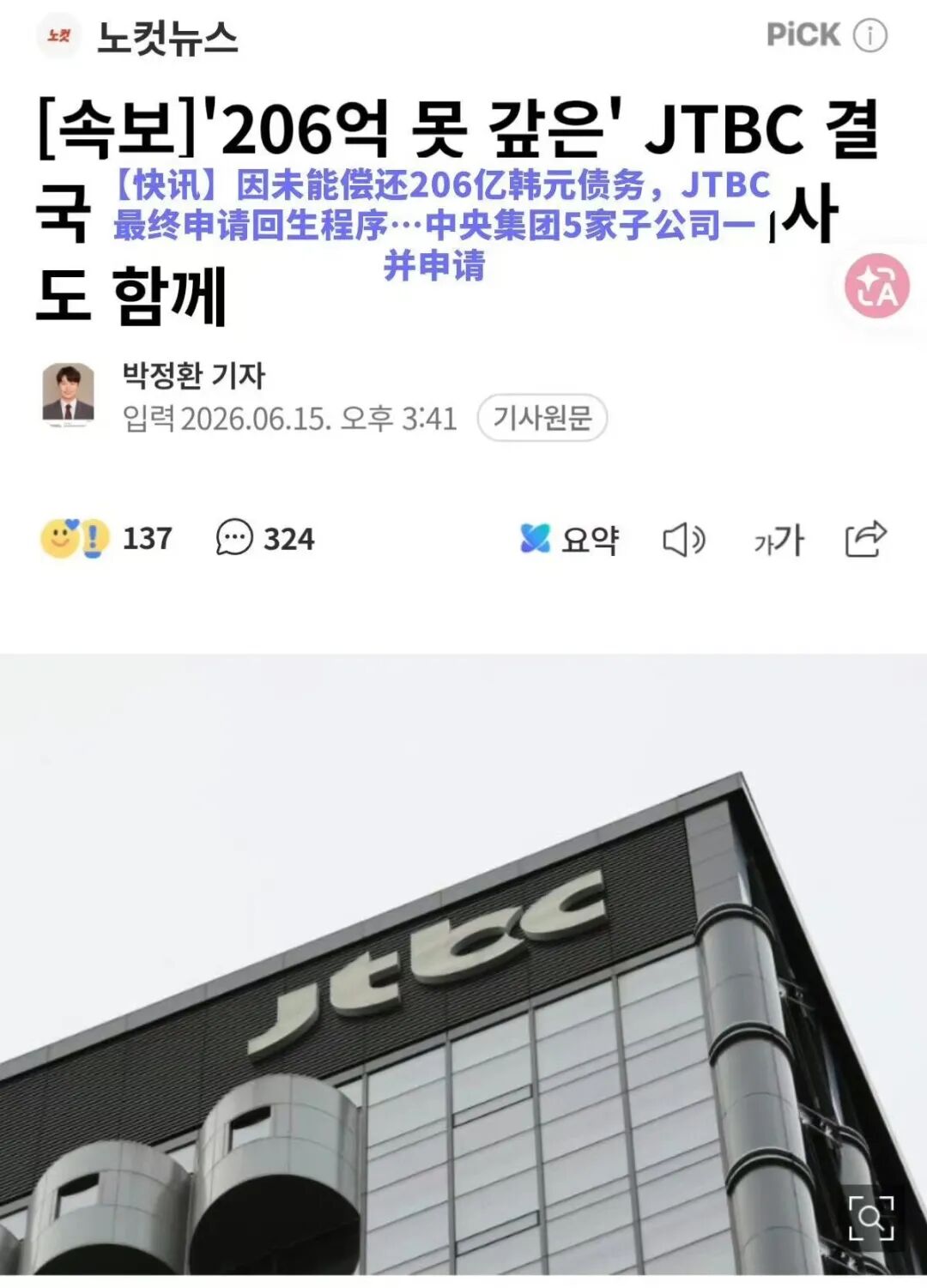
The last straw that crushed JTBC was a high-stakes bet signed in 2019. That year, JTBC bid directly to FIFA and the International Olympic Committee at a sky-high price of about 754 billion KRW, winning the exclusive broadcasting rights for the 2026-2032 World Cup and Olympic Games in South Korea, with the 2026 World Cup alone costing 188.7 billion KRW. JTBC proposed a resale plan of 14 billion KRW per station to the three major terrestrial broadcasters, but only KBS accepted it, while SBS and MBC rejected it outright. Its strategy of monopolizing content and driving up prices completely failed in the domestic market.
Credit rating agency NICE immediately downgraded JTBC's bond credit rating to CCC. The rating downgrade prompted investors to withdraw their capital at an accelerated pace, making it more difficult for the company to raise funds and forming a vicious cycle. The total loans of JoongAng Group have reached a scale of about 2.7 trillion KRW.
The court stated the cause of bankruptcy bluntly: the sharp rise of domestic and foreign OTT platforms such as Netflix after the pandemic led to a significant shrinkage in the advertising market of traditional TV stations, and production costs such as actor remuneration and personnel expenses continued to soar. Under the double blow, the huge payment for Olympic broadcasting rights was made in a concentrated manner, resulting in a complete break in cash flow.
SLL, a production company under JTBC, is the second largest player in the Korean drama industry after Studio Dragon. The new drama Rediscovery of Love starring Kim So-yeon just announced its cast and started filming on June 10, and more than ten days later, it was announced that filming would be suspended for one month. Hit variety shows such as Knowing Bros and Divorce Retreat Camp also reported interruptions in filming. Although JTBC denied the news on June 23, it has become a question mark whether the production of news, World Cup broadcasts and daily programs can be sustained for a long time.
According to the court's schedule, JTBC must submit its restructuring plan by January 29, 2027. This means that within the next two months, the TV station that once shook South Korea's political scene with JTBC Newsroom and rewrote the cable TV ratings record with Sky Castle will welcome a new owner.
The Second Repricing: Netflix's Salary Cap Squeezes the Actor Remuneration Bubble
If JTBC's bankruptcy is the funeral of the old model, Netflix's salary cap is the self-correction of the new model.
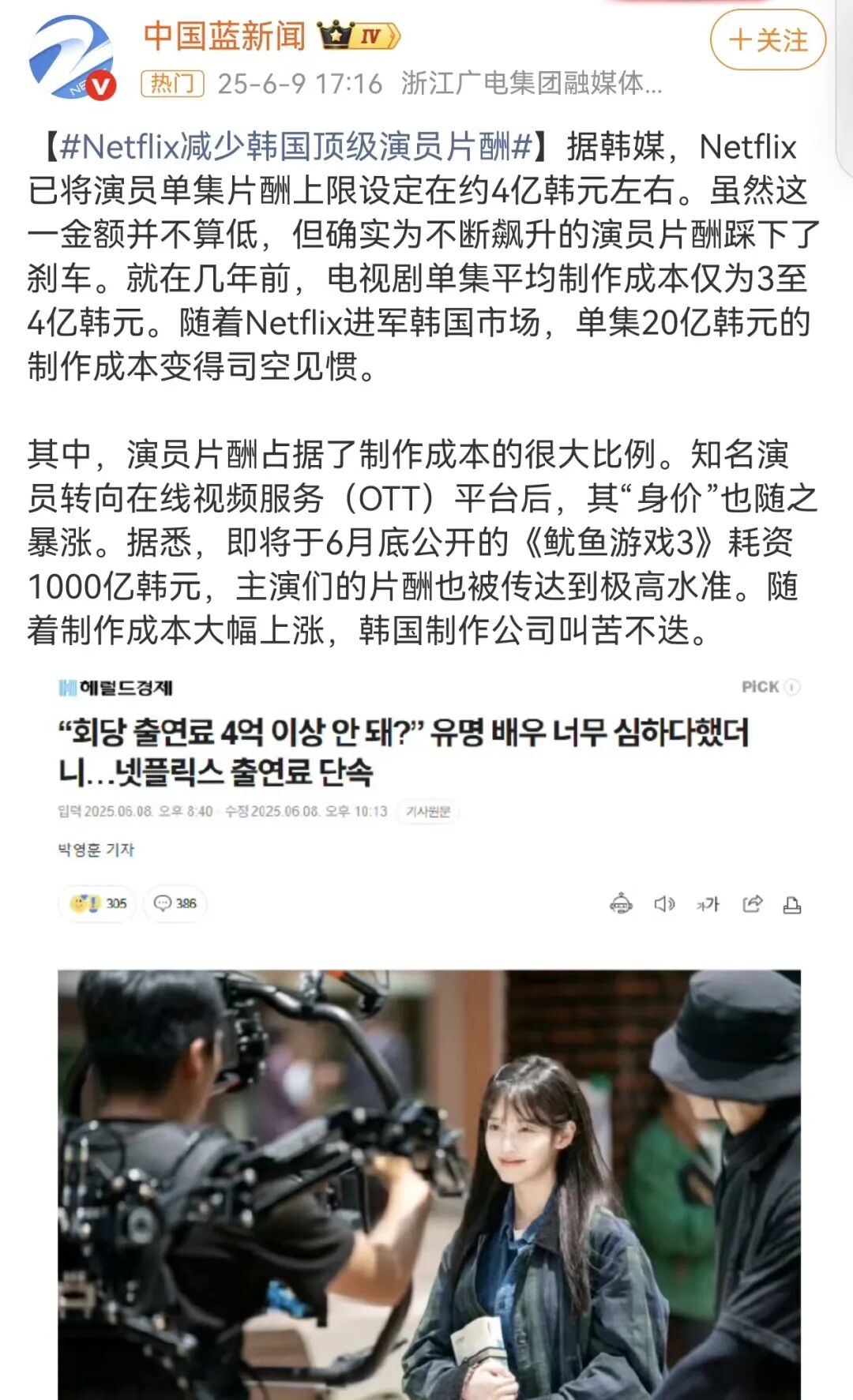
On June 8, the industry first disclosed that Netflix had set the upper limit of actor remuneration at 400 million KRW per episode. On July 15, Korea JoongAng Daily further reported that this upper limit had been lowered to 300 million KRW. Netflix's official response was vague, stating that "there is no uniform salary cap, and we negotiate flexibly with partners", but the industry generally believes that "300 million KRW is the new upper limit".
Compared with the previous peak of remuneration: Kim Soo-hyun was paid 800 million KRW per episode for Disney+'s Copycat Life, Lee Min-ho for Apple TV+'s Pachinko and Lee Jung-jae for Squid Game 2 both received 1 billion KRW per episode, topping the OTT actor remuneration list in South Korea. The production cost of Squid Game 3 is 100 billion KRW, while When Life Gives You Tangerines and Monstrous each cost 60 billion KRW.

Netflix itself pushed Korean actor remuneration to a height that the local market cannot support, and then turned around to suppress prices before the industry could adapt. The consequence is directly reflected in the output: the annual output of Korean TV dramas dropped from 141 in 2022 to 123 in 2023, about 100 in 2024, and is estimated to be only around 80 in 2025. The number of TV drama slots on TV stations is only 66, a 28% decrease compared to 2021.
What is more critical is the distribution rule. Netflix usually only pays the production company a handling fee of about 5% of the total production cost, and other OTT platforms such as Disney+ follow similar standards. Netflix only has about 15 slots for Korean dramas to be broadcast per year, while the number of project proposals waiting in line in the market has accumulated to more than 2000. Actors "line up to compete for roles" for global popularity, and production companies are willing to endure unreasonable income distribution structures for global exposure.
In 2023, Netflix announced that it would invest 2.5 billion US dollars in Korean content in the next four years, and 2026 is the settlement point of this commitment. Netflix must determine within the year whether its investment scale in South Korea after 2027 will increase, decrease or remain the same. After several heavily invested Korean dramas failed to meet expectations, Netflix has begun to systematically cut costs: capping actor remuneration, shifting content focus from high-cost original dramas to variety reality shows, and diverting part of its investment to the Japanese market with lower costs. The four-year commitment of 2.5 billion US dollars is still nominally in effect, but the way of spending money has fundamentally changed - the total investment is maintained, the unit price is lowered, and the structure is shifted.
As previously written in the article The Whole Internet Is Chasing The Glory, Why Did Netflix's Korean Drama Become a Hit?, we described how Netflix reshaped the logic of the Korean drama industry with its global distribution capabilities. Three years later, the same Netflix is using the same global distribution capabilities to redefine the price system of the Korean drama industry.
The Third Repricing: Financial Reports of Four Major Agencies Show Severe Internal Differentiation in the K-pop Idol Economy
The Q3 financial reports released in the first week of November have put the internal differentiation of South Korea's idol economy on the table.
HYBE is the brightest performer. The Q3 financial report disclosed on November 3 shows that the revenue in a single quarter reached 1.5257 trillion KRW (about 1.08 billion US dollars), a year-on-year increase of 109.8%, setting the highest quarterly revenue record since the company's establishment, and it is also the first time for HYBE to break through 1 billion US dollars in single-quarter revenue. The driving force is clear: BTS's ARIRANG world tour generated 726.8 billion KRW in concert revenue in the quarter, a year-on-year increase of 196.7%, selling about 2 million pieces of merchandise across 31 shows in 12 North American cities in 45 days. The cumulative revenue in the first three quarters was 3.674 trillion KRW, only 326 billion KRW short of the annual target of 4 trillion KRW, making it the first K-pop company to break this threshold.
SM is the coldest one. The Q3 financial report disclosed on November 4 shows that the revenue in a single quarter was 291.1 billion KRW, a year-on-year decrease of 9.5%; operating profit was 35.5 billion KRW, a year-on-year decrease of 26.4%; net loss was 1.1 billion KRW. The sales of new albums dropped from 5.5 million copies in the same period last year to 1.67 million copies, a decrease of 70%. SM's explanation is that "in order to strengthen the global fan base, we strategically carried out overseas and small-scale performances, resulting in a relative reduction in domestic new album activities". Translated: the money earned from overseas tours cannot make up for the gap in domestic album sales.
CJ ENM is caught in the middle. The Q3 financial report disclosed on November 5 shows that the revenue in a single quarter was 1.1904 trillion KRW, a year-on-year decrease of 4.4%; operating profit was 22.1 billion KRW, a year-on-year increase of 25.5%; net loss was 25 billion KRW, due to valuation losses of foreign currency bond derivatives and exchange rate fluctuations. By business segment, the media platform division turned a profit (TVING's advertising revenue increased by 42.1% year-on-year), the film and television division's profit doubled (delivery of Netflix original Tantara + global OTT pre-sales), the music division turned to loss (increased investment in Mnet Plus original IP and new artists), and the e-commerce division's profit was cut in half.
YG disclosed its preliminary performance on November 9, with a single-quarter revenue of 156.731 billion KRW, a year-on-year decrease of 9.4%; operating profit of 13.454 billion KRW, a year-on-year decrease of 56.8%; net profit of 6.393 billion KRW, a year-on-year decrease of 73.8%. Revenue and operating profit both increased by 22.7% compared with Q2, but the high base formed by the tours of artists such as BLACKPINK in the same period last year meant that the sequential recovery did not change the year-on-year decline. JYP's Q3 financial report is expected to be released on November 11.
From the perspective of the annual trend, the differentiation of the four major agencies is already a fact: companies with global top-tier artist touring capabilities (HYBE) get the biggest dividends, companies that rely on domestic album sales (SM) are under the most pressure, companies with diversified layouts (CJ ENM) hedge risks through non-music businesses, and YG sees its profit cut in half under the high base of tours.
The Fourth Track: Coupang Play's Third Path
Between JTBC's bankruptcy and Netflix's salary cap, Coupang Play has taken a noteworthy path.
At the end of July 2026, Coupang Play launched the black comedy Affair Is Not the Issue Now starring Kim Hye-soo and Cho Yeo-jeong, produced by Firstman Studio co-founded by Hwang Dong-hyuk, the director of Squid Game, whose Douban score rose all the way from the 7-point range to 8.7. This is Coupang Play's biggest self-produced investment this year.

However, in August, Coupang Play sold the exclusive copyright of its hit variety show I'm Solo to Netflix. The signal significance of this move is greater than the amount itself: Coupang Play is shifting from "self-production exclusive broadcast" to "self-production + distribution". For a streaming platform backed by an e-commerce giant, content is no longer a moat that must be monopolized, but an asset that can be monetized in the global market.
This path contrasts with Netflix's contraction and JTBC's collapse: no bet on exclusivity, no bet on sky-high remuneration, no bet on a single market, using distribution to hedge risks.
From China's perspective, there is an easily overlooked change hidden in the 2026 South Korean entertainment financial reports: Chinese elements are reappearing.
SM explicitly mentioned in its Q3 earnings call that WayV will hold tours in major Chinese cities including Beijing and Shanghai, and NCT member Chenle will release a single in China. This is the first time in nearly a decade since the implementation of relevant restrictions that the four major South Korean entertainment agencies have listed China tours as a key plan for the next quarter in their official financial reports.
Although the number of Chinese users on HYBE's Weverse platform is not listed separately, among the 2 million pieces of merchandise from BTS's North American tour, the contribution of Chinese fans through daigou channels is estimated to account for a considerable proportion in the industry. The personal activities of SEVENTEEN's Chinese members Xu Minghao and Wen Junhui also continued throughout Q3.
CJ ENM's penetration of 4DX/ScreenX technology in Chinese cinemas still ranks first in the world, and Studio Dragon's dramas indirectly reach Chinese audiences through Netflix's global distribution.
YG's Chinese connections have more specific performance data. BABYMONSTER held two concerts at the Venetian Macao Arena in China from September 11 to 12. YG LIFE disclosed that the total attendance of the two shows was about 18,000, and the shows were still sold out even after adding extra seats. However, YG did not list China region revenue separately in its preliminary performance announcement on November 9, and the 18,000 attendance cannot be directly