Cheche Technology's next move
Exiting legacy businesses, expanding into energy storage: Cheche Technology's second breakout
On November 4, the latest data released by the China Passenger Car Association (CPCA) showed that in October, the wholesale sales of new energy vehicles by domestic passenger vehicle manufacturers reached approximately 1.807 million units, a year-on-year increase of 12%, with a penetration rate hitting 68.6%, a record high. This impressive figure has excited supply chain players across the new energy aftermarket. Auto insurance is one of the most high-growth segments here: against the backdrop of a 0.03% slight year-on-year decline in the overall auto insurance market in the first three quarters of this year, new energy vehicle insurance posted an 18.6% year-on-year growth in premium income and a 27.02% year-on-year growth in policy count, almost single-handedly sustaining the industry's growth expectations.
As an online auto insurance transaction platform, Cheche Technology (NASDAQ: CCG) is undergoing a critical business restructuring.
While adjusting its traditional business structure, the company has continued to ramp up investment in new energy vehicle insurance. Its new energy vehicle insurance premium reached 3.2 billion yuan in the first half of the year, up 23.7% year-on-year, with the number of partnered auto manufacturers expanding to 18, keeping its core business on a growth track. At the same time, the planned strategic investment in Australian and New Zealand residential energy storage enterprise Long Way Fortune has opened up new room for growth for the company.
From focusing on new energy vehicle insurance to exploring overseas residential energy storage markets, Cheche Technology is striving to find a new growth curve. For Zhang Lei, how to translate existing business advantages into more stable profitability and further expand the company's growth space will be the key priority in the next stage.
The cost of compliance for licensed institutions
Let's start with a recently widely noticed issue: regulatory fines.
Since the beginning of this year, branches of Cheche Insurance in multiple regions including Yulin, Binzhou, Liangshan and Dezhou have been penalized one after another, with a total fine of about 450,000 yuan imposed on the institutions, and about 127,000 yuan imposed on relevant responsible personnel.
In terms of the nature of violations, these penalties mainly involve matters such as practitioner practice registration, business file management and customer notification documents, and do not involve major issues that could directly impact the company's operations. However, for an enterprise that rarely received penalties before but has faced consecutive fines in multiple regions this time, these issues have still drawn public attention.
Viewed across the entire insurance industry, the scale of these fines is actually not large. According to public data, the total amount of fines imposed on the insurance industry in the first half of 2026 is about 181 million yuan. The 450,000 yuan fine on Cheche Insurance only accounts for about 0.25% of the total industry fines.
The amount of the fine is not the focus; the management problems exposed behind these penalties are what deserve more attention.
Cheche's business model determines that it needs to operate in multiple regions across the country. The headquarters is responsible for system building, R&D of digital platforms and business management, while specific work such as underwriting services and customer communication needs to be implemented by local branches.
The advantage of this structure is that it can rapidly replicate business and expand coverage. On the other hand, the wider the business spreads, the longer the management chain becomes, and whether the headquarters' rules and systems can be truly implemented at the front line increasingly tests the company's internal control capabilities.
Especially when the business extends to different cities and even county-level outlets, it is far from enough to only formulate unified rules and operating specifications. Trivial links such as timely practice registration, complete business files and standardized customer notification all need to be guaranteed by continuous inspection, supervision and correction mechanisms.
The problems exposed this time are precisely concentrated in these specific implementation links. They may not cause obvious immediate operating losses, but reflect that there is still a gap between institutional requirements and front-line execution.
For Cheche, after business expansion, the real lesson that needs to be learned is how to make management capabilities keep pace with business scale. Only by forming a complete closed-loop management system covering rule formulation, front-line execution, daily supervision and problem rectification can the hidden management risks left by scale expansion be avoided.
Exiting fuel vehicle agency business is an active clearance, not a growth stall
In the first half of 2026, Cheche Technology recorded a net revenue of 885 million yuan, down 34.4% year-on-year. At the same time, the company directly lowered its full-year revenue guidance from the original 3 billion - 3.2 billion yuan to 1.5 billion - 1.8 billion yuan, a decrease of nearly half.
For the capital market, such an adjustment is hard not to be regarded as negative news. However, whether the revenue decline means a growth stall or the company is actively adjusting its business structure determines how we should view this change.
Judging from business data, Cheche Technology's new energy vehicle insurance business is still growing. In the first half of the year, its new energy vehicle insurance premium reached 3.2 billion yuan, up 23.7% year-on-year, and the number of partnered auto manufacturers expanded to 18. This shows that at least in the core new energy vehicle insurance business, the company's growth momentum is continuing.
The key to this adjustment is that Cheche Technology has actively exited the traditional fuel vehicle agency business, and further shifted its business focus to new energy vehicle insurance.
The traditional insurance agency business relies on agents and channel networks, and its profit margin is vulnerable to the impact of market competition and changes in commission rates. New energy vehicle insurance, by contrast, puts more emphasis on the coordination between digital systems and auto manufacturer channels, which is more aligned with Cheche Technology's platform-based development direction.
From this perspective, continuing to pursue the scale of traditional business may not bring corresponding profit growth. Instead of maintaining part of the business with limited profit margins, it is better to concentrate resources on directions that are more in line with the company's long-term strategy. However, business transformation also means that the company has to bear the pressure of revenue decline in the short term, and whether new business growth can take over in time will directly affect the effect of the adjustment.
Therefore, the focus of this business transformation is not just to reduce part of the revenue, but to change the business structure behind the revenue.
New energy vehicle insurance is the main battlefield, while overseas expansion and energy storage open up new growth space
If the contraction of the traditional agency business reflects the pressure of the old growth model, new energy vehicle insurance is an important window to observe Cheche Technology's future growth potential.
New energy vehicle models iterate rapidly, with complex components, and their risk assessment, insurance pricing and claim settlement logic are all different from those of fuel vehicles. At the same time, auto insurance demand is usually concentrated in the new car purchase and delivery links, and whoever can enter the business process of auto manufacturers earlier will have more opportunities to reach end users.
This is exactly Cheche Technology's platform advantage. It does not generate revenue simply by selling insurance policies, but connects insurance companies, auto manufacturers, car owners and related service links through digital systems, embedding insurance services such as policy purchase and renewal into the business processes of auto manufacturers.
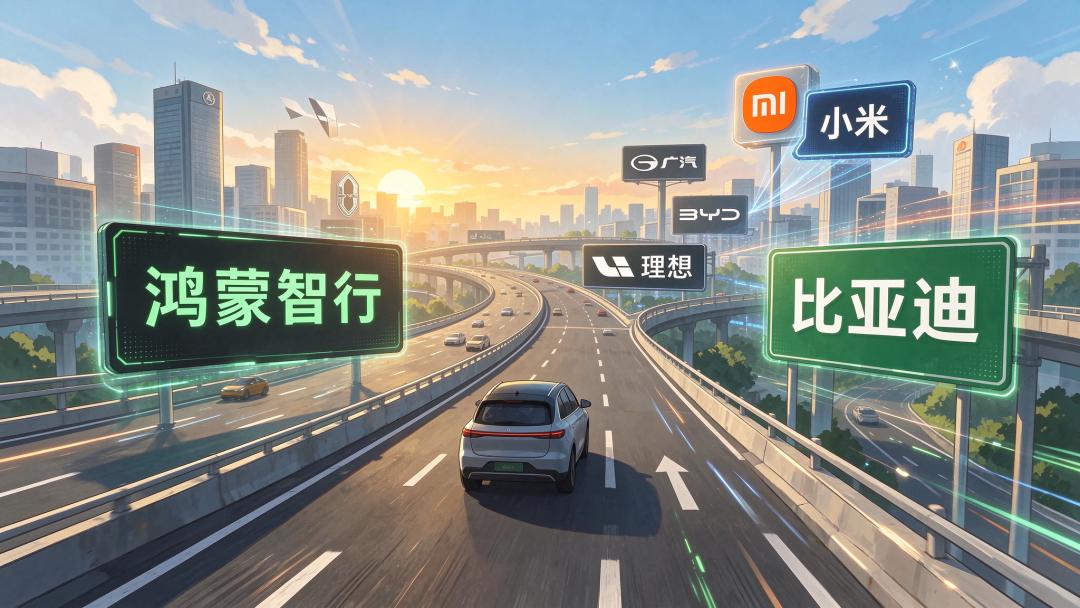
Partnered Enterprises
In the first half of the year, Cheche recorded 3.2 billion yuan in new energy vehicle insurance premiums, representing a 23.7% year-on-year growth, and established partnerships with 18 auto manufacturers including HarmonyOS Intelligent Mobility, BYD, Li Auto, Xiaomi and GAC Group.
At the same time, the overseas expansion of new energy vehicle insurance has also brought new development opportunities to Cheche Technology. As Chinese auto brands accelerate their global expansion, insurance services also need to follow these automakers into local overseas markets.
Cheche Technology is trying to replicate its domestically accumulated digital intelligent insurance service model overseas. It has already laid out operations in regions including Australia, New Zealand, Latin America and the Middle East, and is advancing cooperation implementation with Chinese automakers such as GAC Group, Chery and BYD.
However, the development of overseas markets takes time, and the business implementation and revenue contribution still need further observation. While looking for new growth space, Cheche Technology has also set its sights on areas beyond auto insurance. This year, the company made a strategic investment in Australian and New Zealand residential energy storage enterprise Long Way Fortune, to explore business opportunities in the overseas energy market.
Residential energy storage and auto insurance belong to different tracks. This investment is not a simple extension of the existing auto insurance business, but targets the pain points of surging power demand and high electricity tariffs among users brought by the explosive growth of Chinese new energy vehicles overseas. The user data, sales scenarios and promotion models of new energy vehicles are highly aligned with residential energy storage, bringing new growth opportunities.
Zhang Lei's three strategic moves: courage to contract, courage to focus, and courage to cross boundaries
Behind this series of changes, there is no way around Zhang Lei, founder, Chairman and CEO of Cheche Technology.
Starting from the insurance agency business and leading the company to list on NASDAQ, Zhang Lei has been exploring the platformization of auto insurance business. This time, he is facing another test: how to adjust the original business structure and find new growth space.
The first move is the courage to contract.
The company has drastically reduced its traditional business. Compared with maintaining business scale, the more important priority going forward is to improve business quality, and release resources from low-efficiency businesses.
The second move is the courage to focus.
New energy vehicle insurance premiums continue to grow, and the number of partnered auto manufacturers has expanded to 18. Compared with the past pursuit of channel and scale expansion, Cheche now needs to invest resources in high-conversion scenarios, deepen cooperation with automakers, and translate business growth into real revenue and profits.
The third move is the courage to cross boundaries.
Cheche Technology's strategic investment in Australian and New Zealand residential energy storage enterprise Long Way Fortune is an attempt to extend its business boundary from auto insurance to the residential energy sector.
However, for Cheche, the most difficult period may not be the expansion phase, but the business clearance phase. The company is facing pressure brought by revenue decline and phased losses, but clearance itself does not equal success. The key lies in whether it can obtain a healthier business structure in return.
Going forward, three things are worth paying attention to:
Compliance rectification must be fully implemented, which is the bottom line for business operation,
New energy vehicle insurance must evolve from "scale-driven" to "profit-driven", which is the core test,
The energy storage business is still in the exploration stage, and there is still a long way to go before it can deliver expected investment returns.
Advancing these three lines of work at the same time tests not only Zhang Lei's strategic judgment, but also the company's execution capability and cash flow bearing capacity.
Contracting legacy businesses is to travel light, focusing on core business is to build profitability, and cross-border investment is to explore new growth possibilities.
This article is from the WeChat official account "Houcun Village", written by Wen Ruyan, and published with authorization from 36Kr.