Mobile phone chips are trapped amid the AI boom
In 2026, the mobile phone industry is taking on shrinking shipment volumes with higher selling prices. The revenue of the end market can still be maintained, but the number of mobile phones underpinning this revenue is declining. For the chip industry that ships products by units and relies on product scale to dilute R&D investment, this is a change worthy of vigilance.
The latest statistics from Counterpoint show that in the third quarter of this year, global smartphone shipments fell 19% year-on-year, but the industry's revenue increased by 3% to reach 114 billion US dollars. What propped up the revenue is the average selling price: calculated at wholesale prices, the global average selling price of mobile phones rose 27% year-on-year to 442 US dollars.
This set of changes means that higher selling prices for mobile phones no longer equal more orders for the industrial chain. The price increase comes from both the rising proportion of high-end models and the transmission of rising component prices. End brands can adjust their product mix, but chip suppliers still face reduced procurement volumes and stricter cost control from customers.
AI is exacerbating this mismatch. On the one hand, the expansion of data centers is pushing the supply chain to allocate resources around new major customers; on the other hand, mobile phones continue to add AI capabilities, hoping to find the next round of replacement momentum. Mobile phone chips have to bear the cost pressure brought by the former and continue to invest in the latter, but the corresponding growth revenue cannot be realized at the same time.
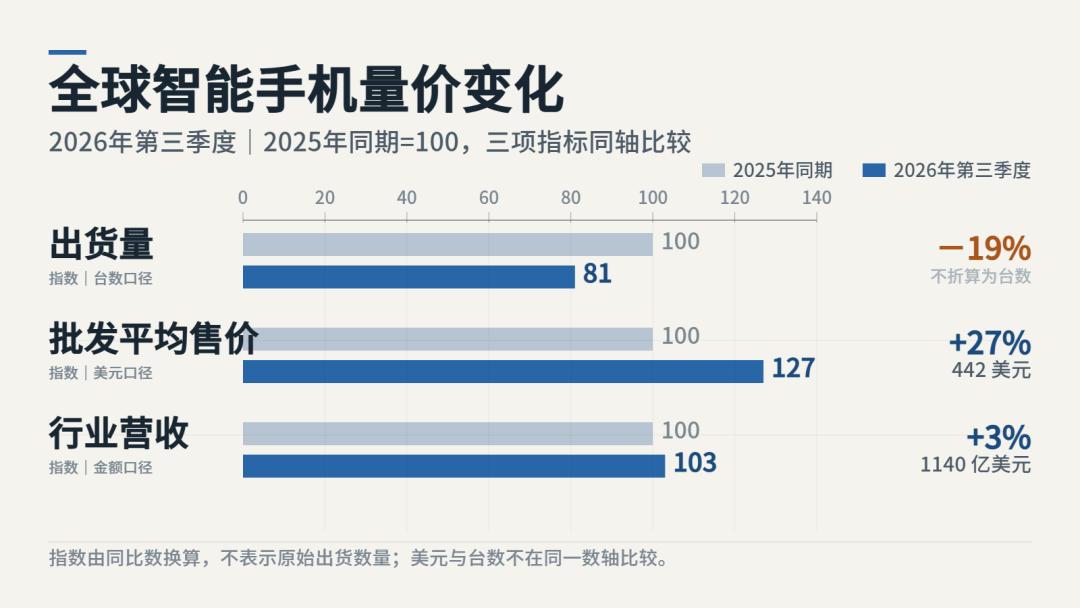
Figure 1 Changes in global smartphone volume and price
Higher overall product prices cannot sustain all chip orders
The high-end transformation of the mobile phone industry is undergoing two changes of different natures. Consumers actively purchasing better products can increase the value of both the whole device and chips; when rising costs force brands to raise selling prices, the increased revenue will first be paid to the supply chain. Both scenarios push up the average selling price, but leave different profit margins for processors.
More importantly, the reduction of mid- and low-end models will also make the average selling price look higher. After the price range that originally contributed a large number of shipments shrinks, the proportion of flagship products in the remaining market naturally rises. This structural change does not convert all consumers who left into high-end users.
Corresponding quantity changes have already appeared in the chip market. According to Counterpoint statistics, global smartphone SoC shipments fell 21% year-on-year in the third quarter, with mid-to-low price segments facing more obvious pressure. Some brands have cut entry-level products, prioritizing profit preservation over shipment scale. Although the statistical objects of mobile phones and SoCs are different, both show a trend of shrinking shipment base.
Corporate financial reports further break down this change. Qualcomm's QCT mobile business revenue in fiscal 2026 was 24.072 billion US dollars, down 13% year-on-year; revenue in the fourth fiscal quarter was 5.137 billion US dollars, compared with 6.961 billion US dollars in the same period of the previous year, down 26% year-on-year. In the same fiscal quarter, automotive business revenue increased from 1.053 billion US dollars to 1.990 billion US dollars, and IoT revenue increased from 1.807 billion US dollars to 1.888 billion US dollars. The overall pre-tax profit margin of QCT, which includes these businesses, changed from 29% in the same period of the previous year to 24%.
MediaTek's total revenue in the third quarter increased by 18.3% year-on-year, while mobile business revenue fell by 17% year-on-year, accounting for 37% of total revenue. The mobile business and the company's total revenue have changed in different directions.
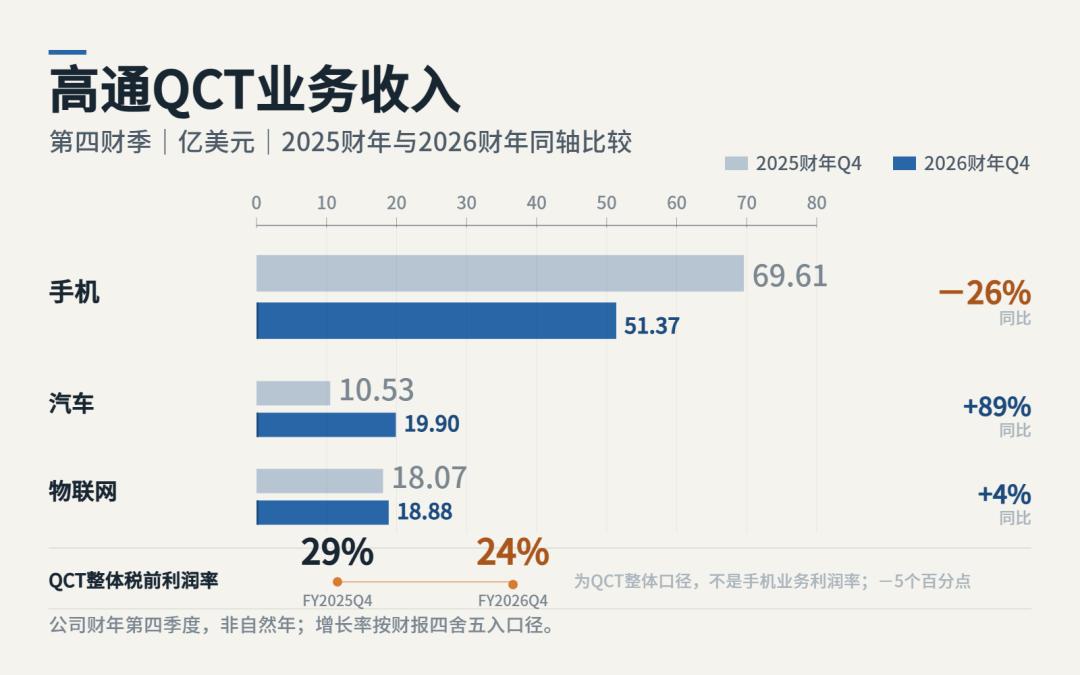
Figure 2 Qualcomm QCT business revenue
These figures do not indicate that all chip businesses are declining together. Demand from different terminals is changing the revenue structure, and the overall growth of companies is increasingly dependent on businesses outside the mobile phone sector. The decline in Qualcomm's mobile revenue is also affected by Apple's gradual adoption of self-developed basebands, so its decline cannot be directly regarded as the decline of the entire mobile phone chip market. For mobile phone chips, the increase in unit price of flagship products needs to offset the reduction of mid- and low-end orders before it can be converted into new revenue.
Competition also occurs within customers. Samsung uses both Snapdragon and Exynos in the Galaxy S26 series, and the share of self-developed chips will affect external procurement. An additional distribution link has been added between terminal sales volume, the quantity of externally purchased chips, and the revenue of chip suppliers.
As a result, chip companies can hardly solve problems only by "moving to the high end". High-end design orders are worth fighting for, but customers have their own chip roadmaps; the scale of mid- and low-end markets is still important, but OEMs are reducing products with thin profit margins. As revenue concentrates in the high-end segment, the difficulty of competing for orders is also increasing.
Mobile phone demand cools down, storage market remains tight
In the past, weakening consumer electronics demand was often accompanied by component destocking, and price cuts would make room for new products. The supply chain faced by the mobile phone market this round has another group of customers with strong demand and higher payment capacity.
TrendForce's research on the storage market in the fourth quarter points out that the low-cost inventory accumulated by mobile phone manufacturers in the early stage is gradually being consumed, and rising costs are suppressing production and procurement demand; at the same time, the demand and profits brought by AI-related applications are prompting suppliers to continue tilting resources to server products, and the allocation of mobile DRAM remains relatively tight.
When fewer mobile phones are sold, upstream suppliers do not necessarily need to cut prices to compete for these orders. The server business provides storage manufacturers with alternative markets, and the price adjustment brought by shrinking mobile phone demand is restrained by the larger market.
This is also the most direct path for AI to affect mobile phone chips. It does not necessarily change consumers first through a stunning application, but first enters the cost sheet of device manufacturers.
The running memory of mobile phones mainly uses DRAM, and file storage mainly uses NAND flash. HBM in AI servers belongs to the DRAM system, and enterprise-level SSDs use NAND. The manufacturing, packaging and resource constraints of the two types of products are different, but the procurement brought by data center expansion is changing the input arrangement of suppliers for different customers.
Processor manufacturers themselves also have to pay higher manufacturing costs. Qualcomm lists pressures in its financial reports involving wafer, packaging, testing and storage links, and has taken price adjustment measures. As a result, OEMs are facing simultaneous increases in multiple costs, while consumers will only see the selling price of a single mobile phone in the end.
Products with thin profit margins are the most difficult to withstand this superposition of cost increases. Funds that could originally be used to upgrade processors may first be used to maintain memory and flash configurations; if they continue to keep the original price, they need to find room from other components or profits; if they raise the selling price, the product will enter a price range with more intense competition.
This pressure will eventually return to chip orders. Even if a processor has competitive performance, as long as the mobile phone equipped with it loses its price advantage, its procurement volume will be affected. Processor suppliers sell chips, but their revenue is determined by whether the finished mobile phones can be successfully transacted.
On-device AI is still waiting for returns from device replacement
When costs are rising, on-device AI requires mobile phones to continue increasing investment.
Running models locally takes up computing, memory and power consumption budgets, and mobile phones also need to complete tasks such as imaging, communication and gaming at the same time. Chip design needs to allocate area and power consumption among these demands, and terminal manufacturers then decide which capabilities are worth occupying the cost of the whole device. After AI performance enters the competition of flagship platforms, this part of investment is difficult to suspend.
There are two rounds of choices between input and revenue. Mobile phone brands first decide what platform to use, how much memory to configure, and which functions to enable, and then consumers decide whether these changes are worth replacing their phones in advance. The AI capabilities in chips can only become a reason for purchase after going through systems, applications and services.
A stronger NPU can provide products with conditions to run models; whether users can continuously benefit from their own languages, commonly used applications and daily tasks still depends on the completion of work by terminal manufacturers. After the improvement of chip performance, system adaptation, application development and service promotion still require continuous investment, and the interval between R&D costs and replacement revenue is further extended.
The rise in mobile phone prices is raising this threshold again. Users are willing to pay for a clear experience upgrade, and they will also compare the difference between continuing to use the old phone and buying a new one. The convenience brought by new AI functions will enter users' judgment together with the higher price of the whole device. The supply chain is driving up selling prices, and on-device AI is taking on heavier expectations of driving device replacement.
As a result, both mobile phone brands and chip manufacturers are trapped in an investment race that is hard to stop. Brands worry that the next generation of products will lack AI capabilities, and suppliers worry about losing flagship design orders; the two sides continue to invest, but they still have to face the shrinking shipment market together. That AI has become a necessary preparation for product competition and that AI has generated enough new orders are two different business stages.
The shipment changes of mobile phones and mobile phone SoCs in the third quarter indicate that this round of cost pressure has not yet been offset by new demand. It is necessary to continue to improve AI performance, but the revenue of mobile phone chips cannot be explained only by the rhythm of technology release, and it also depends on how the device price, product coverage and replacement willingness are re-matched.
Chip companies' new customers are in data centers
While both are investing in AI, orders that mobile phone chip companies face in the data center market are taking shape at an accelerated pace.
MediaTek's first AI accelerator has started small-volume shipments in September, and the target given by the company at the third quarter performance meeting is to achieve 2.5 billion US dollars in related revenue in the fourth quarter. Qualcomm reiterated in its latest financial report that its data center revenue target for fiscal 2027 is 5 billion US dollars. The former has entered the initial delivery stage, and the latter has given the revenue expectation for the next fiscal year, and opportunities are beginning to fall into specific projects and business plans.
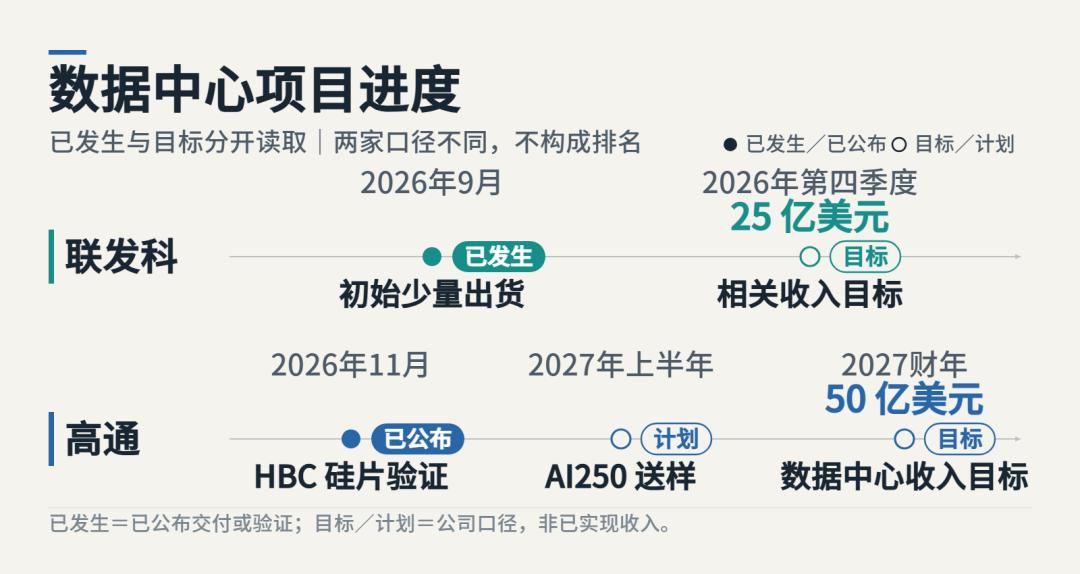
Figure 3 Data center project progress
Procurement from data center customers has also changed the working methods of chip companies. Mobile platforms need to serve multiple brands, models and price ranges, while custom accelerators are designed more deeply around customers' models, interconnection and deployment conditions. Project scales can be very large, and customer verification, production capacity preparation and delivery rhythm will also affect revenue more intensively.
The HBC technology announced by Qualcomm in early November provides a specific entry point for observing this migration. The first-generation high-bandwidth computing technology has completed silicon hardware verification, covering storage read-write and near-memory computing; the AI250 equipped with this technology is scheduled to be sampled in the first half of 2027.
It tries to solve the problem of data movement in inference. Computing units need to continuously obtain model data, and a large amount of data movement consumes time and power. Making computing closer to storage can achieve higher inference efficiency at the system level. The low-power design, storage integration and packaging experience accumulated in the mobile phone era thus get the opportunity to serve new customers.
This is more meaningful than simply adding a new product line: the mobile phone business is under resource pressure brought by the expansion of AI infrastructure, while the technologies accumulated by the mobile phone industry are used to win orders for AI infrastructure. The same industrial change not only compresses the growth space of the old business, but also creates conditions for the company's transformation.
However, the growth of data center projects will not directly repair the cost structure of the mobile phone market. Chip companies can improve their revenue structure through new businesses, but mobile phone brands still need to decide how to configure, price and ship their products. The different trends of MediaTek's overall revenue and mobile phone revenue have shown that the two need to be observed separately.
What mobile phone chips need to strive for next is to preserve product value in more expensive devices and maintain R&D returns in fewer shipments. AI has changed the price of resources it obtains, and is also changing the customers it serves. As for whether AI can bring more consumers back to mobile phone stores, it still needs to be fulfilled by practically available product experience.
This article is from the WeChat official account "Feng Wei Feng Dabai", author: Feng Dabai, published with authorization from 36Kr.