Coherent: Market Capitalization Halved, Has the "All-Round Champion" in the Optical Module Industry Been Unjustly Undervalued?
The two giants in optical communications are Lumentum and Coherent. Their businesses are similar but also different: Lumentum focuses on selling laser chips externally, while Coherent mass-produces laser chips but mainly uses them internally, delivering products to customers through optical modules, with earlier and more thorough vertical integration.
Then what are the advantages of Coherent, which sells modules? This article will focus on its optical module business and answer the following four questions:
I. How did this optical communications giant grow into what it is today?
II. What business products does Coherent cover?
III. What are the differences between selling chips and selling modules?
IV. What alpha does Coherent have in its module business?
Detailed analysis is as follows
I. How did this optical communications giant grow into what it is today?
1. From a materials company to an optical communications giant
Coherent (hereinafter referred to as COHR) has a complex origin. Lumentum (hereinafter referred to as LITE) was spun off and listed from JDSU, a star company in the optical network sector. It took over the optical device business for communications and data centers, with a "pure-blood" communications background.
While the main body of COHR is II-VI, a company started with optical materials. It acquired optical module manufacturer Finisar in 2019, and laser manufacturer Coherent in 2022, then adopted the latter's name and stock code.
Then, how did II-VI, which started as an optical materials manufacturer, gradually grow into a giant in optical communications?
The company's development can be roughly divided into two stages:
a. 1971–2009: Stick to its core business
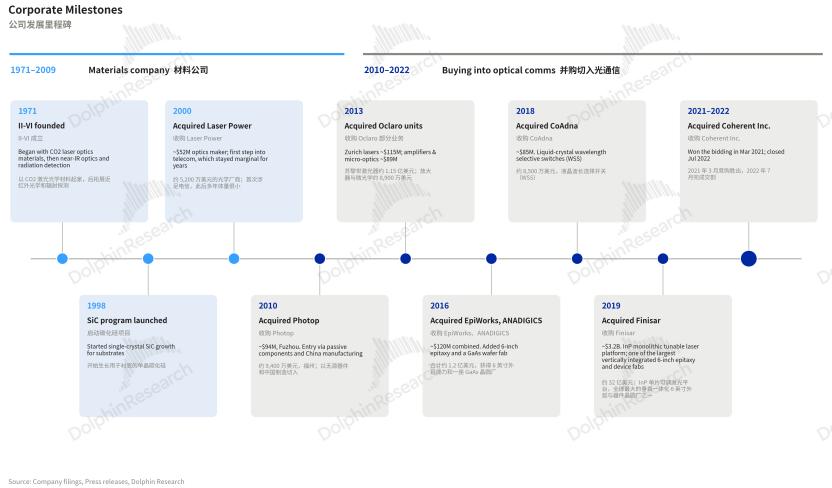
The main business of II-VI has always been optical materials and their extended products. It started with CO2 laser optical materials, launched the single-crystal silicon carbide growth project during this period, and acquired its peer Laser Power to expand its laser optics and military infrared business. It also dabbled in some communication devices in the same period, but communication always remained a marginal business.
b. Since 2010: Shift to optical communications, complete the full-stack layout through mergers and acquisitions
Its original core business had a low ceiling: manufacturing optical components for industrial lasers had a small market size and strong cyclical demand, so II-VI shifted to optical communications through intensive mergers and acquisitions. Optical communications basically uses the same underlying capabilities (crystal growth, compound semiconductors, etc.) with a much larger market scale.
In the following ten years, II-VI successively merged a series of companies including Photop, the laser and amplifier business of Oclaro, CoAdna and Finisar (as shown in the figure below), covering full-stack products from materials, wafers, devices to modules and subsystems.
Theoretically, after II-VI acquired Finisar, its integration in the optical communications industry was basically completed. Then why did it continue to acquire Coherent, whose main business is industrial lasers?
2. Compete with Lumentum for the acquisition of Coherent
The core reason is to diversify cyclical risks. As Haitun Jun mentioned in its coverage of LITE, traditional optical devices have strong periodicity, with a roughly balanced supply and demand, full competition, and declining prices year by year. Therefore, Coherent, which focuses on lasers, was favored by both II-VI and Lumentum. Both parties wanted to diversify their cycles through this acquisition, but with different purposes:
- LITE wanted to develop the second growth curve of its business, enter the laser market beyond optical communications, and hedge against the cycles of traditional communications;
- II-VI wanted to extend the industrial chain vertically, improve the competitiveness of various laser product lines such as material processing, display processing and instruments, and take Coherent's service network as the distribution channel for II-VI's high-margin after-sales consumables.
In 2021, II-VI won the bid and successfully acquired Coherent for 7 billion US dollars.
II. What business products does Coherent cover?
1. Business structure: Communications accounts for about 80% of total revenue
After a series of acquisitions, COHR now mainly has three business segments: network connectivity, industrial materials, and lasers. In FY2026, the company redivided its business departments, and reclassified the original three departments into a. Data Centers and Communications; b. Industrial.
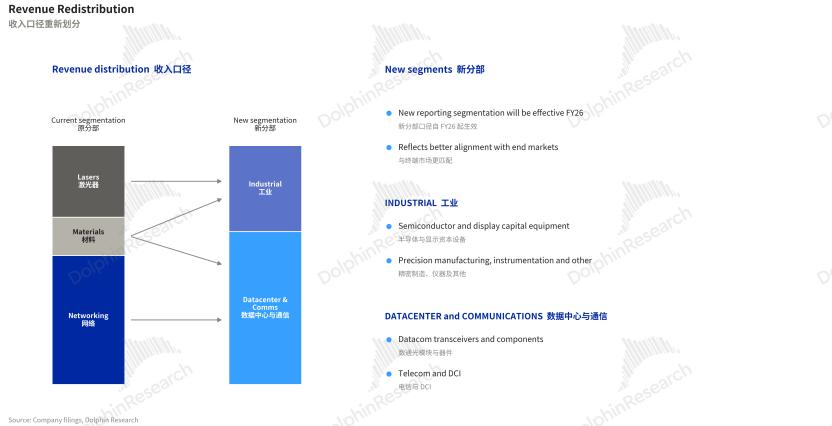
Under the new caliber, the Data Centers and Communications business has become the main source of revenue, accounting for about 80% in FY26Q4. According to Haitun Jun's calculation, under the comparable caliber, LITE's communication-related revenue is as high as 95%, making it an optical communication manufacturer with higher business purity.
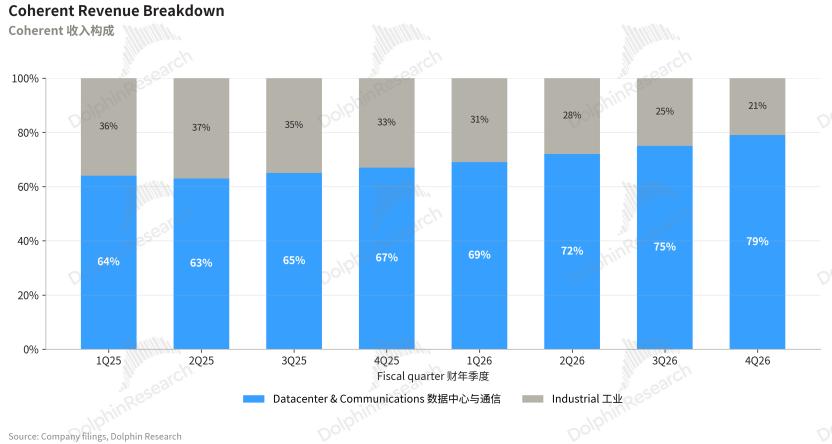
In the industrial sector, the company is streamlining its business and divesting some non-communication assets. Its Aerospace & Defense business (optics and laser systems) and Munich division (laser processing equipment) were sold in September 2025 and January 2026 respectively. The industrial sector is not the focus of this article.
2. Communications business: four core product lines
In the Data Centers and Communications business, the revenue proportion of core products in descending order is: optical modules, communication/DCI related products (ROADM/WSS/tunable modules, etc.), OCS optical circuit switches, and CPO (for CPO related content, you can refer to technical principles and industrial chain).
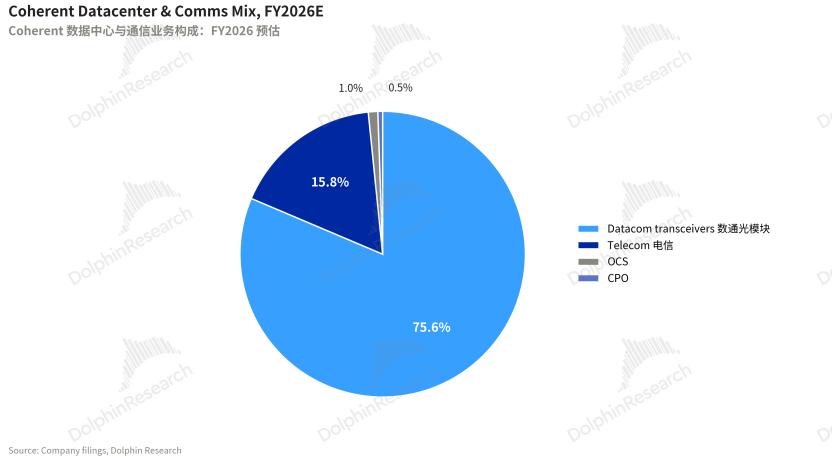
Next, we will focus on the optical module business, which is the biggest difference from LITE:
III. What are the differences between selling chips and selling modules?
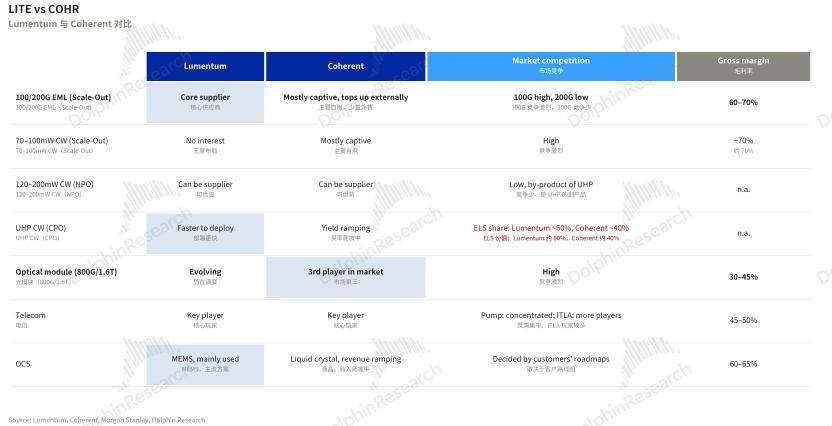
Compared with Lumentum, the core difference is: Coherent has the capability to mass-produce laser chips, but it does not take selling high-speed laser chips (InP laser chips) externally as its main business. Instead, it uses the chips internally and delivers products directly to end customers through modules. Then how to understand the two business models of selling chips and selling modules?
In short, selling chips is close to the scarce upstream links, and this segment itself has the manufacturing barrier of secondary epitaxy, with high gross margin but small market size; selling modules has a larger market size but lower gross margin, and the high gross margin of leading manufacturers comes from upstream and downstream links, rather than the assembly itself.
1. Financial perspective: Expand the market size with relatively low gross margin
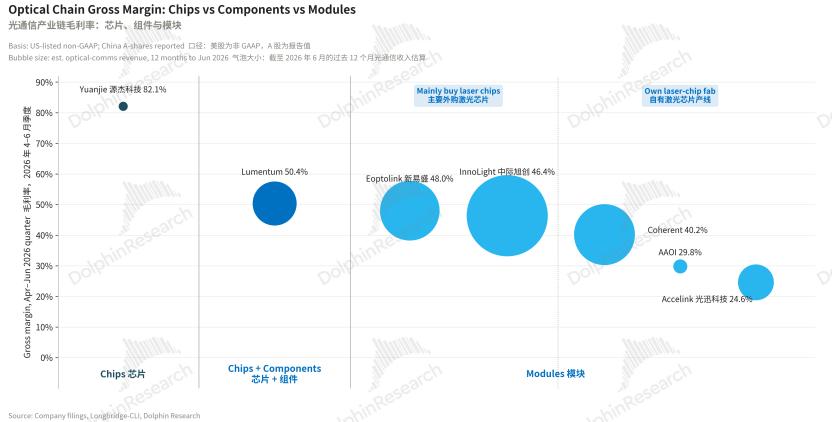
Optical communications players can be simply divided into three categories: chip sellers, chip + component sellers, and module sellers, as shown in the figure.
In terms of absolute revenue, since laser chips are components of modules, the revenue volume of modules is logically higher, corresponding to a larger bubble in the figure.
In terms of gross margin, the gross margin of pure chip business is quite high. The market generally expects that Lumentum's EML chip business has a gross margin of over 60%, while the gross margin of the module business is relatively low. Where does this difference come from?
2. Industrial chain perspective: The more upstream, the higher the concentration
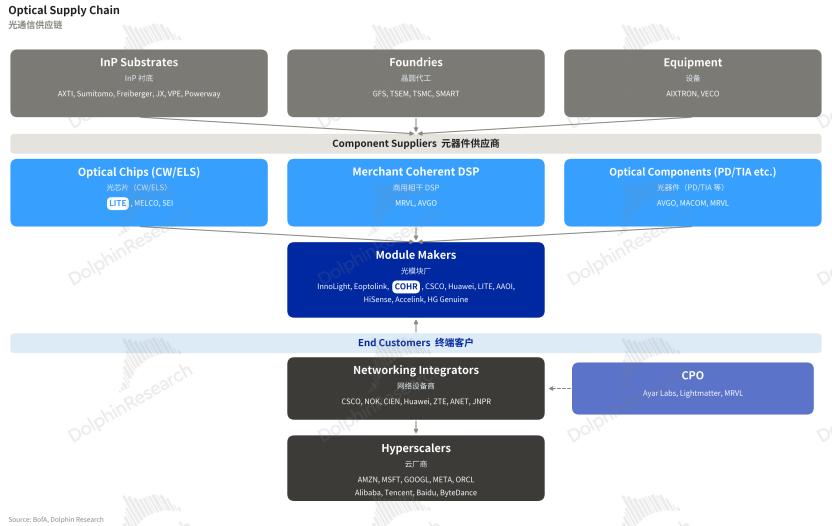
In the industrial chain links of pluggable optical modules (as shown in the figure below), the most upstream links include substrates/wafers, wafer manufacturing, equipment, etc.; the upstream links are components such as laser chips, DSP and optical components that make up optical modules; the downstream links are network integrators and CSPs, etc. Obviously, in the industrial chain, upstream players are highly concentrated; there are a large number of midstream module manufacturers with fierce competition.
InP laser chips: Close to the scarce upstream links, with inherent process barriers and high gross margin
For laser chip manufacturers like LITE, this segment is currently in an upward cycle, and the high premium mainly comes from two points:
First, the secondary epitaxy under the EML route has process barriers (refer to Lumentum in-depth analysis).
Second, it is closer to the scarce upstream, and the demand from downstream optical module manufacturers still far exceeds the supply.
- On the demand side, the current industry's optical module deployment is shifting from 800G (8 x 100G) to 1.6T (8 x 200G). Therefore, under the condition of scarce most upstream resources, no matter which technical route is adopted, the primary factor is that the rate can meet 200G, and downstream customers will basically accept all available products.
- On the supply side, the core bottleneck is still the most upstream InP substrate link. Haitun Jun believes that the tight supply pattern will hardly reverse before 2028.
Therefore, for laser chip manufacturers, the current competition lies in two points: a. Technical capabilities can meet downstream demand; b. Production capacity of upstream substrates/wafers.
3. Modules: Limited barriers in the assembly link, value lies in upstream and downstream
For module manufacturers, they are involved in many upstream links in the industrial chain and are closer to end users, with very fierce competition. They need to have the integration capability of upstream supply, and also need to have strong product delivery and verification capabilities. From the common upstream and downstream relationship, its positioning is similar to that of an "assembly plant".
1) How much value does the "assembly" of module manufacturers provide in the industrial chain?
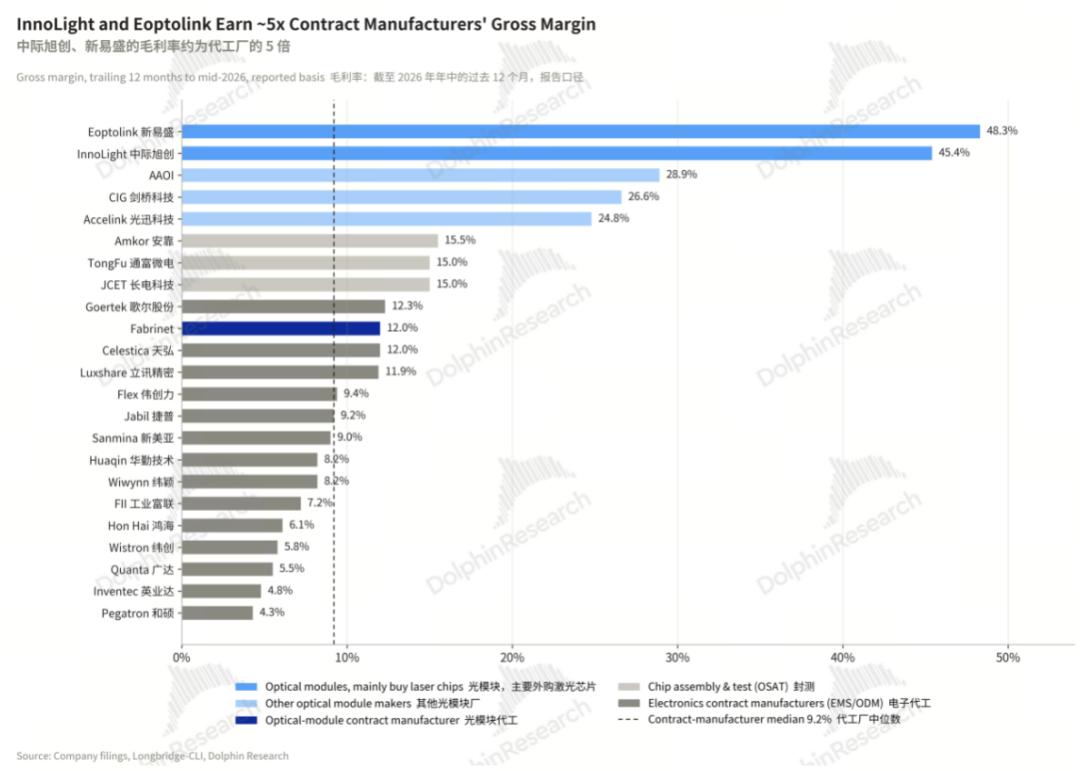
The assembly link is usually difficult to obtain high profits in the manufacturing industrial chain, with gross margin usually between 5% and 20%; Fabrinet, which focuses on assembly and OEM, has a gross margin of only 12%.
However, leading peers such as Innolight and Eoptolink have a gross margin of over 45%. What value does this link provide in the industrial chain?
The conclusion is: although the assembly process has certain difficulties, it is not as high-barrier as the secondary epitaxy of chip manufacturers. Haitun Jun does not think it can support the high gross margin of leading manufacturers.
Let's first take a look at how module manufacturers process and assemble upstream components into pluggable optical modules. Taking the 1.6T EML solution as an example, after the module manufacturer obtains the components from upstream links, it needs to go through four stages: die bonding and wire bonding on the board, optical coupling, final assembly, testing and shipment. As shown below:
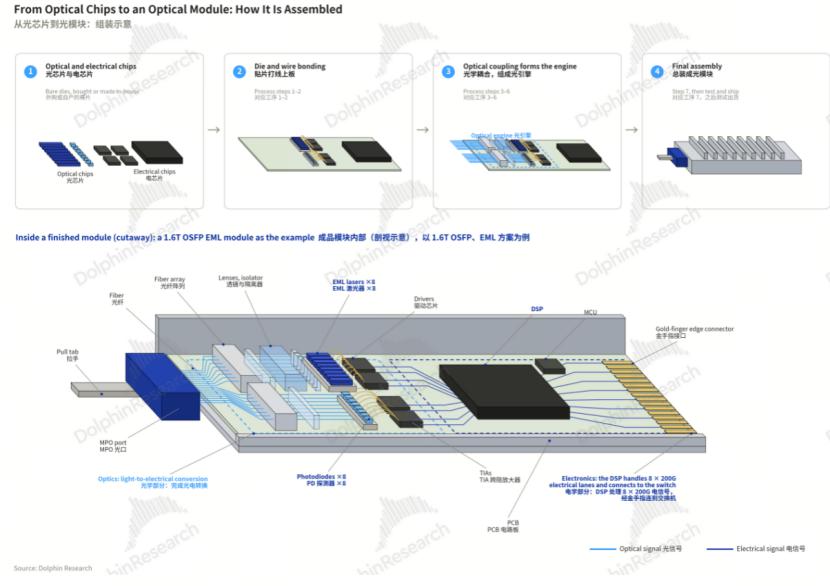
For the signal transmission path, refer to the schematic diagram of the optical module in the above figure: the electrical signal of the switch enters the DSP through the golden finger, is amplified by the Driver and then drives the EML to emit light. The light passes through the lens and isolator in turn, enters the fiber array, and then exits from the MPO optical port. The receiving path is the opposite: the optical signal is converted back to electrical signal by PD, amplified by TIA, sent to the DSP for processing, and then returned to the switch.
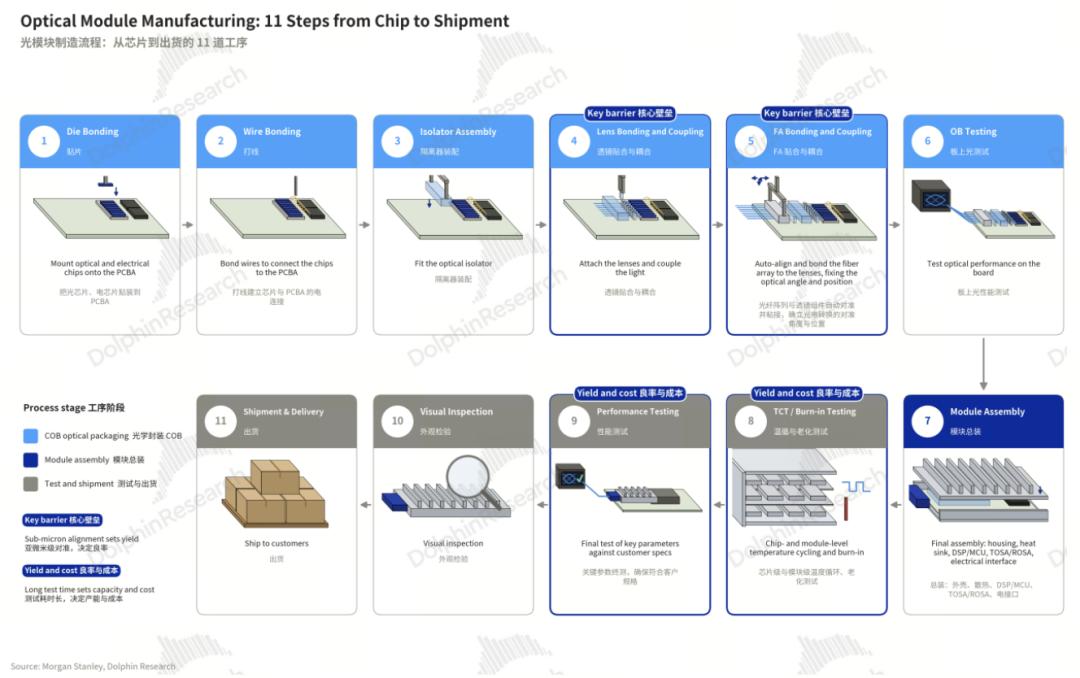
The specific process under the EML route is shown in the above figure. The core links are the 4th and 5th steps: lens fitting and coupling, fiber array (FA) alignment and bonding, which are collectively referred to as "optical path coupling" in the industry.
Since the light emitted by the laser is thin and divergent, the optical fiber can only receive light with appropriate thickness and straight direction; optical coupling is to shape the laser with a lens and accurately send it into the fiber core. Optical path coupling is widely regarded in the industry as the most time-consuming process that most affects the yield.
Let's explain the process flow in detail:
Lens coupling (upper row): Its function is to shape the divergent light emitted by the laser into parallel light