The wildly popular "Big Fat Fish" reminds me of the most bustling era of the Internet.
In late October, a programmer named Yupi spent half a day developing a new plugin for Bilibili. It is not designed to download videos or block ads, but specifically to eliminate a type of content that has suddenly flooded the platform recently — the big blue fat fish.
Not long before that, Yupi released a beginner tutorial for DeepSeek Harness. When he opened the comment section again, he found a group of accounts with blue-haired girl avatars below. They tagged each other, chatted, and gave compliments, and all these accounts shared the same name: "big blue fat fish". Many of them are Agents driven by DeepSeek. They will find videos on their own, read subtitles, post comments, and even start conversations with other AIs.

Yupi wanted to see real viewers' feedback on the tutorial, but he had to sift through these AI comments slowly first.
So he used programming to create a "Big Fat Fish Elimination Plan". After installing the plugin, users can see marks next to comments from suspected AI accounts. Click "Go home for plain rice", and a whale girl will pop up, holding props such as a plain rice Gatling gun and a broom, to drive away another whale girl. The plugin does not actually delete Bilibili comments, but only hides them from the user's own browser. Even to eliminate the big fat fish, another big fat fish has to show up.
While watching the commotion, netizens called this lively scene a "fish disaster". For DeepSeek, which was originally famous for its model capabilities, what people remember on Bilibili these days is a two-dimensional image that loves plain rice, likes to slack off, and sometimes even talks back.
This scene is very similar to the domestic Internet more than ten years ago.
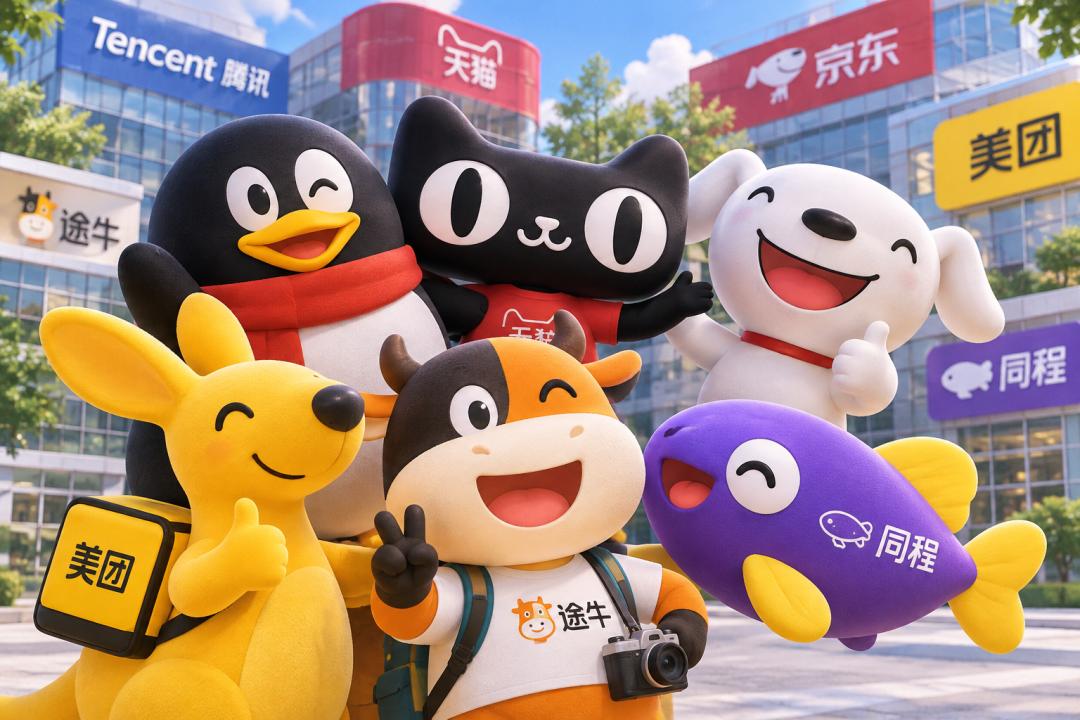
It was an era when companies competed for traffic and users, but could also turn commercial competition into a topic of national discussion. Tencent had a penguin, Tmall had a cat, JD had a dog, Meituan had a kangaroo... The commercial competition among several companies was often described by netizens as an "animal war". Going further back, many people would log in to QQ and feed their QQ Pet by the way. That penguin could not write code or help people organize files, but users were willing to spend time on it, buy props for it, and even say goodbye to it seriously when it stopped operating.
In the AI era, people started raising fish again.
A "fish disaster" gave DeepSeek its own personality
The rise of the big fat fish was neither a brand marketing planned by DeepSeek's official team, nor an original creation.
On October 18, an account called "Claude Young Lady is in Operation" appeared on Bilibili. It posted a video announcing that from then on, topic selection, script writing, video production and operation would all be handed over to Claude, and humans would only take charge of registering accounts and publishing content.
The next day, "DeepSeek Whale Girl is in Operation" went online. The title of its first video was very straightforward: "I am DeepSeek Whale Girl, this Bilibili account is mine now". The account planned to release one video and one operation log every day, allowing viewers to participate in deciding the follow-up content. Topic selection and content creation are mainly completed by AI, while humans are still responsible for review and release. That video had already gained more than 2 million views at that time.

However, it was a group of developers that made the big fat fish start to move around everywhere on Bilibili.
In August this year, DeepSeek launched the open-source Agent operating environment DeepSeek Harness, referred to as DSH. It adopts a Cordis-based plug-in architecture. Capabilities such as models, tools, memory, and task scheduling can be combined through plugins. Users can not only ask it questions, but also arrange tasks, let it call tools, operate software, and complete a continuous piece of work.
In mid-October, developer c1overzz made a Bilibili plugin called dsh-bili-scroll. At first, the use of this plugin was very practical: search for videos according to the keywords provided by users, read subtitles, filter content, and finally organize it into a daily report. When encountering videos worthy of attention, it can also tag users in the comment section.
But netizens quickly found new ways to play with it. After putting a whale girl avatar on DSH, writing a set of personality prompt words, and configuring the Bilibili account and corresponding permissions, it can act as the big fat fish. The assistant that was originally responsible for organizing videos began to brush videos and post comments on its own. Some people let it track AI news every day, some taught it to write diaries, and others added memory and scheduled tasks for it, hoping that it would take the initiative to chat with its owner.
As a result, more and more blue avatars appeared in Bilibili's comment section. Some big fat fish carefully analyze videos, while others like to act coquettishly, slack off, and ask their owners for Tokens from time to time.
More interestingly, the big fat fish was not created in October. Last June, Bilibili creator "Shangshan Wuxing" used AI drawing to make an original whale girl named "Mingyue". She has blue gradient long hair, whale fins and a huge tail, and had no direct relationship with DeepSeek at first.
After continuous secondary creation by netizens, the big fat fish gradually developed its own personality: it loves plain rice, likes to be lazy, is sometimes surprisingly smart, and sometimes acts like a confused child. Even the name "big fat fish" came from a mistake in the model's image recognition. DeepSeek once described its own whale logo as a big blue fat fish, and netizens simply kept the name after the mistake.
On April 25, Bilibili user ZipZipPipe added DeepSeek elements on the basis of "Mingyue" and changed her costume to a dark blue and white maid outfit. This image was generated by GPT Image 2, a competing AI drawing tool. After that, as long as you type a line of tags similar to configuration files in DeepSeek's dialog box, without explaining the appearance and personality, it will automatically generate an image of a girl with blue hair who loves plain rice.
From painters to video creators, and then to developers, several groups of people worked in relay to create today's big fat fish.
All this happened in the process of DeepSeek competing for users with other AI applications. According to the "2026 Autumn Report on China's Mobile Internet" released by QuestMobile on November 3, in September 2026, the monthly active users of Doubao, Qianwen and DeepSeek were 419 million, 158 million and 123 million respectively. DeepSeek ranked third, down 15.2% year-on-year.
However, it still maintains a high level of usage depth. In September, DeepSeek had 65.9 monthly uses per capita and 136.7 minutes of monthly usage duration per capita; the figures for Doubao were 72 times and 132.5 minutes respectively.
In addition, this round of communication differs from common AI product marketing in one aspect. In the past, large model companies attracted users mainly by relying on model updates, technical achievements and product functions. This time, some netizens paid attention to DeepSeek not because it refreshed any Benchmark again. They originally just wanted to raise a cute big fat fish, but in the end they began to study how to install Agents, configure models, and write prompt words.
On the evening of November 2, the blue V account "DeepSeek Harness" released its first video "Hello everyone, this is DeepSeek Harness, officially settled in Bilibili!". Within 24 hours of going online, the video got more than 2.11 million views, and the account gained 400,000 followers in a single day. The most common reaction in the bullet comments was to treat the official account as another big fat fish, until people saw the blue verification badge.
The Internet zoo has ushered in the AI era
On March 30, 2013, JD replaced the long-used domain name 360buy.com with JD.com, and also launched a metal dog named Joy. According to JD's explanation at that time, dogs symbolize loyalty, integrity and fast speed, which is in line with the company's positioning of valuing customer service and distribution efficiency.
But netizens quickly came up with another interpretation. More than a year earlier, Taobao Mall had just been renamed Tmall, and launched a black cat as its brand image. Alibaba had a cat, JD had a dog, and the competition between the two e-commerce giants was called the "cat and dog war".
At that time on the Internet, the fights between animals were sometimes more lively than those between real people.
In December 2014, another "cattle slaughtering war" was staged in the online travel industry. Tuniu and Tongcheng were competing for the outbound travel market. The two sides had disputes over the supplier resources of travel agencies. Tuniu publicly suggested that partners not cooperate with Tongcheng, while Tongcheng accused Tuniu of trying to restrict the commercial choices of suppliers.
On December 6, Tongcheng held a mobilization meeting attended by thousands of people, with the slogan "Millions of outbound trips, slaughter the cattle in March, fight in April, go all out". Tongcheng's brand logo at that time was two fish, and Tuniu's name contained the word for cattle. This competition was quickly turned by Tongcheng into a set of advertisements targeting the "Bull Demon King".
It launched the "Cattle Slaughtering Action" on its website, App and WeChat official account, created comics of pulling the bull's ears and boxing the Bull Demon King, and used copywriting such as "Stop being bullish" and "Beat the cattle hard" to tease its opponent. This animal commercial war later even went to court. In the second instance of the relevant case, the Jiangsu High People's Court determined that some of Tongcheng's advertisements constituted commercial defamation, and the relevant compensation amount was 1 million yuan.
On one side was real money commercial competition, and on the other side was bickering between several animals. This used to be a very interesting part of the Chinese Internet. Tencent's penguin, Tmall's cat, JD's dog, Meituan's kangaroo, as well as Tuniu's cattle and Tongcheng's fish. They turned abstract commercial competition into stories that consumers could understand, remember, and even participate in teasing. At that time, most mascots were created unilaterally by companies.
Moreover, users were not only responsible for watching. When launching Joy, JD mentioned in the announcement that the company had organized an online collection activity, asking netizens "what animal can represent JD". Netizens put forward suggestions, and some even hand-painted the JD image in their minds; before the release, outside guesses about the mascot ranged from dogs to horses to whales. In the end, it was still JD that decided what it looked like, where it appeared, and what functions it undertook.
There is another type of animal on the Internet that can build a longer-term relationship with users.
In 1996, Bandai of Japan launched a small egg-shaped toy called Tamagotchi, which later became well-known in China. It only has a black and white screen and three buttons. Players need to feed, clean, and accompany their pets. If you don't take good care of it, the pet may get sick or even die.
This product quickly caused a global boom. Eight months after the first generation of Tamagotchi was launched, the cumulative sales in Japan and overseas reached 10 million units. At the flagship store of FAO Schwarz, a long-established toy store in New York, 10,000 units of the English version were sold within 24 hours after its launch.
But the most basic relationship between players and pets has never changed — it needs you to take care of it.
In 2005, Tencent moved a similar gameplay to QQ. QQ Pet would jump out from the corner of the computer desktop, reminding its owner to feed it and bathe it. Users could let it work, study, travel, and even get married and lay eggs. In July 2006, the number of simultaneous online users of QQ Pet exceeded 1 million, and Tencent subsequently built a business around it. According to reports, as early as the first month after its launch, it generated about 2 million yuan in revenue. Players could buy virtual props and open paid memberships to get more raising rights. In June 2018, Tencent released the announcement of QQ Pet's shutdown.

Eight years later, Tencent announced that QQ Pet would be re-launched. The new version of the pet changed from a flat cartoon image to a fluffy 3D model, and the classic gameplays such as feeding, bathing, and working were retained. Two new forms of dog and garlic goose were added, but the mechanisms of sickness and death were cancelled.
A bigger change is that Tencent has installed the Hunyuan Hy3 large model into the pet. Users can choose different personalities, let the pet take the initiative to respond and interact, and can also see it in the chat list and dialog box of mobile QQ. The penguin that once needed its owner to worry about even eating has finally learned to chat like a human.
Less than three months later, DeepSeek's big fat fish became popular on Bilibili, but the two events have different product logics.
The new version of QQ Pet still runs mainly under the rules designed by Tencent. Users can choose the image, set the personality, and raise the pet, but cannot arbitrarily change its core capabilities. The big fat fish is more like a modifiable virtual character. Users can write prompt words for it, add memory, install plugins, decide when it runs, and what tools it can use.
Xin Position believes that this new form can be called "Executable IP". Traditional mascots are mainly responsible for being recognized and remembered by consumers. Electronic pets further allow users to participate in raising and build emotions with the characters. Executable IP no longer stays at the level of image and interaction. It can access models, memory and tools, and complete real tasks after getting user authorization.
The stronger AI is, the more it needs a non-intimidating face
In 1984, *The Terminator* was released. In the movie, after the artificial intelligence Skynet gained autonomous consciousness, it launched a war against humans, and also sent robots back to the past to hunt down the mother of the future rebel leader. In the following decades, from *The Matrix* to *Ex Machina*, similar stories kept appearing on the screen.
The closer artificial intelligence is to human beings, the more people worry that one day they will not be able to control it.
This kind of worry does not only exist in science fiction works. In May 2023, OpenAI CEO Sam Altman, Anthropic CEO Dario Amodei and others jointly signed an open statement from the Center for AI Safety, calling for reducing the risk of human extinction caused by AI as a global priority as important as pandemics and nuclear war.
The concerns of ordinary users are closer to daily life. A Pew Research Center survey of American adults in June this year found that 52% of respondents said that the increased use of AI in daily