Guabao Pet's profit has plummeted by more than 80%, and the leading giant in the pet food industry is also struggling to make profits.
Young people raise cats and dogs as if they were their own children, yet making money in the pet industry has become increasingly difficult. "The top player in domestic pet food" Guabao Pet has fallen into the dilemma of "rising revenue but no rising profit".
According to the recently disclosed financial report of Guabao Pet (301498.SZ), the company's net profit attributable to shareholders in the third quarter was 23.0063 million yuan, down 82.96% year on year; the net profit attributable to shareholders in the first three quarters was 214 million yuan, more than half less than the same period last year.
Although its revenue is still growing, the profit decline far exceeds the revenue growth rate. In response, Guabao Pet attributed the problem to exchange rate fluctuations, rising raw material prices, and the increasing proportion of self-owned brands and direct sales.
The dilemma of Guabao Pet is not an isolated case. Listed pet food companies such as China Pet Foods and Pet Co. have generally fallen into the predicament of "rising revenue but no rising profit", which has also put the collective problems facing the domestic pet food industry on the table.
01. Profit can no longer hold up first
Calculated by revenue scale, Guabao Pet currently ranks first among domestic listed pet food companies, with brands such as Myfoodie, Fregate, and Baff under its banner. But now the life of the "top player" in the industry does not seem to be easy.
Financial data shows that in the third quarter of this year, Guabao Pet achieved revenue of 1.582 billion yuan, a year-on-year increase of 4.27%; the net profit attributable to shareholders was 23.0063 million yuan, a sharp drop of 82.96% year on year; the non-recurring profit and loss deducted net profit was 23.8938 million yuan, with a decline rate as high as 80.93%.
In the first three quarters, the company's revenue was 5.125 billion yuan, up 8.17% year on year; net profit attributable to shareholders was 214 million yuan, down 58.35% year on year; non-recurring profit and loss deducted net profit was 214 million yuan, down 56.50% year on year.
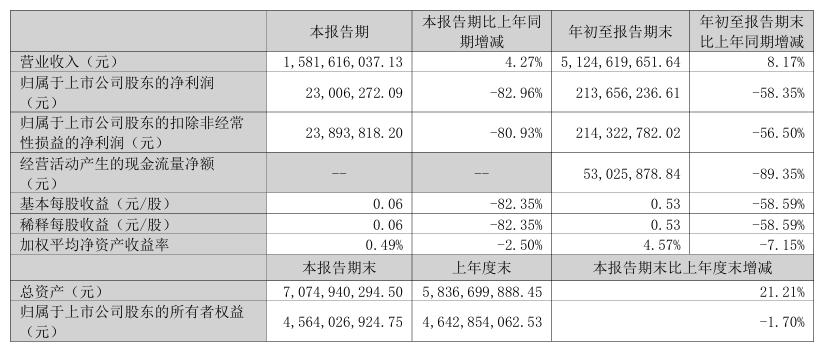
Source: Screenshot of Q3 Financial Report
Looking at the longer timeline, in the first half of this year, Guabao Pet achieved revenue of 3.543 billion yuan, a year-on-year increase of 10.01%; net profit attributable to shareholders was 191 million yuan, down 49.57% year on year. It can be seen that Guabao Pet has already faced the situation of "rising revenue but no rising profit" in the first half of the year, and this situation was further amplified in the third quarter.
For the profit decline, Guabao Pet explained in the financial report that it is mainly due to the decline in gross profit margin caused by exchange rate fluctuations and rising raw material prices, coupled with the increase in the proportion of domestic self-owned brands and direct sales, and the corresponding rise in rates, which comprehensively led to the reduction of net profit.
From the expense side, Guabao Pet's sales expenses in the first three quarters were 1.241 billion yuan, up 20.04% year on year, accounting for about 24.21% of revenue; management expenses were 327 million yuan, up 21.51% year on year. The growth rate of the two expenses is much higher than the 8.17% revenue growth rate in the same period.

Source: Screenshot of Q3 Financial Report
The company's management stated in a recent investor exchange activity that the company's domestic self-owned brand business is in a "strategic restructuring stage" and is actively stripping low-quality traffic. This direction is understandable, but the growth rate of expenses on the sales side is still significantly higher than the revenue growth rate; therefore, the effect of stripping low-quality traffic remains to be verified.
More critically, the pressure on profitability is also superimposed by rising cash occupation, heavier short-term debts and construction in progress, and the company is facing no small pressure. In the first three quarters, the net cash flow generated by the company's operating activities was only 53.0259 million yuan, down 89.35% year on year, which was mainly due to "increased expenditure on purchasing goods and expenses"; its short-term borrowings increased from 301 million yuan at the beginning of the year to 1.25 billion yuan, an increase of 315.3%. In the same period, the balance sheet also included 65 million yuan of long-term payables, which was mainly the purchase payment for NPFG brand assets; the construction in progress also rose sharply by 717.2% to 481 million yuan due to "increased investment in fixed asset construction projects".
For Guabao Pet, which is increasing investment in brand assets and fixed assets, the shift from scale expansion to quality growth is destined to be a difficult tough battle.
02. The test for Guabao Pet
Objectively speaking, the performance situation presented by Guabao Pet in the third quarter does have a certain relationship with external factors. For example, affected by exchange rate fluctuations and other factors, its financial expenses rose from -10.8812 million yuan in the same period last year to 50.6007 million yuan, which has produced a considerable squeezing effect on profits.
This kind of situation is not uncommon in this year's pet food industry. For example, China Pet Foods, which is also located in Shandong, is also affected by factors such as exchange rate fluctuations.
However, when Guabao Pet is placed among its peers, its 82.96% single-quarter profit decline is also quite conspicuous; especially as a leading enterprise in the industry, in addition to external factors, the company's own business adjustment and brand pressure have also been placed under the spotlight.
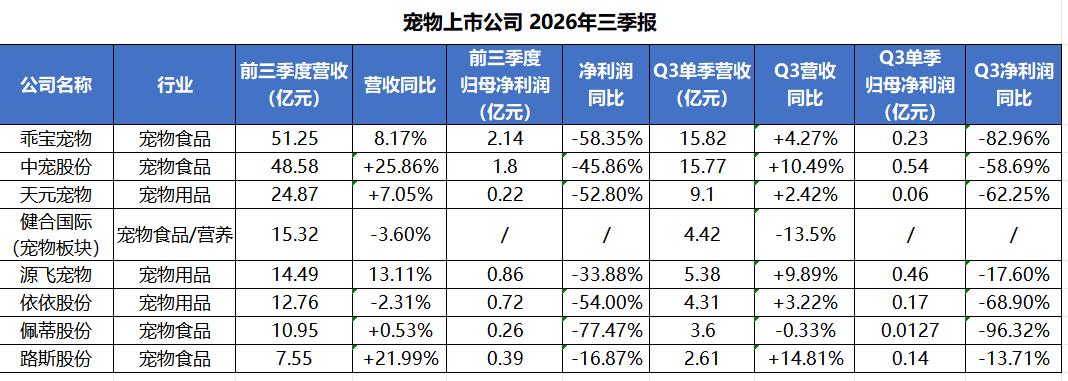
Source: First Pet TROVES
In the past few years, the rapid growth of new pet food brands is essentially a cycle of exchanging traffic for scale and exchanging scale for valuation. Brands invest in traffic and promote grass-root marketing on platforms such as Douyin and Xiaohongshu to expand GMV, and then use high growth rate to support premium and market pricing.
But this cycle is cracking with the rise of traffic and customer acquisition costs, resulting in the "traffic prisoner" dilemma: if you continue to invest in traffic, part of the profit has to be handed over to the platform; but if you stop investing first, the market share will soon be eaten by competitors.
In response, Guabao Pet proposed to "actively strip low-quality traffic", reduce dependence on pure traffic-driven growth, and turn to closed-loop operation of user assets and product strength improvement to reduce customer acquisition costs and increase repurchase rate.
At the same time, brand trust restoration has also become an important current issue for Guabao Pet.
In the middle of this year, cat food of brands such as Bonatry and Fregate fell into public opinion turmoil, and consumers launched collective complaints, saying that their cats developed hind limb weakness or even paralysis after eating the brand's cat food for a long time. After the regulatory authorities launched spot checks, no problems were found; Fregate also responded that every batch of the company's products has undergone multiple tests by a professional team, and the raw materials entering the factory and finished products leaving the factory all meet national standards.
But the market is not only concerned about whether the fact is established, but also about whether consumers believe it. In particular, Fregate was also exposed by the media for "deleting a large number of posts on social platforms", which will affect the brand image to a certain extent.
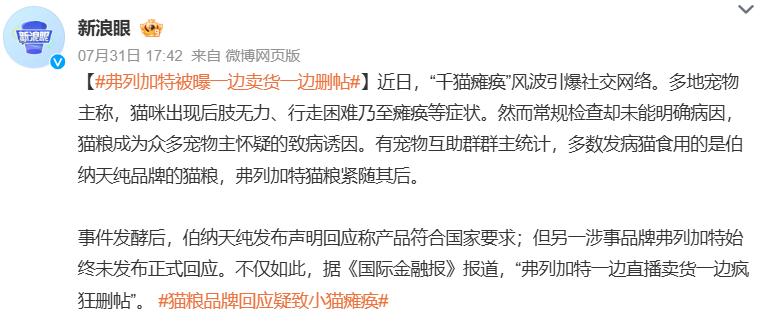
Source: Screenshot of Weibo
The management of Guabao Pet confessed in the investor research activity at the end of August that public opinion has a great impact on the short-term performance of the brand. Later, it will adjust the delivery rhythm of Fregate in the second half of the year, giving priority to restoring consumer trust rather than pursuing short-term growth.
In the secondary market, since Guabao Pet's stock price hit a high point of 124.88 yuan per share in intraday trading in May 2025, it has been falling all the way; as of the close on November 9, Guabao Pet closed at 35.8 yuan per share, down more than 70% from its peak.
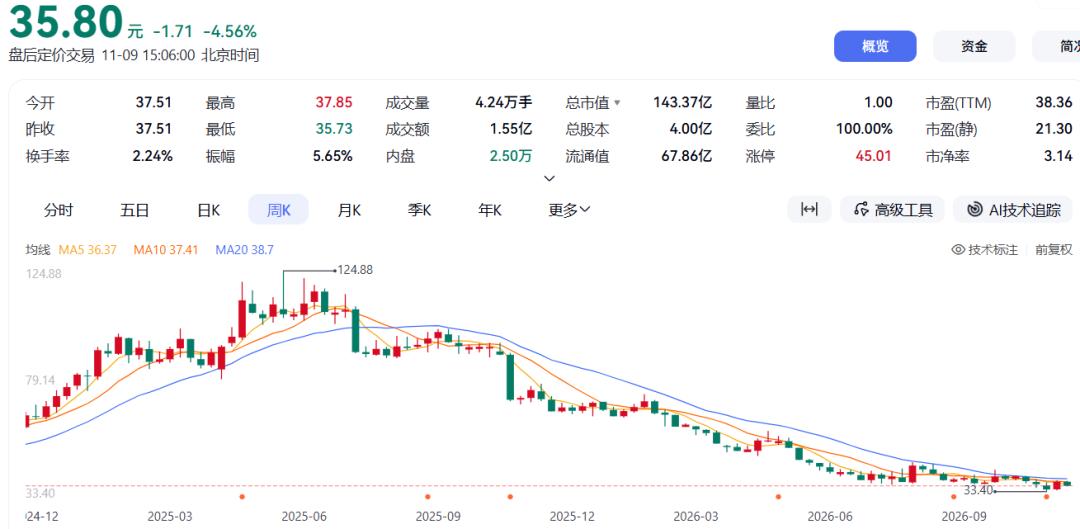
Source: Screenshot of Baidu Stock Connect
From 2021 to 2025, Guabao Pet achieved double growth in revenue and profit for five consecutive years, but the company's profit growth rate slowed down year by year, from a nearly doubling growth in 2022 to only a single-digit year-on-year growth rate in 2025, showing a cliff-like decline.
03. Expanding production against the trend
In 2026, an obvious change in pet consumption is that "poop scoopers" are no longer so easy to pay for emotional impulse; they pay more attention to ingredient sources, nutritional ratio, functional orientation, and supply chain quality control.
Whether the product side can provide verifiable differences, such as having unique advantages in ingredients, quality control and efficacy, may be the key to the new round of differentiation.
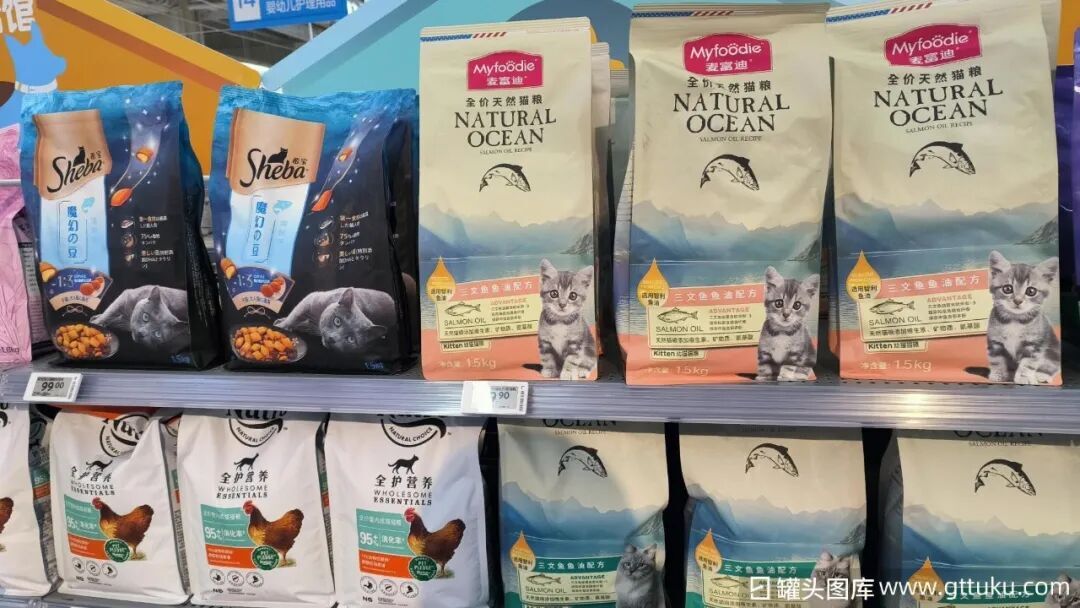
Facing the changes in the industry, Guabao Pet has launched a multi-brand combination punch: K9 and Comvita are positioned as ultra-high-end and clinical nutrition to open new price bands, Fregate repairs the price system, Myfoodie and Baff stabilize the basic market, and NutriForest and Baicui are responsible for expanding the coverage of the crowd.
Source: Canva Gallery
Despite the continuous pressure on performance, Guabao Pet still chose to expand production against the trend.
In August this year, Guabao Pet issued an announcement that the company plans to issue convertible corporate bonds to unspecified objects, with a total raised capital of no more than 1.1 billion yuan, which is mainly invested in the annual output 300,000 tons of high-end pet staple food project, the digital intelligent pet food factory project, and supplement working capital. At the same time, its New Zealand high-end production capacity project has also entered the bidding and evaluation stage, and the first phase is expected to be put into operation in the second half of 2028.
Under the trend of increasing industry concentration, Guabao Pet wants to use production capacity to lock in long-term supply chain advantages. This judgment is not unfounded, but the risks are equally clear.
After all, the return of high-end production capacity depends on the continuous premium generated by high-end brands to absorb, while Fregate is now facing declining revenue and lingering aftereffects of public opinion; moreover, if the demand side cannot keep up after the production capacity is put into operation, depreciation and financial expenses will also form rigid pressure.
The management of Guabao Pet once proposed that China's current pet food industry is in a structural opportunity period of transition from decentralized competition to head concentration, and the next 2-3 years will be a critical period to determine the industry pattern. But whether it can win the competition in the future depends more on a precondition: in the pet food market where consumers are shifting from trusting traffic to trusting evidence, can Guabao Pet establish stable brand trust before the production capacity is released? And how to strike a balance between short-term profit pressure and heavy asset investment? These issues still need to stand the test of the market.