Embodied intelligence companies are accelerating their entry into primary and secondary school classrooms.
The key to robots entering campuses lies in curriculums and development ecosystems.
Recently, at the 88th China Educational Equipment Exhibition, Dige Robot and Unitree Robotics jointly exhibited for the first time, announced the launch of in-depth cooperation, and jointly launched embodied intelligent education solutions for primary and secondary schools.
This cooperation takes the Sunrise S100 intelligent computing platform of Dige Robot as the core computing power base, combined with hardware including Unitree Robotics Go2 quadruped robot, R1 humanoid robot, and Guyueju desktop robot, supporting 15 themed courses with a total of 180 class hours, covering three school stages: primary school, junior high school and senior high school.
At the same time, the two sides will also provide practice projects integrating courses and competitions, teaching material resources and teaching environment construction, striving to provide schools with integrated solutions ranging from robot hardware to curriculum content.
The division of responsibilities in this cooperation is clear: Unitree provides the robot body, while Dige provides the computing power platform and development ecosystem. The two sides hope to integrate robot hardware, underlying computing capabilities and teaching content, so that students can not only observe robots move, but also further understand and participate in the development process of robot perception, calculation, control and other links.
It is worth noting that this is also an extension of Dige Robot's education business. Previously, Dige's education cooperation was mainly concentrated in universities and developer ecosystems, and now it has begun to expand to primary and secondary school curriculums and teaching solutions.
Unitree Robotics, on the other hand, built a basic education embodied intelligence laboratory with Jinjiang District, Chengdu in July this year. This cooperation further enriches its product and curriculum system for primary and secondary schools.
For robot enterprises, education is becoming a new scenario for the implementation of embodied intelligence. Compared with industrial, commercial and other scenarios, schools have different requirements for robot motion capability and production efficiency, but they have their own demands for equipment operability, teaching content and long-term use value.
How to turn a robot from a display device into a real teaching tool has become a problem that every embodied intelligence company needs to solve.
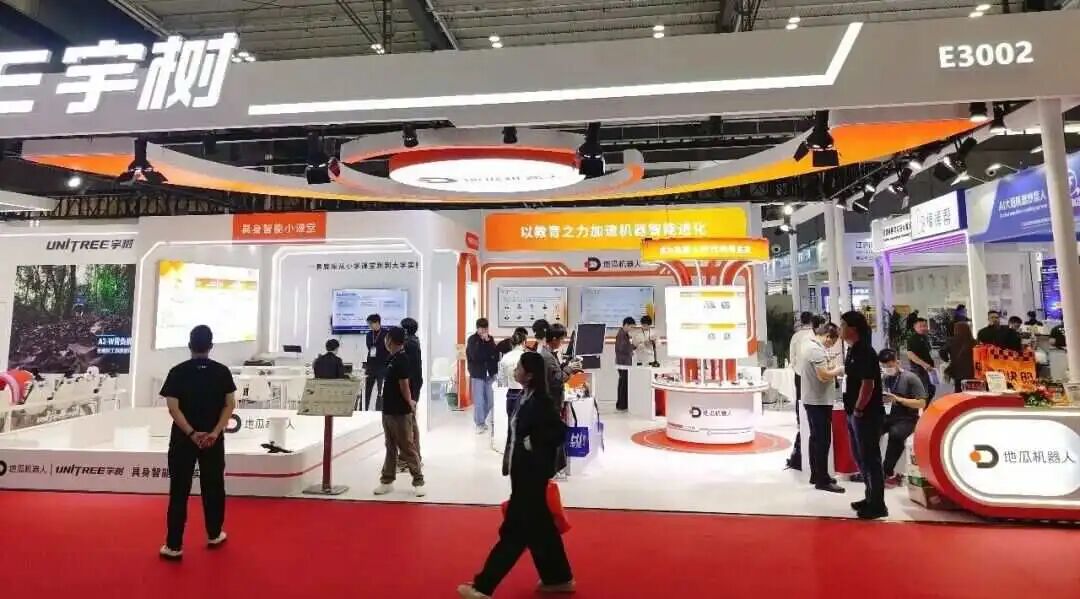
01 Robots Enter Campuses: The Key Lies in Curriculums and Development Ecosystems
How to ensure robots can be continuously used after entering campuses.
If a robot only appears on campus open days, science and technology festivals or exhibition booths in laboratories, completing several walking, dancing and interactive performances, its educational value is limited. Only when students can continuously program, debug and complete tasks around the robot, and understand technologies such as perception, decision-making and motion control in the process, can the hardware truly become a teaching tool.
This is also the noteworthy part of the cooperation between Dige and Unitree. 180 class hours, curriculum-competition integrated projects and real machine development mean that the two sides hope to turn robots into teaching tools for students to continuously learn and develop.
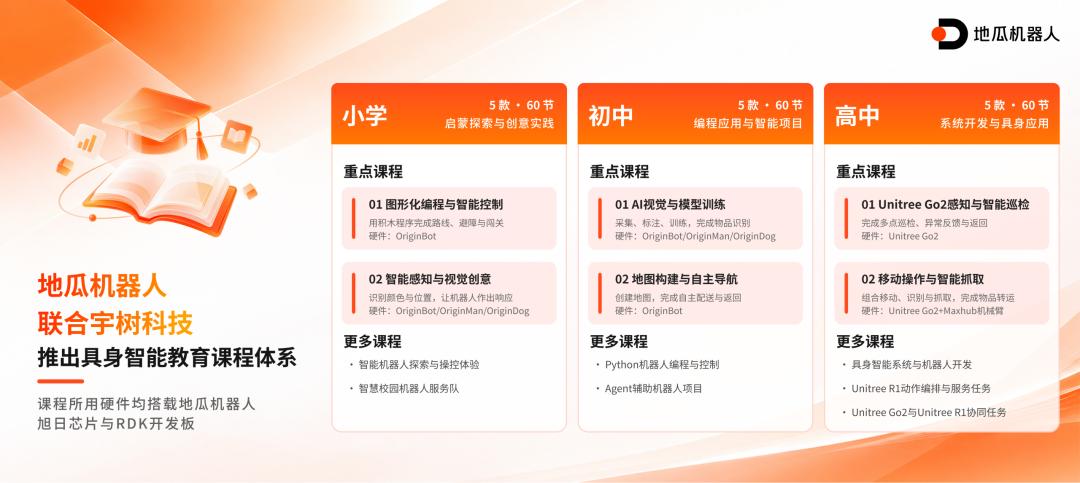
Unitree's advantages lie in the R&D of quadruped robots and humanoid robot bodies, motion control and complete machine product capabilities. However, for robots to enter the classroom, a machine with good performance alone is far from enough. Schools also need development tools suitable for students to get started, a stable computing platform, and curriculum content matching different age groups. What Dige provides is exactly part of this infrastructure.
At the technical level, the Sunrise S100 intelligent computing platform integrates CPU, BPU and MCU in a single SoC, integrating robot perception, decision-making and real-time motion control on the same platform to provide end-side computing support for robots.
For students, this means that they can go beyond observing robots performing tasks, further engage in links such as perception, calculation and control, and carry out development practices on real equipment.
The two sides have also designed an advanced practice path from desktop robots to quadruped and humanoid robots according to different school stages, and set up curriculum-competition integrated projects such as dual robot relay, Go2 stable transportation challenge, and R1 robot referee. Such tasks can provide students with relatively specific learning goals, and make it easier to connect curriculums, club activities and competitions.
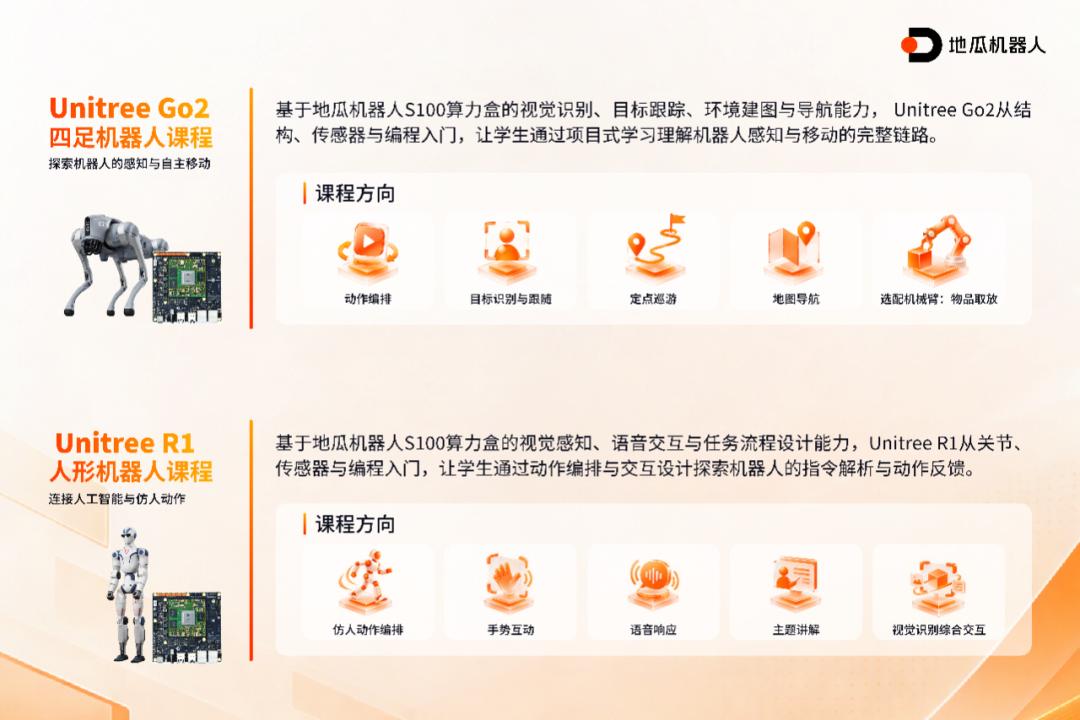
Jiang Yongsheng, head of the General Education Division of Unitree Robotics, said, To enable robots to be continuously used in schools, the computing platform, development tools and teaching resources need to cooperate with each other. The end-side computing capability of Dige Robot's Sunrise S100, together with supporting courses and educational ecological resources, helps Unitree transform its ontology capabilities into a more complete teaching solution. We look forward to polishing products in educational practice and jointly exploring more industry application needs.
Hu Chunxu, Vice President of Ecosystem of Dige Robot, said that Unitree's R&D strength in core components, motion control and complete machine products forms a good complement to Dige Robot's intelligent computing platform. High-performance quadruped and humanoid bodies will bring richer development scenarios to Dige's computing platform. Education is the starting point for the long-term cooperation between the two sides, and we hope to jointly support the growth of developers and realize deep collaboration between the ontology and the computing platform in more products.
From the perspective of this cooperation, the two sides are trying to lower the threshold for schools to carry out embodied intelligent education. For schools lacking robot development experience, the fact that hardware, development platforms, curriculums and teaching resources can be provided together obviously makes it easier to form practical teaching than purchasing equipment separately.
However, whether the solution can be truly implemented depends on the subsequent school procurement, teacher training and curriculum usage.
It is understood that education is the first implementation scenario of the cooperation between Dige and Unitree, and the two sides plan to expand to more fields such as industry in the future.
02 From Universities to Primary and Secondary Schools: The Embodied Intelligent Education Market Is Heating Up
Previously, the education market of various embodied intelligence companies was mainly oriented towards university scientific research and developers, and now many companies have begun to further extend to primary and secondary schools.
Dige Robot was established in January 2024, split from the Horizon Robotics Robot Division, and mainly provides general software and hardware bases and development infrastructure for the robot industry.
In April 2026, Dige Robot completed a $150 million Series B2 financing, with the total Series B financing reaching $270 million.
Education has always been an important part of Dige Robot's construction of the developer ecosystem.
Since 2023, Dige Robot has cooperated with many universities to jointly build robot majors and talent training systems. Through the DUP University Developer Program, Dige Robot has established cooperation with more than 500 universities, carried out more than 1,000 courses and activities in total, and gathered more than 50 education partners.
This cooperation with Unitree marks its entry into primary and secondary schools. This change also reflects Dige Robot's thinking: universities focus on developer training and technical research, while primary and secondary schools have a greater demand for curriculums suitable for different age groups, standardized teaching tools and teacher support. The former helps enterprises build a technical developer ecosystem, while the latter has the opportunity to expand the popularization scope of embodied intelligence technology.
Unitree Robotics is also promoting similar expansion, and education is the starting point of its business. The 2026 Q3 report does not separately disclose the revenue structure of Unitree's humanoid robots. According to the data disclosed in the previous prospectus, in the first three quarters of 2025, 73.60% of the revenue of Unitree's humanoid robots came from scientific research and education, which was highly dependent on the procurement of universities, scientific research institutes and developers. Now, Unitree Robotics has expanded to primary and secondary schools.
On July 24 this year, the Unitree Robotics·Chengdu Jinjiang (Jiaxiang) Embodied Intelligence Laboratory, jointly built by Unitree and Jinjiang District, Chengdu, was inaugurated at Jiaxiang Foreign Language School. This is Unitree's first embodied intelligence training platform for the basic education stage, covering humanoid robot training, quadruped robot practice, motion capture, remote control operation, as well as supporting courses and teaching resources.
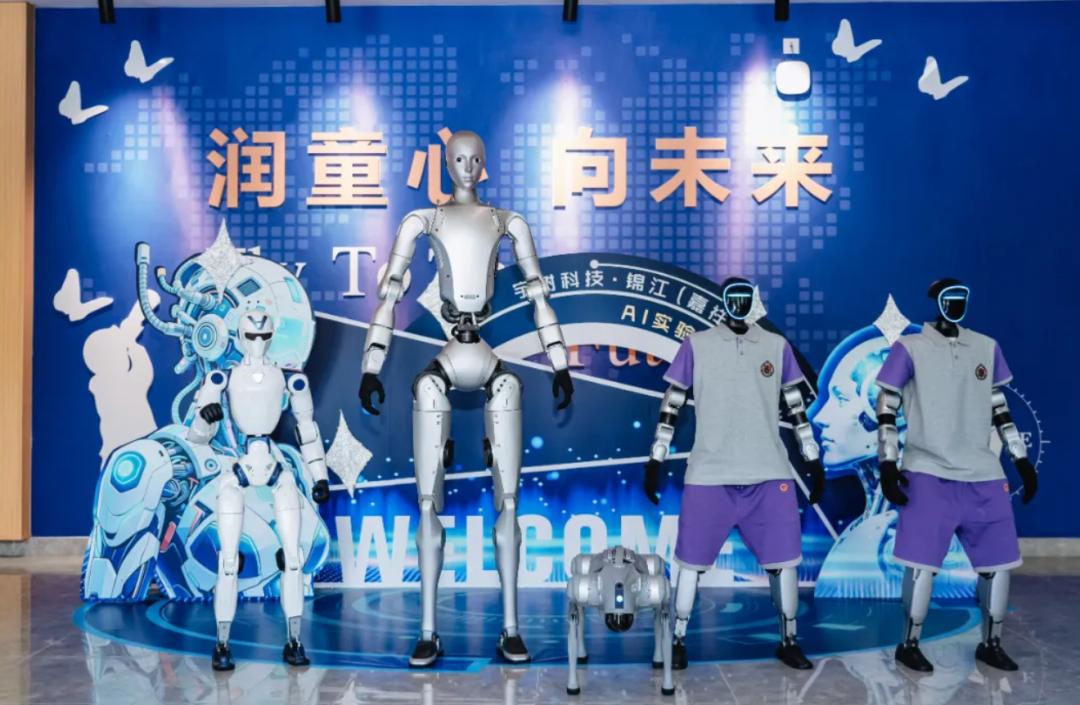
This cooperation with Dige further integrates the robot body, computing platform and curriculum system. For Unitree, in addition to entering schools through regional cooperation, it has also begun to rely on industrial partners to complete the teaching development ecosystem.
In fact, UBTECH has accumulated many years of experience in this market long ago. As a representative of the last round of robot industrialization, UBTECH began to lay out its education business around 2016, and gradually formed a business system covering educational robots, AI courses, teacher training and competition activities. It is one of the earlier enterprises that brought robots into primary and secondary schools, and has also experienced the process of robot education developing from hardware sales to overall solutions.
However, the new round of embodied intelligence wave is also changing the product direction of UBTECH's education business.
In the past, UBTECH mainly brought robots into classrooms to let students learn about robots and artificial intelligence; now, it is also trying to make robots themselves become teaching tools in the classroom.
For example, in the field of basic education, UBTECH's Walker C1 EDU Tutor is equipped with the UIRO UNO intelligent teaching assistant system, which can complete independent teaching, problem shooting and explanation, intelligent Q&A and multi-modal classroom interaction, striving to provide schools with an integrated intelligent teaching assistant solution.
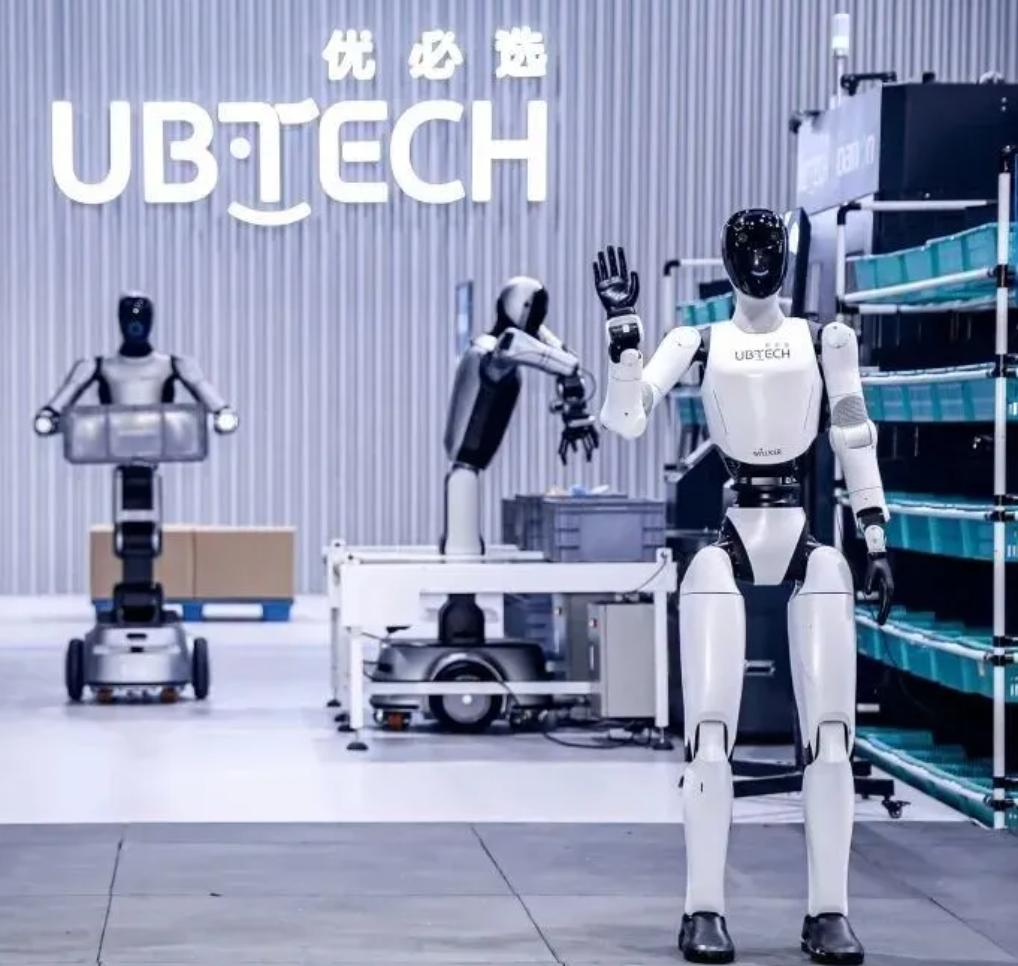
However, UBTECH has also been vigorously expanding industrial scenarios such as manufacturing and warehousing in the past two years, and its education business is also facing operating pressure. According to UBTECH's 2026 interim financial report, the company's revenue from other intelligent robot products and solutions in the first half of the year decreased by 18.8% year-on-year to about 246 million yuan, mainly due to the decrease in revenue from educational intelligent robots and intelligent robot solutions.
In the new round of embodied intelligence wave, a number of new players have begun to accelerate their entry into primary and secondary schools.
Jiasu Jinhua has chosen a relatively specific entry point: robot football. It tries to drive teaching through competitions, promote the popularization of robots through teaching, and then form continuous user connection through the developer ecosystem. According to the disclosure of Jiasu Jinhua in September this year, more than 30 middle schools in Beijing have used its tools to offer embodied intelligence courses.
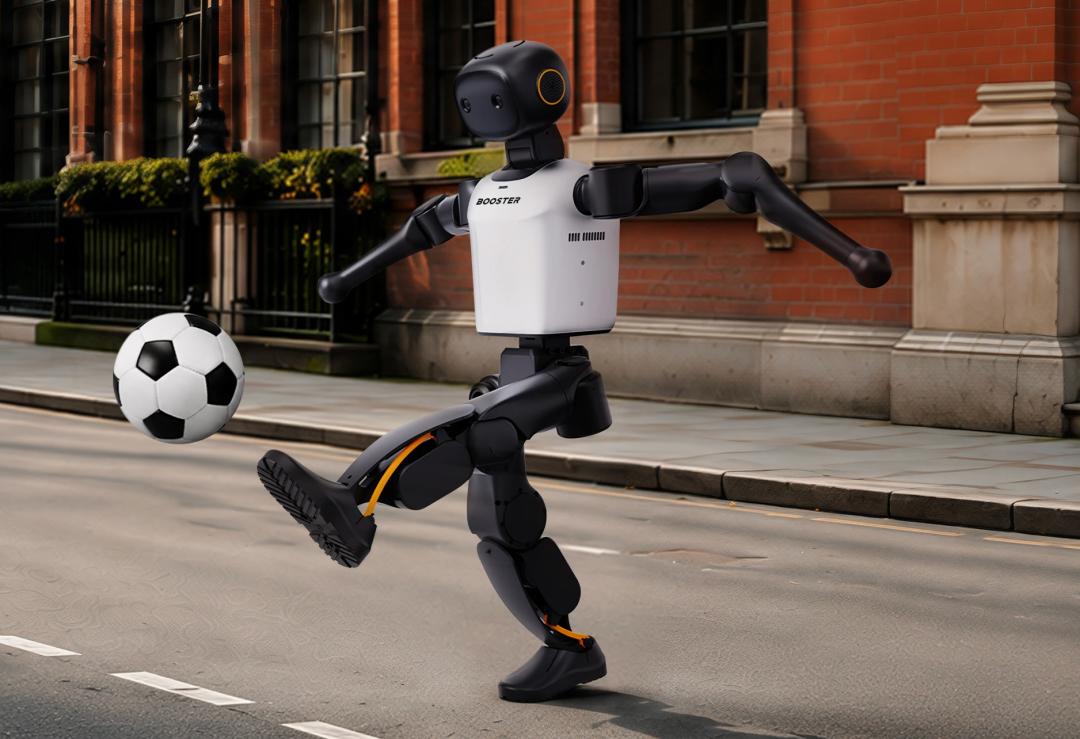
The advantage of robot football is that it is a relatively complete practical project in itself. Students need to learn around robot perception, motion control, decision-making and programming, and finally test the results through competitions.
Compared with simply displaying robots, this model is easier to form a continuous relationship among curriculums, clubs, training and competitions, and also provides schools with a relatively clear teaching organization method.
Songyan Power is trying another path, combining small humanoid robots with children's programming and regional science and innovation education.
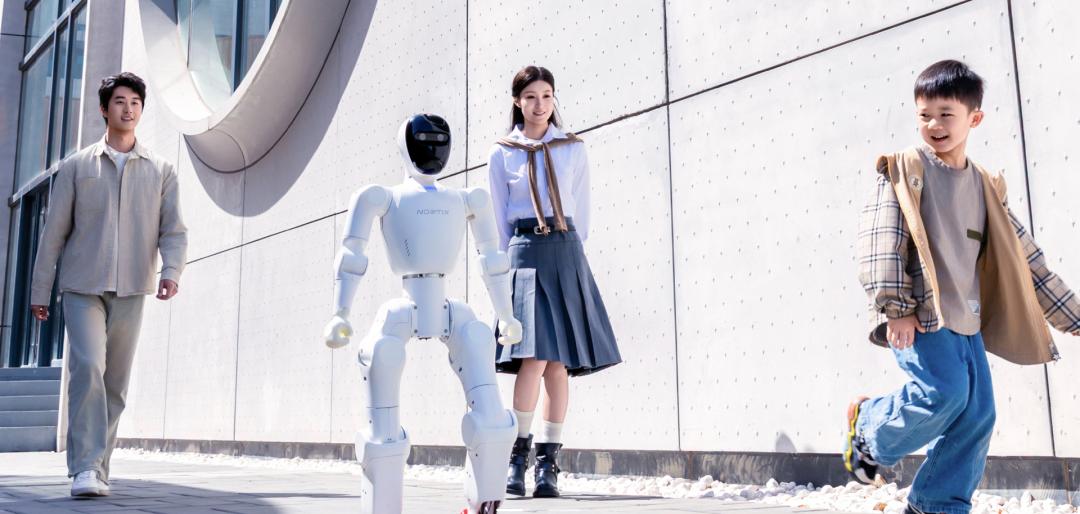
In May this year, the Education Committee of Changping District, Beijing signed a cooperation agreement with Songyan Power. The two sides proposed to establish a three-level hierarchical science and innovation teaching system of "Enlightenment-Advanced-Elite", and carry out cooperation around student training, teacher empowerment, joint curriculum construction and competition organization.
On the curriculum side, Songyan Power has also cooperated with educational institutions such as Codemao and Xiaomawang to try to introduce humanoid robots into programming education; on the family side, it explores the family education market through small humanoid robots such as Xiaobumi.
From the layout of these enterprises, we can see that embodied intelligence is bringing new product forms and teaching content to robot education. In the past, robot education was more focused on building, programming and basic artificial intelligence knowledge; now, students have the opportunity to directly access robots that can walk, perceive the environment and complete complex actions, and the learning content has accordingly extended to multi-modal perception, motion control and embodied interaction.
For enterprises, the real test lies in whether they can establish a continuously operating education service system.
This article is from the WeChat official account "Duozhiwang" (ID: duozhiwang), written by Wang Shang, authorized for release by 36Kr.