Taobao Flash Sale tests the waters of "Jiwa Canteen", sparking a three-way showdown in the takeout kitchen industry.
According to Dujia, Taobao Flash Purchase has piloted the "Jiwa Canteen" takeaway stores in some areas of Shenzhen. These stores are not self-operated back kitchens of Taobao Flash Purchase, but are actually operated by local catering merchants, possibly adopting a brand authorization cooperation model.
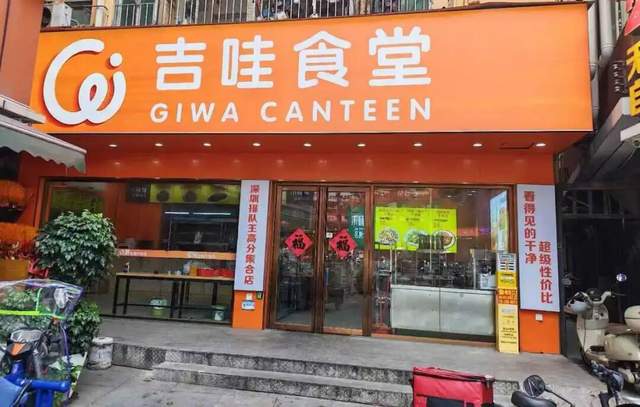
Caption: Screenshot of Jiwa Canteen Minzhi Store from Amap
According to the public information released by the China National Intellectual Property Administration, Lazas Network Technology (Shanghai) Co., Ltd., the operating entity of Taobao Flash Purchase, submitted the trademark registration application for "Jiwa Canteen" on October 14, 2026. The trademark pattern is completely consistent with the brand logo on the offline storefront, proving that this is most likely not a short-term traffic diversion activity, but a pilot project with a clear brand planning.
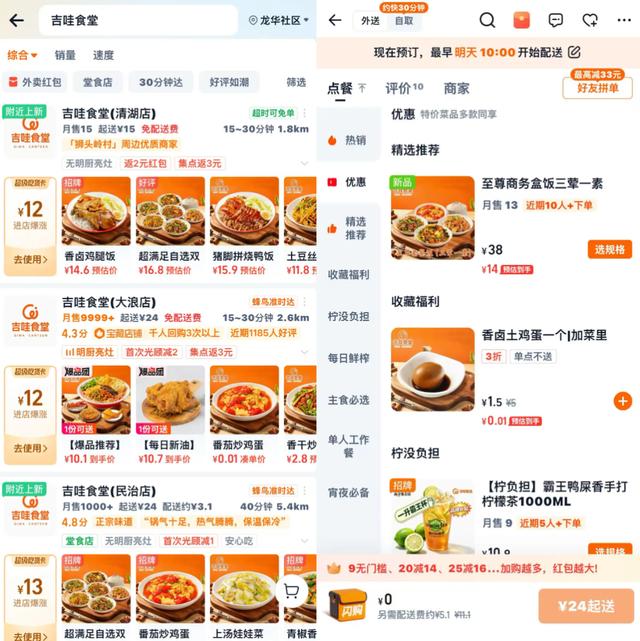
Open Taobao Flash Purchase and search for the Jiwa Canteen takeaway page, you can see that Jiwa Canteen has opened multiple branches in Qinghu, Dalang, Minzhi and other areas. Among them, the Dalang store has monthly sales of more than 9999 orders, marked with thousands of repeat customers; the newly opened nearby Minzhi store has monthly sales of thousands of orders. The products are mainly mass simple meals, including braised flavor rice, roast duck rice, home-cooked dishes and self-selected set meals, focusing on low price and high sales volume. Many dishes are set at 0.01 yuan for order filling, and group buys of best-selling products at just over 10 yuan, while offering discounts such as free delivery fee and in-store red envelopes. Some stores support dine-in, with a unified orange visual design for offline storefronts, displaying the slogan "Visible cleanliness, super cost-effectiveness", and some stores are marked with open kitchen programs.
It is worth noting that Meituan Raccoon Canteen and JD 7Fresh Mini Kitchen have already entered the similar track, but their operating models are different:
- Raccoon Canteen focuses on building aggregated stalls on the platform, the platform provides site infrastructure and introduces a number of merchants to settle in
- JD 7Fresh Mini Kitchen operates joint stores relying on its own supply chain
- Jiwa Canteen may take the asset-light OEM route: the platform owns the brand, outputs traffic and marketing methods, and the rent, back kitchen, ingredients and labor are all borne by cooperative merchants. The platform does not need to invest heavy assets to open stores, so the trial and error cost is lower
The core demand for giants to launch their own brand canteens intensively is to solve the long-standing trust problem in the takeaway industry. In the past, platforms were only traffic intermediaries, the quality of small stores was uneven, and food safety disputes occurred from time to time. Platform-owned brands are equivalent to using the platform's credit to endorse the dishes, unify the brand image and pricing strategy, making it easier to stably output cost-effective simple meals and attract price-sensitive users.
For Taobao Flash Purchase, this is also a step to make up for the short board of full-course meal business.
Taobao Flash Purchase previously focused more on supermarkets and fresh food retail, with weak supply of full-course takeaway. Through Jiwa Canteen, it can quickly expand the catering supply pool, and form synergy with Taobao Flash Purchase business in highlands of instant retail like Shenzhen. For settled merchants, the platform brand with built-in traffic saves the cost of building their own brands and doing online operations, so they can focus on meal preparation. #TaobaoFlashPurchase #TaobaoFlashPurchasePilotsJiwaCanteen #TaobaoFlashPurchase #TakeawayWar