2026 Q3 Household Environment Cleaning / Laundry Care Market Review
This week, we will review the market development of the home environment cleaning and laundry cleaning categories as well as the performance of key categories in 2026 Q3.
All reviewed data is sourced from Maisy Brand CT, the Maisy MSY150 Equilibrium Model and the Maisy Full-volume Store Model, and the applied models are marked in all data charts. The Maisy Brand CT data covers all cities at and above the county level across China (excluding townships, towns and villages), and deeply covers core urban agglomerations nationwide. The covered business formats include hypermarkets, large supermarkets, small supermarkets, convenience stores, and grocery stores. At present, Maisy Brand CT tracks more than 300,000 brands, over 10 million product barcodes, and more than 6 billion annual orders.
01 Overview of Home Cleaning & Personal Cleaning Categories:
Category Insight: Proportion and Year-on-Year Change in Sales Revenue
In the home environment cleaning category, we selected 5 high-proportion, representative sub-categories including dish soap, heavy-duty degreaser, general cleaner, disinfectant, and air freshener for focused analysis in the following sections. These 5 sub-categories account for over 90% of the home environment cleaning category in 2026 Q3.
First of all, looking at the overall situation of the category, the market pattern of the home environment cleaning category in 2026 Q3 is still dominated by dish soap, whose category proportion exceeds 65%, significantly higher than other sub-segments. Cleaners account for about 15%, ranking second; the proportion of sub-categories such as heavy-duty degreaser, disinfectant and air freshener are all less than 10%, with relatively low overall market share.
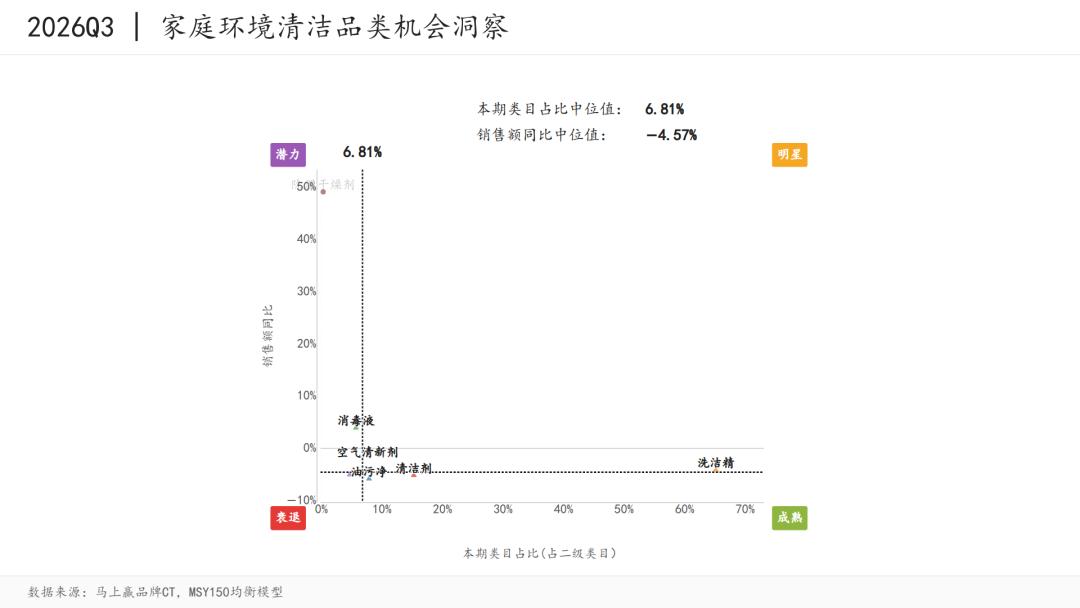
From the perspective of year-on-year sales change, the whole home environment cleaning category and all its sub-categories are under pressure. Only the small-scale desiccant sub-category maintains a high year-on-year sales growth rate of 50%. Among the key categories, only disinfectant achieves positive year-on-year sales growth, while the sales of air freshener, heavy-duty degreaser, cleaner and dish soap all decline slightly, with the decline rate staying around 5%.
In the laundry cleaning category, we selected 5 high-proportion, representative sub-categories including laundry detergent, laundry powder/laundry soda powder, laundry bar, fabric softener, and laundry pods for focused analysis in the following sections. These 5 sub-categories account for over 90% of the laundry cleaning category in 2026 Q3.
From the perspective of the category proportion pattern in 2026 Q3, the laundry cleaning category is still mainly composed of laundry detergent and laundry powder/laundry soda powder, which together occupy more than 80% of the market share. Among them, laundry detergent ranks steadily first with a proportion of over 40%, followed by laundry powder/laundry soda powder. In contrast, the proportion of sub-categories such as laundry bar, fabric softener and laundry pods is relatively low.
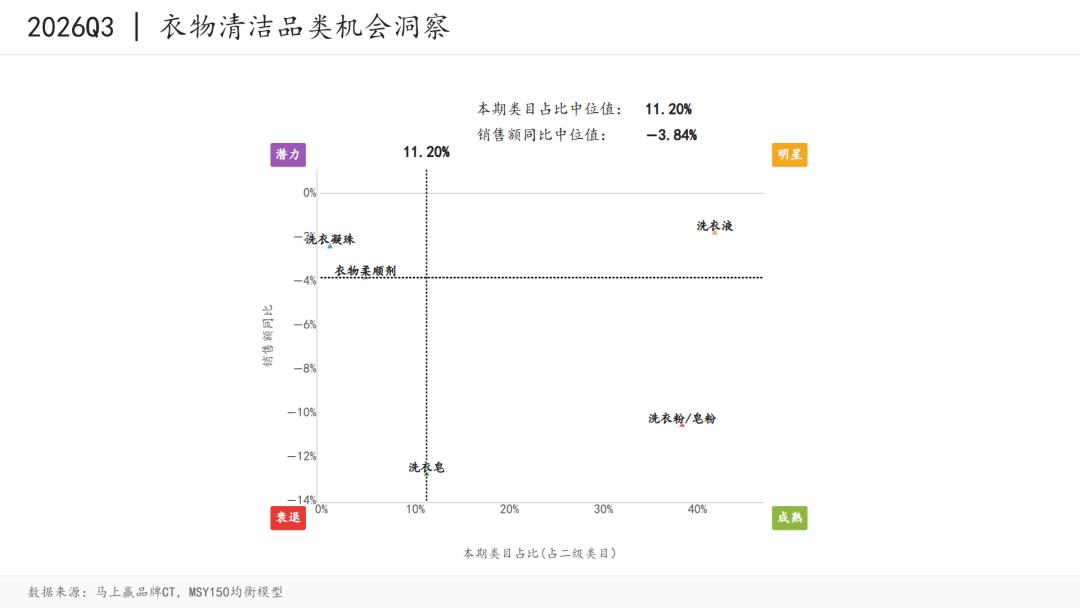
In terms of year-on-year sales performance, the overall laundry cleaning category is also facing certain downward pressure, and the 5 key sub-categories we observed all record negative year-on-year sales growth. Among them, the year-on-year sales decline of laundry detergent, fabric softener and laundry pods is within 4%, while the decline of laundry powder/laundry soda powder and laundry bar both exceed 10%. In addition to the overall market pressure, the faster decline of laundry bar and laundry powder/laundry soda powder may also indicate the structural migration of the laundry cleaning category: more consumers are accepting the product form of laundry detergent, and are switching from traditional products such as laundry bar and laundry powder to laundry detergent.
Maisy Price Index
To better analyze the price change and trend of the categories, we pulled the Maisy Price Index (WPI) of the home environment cleaning (home cleaning) and laundry cleaning (laundry care) categories from October 2024 to September 2026. The index takes 100 as the benchmark value. The fluctuation of its value represents the relative percentage of the category's price index compared with the price index of the same period last year. 100 means it is flat with the same month of last year, a value higher than 100 means the year-on-year price level rises, and a value lower than 100 means the year-on-year price level drops.
Looking at the price index trend of the home environment cleaning category from October 2024 to September 2026, the overall price level has shown a significant upward trend since 2026, especially since April 2026. The price index of the whole home environment cleaning category was below the 100 benchmark line for most of 2025, briefly rebounded at the end of the year and then fell back again in January 2026. After that, it gradually rose and reached 101.7 in September 2026, meaning the whole category has returned to the track of year-on-year growth.
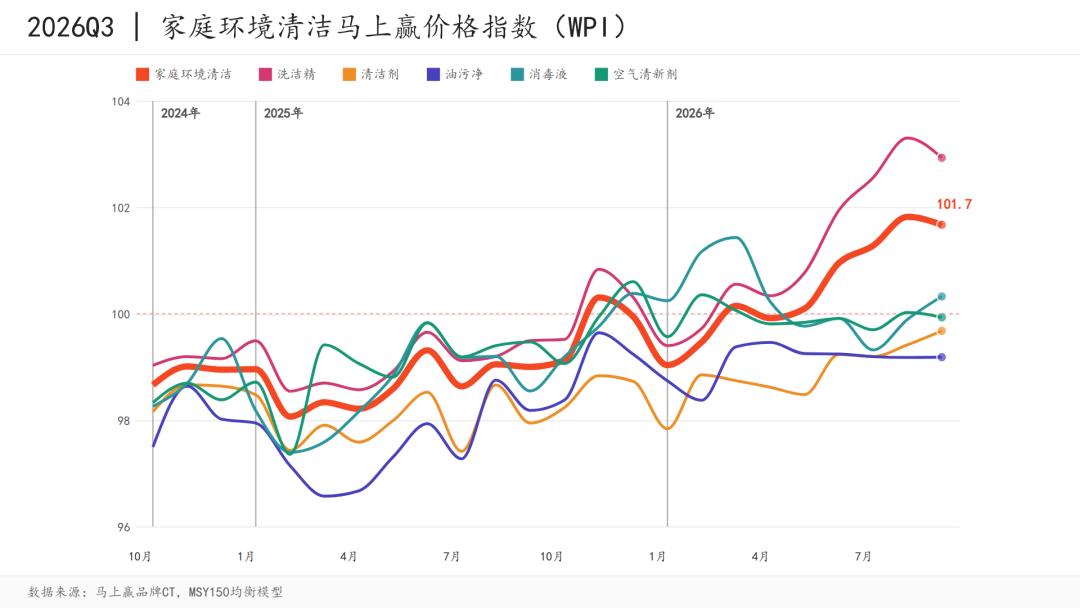
Among the sub-categories, the price index of dish soap rises most obviously. It gradually returned above the 100 benchmark line at the end of 2025, and continued to rise after entering 2026. Especially since May 2026, the increase has further expanded, and it has approached 103 by September. Combined with its proportion in the whole category, it has become an important sub-category driving the rebound of the overall category price index. The price index of other sub-categories such as disinfectant and air freshener have also fluctuated around 100 since 2026.
In contrast, the price performance of heavy-duty degreaser and general cleaner is still under relatively high pressure. The price index of heavy-duty degreaser once dropped below 97 in 2025, and then gradually rebounded, but still failed to break through 100 by September 2026; the price index of general cleaner has long fluctuated between 98 and 99. Although it rebounded in the second half of 2026, it is still slightly lower than the benchmark line.
Looking at the price index trend of the laundry cleaning category from October 2024 to September 2026, the overall price level of the whole category also shows a certain upward trend. Especially in 2026, on the one hand, the upward trend is more obvious, on the other hand, its price index has broken through 100 in April and May 2026, showing an overall year-on-year rising trend.
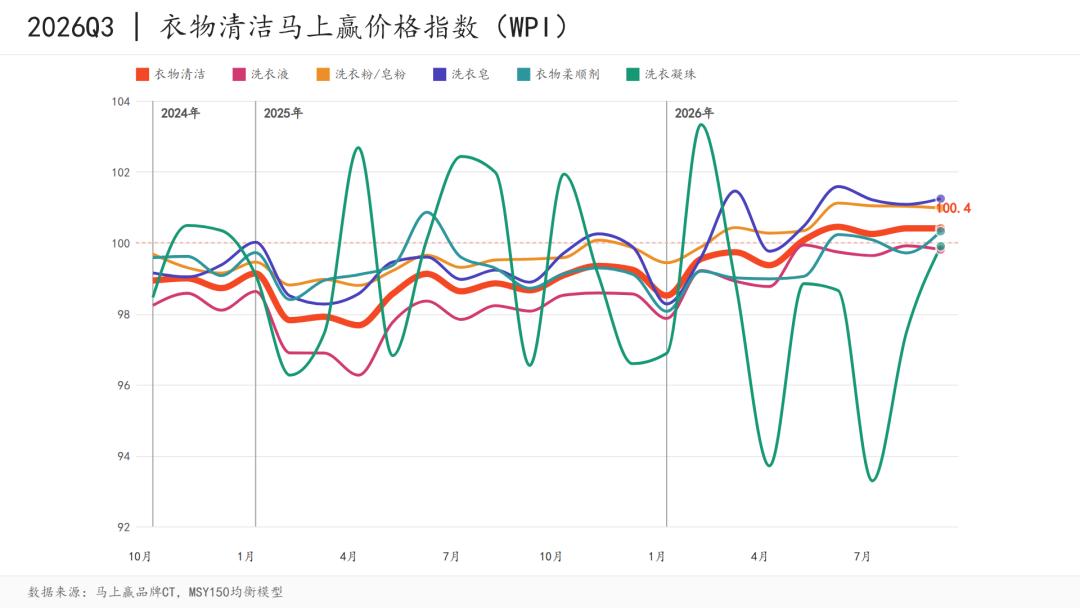
Among the sub-categories, the price performance of laundry powder/laundry soda powder and laundry bar is relatively prominent. The laundry powder/laundry soda powder shows a fluctuating upward trend, and stabilizes above 100 after March 2026; the laundry bar briefly fell back at the beginning of 2026 and then rebounded rapidly, remaining above the 100 benchmark line afterwards. The price index of laundry detergent has long fluctuated around 98, and gradually rebounded in the second half of 2026 to be close to the 100 benchmark line; the fabric softener mainly fluctuates between 99 and 100. In contrast, the price index of laundry pods has risen and fallen sharply for many times. This obvious price fluctuation may be related to the fact that the market size of laundry pods is still relatively small, and the impact of promotional activities on the price index is more significant.
Average Price Per Unit / Specification Change
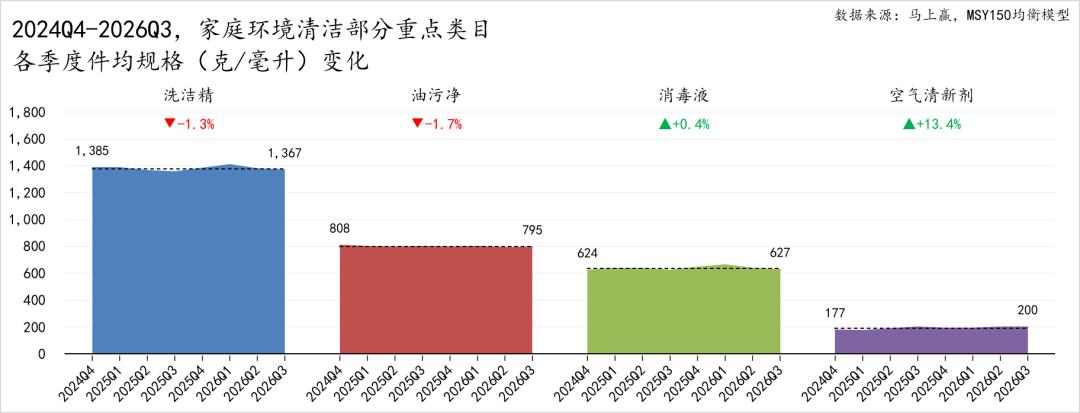
Looking at the change of average specification per unit of key home environment cleaning categories from 2024 Q4 to 2026 Q3, the product specifications of the home environment cleaning category are relatively stable. Except for air freshener, other sub-categories have no significant change in average specification per unit. Dish soap has the largest average specification per unit, which remains above 1350g for a long time; the average specification per unit of heavy-duty degreaser also drops slightly from 808g to 795g. In contrast, the average specification per unit of air freshener increases from 177g to 200g, which may reflect that the market proportion, consumer demand and supply of large-capacity products have increased.
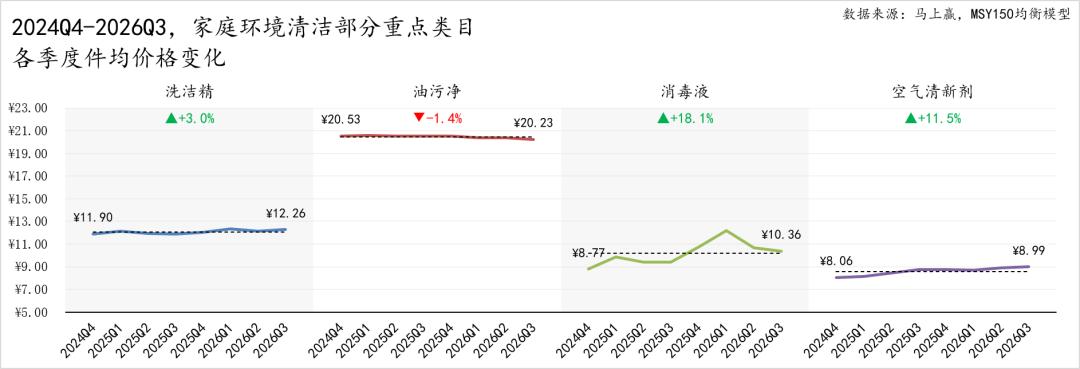
From the perspective of average price per unit change, the average price per unit of heavy-duty degreaser always remains above 20 yuan, with a slight drop of 1.4%, which is the highest price and the most stable trend among the four sub-categories. The average price per unit of dish soap also remains basically stable, rising slightly from 11.90 yuan to 12.26 yuan. In contrast, the price of disinfectant rises most obviously, with large overall fluctuation. Its average price per unit increases from 8.77 yuan to 10.36 yuan, and once broke through 12 yuan in 2026 Q1. The average price per unit of air freshener increases from 8.06 yuan to 8.99 yuan, showing a relatively steady upward trend.
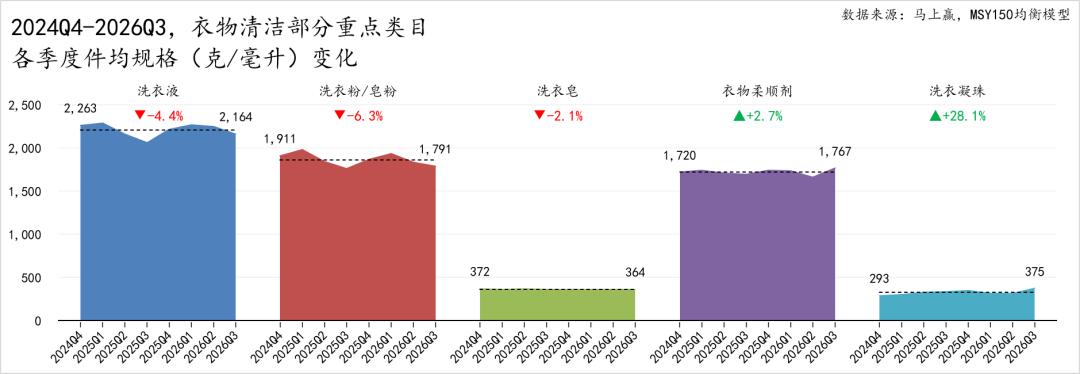
Looking at the change of average specification per unit of key laundry cleaning categories from 2024 Q4 to 2026 Q3, only laundry pods show obvious specification growth, while other sub-categories have little change, and the fluctuation is more affected by seasonal periodicity. Among them, laundry detergent and laundry powder/laundry soda powder are still the two sub-categories with the largest average specification per unit, but both show a slight overall contraction trend. The average specification per unit of laundry bar also shrinks slightly by 2.1%. The average specification per unit of fabric softener increases by 2.7%, remaining at about 1700g.
In contrast, the growth of average specification per unit of laundry pods is the most prominent, increasing from 293g to 375g, with an increase of 28.1%, which is significantly higher than other sub-categories. This may reflect that the market proportion of large-specification, multi-pack products has increased, or it may be because this sub-category is more emerging than traditional laundry cleaning categories, so the market competition and the pursuit of cost performance are more important.
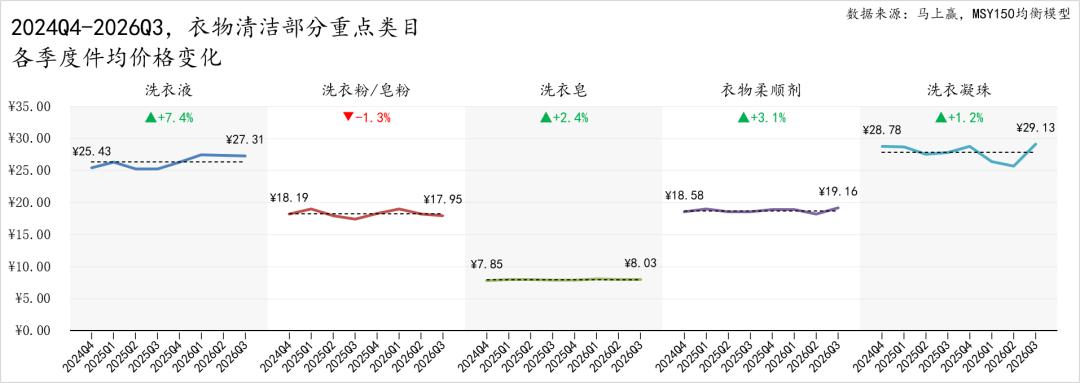
From the perspective of average price per unit change, the average price of most sub-categories rises steadily, which is consistent with the trend presented by the Maisy Price Index. Among them, the average price per unit of laundry detergent rises from 25.43 yuan to 27.31 yuan, which is the sub-category with the most obvious average price per unit growth. Laundry pods have the highest average price per unit, with a slight increase of 1.2% and obvious price fluctuation. The average price per unit of fabric softener and laundry bar also has a certain increase. In contrast, the average price per unit of laundry powder/laundry soda powder drops slightly from 18.19 yuan to 17.95 yuan, with a small decline. Combined with the change of average specification per unit, the specification of laundry detergent shrinks slightly and the average price per unit rises, while laundry pods significantly expand the specification while the average price per unit remains basically stable, reflecting the differences in specification and pricing adjustment of different categories and different product forms.
Number of New Products
Next, we will observe the new product launch situation of all sub-categories of home environment cleaning and laundry cleaning in 2026 Q3.
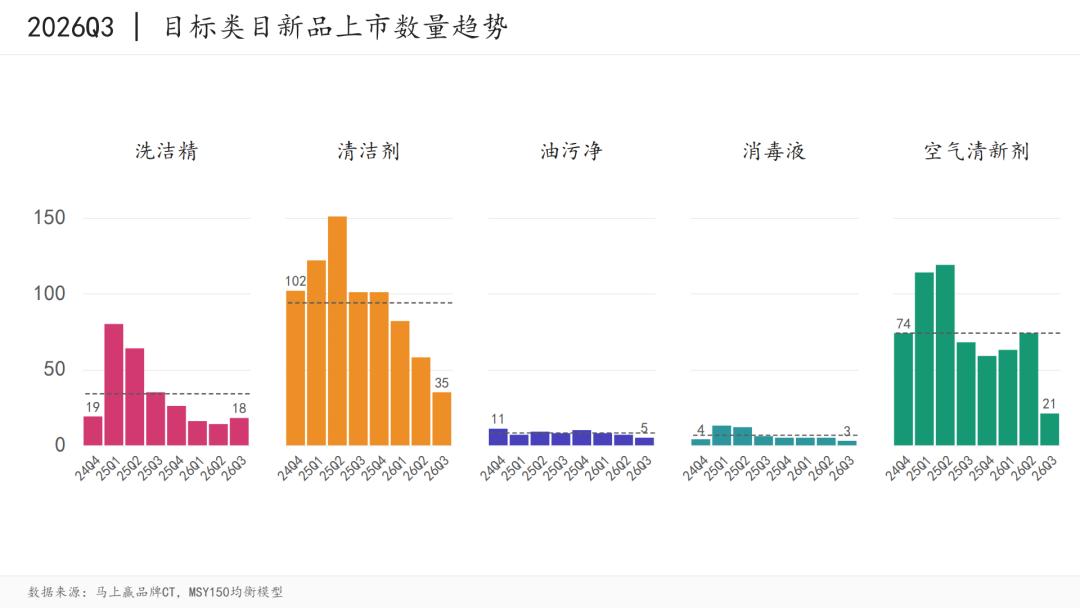
Looking at the number of new products launched of key home environment cleaning categories from 2024 Q4 to 2026 Q3, all sub-categories show an overall trend of rising first and then falling. The number of new products launched in each quarter of 2026 has decreased to a certain extent compared with the same period in 2025, which may indicate that brands in the category are more cautious about the market trend.
From the perspective of different sub-categories, general cleaner and air freshener are the two sub-categories with more active new product launches, both reaching a phased high in the first half of 2025, and then falling back continuously, dropping to 35 SKUs and 21 SKUs respectively in 2026 Q3. The number of new products of dish soap also shows a gradual decreasing trend. In contrast, the number of new products launched of heavy-duty degreaser and disinfectant is always at a low level, and the market new product promotion activities are relatively limited. This may reflect that the demand growth of the home environment cleaning market is slowing down, brands' new product development strategies tend to be more cautious, and mature categories have relatively limited space to expand the market through new products.
