Who calls the shots when your AI smartphone operates apps on your behalf?
Imagine this scenario. You say to your phone: "Find a nearby restaurant with available seats and send the address to your family members." The assistant needs to look up restaurants, verify the time slot, and then open the chat application. It can only sort out several candidates, fill the address into the input box, or press the send button for you. For the same instruction, which step it can complete is related to which applications it needs to use, which data it will access, and whether you still have the chance to change your mind.
On November 6, the Ministry of Industry and Information Technology of the People's Republic of China publicly released the Notice on Strengthening the Network Access Management of Intelligent Agent Terminal Equipment. The document includes telecom terminals such as smartphones, tablets, and wearable devices pre-installed with intelligent agents into relevant management, covering adaptation verification, network access testing, live network upgrade, and application distribution. For consumers, when buying an AI phone, you can ask one more question: For those few apps I use every day, what exactly can this phone help me accomplish?
Whether the App Consents Shall Be Declared by Developers First
Mobile phone manufacturers can pre-install assistants in the system, but restaurant orders, chat records, and after-sales services for online shopping are usually processed in their respective apps. When an intelligent agent crosses boundaries to perform tasks, it calls third-party applications. The Notice requires application distribution platforms to push App developers to actively declare with electronic signatures whether they consent to being called by intelligent agents. Without the consent declaration from developers, intelligent agents shall not forcibly call or access the relevant application.
This gives App developers a clear right of decision. Taking the after-sales service of online shopping as an example, the assistant can guide users to open the order page, read the order details, fill in the refund application on behalf of the user, or submit it directly, with different involved data and operation consequences. Which types of capabilities to open, how the system identifies failures, and whether users can continue to handle operations manually will all affect whether a call can become a stable service. For mobile phone manufacturers, the layer reached by cooperation determines how much of the "one-sentence processing" in sales demonstrations can become part of daily experience.
Developers' declarations and users' specific instructions should also be viewed separately. The former answers whether the App accepts calls from intelligent agents, while the latter involves which permissions will be used and which step will be completed for this task. Even if an App accepts calls, whether confirmation is required when sending messages, submitting applications or making payments still depends on the arrangement of specific products, applications and scenarios. The Notice clarifies the developer consent mechanism. For consumers to understand at which step they can confirm or stop the operation, they still need to refer to the actual operation process on the mobile phone.
This also affects how mobile phone manufacturers sell this function. During the demonstration, manufacturers can select connected applications, pre-set accounts and permissions, and then demonstrate a complete operation. When it is in the hands of consumers, the commonly used food delivery, travel or office software may vary from person to person, and the value of the same function will change accordingly. People who are willing to pay extra for the assistant can ask the salesperson to show the available applications and scenario descriptions, and then operate one of them on site. Whether it can cover the trivial thing you have to do every day is easier to measure than how many functions it supports.
The Purchased Model and System Shall Match Each Other
The task runs successfully in the sales demonstration, but the result may be different if you switch to another model or a different system version. The Notice requires intelligent agent developers to verify the adaptation with terminals, and list the verified terminal models and operating system information on the product setting page. Before the intelligent agent is launched on the market, developers shall also submit the verification status to the distribution platform. The platform shall also make the adaptation list public on the distribution page, and restrict downloading and installation on incompatible device models.
Checking the model and system information in the list clearly is more useful than remembering a series name. When buying a mobile phone for family members, you can check two things separately: whether this device is within the adaptation scope, and to what extent the commonly used Apps of your family members can perform operations. The adaptation list answers whether the intelligent agent is compatible with the device. To know whether the assistant can look up routes in the commonly used map App and send addresses in the commonly used chat software, you need to check specific scenarios, and it is best to test it with a device of the same model.
In addition to adaptation, there is also network access testing. For relevant terminals pre-installed with intelligent agents, the Notice requires carrying out intelligent agent adaptation verification in the network access testing, legally assessing fraud-related risks, and conducting pre-evaluation of anti-fraud capabilities. Terminal production enterprises shall ensure consistency before and after obtaining the certificate, report to the Ministry of Industry and Information Technology when major changes occur to the equipment, and conduct testing as required. After the policy is made public, whether a certain device on sale or a certain system version has completed relevant verification shall still be subject to the corresponding testing and adaptation information.
For the Statement of "It Will Be Usable After Future Update", Clarify Which Exact Update It Refers To
When you first buy the mobile phone, the assistant may only be able to find information. After a system update, it may start to fill in forms or submit tasks across applications. For users, the assistant icon on the screen remains the same, but the actions that this mobile phone can perform on their behalf have changed. For manufacturers, expanding from information query to handling affairs on behalf of users also means that they need to deal with data security and execution risks in more scenarios.
According to the Notice, when terminal production enterprises carry out live network upgrade of intelligent agents through online push and other methods, they shall submit a plan to the Ministry of Industry and Information Technology, explaining which users the upgrade is for, the coverage scale, what services are provided in which scenarios, and how to implement measures such as data security and anti-fraud. After the upgrade is completed, they shall also submit a report, which can be officially provided to users only after the Ministry of Industry and Information Technology organizes expert evaluation and solicits opinions. This set of procedures is aimed at the live network upgrade of intelligent agents, and the specific content of the update shall be referred to when understanding.
This also adds a practical verification condition for the "future support" when purchasing a mobile phone. If the salesperson says the function will be pushed later, you can ask him to distinguish between the functions that have been launched, the functions that are under trial, and the functions that are expected to be opened later, and then ask about the corresponding model and system version. If you already have the device in hand, you can read the version description first when receiving the update, check whether the new added function is information sorting, or actions such as form submission and message sending, and then check the permissions related to these actions in the settings. If you can't see the specific changes clearly, you can try a low-risk trivial thing first, such as asking the assistant to sort out a route, and see at which step it will stop.
When Selecting and Testing the Device, Clarify Three Matters
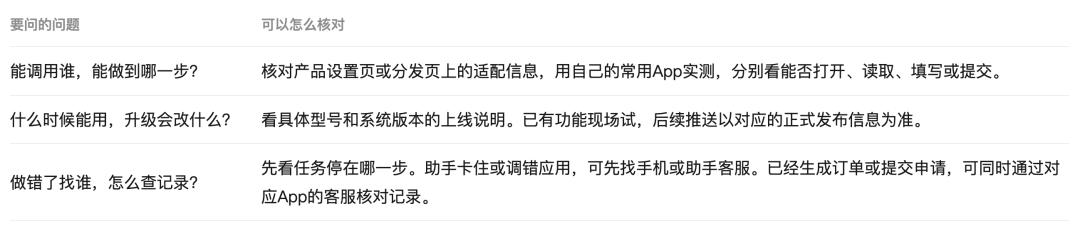
The last question is easily overlooked. For example, you only ask the assistant to compare two stores, but later you find an extra order in the App. At this time, the most useful thing is to check the order status, time and amount first, and then save the instruction you sent, the execution prompt of the assistant and the order page. When the assistant shows "Completed", it may only have filled in the information, or it may have submitted the order. Only by clarifying this step can you know whether you should handle the order or feedback the execution problem to the mobile phone or assistant manufacturer. The customer service entrance is the starting point for finding out the situation, and the specific responsibility shall be judged in combination with who performed what action, whether there was confirmation at that time, and the retained records.
For shared devices at home, or when configuring mobile phones for the elderly and children, you can specially test the process before sending. Ask the assistant to fill in a piece of privacy-unrelated address into the chat box, and see if it will display the recipient and content, whether it will wait for confirmation, and whether you can exit halfway. The experience of some devices is suitable for the assistant to prepare first, and finally submitted by the user. In this way, when you really encounter the situation of sending the wrong address or selecting the wrong contact, you can know at which step you can take over.
If the price difference between two mobile phones mainly comes from the cross-application execution capability, you can compare the two things you do most often. For example, one is to send the route to your family members, and the other is to check the order and prepare the after-sales application. Being able to cover commonly used Apps, knowing at which step the assistant will stop, and being able to check the execution record when a problem occurs, these are the differences that you can personally verify before paying.