The assured consumption platform has been launched. How can I check the commitments made by merchants?
When you take your family to a scenic area on weekends and ask about rescheduling before booking, you may find the conditions stated by the front desk at the store are different from those on the booking page after arrival. Who should you turn to for verification? First, you need to clarify which store it is, who collected the payment, and which commitment applies to this order. In the future, when you see a "Hassle-Free Consumption Code" posted at the store entrance, you can scan it first to check what information the store has made public.
On November 3, the National Hassle-Free Consumption Platform built by the State Administration for Market Regulation was officially launched. Consumers can search for the "Consumption Check" mini-program, or scan the offline Hassle-Free Consumption Code. The merchant homepage brings together business licenses, in-store real-scene photos, hassle-free consumption commitments, consumer reviews and after-sales methods. For a family going out for meals, shopping or booking accommodation, this entry turns "what this store says" into information that can be checked before payment. If a dispute really arises, you still need to refer to the specific store, commitment content and order records.
Scan the code first to verify that it is the exact store in front of you
Merchants register on the platform first, make commitments online, and obtain the corresponding Hassle-Free Consumption Code and unified logo for their stores after verification and public notification. The first batch of settled scale announced by the State Administration for Market Regulation covers more than 10,000 hassle-free consumption units and 100 hassle-free consumption clusters. The former mainly refers to individual business entities, while the latter can be areas with management entities such as business districts, markets and scenic spots. When you see the logo at the entrance of a scenic area, you can click to check whether it corresponds to the entire scenic area or the specific store where you plan to consume.
There may be multiple branch stores under the same brand name. After the page pops up from scanning the code, first check the store address, real-scene photos and the operator listed on the business license, then compare them with the merchant information in your order. The brand name may be different from the operator name on the license, and you cannot judge there is a problem solely based on the name difference. For example, for the same chain restaurant, the map marks it as the mall branch, but the food delivery order page selects another branch. Only by clarifying which store actually accepts the order can you determine which page of commitments to refer to, and it is also convenient to find the responsible store afterwards.
You can also use "Consumption Check" to look up surrounding stores before arriving. The first batch of the platform has been connected with Baidu Maps, Meituan Waimai, Taobao Flash Purchase and JD Waimai. You can search for relevant locations on Baidu Maps through keywords such as "Hassle-Free Consumption Map", and food delivery platforms display commitment labels on some stores. The State Administration for Market Regulation announced that the first batch of food delivery platforms has enabled the function for about 3,000 catering stores. This figure is calculated under a different statistical caliber from the total number of settled stores on the national platform. The Administration also disclosed that the first batch of cross-platform display has been implemented in 9 cities including Beijing, Hangzhou, Quanzhou and Shenzhen, and will be promoted later. You can verify the corresponding store after seeing the label. If no results are found, it may be that the local area has not been covered yet, or the merchant has not participated in this commitment. You can still check the business licenses, order terms and after-sales methods through the original channels.
Verification, Public Notification and Review: What Do They Respectively Explain
Business licenses are clues to identify business entities, commitments are the publicly expressed operation and service requirements of merchants to consumers, and star ratings are experience feedback left by consumers. Checking the three types of information together can reduce the time spent searching back and forth. Checking them separately can help you understand what each item indicates. A high star rating can provide experience reference, and consumer reviews and inspection conclusions from regulatory authorities come from different sources. The settlement logo indicates that the merchant has gone through the process of commitment, verification and public notification, but the government does not provide quality or refund guarantee for every single order as a result.
Some of the commitments on the platform are common requirements around safety, quality, price, service and rights protection. When it comes to matters you care deeply about, you also need to ask about the applicable conditions. For example, when a traveling family books a homestay, what really needs to be confirmed is the deadline for rescheduling, how much will be deducted for cancellation, and whether the rules apply on holidays. Whether a restaurant allows refund of unused set meal coupons also depends on the specific store, the type of coupon and its validity period. After finding the commitment, you can send these specific questions to the store, and try to keep clear replies on the order page or in the chat history.
The logo will also change with the actual performance of the merchant. The State Administration for Market Regulation has made it clear that if merchants violate laws and are untrustworthy, refuse to fulfill their commitments, or deliberately prevaricate consumers' reasonable demands, consumers can report to the local market regulatory authority. Once verified, the relevant merchants will be ordered to exit the platform, and their offline logos and codes will be recovered. For small stores, public commitments can be seen by more people on maps, food delivery platforms and offline stores. Whether it can bring repeat customers depends on whether the store staff, cashiers and after-sales personnel can act in accordance with the same set of conditions.
For a small store that provides both dine-in and food delivery services, the most prone problem is that the commitment is displayed in one entry while the order is placed in another. For example, the store says unused reservations can be cancelled, but the set meal coupons on the food delivery platform have independent rules. If the merchant writes the applicable channels, start and end time and refund method on the corresponding page, and the person in charge of answering calls can reply in accordance with the same conditions, customers will avoid the cost of going to the wrong store or contacting the wrong customer service. Whether the commitment can bring more orders depends on whether these details can be fulfilled in actual transactions.
Spend One Minute Checking Four Items Before Arriving at the Store
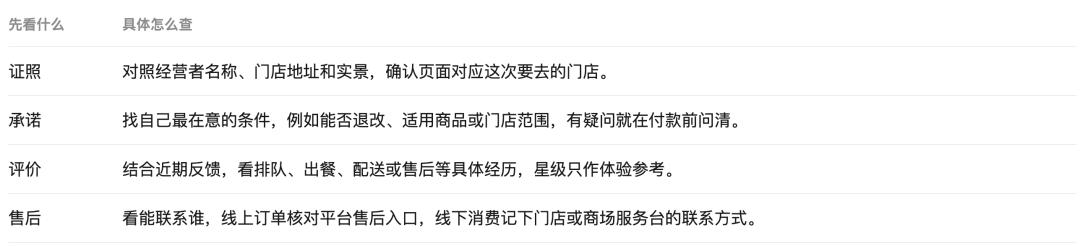
These four items are also suitable for comparing two stores in the same business district. For example, when taking the elderly out for dinner, you may be more concerned about whether there is an accessible entrance and whether the reservation can be rescheduled. Business licenses and real-scene photos can help you find the right store, and the actual service conditions need to be reconfirmed. When several people book a table together, try to put the answers and the corresponding order together before payment, such as who buys the coupon on the platform, which store will verify the coupon, and how to handle the situation when one person cannot come temporarily, so as to avoid that everyone only remembers a verbal statement after arriving at the store.
If you are going shopping in a business district in a different city for the first time, you can also check the after-sales service of the cluster conveniently. The cultivation guidelines require the cluster to make commitments on matters such as rights protection service stations and first-responsibility system. In case that the counter in the mall is closed and you do not have time to return during the trip, first keep the contact information of the business district service desk, and then write down the operator on the order. In this way, you can find the person in charge of coordination, and also know which specific merchant accepted the order.
Make Sure the Order Matches the Commitment After Payment
The platform has already provided functions such as navigation, review and phone contact. If you encounter after-sales problems, you can contact the store through the merchant page, or use the after-sales entry of the original ordering platform. "One-click Reconciliation" is the follow-up expansion direction announced by the Administration. Currently, if you encounter problems with rescheduling, refund or unfulfilled services, you still need to handle them through the actual transaction channel. Phone calls are suitable for quickly reaching the contact person. When it comes to the amount of money, time limit and processing result, you can ask the other party to confirm it on the order after-sales page or in the chat window.
For example, when a family books accommodation, the store clearly promises in the chat that free rescheduling is allowed before a certain time, but later asks for a price difference. When communicating with the store or the ordering platform, you can present the rescheduling terms on the booking page, the store's reply and the order number together. For offline payment, keep the receipt, invoice or payment record. The payment record can prove how much you paid, and the product page, contract and chat record can help explain which service you bought and what the other party promised. Only by putting the two types of materials together can you describe the problem completely.
If no agreement is reached after negotiation, you can file a complaint through the national 12315 platform, 12315 hotline or other channels announced by the market regulatory authority. When filing a complaint, you need to provide your identity and contact information as required, state the name and address of the operator, what happened, what specific handling you expect, and provide corresponding factual basis. Leaving a negative review can share your experience, while submitting a complaint requires you to clearly state the order, commitment and demands. The two things can be handled separately.
For consumers, the most useful moment of the code at the store entrance is often before payment. First find the right store, then clarify the conditions you care about. For consumption with a large order amount and tight rescheduling time, keep the replies and vouchers in the original channel. In this way, even if the store staff, customer service or processing platform changes, both parties have the same record to verify.