Liang Wenfeng hosted a gathering for his fellow townspeople.
In Guangdong in the 1990s, factories were recruiting workers and businesses were booming. As long as young people were willing to venture out, they could earn their first bucket of gold. The private economy was thriving, and many people believed that wealth could change fate more effectively than a diploma.
However, a primary school teacher in Wuchuan, Zhanjiang, Guangdong, stuck to his own beliefs. Even though parents often came to his door telling him that "studying is useless", he still attached great importance to education and insisted that his son study hard. The son lived up to expectations and was admitted to Zhejiang University at the age of 17.
Over the following two decades, the young man completed his undergraduate and postgraduate studies in Hangzhou, focusing on machine vision. He tried to apply machine learning to financial trading with his classmates, and later co-founded a quantitative investment institution with Zhejiang University alumni. In 2015, High-Flyer Technology was established in Hangzhou. In 2023, DeepSeek was also born in Hangzhou. That young man from Guangdong rose to prominence.
Just like Liang Wenfeng's hometown Guangdong, Zhejiang, where DeepSeek is based, boasts a vibrant private economy and a long-standing tradition of doing business.
As early as the Ming and Qing dynasties, the Longyou Business Group, Ningbo Business Group, and Shaoxing Business Group had been active across the country. In modern times, Ningbo merchants traveled along waterways to Shanghai, running money shops, shipping and trading businesses. There was a saying in old Shanghai that "no market can thrive without Ningbo people". After the reform and opening-up, Wenzhou merchants traveled all over the country, small commodities from Yiwu were sold around the world, and Hangzhou gradually became a key hub for internet and technology startups.
Business ultimately relies on people. Seniors support juniors, and when juniors achieve success, they never forget the old bonds. Relationships and trust gradually accumulate through business interactions, leaving room for negotiation on many matters.
In 2026, when Liang Wenfeng opened the door to external capital for the first time, a group of Zhejiang-based capital players quickly gathered behind him. Behind this company with strong technical idealism, there stands a group of capital figures deeply rooted in local business traditions. At first glance, it looks quite like a "fellow townsmen circle" of Zhejiang capital.
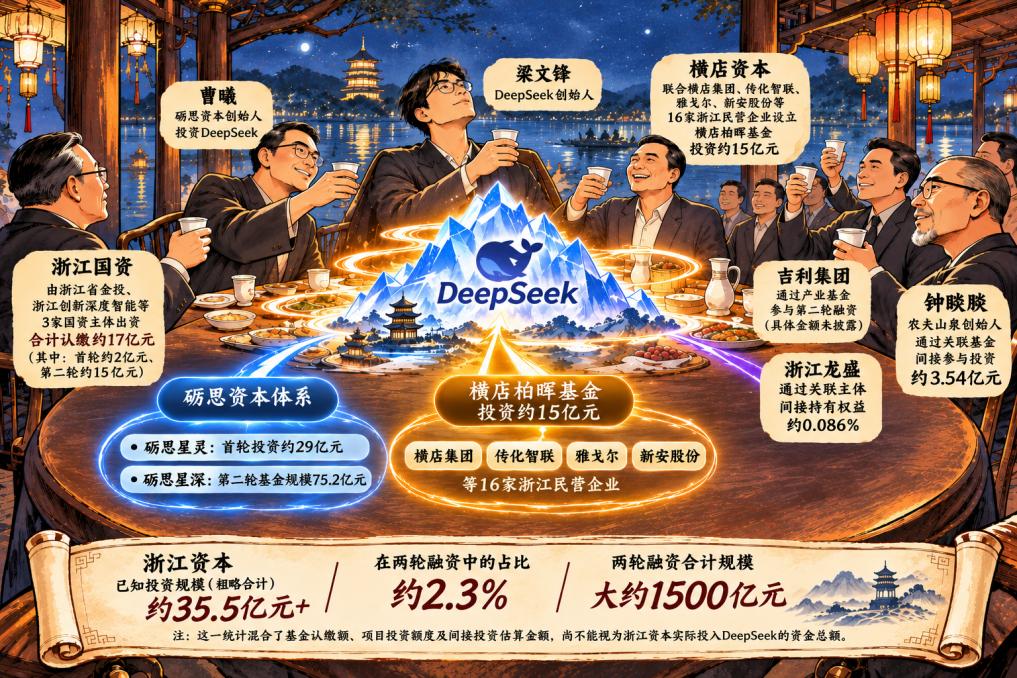
After a rough sort-out, the currently identifiable Zhejiang-related capital involves an amount of about 3.55 billion yuan. If calculated based on DeepSeek's two rounds of total financing of about 150 billion yuan, it accounts for roughly 2.3%. However, this figure mixes the subscribed amounts of funds at different levels and the investment amount of the project, which can only serve as a preliminary reference for the scale of capital participation, and cannot be regarded as the actual capital contribution proportion of Zhejiang capital.
The 2.3% figure does not look high, but it is actually not low considering the financing threshold of DeepSeek. Taking the first round of financing as an example, Liang Wenfeng and the founding team still firmly hold the control of the company. Hangzhou Chengli, as an important external shareholding platform, holds about 8.52% of DeepSeek's equity. Although this cannot be regarded as the shareholding ratio of all external investors, in such a financing with tight investment qualifications, Zhejiang capital securing a seat is already eye-catching enough.
Looking closely at the players in this capital game, there are local state-owned assets, private enterprises organized by the Hengdian system, and Zhejiang billionaires like Zhong Shanshan. They originally ran their own businesses and followed their own capital paths, but finally intersected at DeepSeek.
The outside world has no way of knowing how many old friendships and how many new interest consensuses lie behind these funds. The only thing certain is that in such a project with tight investment shares, getting a seat at the table is never an easy task.
"The arena is not just about fighting and killing, it is all about worldly wisdom and personal connections." Even for the most cutting-edge technology like large models, when it comes to sharing the benefits, there is still a network of relationships that ordinary people cannot see clearly behind the scenes.
AI-generated illustration
Cao Xi Bridges the Gap, State-owned Assets Enter the Game
Let's start with the background.
Liang Wenfeng once looked for investors in his early years, but he gave up the idea because his focus on cutting-edge exploration did not align with the profit-seeking demands of VCs. But this did not stop wave after wave of investors from queuing up to visit DeepSeek. I remember a rather prestigious investment institution told me at that time, let's go queue up and get a number first, just in case there is a financing opportunity in the future.
Thanks to their good forward planning, this institution has finally appeared on DeepSeek's investor list recently. However, the most prominent player in this round is Cao Xi's Lisi Capital. It has not only appeared in DeepSeek's financing network for two consecutive rounds, but also has naturally become the largest "channel" for DeepSeek's shares.
Speaking of which, Lisi Capital was not established long ago, but it has already laid out its presence in the most popular tracks of China's AI startups, including Moonshot AI, MetaX, MIPS... Lisi Capital has its footprints behind all of them. Centered around DeepSeek, in May this year, when DeepSeek's first round of financing entered a critical stage, Tianjin Lisi Xingling Fund under Lisi Capital was established. After that, this fund with a scale of about 2.9 billion yuan indirectly participated in DeepSeek's financing through Hangzhou Chengli.
The first round of investors were personally selected by Liang Wenfeng. As for how he established contact with Cao Xi and when the two first talked about investment, we have no way of knowing. But the financing access ticket that Lisi Capital got for DeepSeek is enough to show Cao Xi's great popularity.
This access ticket soon demonstrated its value.
In the LP list of Lisi Xingling Fund, the third phase of Zhejiang Provincial Golden Investment Science and Technology Innovation Parent Fund has appeared, holding about 6.9% of the fund shares. Roughly converted according to the fund scale, it corresponds to a capital contribution of about 200 million yuan.
Zhejiang state-owned assets thus entered DeepSeek's indirect investment network. Some media disclosed that the participation of state-owned assets in the first round was not high. Only the National Artificial Intelligence Industry Investment Fund directly invested in DeepSeek, contributing about 980 million yuan, with no lock-up period restriction and enjoying voting rights in the company.
In the second round, the cooperation between Zhejiang state-owned assets and Cao Xi further expanded.
At the beginning of November, another fund under Lisi Capital, Tianjin Lisi Xingshen, completed fundraising of 7.52 billion yuan, with 40 LPs participating, and Lisi Capital continued to obtain DeepSeek's investment shares.
Among them, Zhejiang Innovation Deep Intelligent Venture Capital Partnership subscribed 1.4 billion yuan, as the second largest contributor to the fund. In addition, the two funds of Zhejiang Provincial Science and Technology Innovation Strategic Emerging Fund and Science and Technology Innovation Future Fund each subscribed 50 million yuan. The three Zhejiang state-owned entities subscribed a total of 1.5 billion yuan.
From about 200 million yuan in the first round to 1.5 billion yuan in the second round, the subscription scale of Zhejiang state-owned assets to Lisi-related funds has increased significantly. However, Xingshen is a blind pool fund, and public information cannot yet prove that all of the 1.5 billion yuan is actually invested in DeepSeek, nor has Lisi Capital made any public response to the outside world.
In the capital circle, being able to raise money is one skill, and being able to secure good projects is another. Cao Xi happens to have both skills. But in my opinion, the ability to win projects is even more important. You know, so many people holding money want to invest in DeepSeek but can't find a way in, yet Cao Xi gets it done effortlessly.
Hengdian Organizes the Game, Zhejiang Merchants Gather
Different from official participation, when private business people enter the game, there usually needs to be a leader.
Xu Wenrong, the head of Hengdian Group, is just like that leader among Zhejiang's private capital.
Many people know Hengdian because it is home to one of the largest film and television shooting bases in China. Palaces, streets and rivers and lakes feuds in costume dramas are often staged here. But Hengdian's real business story started much earlier than the film city.
In 1975, Xu Wenrong led local farmers to set up a silk reeling factory, and later gradually developed industries such as magnetic materials, pharmaceutical chemicals, electronics and electrical appliances. By the 1990s, Hengdian Group had become a pivotal local enterprise. In 1996, Hengdian World Studios began construction, which gave rise to the nationally renowned film and television industry later.
Xu Wenrong is a representative figure of the first generation of township entrepreneurs in Zhejiang. His entrepreneurial experience almost condenses a section of the development history of Zhejiang's private economy after the reform and opening-up: starting from township factories, accumulating capital through manufacturing, and then expanding into different industries.
However, Xu Wenrong has his own understanding of wealth. In 2000, the Hurun China Rich List listed Xu Wenrong as one of the richest entrepreneurs in China. Later, Xu Wenrong approached Hurun and explained that the assets of Hengdian Group could not be simply counted as his personal wealth. Hengdian Group has a unique community economic background and is not a private enterprise of the Xu family.
Since then, Xu Wenrong and his family have rarely appeared on the rich lists.
In China's business society, the number of wealth is one way to measure an entrepreneur's influence, and how many industrial resources he can organize is another. After decades of development, Hengdian Group has grown into a large enterprise group with an annual revenue of more than 95 billion yuan, owning multiple listed companies under its umbrella. Xu Wenrong gradually stepped back from the front line, but Hengdian's industrial and capital network continues to operate.
In 2026, this network may extend to DeepSeek.
On June 8, Hengdian Baihui Venture Capital (Hangzhou) Partnership was established. On September 18, the fund completed filing. Starting from late September, a number of Zhejiang listed companies successively disclosed investment announcements.
Transfar Zhilian joined, Youngor joined, Xin'an Co., Ltd. joined, and enterprises including Hengdian DMEG, Topband Lighting, Innuovo, Jiansheng Group, Nanhua Futures also appeared on the contributor list.
The founders and actual controllers of these companies are all prominent figures in Zhejiang's business circle. They represent a group of private enterprises that have collectively experienced manufacturing expansion, capital market development and industrial transformation. Having gone through decades of industrial cycles respectively, they have also completed capital accumulation in different fields.
For these seniors who have been operating in Zhejiang's business circle for many years, the Guangdong young man who came to Hangzhou to study at the age of 17 more than 20 years ago has now become a figure that everyone is vying to make friends with.
According to the announcements of listed companies, Hengdian Baihui Fund plans to raise 1.65 billion yuan, with investment direction targeting high-growth technology enterprises. Hengdian Capital serves as the fund manager, and Xu Jiawei is the legal representative of Hengdian Capital.
Judging from public documents, the capital contributions of these enterprises to the fund were not completed on the same day, but joined one after another along with the fund's expansion. In the announcement disclosed by Transfar Zhilian in September, the arrangement of Hengdian Baihui expanding its fundraising scale to 1.65 billion yuan has already appeared. After that, Youngor and other enterprises continued to disclose relevant investments.
According to people close to Hengdian Capital, Hengdian Capital obtained an investment share of about 1.5 billion yuan in DeepSeek's second round. If this information is finally confirmed by the delivery documents, the 1.65 billion yuan scale of Hengdian Baihui Fund will be quite close to the DeepSeek investment share it obtained.
The Richest Man Steps In, Tycoons Place Their Bets
Compared with the collective investment organized by Hengdian Capital, the way Zhong Shanshan, the richest man in Zhejiang, entered DeepSeek is much more hidden.
I checked public equity data and found that Zhong Shanshan, through his affiliated investment entities, passed through multiple layers of partnerships including Guanzi Equity Investment (Lishui), Tianjin Huixing, and Tianjin Huiqi, and finally entered Hangzhou Chengli, indirectly participating in DeepSeek's first round of financing. The investment scale is estimated by media to be about 350 million yuan.
This entrepreneur who accumulated huge wealth with Nongfu Spring and Wantai Bio appearing in the investment network of a foundational model company is somewhat unexpected to many people.
The outside world calls Zhong Shanshan the "lone wolf in business", and his work style is always independent. He was born in Zhejiang, worked as a journalist and a salesman in his early years, then entered the drinking water industry and founded Nongfu Spring. His main wealth has long been concentrated in consumer goods and biomedicine, and he rarely appears in front of the public as a technology investor.
However, keeping a low profile does not mean taking no actions. According to the Hong Kong Stock Exchange listing application documents of Xizhi Technology, Guanzi Venture Capital once appeared in the list of pre-IPO shareholders of this AI optical computing chip enterprise. Now, by participating in DeepSeek through affiliated funds, Zhong Shanshan's investment map has covered two fields: AI computing power and foundational models.
Another unexpected investor is Zhejiang Longsheng. In the equity chain of DeepSeek's first round of financing, Zhejiang Longsheng, through affiliated entities including Hangzhou Longshan Chemical, Shanghai Lejin and Shanghai Tanying, finally entered Hangzhou Chengli. According to the penetration calculation of public equity relations, it corresponds to an indirect equity of about 0.086% in DeepSeek.
Zhejiang Longsheng is famous for its dye and chemical business. Traditional manufacturing businesses such as dyes and chemical intermediates have long formed its industrial foundation. Now, this veteran listed company has also established a capital connection with an AI large model enterprise through an investment platform.
Geely is another case.
Geely Automotive Industry Fund participated in DeepSeek's second round of financing. Compared with the indirect investment made by Zhong Shanshan and Zhejiang Longsheng through affiliated funds, Geely has more direct artificial intelligence application scenarios.
From intelligent cockpit, assisted driving, to automotive R&D, manufacturing and supply chain management, AI technology is entering multiple links of the automotive industry. Geely has also continued to deploy intelligent business in recent years. For this automotive group, investing in a foundational model company not only brings potential financial returns, but also leaves room for future technical cooperation.
In fact, many traditional industrial capitals have already appeared in DeepSeek's first round of financing. In addition to the CATL system which reportedly contributed about 5 billion yuan, listed companies such as iHealth and By-Health also indirectly participated in it through funds.
On the whole, DeepSeek's selection of investors in the second round of financing shows a stronger industrial orientation. It is said that DeepSeek requires intended investors to specify the data support and business synergy resources they can provide. Institutions with industrial backgrounds such as Geely, Shixi Capital established by GigaDevice, Legend Capital of the Lenovo system, and SMIC Origin have become new faces in this round of financing.
Behind the new upstarts are ultimately the old money. The arrival of the old money adds a more profound touch to this tech new star. In this game, some people value the wealth return that technological change may bring, some hope to find new growth opportunities for their existing industries, and some just want to secure a seat in the next round of technological competition and buy a ticket to the future.
Whether they are fellow townsmen or new acquaintances, once they sit at the same table, they are all friends. Come on, bottoms up first.
This article is from the WeChat official account "36Kr", author: Wei Xianghui, editor: Liu Yanqiu, published with authorization from 36Kr.