How did HSG end up becoming the very thing it "hated the most"?
This Wednesday, HSG released an open letter announcing that it will carry out major reforms, which can be roughly summarized into three key points: first is "layoffs", it shut down the London office (along with a large number of employees who were unwilling to relocate to the United States), the incubator Arc, the external investor network Scout, and more; second is "flat structure", the weekly routine meeting is cancelled, there is no longer distinction between "early-stage investment" and "growth-stage investment", the internal "hierarchical system" is streamlined to pursue a flatter partnership structure; third is "personnel adjustment", it clearly specified which 7 partners are the core partners of HSG, and welcomed the return of former Chairman Douglas Leone.
There is another important piece of information: they officially announced in this open letter that they have completed a $10 billion fundraising. Strictly speaking, reports about this $10 billion new fund have been circulating since around April this year, and there is nothing surprising about it. What is remarkable is that in reports at the beginning of this year, a large number of "sources who requested anonymity" clearly stated that this fundraising was for the Expansion Strategy, a fund dedicated to investing in companies at the growth and expansion stages — as mentioned earlier, just a few months later, they now claim that there is no longer distinction between "early stage" and "growth stage", which is really unexpected.
Let's stay on topic and talk about this so-called reform of HSG. My overall feeling first: it feels awkward.
I have always believed that the term "flat structure" is not something worth chasing. It's not that I was born toil-loving and like being managed, but that I know I am an ordinary person with limited mental power, physical strength and energy, no strong self-drive, and all the comments my teachers gave me when I was young were "weak awareness of self-management". All I can do is try my best to complete work with specific instructions and clear goals. I also want to have longer-term plans and broader vision, but I can't do that, and what I do in this regard is often wrong. So deep down I yearn for industrialized and systematized operations, because I know that the essence of the existence of "system" is to help people "complete collaboration more efficiently". The "high efficiency" here is not only equivalent to higher production efficiency and larger output, but also means that people can complete "collaboration" more easily.
With a system, people can be less smart or slower, and they can still be useful, and the result will never be too bad.
Conversely, "flat structure" is a typical elitist narrative. It emphasizes that employees have stronger autonomy, break the original management structure, and cooperate with each other more effectively and even more vibrantly. This means that the organization assumes that everyone has a high degree of execution to perform their own job well, and also has sufficient sense of responsibility (realizing that they are part of a huge strategic system), sufficient insight (able to perceive the core value of their work to the entire system), and sufficient sense of faith (because the so-called flat management is more about interaction between people, rather than people interacting through certain mechanisms or platforms, and this kind of cooperation requires deeper connections).
More importantly, people want to get as much as they pay, which is human nature and also a physical law that does not need to be discussed. Therefore, to truly realize "flat structure", it is necessary to grant corresponding decision-making power, resource allocation power and income distribution power. Under this premise, I have always believed that an organization or team that emphasizes "flat structure" is an organization or team that does not need ordinary people. And organizations or teams that do not need ordinary people will not pursue large-scale and large-volume operations.
But you have to know that this $10 billion fundraising (it is not specified whether it is a single fund or the total of a series of funds) ranks high in the history of HSG. The famous and high-performing Global Growth Fund III in 2018 only had a total size of $8 billion — why does HSG like this emphasize "flat structure"?
The reasonable explanation I can think of is that venture capital is originally not a job for ordinary people. It is a tool for the wealthy to seek asset appreciation, a highly idealized application of market rules and tools, and a "slightly divine" and "slightly creationist" pursuit that emerges only after human wealth accumulates to a certain level. Only in the past 20 years of rapid global economic expansion, it penetrated too deeply into all aspects of society, and had to generate demands for "certainty", thus opening the door to ordinary people. Now with AI, venture capital has the opportunity to return to its original nature.
Of course, there is another reasonable explanation. In my previous video podcast "Conversation with Cui Kedi: Post-90s, Unhappy", I discussed an observation with Kedi, that is money is the most important and even the only productive tool for VC, but the influence of money is getting smaller. Because the current venture capital themes are artificial intelligence, biomedicine, brain-computer interface, aerospace, which are closely related to "science". Money can only promote their development with a certain probability, and enough money is needed to increase the success rate.
So in the past, venture capital was a game where tens of millions of dollars were invested in the hope that the company would grow to a value of $1 billion; now it has become a game where $1 billion is invested in the hope that the company will grow to a value of $200 billion. With this premise, applying it to HSG's proposition of "flat structure", it seems that HSG is using practical actions to tell us: In the current market, even $10 billion is not a large amount, and it has to be spent frugally.
You can see that they also hinted at this in the open letter, saying that they are betting on "tomorrow", a golden era where "multiple earth-shaking changes are happening in parallel", covering AI, space, biology, and re-industrialization.
But the problem is that this "flat structure" reform of HSG is also clearly targeted at processes, aiming for a shorter chain, and claiming to "let every partner thrive and enjoy all the dividends of the HSG team" — this is really hard to comment on, because I have always believed that the "process" invented by human beings in the process of forming organizations is essentially a set of prevention mechanisms, a check and balance on power. Under this premise, it is too hasty to conclude from "flat structure" alone that HSG is actively adapting to the times, pursuing high efficiency and maintaining institutional vitality. Because the premise of this conclusion is to make clear what formalistic processes they have cancelled? How much substantive investment review and internal checks and balances have they retained? On what basis do they determine that a certain process is meaningless "formalism", and on what basis do they think certain processes are "necessary and have positive value"?
But HSG didn't say anything, it's full of empty preaching. Apart from the three key points I summarized at the beginning, most of the full text is just repeating empty slogans, like "building our business so that we can support you to build yours" and "some things remain the same. Our mission is to help the brave build legendary companies" — to use a popular formula, is this using grand narratives to try to blur specific problems? Is this using "coin new terms" to create a sense of "divinity" to cover up the "makeshift team" nature of the fact itself?
Besides, HSG has experienced internal power struggles. The former chairman Douglas Leone, who is paid tribute to in this HSG open letter, once stood by the two current managing partners Alfred Lin and Pat Grady in November 2025 to remove the former head of HSG Roelof Botha. That is to say, this is the first public statement from the new HSG management after HSG completed the power transition and Roelof Botha officially announced his departure.
Moreover, in this public statement, former Chairman Douglas Leone is honored as "GOAT" — Greatest of All Time, ignoring Don Valentine and Michael Moritz.
Besides, HSG once advocated the "necessity of processes", and even took the initiative to add "processes". I still remember that a few months ago, I recommended an episode of the 20VC program where HSG partners were guests (also mentioned in the podcast "Conversation with Cui Kedi: Post-90s, Unhappy"), they once mentioned that if an entrepreneur gets an average score of 7 or 8 from HSG's investment committee, HSG will appoint a devil's advocate, who specifically looks for problems in the investment logic and conducts a failure rehearsal before the investment is made, saying that "It's a feature. It's not a bug — debate is a feature intentionally retained by the system, not a defect that needs to be fixed".
And the person who said this is Julien Bek, who is exactly the partner of HSG Europe, the primary streamlining target of this reform. According to reports, he "refused to move to the United States and stayed in Europe to continue supporting the portfolio companies". Another main partner in Europe, Luciana Lixandru, has announced that she "chooses to stay in Europe, will no longer make investments on behalf of HSG, and only retains board seats".
Considering that the incubator Arc and the external investor network Scout, the two tools that once brought them Uber and Stripe and were used to increase perspective diversity, were also ruthlessly cut in this reform, from all perspectives, the only visible result is that the chain for HSG partners to exercise power has also been shortened unprecedentedly in this reform. Coupled with the obvious "elitist narrative" background, the only word that comes to my mind is "authoritarianism".
This is really quite awkward. Even if we all already know that current HSG is getting further and further away from the venture capital institution that once stayed on Sand Hill Road close to Stanford, even compared to before 2020, current HSG has severely degraded in the amazing degree of its cases, the innovation ability of its methodology, and the construction ability for the entire venture capital industry. a16z, Benchmark, Index, even Hongshan are more like samples worthy of contemporary people's research than it. But why this once banner unfolds its story along this route, and why it has reached the pass where it needs to make "such a major choice", this itself is still a proposition worthy of serious treatment.
Therefore, the 5th issue of VC Weekly interviews the parties involved this week, spanning from 2021 to 2026, to restore the whole process step by step. Listen in chronological order, and pay special attention to how HSG gradually established a multi-level investment management system from a decentralized global partner alliance, and began to dismantle part of it in 2026. Interestingly, the descriptions of HSG's organization by several heads in different periods have formed a rather sharp contrast.
01|Five years ago, Doug Leone was still explaining why HSG needed to decentralize power
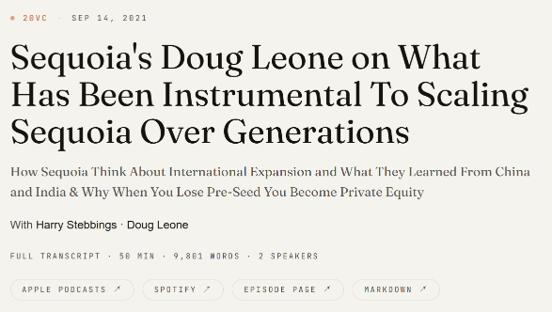
On September 14, 2021, 20VC updated "Sequoia's Doug Leone on Scaling Sequoia Over Generations", inviting Doug Leone, then global head of HSG, to review HSG's expansion in overseas markets such as China and India, and how it achieved generational succession.
Leone mentioned that in 2004, he once wrote a one-page memo discussing why HSG needed to go out of Silicon Valley. He was worried that if the greatest tech companies in the future were born in China or India, and HSG did not have local teams, it might miss these opportunities.
But after expansion, how should HSG manage investors in different regions? Leone's answer is: A decentralized organization under the one umbrella brand. The headquarters is responsible for culture, compliance and financial reporting, and specific investment judgments are more handed over to local teams. He even believed that his management work was less important than the partners responsible for investment in various regions.
Leone also said a very representative sentence: HSG is a team, not a family. Team members need to meet both performance and collaboration requirements at the same time. Now, Leone has been invited back to HSG to serve as chairman, and is called GOAT by the new management. But the global decentralized structure that HSG once adhered to has changed a lot in the 2023 business split and the 2026 European office closure.
The same person witnessed the global expansion of HSG and also participated in its re-contraction.
02|In 2021, Botha already admitted: HSG is increasingly like a big company

On November 5, 2021, Invest Like the Best updated its 250th episode "Sequoia's Crucible Moment", host Patrick O'Shaughnessy invited HSG partner Roelof Botha to discuss the newly announced Sequoia Capital Fund evergreen fund reform.
At that time, HSG tried to get rid of the restriction of the traditional 10-year VC fund cycle, held high-quality companies for a long time through an open-ended fund structure, and continuously allocated capital to different investment stages.
In the second half of the program, Botha also talked about the change of his work focus.
He recalled that more than 20 years ago, venture capital was more like a small business run by a small number of partners. But by 2021, HSG not only had two teams for early-stage investment and growth-stage investment, but also established professional departments such as marketing, community, talent and technology.
Managers need to consider how to configure teams, how different departments collaborate, and how professional support personnel serve investment partners. Botha admitted that HSG has become a much more complex organization.
This statement is particularly memorable today. In 2026, the new management believes that the business expansion over the past 20 years has brought too many levels, so it decides to streamline part of the professional system and simplify the evergreen fund structure promoted by Botha back then. The organizational complexity described by Botha in 2021 became a problem that the new management wanted to solve five years later. Is it the price of HSG's excessive expansion, or the management cost that must be paid to serve larger and larger entrepreneurial enterprises?
03|One month before being replaced, Botha was still praising the Scout fund that made 26 times returns

On October 9, 2025, Silicon Valley podcast All-In updated "Sequoia's Roelof Botha: Why Venture Capital is Broken & How Great Companies Are Built", inviting Roelof Botha, who was still the top head of HSG at that time, to discuss capital surplus in the venture capital industry, global business split, and how HSG maintains long-term competitiveness.
At the beginning of the program, Botha talked about the Scout program established around 2009 to 2010. Under this mechanism, HSG provides funds to allow outstanding entrepreneurs and people in the technology industry to find early-stage projects in their own social networks.
The first batch of Scouts included Jason Calacanis and Sam Altman. The former helped HSG invest in Uber, and the latter participated in the discovery of Stripe. Botha revealed that the relevant Scout fund had achieved 26 times returns at that time.
More notably, Botha talked about HSG's investment decision-making system around the 13th minute of the program. He emphasized the importance of consensus-based decision-making and the necessity of mutual challenge between partners.
Botha also talked about why HSG has long maintained a private partnership system. He believes that leaders have a responsibility to hand over the institution to the next generation in a better state. Don Valentine handed over HSG to Michael Moritz, Doug Leone and others back then, and subsequent managers should also follow the same principle.
By November 2025